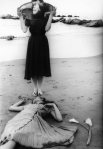
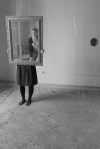
[←] Francesca Woodman – Untitled, Providence, Rhode Island (1975-1978); [→] Veru Iché – Untitled from The White Lodge project (2012)
Juxtaposition As Commentary; Or: Who Wore Shot It Better?
[←] Francesca Woodman – Untitled, Providence, Rhode Island (1975-1978); [→] Veru Iché – Untitled from The White Lodge project (2012)
Juxtaposition As Commentary; Or: Who Wore Shot It Better?

Vlad Krum – Upstairs (2013)
I’ve been staring at this image for an hour trying to find a way to express what it is about it that hits me like an anvil dropped from a skyscraper.
If I was in my apartment, I’d dig through my college notebooks–nerd alert: I still have all of them–and couch things in terms of the points of contrast between Balinese and Javanese dance.
For better or worse, I am a long way from home. And unfortunately, once my brain shifts into a particular mode–in this case compare/contrast–I keep trying to find the words to point to what is so breathtakingly radical in this not necessarily good image by subtracting this image from it and analyzing the difference.
And that difference would almost certainly get at something with which I’ve been trying to come to terms for half a decade: when and if pornography can also be Art.
But every time I try to approach that vector my brain redirects me to a recent memory; namely: last week I boarded the subway and standing across from me in the opposite door well was this young woman. She was tall, perhaps an inch shy of six feet tall. It wasn’t her height that drew my attention; it was the not yet completely unlearned, painfully self-conscious awareness that made her cross her feet at the ankles and slouch slightly.
She had that I’ll-never-be-a-cover-girl-and-I-could-be-style-myself-in-such-a-way-as-to-be-conventionally-pretty-but-I-can’t-be-arsed look that gets me everytime: black Shure studio headphones, flaxen hair with ginger root highlights, alert eyed, constantly scanning her surroundings.
I found myself achingly aroused. An odd thing during morning rush hour in NYC. I tried not to look at her–I’m sure she realized I was eying her and the last thing I wanted to do was make myself a nuisance to her.
I’ve thought about her frequently since then. I still get the same pheromonal flush but it’s not sustained. Yes, my initial response was to her body. But a body is just a body unless it’s understood as part of the totality of a discrete personal identity. It was that searching spark–like the glimmer of a starving fire–that I saw that made me look closer.
And that’s the thing that gets me about this image: it’s not staged to play towards my preconception with regard to the semiotics of desire. It declares this is what my wanting looks like.
Pornography lacking in consideration for the empathy underlying the mechanics of pleasure will be forever incapable of being Art.
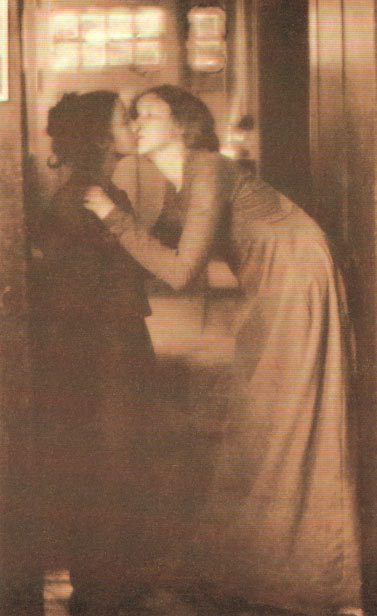
Charles Hudson White – The Kiss (1905)
Although this is clearly staged (not to mention: some #skinnyframebullshit), it feels like that Lacanian sentiment: [t]ruth has the structure of fiction. The truth here has the structure of the fiction that in every relationship one person loves more than the other.
…and oh my! But, the light coming through those eight background window panes, and the reflection on the wood floor and that angled kicker reflection highlighting the line of her throat.
I can’t look at this and not recall the way “[m]y blood is alive with many voices telling me I am made of longing.”
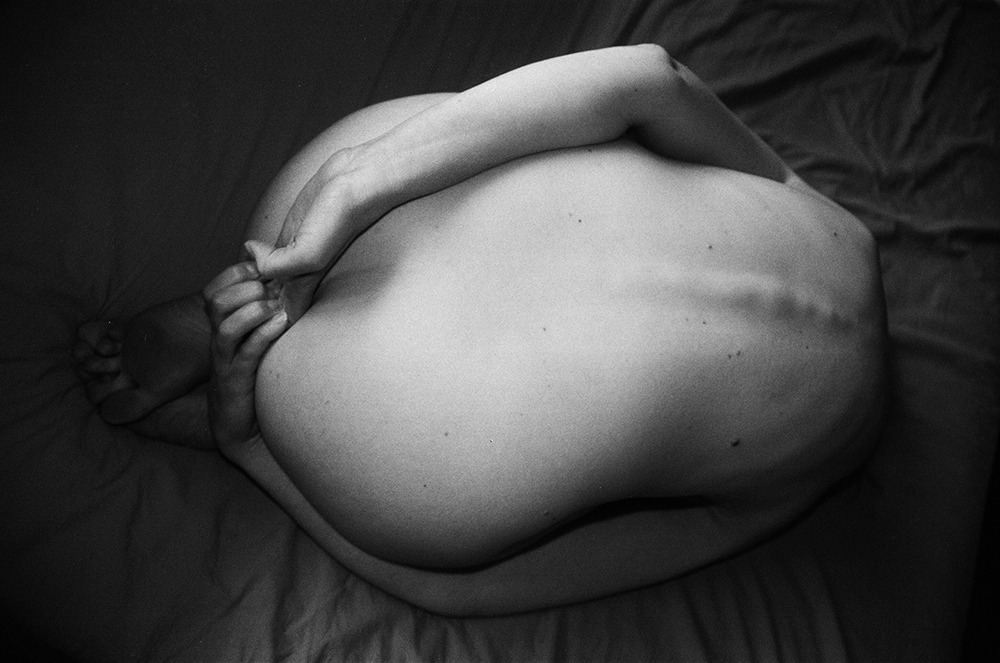
Lina Scheynius – amanda (2014)
If you do any reading on Scheynius, after the model turned photographer angle, you’ll invariable hear folks opine ever so elegantly about how her work focuses on intimacy or is preoccupied with the so-called female gaze.
I won’t object to either suggestion but I do find the tendency towards reducing a complicated, nuanced work to one or two of it’s representative elements almost always does a disservice to the artist and the work.
To my eye there is always something related to an effort to externalize and give voice to a primal, gnawing physical desire.
I don’t remember where I read it–perhaps in Scheynius’ recent interview with Zeit–where she recalls how one of her first modeling contracts stipulated that she could not gain more than a cm in any of her measurements over the course of a year.
And in much of her self-portraiture there is an element of violence in the way she documents her body that is always in dialogue with a ferociously unapologetic presentation of sexuality and a flirtatious ambivalence towards coyly implicit and outre explicit.
However, this approach to depicting herself doesn’t extend to others. The unflinching eye she turns on herself, becomes tender, seeks the wonder in light on skin, the line of the body in space–a fierce awe that acknowledges the connection between physicality and sexuality while refusing to sexualize the subject against the parameters of how they wish to be seen in any given moment.
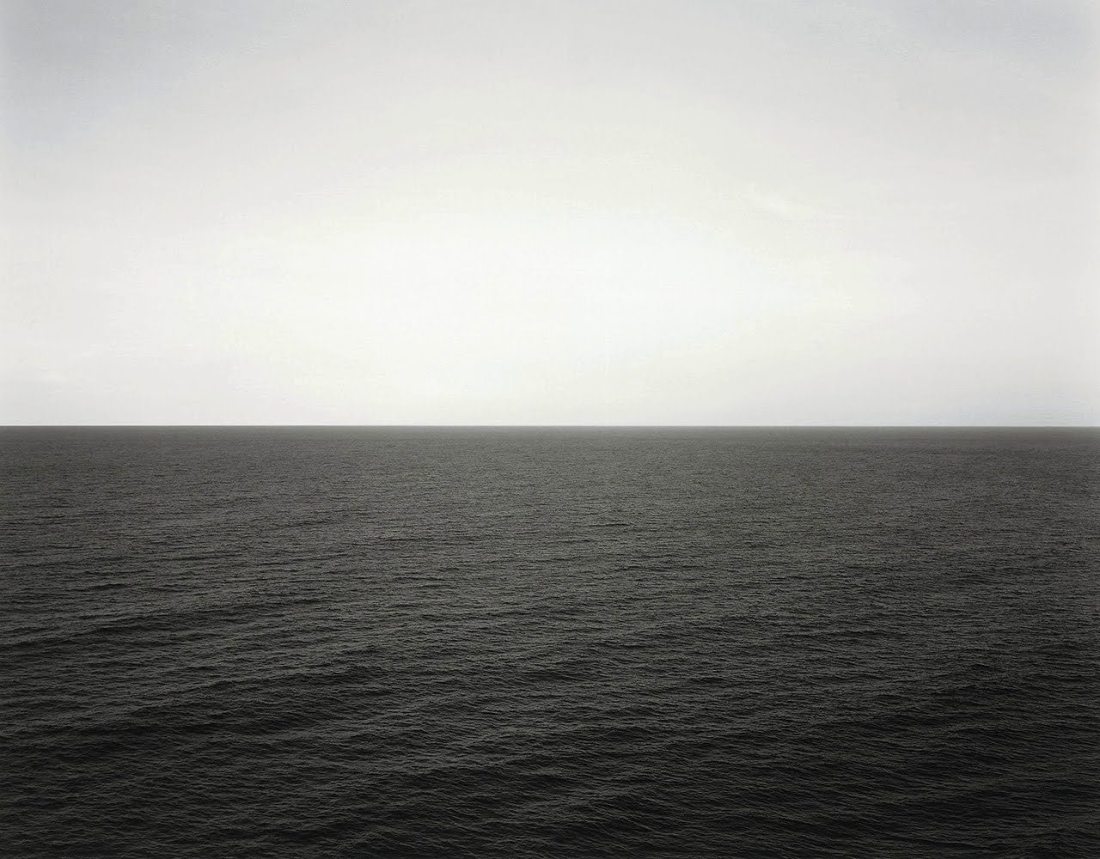
Hiroshi Sugimoto – Indian Ocean, Bali from Seascapes (1991)
The person you think about when you stand in front of the ocean. That’s the person you’re in love with.

Igor Mukhin – img167 (2009)
I’ve been looking at a metric fuck ton of Mark Steinmetz’s photos lately. And the reason I mention him is because of the fact that although I adore his use of space, he compositions don’t adhere to any ideal with which I am familiar.
With Mukhin, I can always draw a diagram. For example in the above image the staging from left to right of the nude male (standing in a modified contrapposto stance), the woman (whose semi-striding pose wouldn’t be out of place in one of those infamous Soviet war memorials) and the towel/purse hanging from the sapling form a triad that is not only easy to scan but also suggests a downhill slope from right to left toward the stream.
There’s also the little details: the darkest points in the frame are the purse and her inseam. This pulls the eye back to the man’s carefully man-scaped, uncircumcised member. (I enjoy the contradiction in his more modest post and the way she seems to be standing to block him from view slightly even though clearly whatever led up to this scene didn’t involve any sort of concern for modesty).
In fact, that’s what I think I dig most about Mukhin’s work: even aside from the fact that he tends to release images in groups inclusive of a particular happening, removed from the grouping there’s still very much a feeling of the image as rooted firmly in a very particular milieu. The virtue of what is included is that it points strongly towards what was excluded.
(In a value-neutral judgment, Steinmetz’s photos are dislocated, free floating, timeless. Thus his tendency to name images with their location.)
And I’m not sure if it’s because the first thing I encountered of Mukhin’s was his more erotic imagery but to me the specter of permissive sexuality seems to always resonate with his work. Such as here, where I can’t help wondering if what I think might have led to the need to brush one’s teeth is why the woman is brushing her teeth.
This photograph verges on being narrative because I want to know the nature of the events that led up to this moment. And the thing that Mukhin is so talented at doing is presented as a story something that he as the image maker stands in the same position as the viewer with regards to curiosity as far as origination.

Arno Rafael Minkkinen – Sandy, Connecticut (1971)
My familiarity with Minkkinen pertains more to his seminal Helsinki Bus Station Theory.
Yes, I would take issues with a few of his tangents but his analogy is otherwise lethally on point.
Given that I was so moved by his words, I was put off by my ambivalence for his images. They reminded me of Jerry Uelsmann–for whom, as someone reasonable skilled in photo manipulation in a traditional darkroom, I have a great deal of respect but whose work does fuck all for me.
Mostly because I’m lazy but also due to the fact that I’m impatient, I didn’t bother to dig deeper into his work.
As it turns out, that was an appreciable mistake. If someone manages to make something that not only speaks with you but connects with you, it’s very rare in my experience that there’s not something similar animating the rest of their work.
Will I ever be into the in-camera optical illusions that typify Minkkinen’s work? Hardly. But, the man really has a knack of translating the feeling of physical intimacy into something visually manifest. That’s no small feat.
Also, I can know see a thread running from Minkkinen to Ahndraya Parlato; a thread that once observed serves to amplify the effect of both.
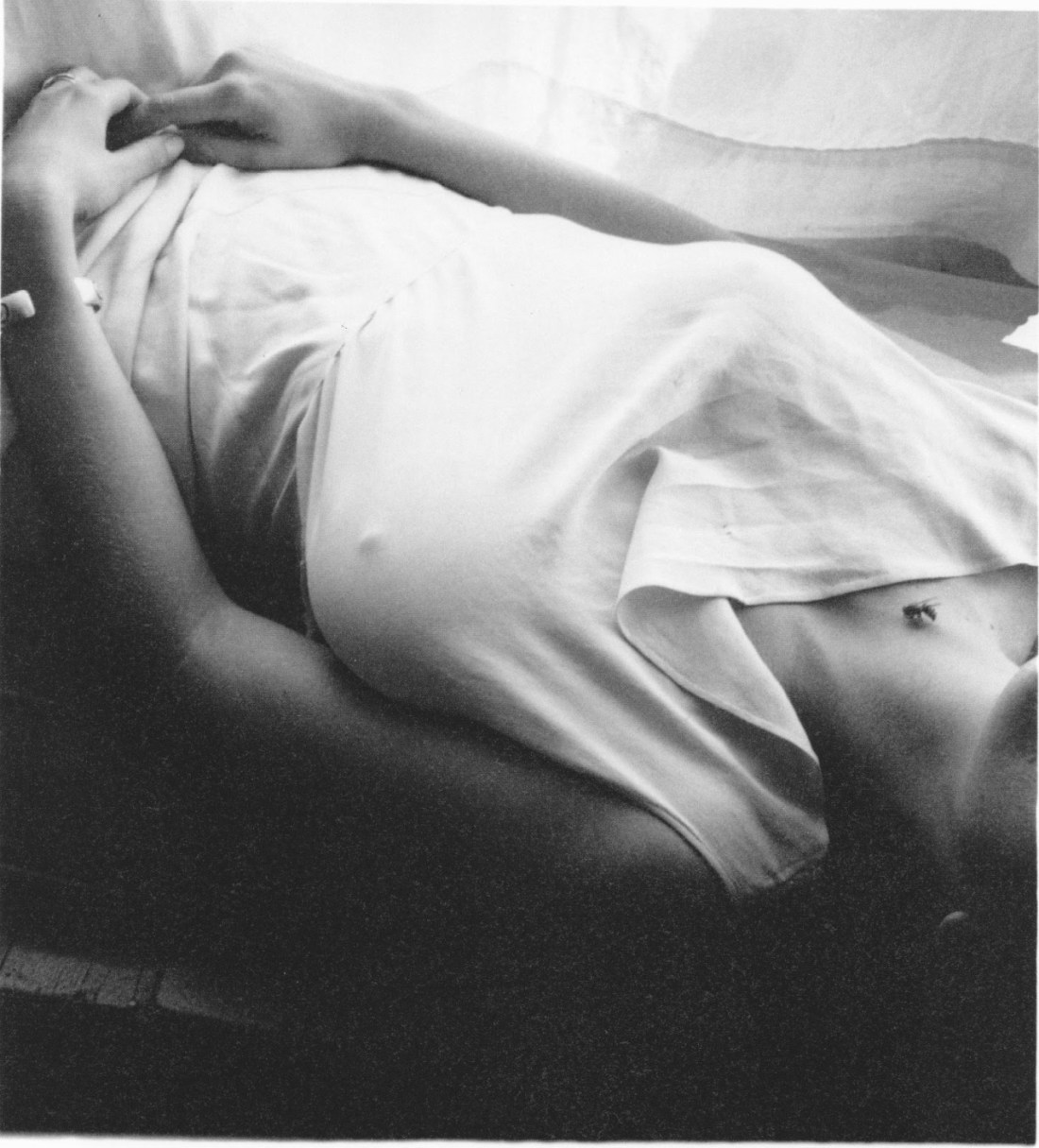
Francesca Woodman – Untitled, New York (1979-80)
My Life had stood – a Loaded Gun –In Corners – till a DayThe Owner passed – identified –And carried Me away –And now We roam in Sovreign Woods –And now We hunt the Doe –And every time I speak for HimThe Mountains straight reply –And do I smile, such cordial lightOpon the Valley glow –It is as a Vesuvian faceHad let it’s pleasure through –And when at Night – Our good Day done –I guard My Master’s Head –’Tis better than the Eider Duck’sDeep Pillow – to have shared –To foe of His – I’m deadly foe –None stir the second time –On whom I lay a Yellow Eye –Or an emphatic Thumb –Though I than He – may longer liveHe longer must – than I –For I have but the power to kill,Without – the power to die –-Emily Dickinson
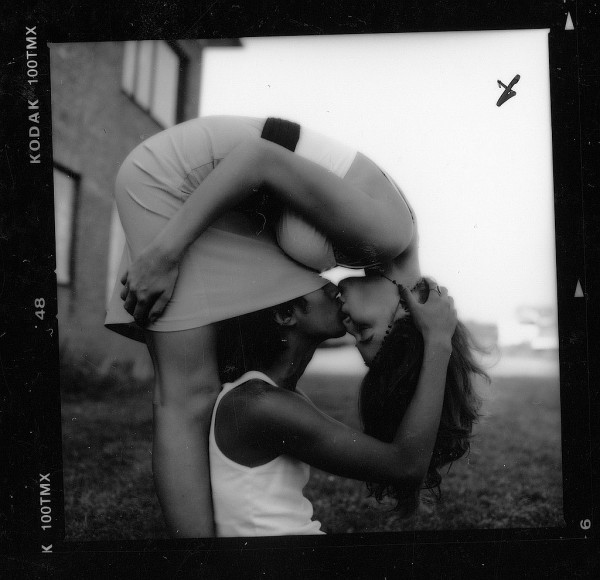
Lynn Kasztanovics – Title Unknown (200X)
On the infrequent occasion I’ll publicly admit to ‘being a photographer’ and because I live in NYC where everyone seems to know something about art, the question arises: which photographers influence your work?
I never know how to respond. I mean Francesca Woodman and I are involved. But who doesn’t like her? She was that rare and singular wunderkind, we term a ‘prodigy’. I’m nearing the 10,000 hour point when it comes to studying Sally Mann’s work. I adore Jeff Wall for both his technical skill and the narrative angle in his work. I’ve yet to encounter a Stephen Shore frame wherein the composition fails to exemplify perfection. (Plus, he’s damn hilarious… if you don’t leave his work feeling like you’ve spent time with the subversive uncle at the family reunion who convinces the little one’s that the moon is made of green cheese and that you have to hold your breath when driving through tunnels because the air is poisonous and then leaves the kids’ parents to deal with the fallout…then you haven’t really engaged with the work properly.) Recently, I’ve been finding myself flat out hypnotized by Mark Steinmetz’s heavenly eye and the way it locates transcendent beauty in mundane exigencies.
Despite incredible talent, your average Jane on the street isn’t going to know Allison Barnes or Prue Stent or Igor Mukhin. (I’ve mentioned Traci Matlock and Ashley MacLean and increasingly folks have some idea of who they are/were.)
The truth is–and probably also the reason my work will never be deemed ‘important’–in my heart of hearts, Lynn Kasztanovics is the most important photographer in the history of photography.
As with most things I feel so completely through and through, I have a hard time knowing how to explain this preposterous insistence except to say her work is the appositive of the seven syllable Fuegian sentence word Martin Buber mentions in his astounding I and Thou:
They look at each other, each waiting for the other to offer to do that which both desire but neither wishes to do.
Sans all the abstraction: her work is like seeing something beautiful and in the moment of realizing you want to touch it, it reaches out to you and tucks a stray strand of hair behind your ear then smiles before looking away shyly.
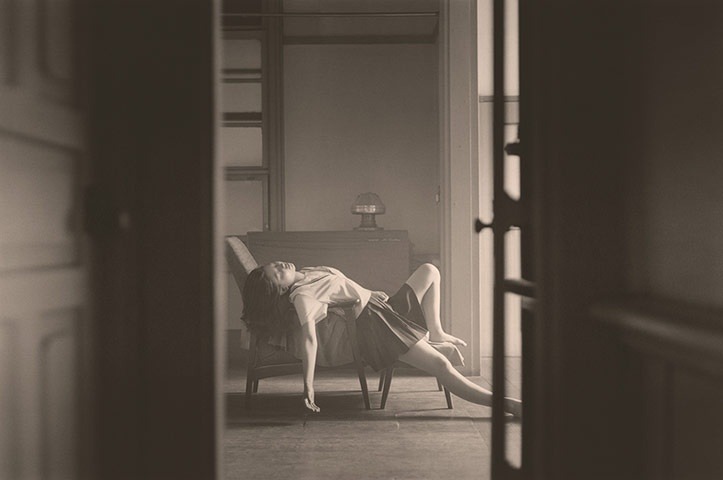
Hisaji Hara – A Study of The Room (2009)
In 1949, Albert Camus provided an introductory essay for an exhibition of paintings by his friend, enigmatic Polish-French artist Balthus. “We do not know how to see reality,” wrote Camus of Balthus’s strange and sometimes sexually suggestive paintings of adolescent girls, “and all the disturbing things our apartments, our loved ones and our streets conceal.”
Balthus, who died in 2001, aged 92, made paintings that managed to be both naive and slightly sinister, and his precise figurative style only emphasises the general air of dark fairytale mystery in his paintings, the hidden disturbing things that Camus picked up on. Balthus said that he painted little girls because “women, even my own daughter, belong to the present world, to fashion”. He was aiming, he said, for the timeless quality that Poussin’s paintings possessed.
Balthus’s studies of girls in often stilted poses are certainly timeless in their strangeness, their evocation of a pre-adult world of dark childhood reverie. Now, Japanese photographer Hisaji Hara has made a series of images that meticulously recreate some of Balthus’s most famous paintings. Made between 2006 and 2011, they are beautiful in a quiet way, and give off not so much a sense of timelessness as of time stilled. Interestingly, given that they are photographs of a real young girl, they do not exude the same sinister suggestiveness of the originals. (Hara has, perhaps wisely, chosen not to recreate Balthus’s most wilfully shocking painting, The Guitar Lesson, in which an older woman seems to be playing a young girl, who is naked below the waist, like an instrument.)
Hara, like Balthus, would seem to be an obsessive, so familiar and painstakingly composed are his photographs. On closer inspection, though, all is not what it seems. Shooting in black and white, Hara has created a world that nods to Balthus, but does not attempt to recreate the slightly surreal oddness of the originals. Instead, the photographs often look like stills from a lost Japanese formalist film in which the characters exist in a netherworld between waking and dreaming.
The actual setting for the interiors is a Japanese medical clinic Hara discovered. It had been built in 1912, but had remained unused and untouched since its closure in 1960. The furniture and found props all suggest an earlier time in Japan’s history, and the recreated tableaux a harking back to childhood, or, more precisely, to the period between childhood and adulthood.
In one photograph, “A Study of ‘The Passage du Commerce-Saint-André’”, the girl stands in a leafy garden lost in thought, while a young man, possibly in uniform, strides purposefully away. Everything about the photograph is painterly, from its composition to the soft light and shadows and the blurry leafiness of the trees. There is a strangeness here, too, but it is not the strangeness of a Balthus painting, rather the heightened formality and unrealness of a staged photograph. And even in the most instantly recognisable compositions – the young woman at her most languorously suggestive, gazing into a mirror or draped on a chair before a window – the dark suggestiveness of the paintings is replaced by something else, a mood that is altogether less provocative and, at times, almost serene in its calmness.
Part of this is undoubtedly to do with Hara’s technique, his craft and patience as a photographer of staged tableaux. In an age of digital post-production manipulation, he prefers to use more old-fashioned, labour-intensive methods, including multiple exposures and the use of a huge smoke machine to create the opaque quality that many of his prints possess. In some photographs you can see the slight blurring between one exposure and the next, usually when he has placed the girl in two different positions in the photograph. The blur, like the opaqueness, only adds to the otherworldly atmosphere of the prints.
For the technically minded, Hara made a huge box to surround his large-format camera so that he could mask part of the picture, then shot multiple exposures while shifting the focus. He also built the table that appears in the pictures and hand-painted the tablecloth to achieve an unreal perspective in which the lines and squares do not converge as they recede into the background. One photograph, simply called “A Study of Oil On Canvas”, even replicates the yellowish tone of the original half-finished work. As I say, this is a distinctly obsessive imagination at work.
What, though, does it all add up to? These photographs work for me not because they are postmodern nods to Balthus but because they relocate his world to a Japanese setting and, in doing so, reimagine the atmosphere of his paintings. They are also beautiful photographs in and of themselves. In one entitled “A Study of ‘The King of Cats’”, which is based on a Balthus self-portrait, Hisaji Hara stares calmly and enigmatically out at the viewer from his own photograph. He is wearing a suit that looks like a uniform and a hat that could belong to a train driver or a soldier. His expression is blank, unreadable. The pose and the props are all Balthus, but the photograph has a life all its own. This is Hara’s great gift: to imbue the familiar with new meaning, new mystery and a new form of strange beauty. Balthus, one suspects, would have approved.
(via Sean O’Hagan/theguardian)
 Acetylene Eyes
