Ilina Vicktoria

An increasing number of image makers claim to have been disproportionately influenced by Andrei Tarkovsky; few benefit from comparison. (Only two come to mind: Bela Tarr and to a greatly diminished and inconsistent effect Gus Van Sant.)

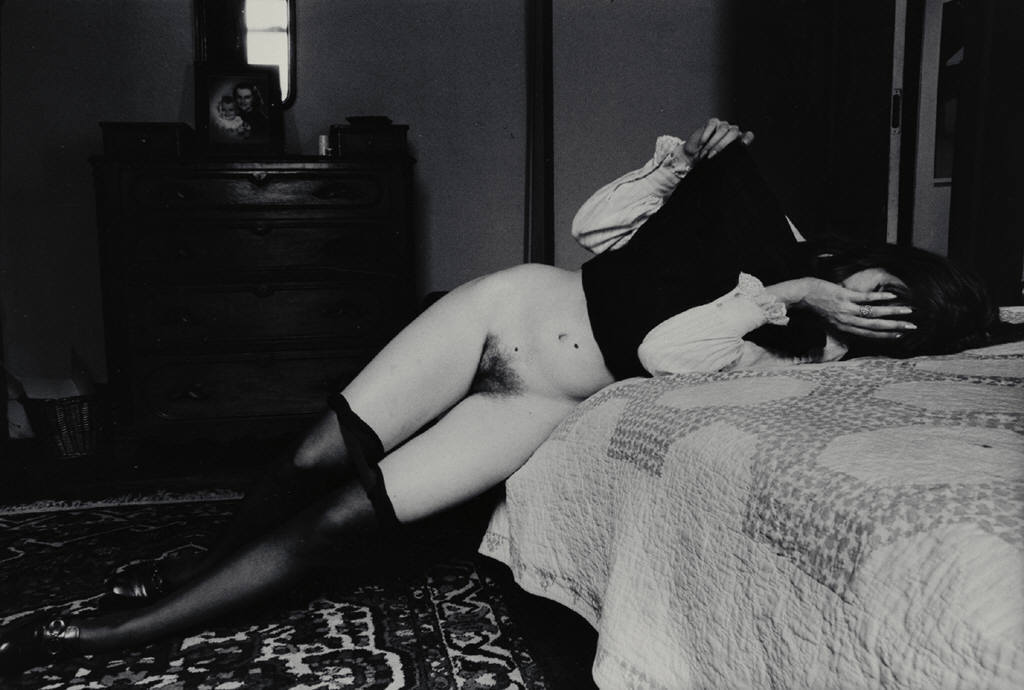
I am not sure Ilina Vicktoria espouses Tarkovskian influences but considering this famous still of Anatoliy Solonitzyn as Pisatel in Stalker crowned with twisted tree branches bears more than a passing resemblance to the top image, I’d say the odds are good she does.

Her angle of view and scale are different. Also, in her photo the branches serve less of a crown than a mobile artfully counter weighted with Siberian dogwood berries. (Also what is with that distorted blob: is it a light leak? How is it’s position so freakishly perfect to balance out the baseboard/floor and curtains at the lower right edge of the frame? It’s slightly unnerving given the clear Stalker reference—a film notable for being shot twice due to the lab ruining the original footage.)

Something deeper links Vicktoria to the famed Russian auteur, something more than similar content and shared nationality, something more like an attitude toward the image. An attitude built upon a belief of what images are meant to do.

Tarkovsky tries to say something about this attitude but his explanations skew all-to-readily toward justification and abstraction. But it wasn’t until searching for the aforementioned still of Solonitzyn for this post that I stumbled upon this awesome article on Stalker. In it, Brecht Andersch describes the effect Tarkovsky’s films achieve as follows:

The members of Tarkovsky’s audience, if only subconsciously, are brought to awareness of their own hidden depths, of the calling of the soul, of the imperative quest for the sacred. To see his films is to experience the process the Russian filmmaker described as “scales falling from the eyes”.

And that is how you can spot the real Tarkovskians even from low orbit: they are less interested in creating beauty as revealing it was there all along. (Not at all unlike Michelangelo trying to free the form which existed within the stone with his Unfinished Slaves—I can’t help but think Tarkovsky had these monumental sculptures just as much in mind as he did Acts 9:18.)

The question I am left with is: how the transcendence of discovering what is in plain sight instead of manufacturing spectacle can be applied to the visual depictions of sexuality (which is itself a pathway to transcendent experience.)

(Kudos to youarecordiallyinvitedtopissoff for once again bringing another mindblowing photographer to my attention that I never would have otherwise found.)

m-as-tu-vu:

by fred.c.fred

Normal
0

false
false
false

EN-US
X-NONE
X-NONE

/* Style Definitions */
table.MsoNormalTable
{mso-style-name:”Table Normal”;
mso-tstyle-rowband-size:0;
mso-tstyle-colband-size:0;
mso-style-noshow:yes;
mso-style-priority:99;
mso-style-parent:””;
mso-padding-alt:0in 5.4pt 0in 5.4pt;
mso-para-margin-top:0in;
mso-para-margin-right:0in;
mso-para-margin-bottom:10.0pt;
mso-para-margin-left:0in;
line-height:115%;
mso-pagination:widow-orphan;
font-size:12.0pt;
mso-bidi-font-size:11.0pt;
font-family:”Garamond”,”serif”;}

Received wisdom maintains that a boy willing to hold a girl’s hair back is a ‘nice guy’.

Isn’t it more complicated than that? What if a girl doesn’t want her hair held back, wants to hold the boy’s hair back or wants another girl to hold her hair back?

If I were a boy I’d a girl to hold my hair back and were I a girl, I’d want to hold another girl’s hair back.

But I am neither/both and all I have are hair ties.

amorsexus:

harold cazneaux

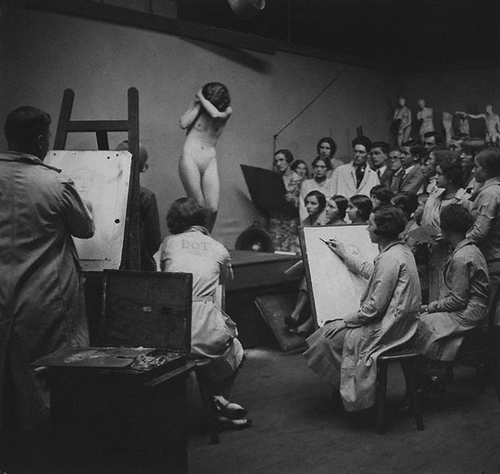
I endlessly bitch about lackadaisical composition so here’s an example of a photograph with fucking impeccable composition to balance things out a bit.

A loose rule of thirds is at work here. The young woman ostensibly nude modeling for a life drawing class stands inside the central-vertical third of the frame while the central-horizontal third of the frame starts at the top of the standing man’s head in the left foreground painting and extends to somewhere between echoed elbows of the two young women—one sketching, one sitting—in the right-hand mid-ground.

To the right of the standing man in the foreground and seated young woman there is a break the guides the eye toward the center of the frame; everything in the center, however, is stationed just inside the third-lines. This has the effect of pushing the viewer’s gaze outward.

What is fascinating is how that outward tension is then countered by the fact that all the eyes in the room are on the model—which immediately draws the eye back to her. Also, Cazneaux strategically positions the pencil held by the seated sketching woman toward the model’s mons pubis.

Unlikely everyone else, whose attention is focused on her, the model seems to be aware of the camera, facing it directly with head bowed and hands raised to cover her face.

One might say something about the constant framing and reframing the eye does on the fly when confronted with this photo. More interesting, perhaps, is the way the composition both insists on itself at the same time it cancels itself out.

Truth be told, there is never an instance in everyday life where a group of people could stand so picturesquely without direction. Thus, the image is inherently stylized. But it does not appear that way—and appears instead an authentic glimpse into an art lesson.

I can’t help drawing a correlation to the Zen tradition of koans, specifically the notorious: what is the sound of one hand clapping?

Victor Hori offers one of the best commentaries on the purpose of the question:

…in the beginning a monk first thinks a kōan is an inert object upon which to focus attention; after a long period of consecutive repetition, one realizes that the kōan is also a dynamic activity, the very activity of seeking an answer to the kōan. The kōan is both the object being sought and the relentless seeking itself. In a kōan, the self sees the self not directly but under the guise of the kōan… When one realizes (“makes real”) this identity, then two hands have become one. The practitioner becomes the kōan that he or she is trying to understand. That is the sound of one hand.

I am not just an analog purist when it comes to photography: take your Nook/Kindle/iPad and shove it up your ass sideways.

Give my hand the solid heft of a book, smooth texture of cover and spine against my skin as it spreads open, beckons my gaze, waits for fumbling fingers and claims my mind so completely for a time.

And the smell…

So, in summary:   

1. Books are hell of sexy as fuck.
2.This had me from lesbian foreplay in a bookstore.

Being a book loving nerd makes me no stranger to bookstores. But I have an affinity for them I don’t know how to explain except to admit that books very nearly jump off the shelves and latch onto me. (Also, I want to visit the Ryōan-ji Temple one day and when I imagine what it will be like it always feels the calm, timelessness that I almost always fee in bookstores.)

But there’s also Fowles’ The Magus and Franzen’s The Corrections framing the head of the young woman whose undergarments are being removed—both of which I have read and enjoyed to varying degrees. (Leave the Franzen. Take the Fowler.)

These tiny points of familiarity engage me with the tableau.

Right off, I notice the woman being undressed is not entirely comfortable with transgression of personal boundaries but remains nonetheless consenting.

This resonates deeply with me. See: I am borderline autistic and as a result have zero ability to negotiate expectations others have for/of me. As best as I can tell this is a result of my inability to understand inconsistencies in the personal boundaries of others.

A tact I have learned for managing this is to assume everyone I meet has the most highly restrictive personal boundaries I can imagine until I discover some evidence to the contrary.

This has the benefit of preventing many otherwise unnecessary misunderstandings with strangers and acquaintances. But it causes problems as I only know where I stand with them when they tell me. And in relationships such a prerequisite is not exactly desirable.

The only thing that works is the rare person who enjoys pushing personal boundaries and is completely unprepared for someone who almost completely lacks them.

All that is to say: I would give anything to trade places with the woman and have my friends who I trusted completely begin to undress me daring me to stop them. Knowing they would if I asked and knowing that I would not.

Normal
0

false
false
false

EN-US
X-NONE
X-NONE

/* Style Definitions */
table.MsoNormalTable
{mso-style-name:”Table Normal”;
mso-tstyle-rowband-size:0;
mso-tstyle-colband-size:0;
mso-style-noshow:yes;
mso-style-priority:99;
mso-style-parent:””;
mso-padding-alt:0in 5.4pt 0in 5.4pt;
mso-para-margin-top:0in;
mso-para-margin-right:0in;
mso-para-margin-bottom:10.0pt;
mso-para-margin-left:0in;
line-height:115%;
mso-pagination:widow-orphan;
font-size:12.0pt;
mso-bidi-font-size:11.0pt;
font-family:”Garamond”,”serif”;}

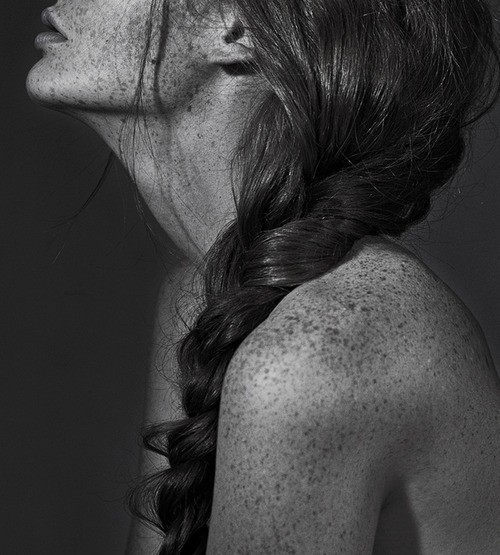
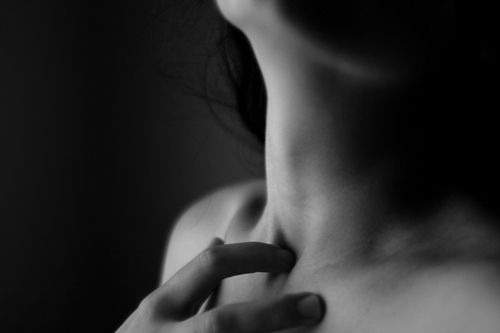
Great googly moogly aren’t freckles goddamned sexy as fuck?

And their effusion on this young woman’s shoulders and face is truly resplendent.

Now I could follow my usual knee-jerk rabbit trail with regard to composition—a horizontal frame would have almost certainly improved this photograph—but the freckles seem more the point.

Photography and digital imaging distill the space and time of a select visible area down to a two-dimensional representation. In the process, a great deal is changed and/or lost completely.

To a degree, image makers exercise control over what remains in the picture. For that reason, I am constantly unnerved that given a field of so many options the results of what stays and what goes tend to be so starkly homogenous.

Most images provide a record of an objects position in a particular spatial field at a given moment in time. How often though is the object treated as more than an insinuation representation of itself? Or, to say it in a less abstract way: when was the last time you say an image wherein skin was presented as more than the container for representation identity or a symbolic placeholder?

It’s not just pictures of people, it’s fabric, wood, everything. Photography fails more often than it succeeds to give solidity to its representations. A means of accomplishing that is beginning to think less strictly visually. There is this amazing sensory overlap between sight and sound—a sort of synesthesia that everyone shares: the sight of different textures affects our eyes differently, in a way that is—in fact—somewhere between seeing and feeling.

For example, consider this image of coffee beans ground to varying coarseness. By looking at them you see the different visual texture but that impression is processed in some fashion as an awareness that each feels different.

That’s ultimately what I adore about this image: her freckles add texture to her skin and thus weight and solidity to her body. She is not a representation; she’s a living, breathing, dreaming being with fears, hopes and ideas who also happens to be breathtakingly beautiful.

youarecordiallyinvitedtopissoff:

Christian Vogt

Baryta print from the SIX/TWELVE series.

The Fish by Elizabeth Bishop

I caught a tremendous fish
and held him beside the boat
half out of water, with my hook
fast in a corner of his mouth.
He didn’t fight.
He hadn’t fought at all.
He hung a grunting weight,
battered and venerable
and homely. Here and there
his brown skin hung in strips
like ancient wallpaper,
and its pattern of darker brown
was like wallpaper:
shapes like full-blown roses
stained and lost through age.
He was speckled and barnacles,
fine rosettes of lime,
and infested
with tiny white sea-lice,
and underneath two or three
rags of green weed hung down.
While his gills were breathing in
the terrible oxygen
–the frightening gills,
fresh and crisp with blood,
that can cut so badly–
I thought of the coarse white flesh
packed in like feathers,
the big bones and the little bones,
the dramatic reds and blacks
of his shiny entrails,
and the pink swim-bladder
like a big peony.
I looked into his eyes
which were far larger than mine
but shallower, and yellowed,
the irises backed and packed
with tarnished tinfoil
seen through the lenses
of old scratched isinglass.
They shifted a little, but not
to return my stare.
–It was more like the tipping
of an object toward the light.
I admired his sullen face,
the mechanism of his jaw,
and then I saw
that from his lower lip
–if you could call it a lip
grim, wet, and weaponlike,
hung five old pieces of fish-line,
or four and a wire leader
with the swivel still attached,
with all their five big hooks
grown firmly in his mouth.
A green line, frayed at the end
where he broke it, two heavier lines,
and a fine black thread
still crimped from the strain and snap
when it broke and he got away.
Like medals with their ribbons
frayed and wavering,
a five-haired beard of wisdom
trailing from his aching jaw.
I stared and stared
and victory filled up
the little rented boat,
from the pool of bilge
where oil had spread a rainbow
around the rusted engine
to the bailer rusted orange,
the sun-cracked thwarts,
the oarlocks on their strings,
the gunnels–until everything
was rainbow, rainbow, rainbow!
And I let the fish go.

amorsexus:

robert mapplethorpe / bush

For me, the cloud of controversy surrounding Robert Mapplethorpe’s photographs becomes a filter through which I see them.

Mapplethorpe’s focus on taboo/pornographic content courts outrage. But it is an outrage unlike the allegations of child pornography leveled against Sally Mann for Immediate Family or claims of exploitation dogging Nan Goldin since The Ballad of Sexual Dependency; it is intended. Mapplethorpe invites a visceral reaction, even if that means pissing someone right the fuck right off.

Were that all he were about he’d be no more relevant than any other shock-solely-for-shock’s-sake artist. What makes Mapplethorpe matter is his realization that for good, bad or ill: even being pissed off at it necessitates at least some degree of visceral engagement with the work.

A dangerous thing when the work possesses a deep wonderment and the  taboo/pornographic content is carefully underscored with an uncommon intimacy. Even more upsetting when technical craft is so stunningly refined—and not for its own sake, as a testament to a belief in the labor owed as a result of being allowed to bear witness to profound beauty.

This is may be why Mapplethorpe’s work remains controversial—one either sees and embraces its beauty or the dissonance between authorial intent & audience reaction creates a deafening feedback loop.

(Then again, I could just be floored by finally finding a depiction of fisting that despite being a bit too much of a close-up is masterfully executed and resonates with my experiences of feeling my hand encircled tightly with wetness and warmth.)

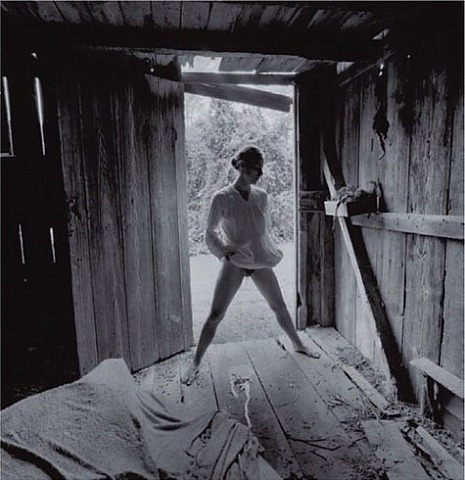
Emmet Gowin Edith Danville, Virginia 1971

When I study Gowin’s work I am always struck by its deep reverence. Whether his subject is his wife Edith, or various members of her family or his later aerial landscape, each image is treated with the same quiet wonder.

In Edith Danville, Virginia 1971, Gowin’s wife stands in the doorway of a dilapidated shed and pisses on the floor—the scene is handled with a quiet awe rather at odds with ‘taboo’ of enjoying the sight of someone urinating.

Whether intended or not, it strikes me that this is reverent watching is not at all unlike the way pissing is commonly depicting in pornographic media.

The actress informs her partner she ‘has to pee’ and moves several steps away to stand with her legs spread wide or more often than not to squat. With this movement her body transforms from the discrete catalogue of penetrable orifices and denuded erogenous zones it is likely to have been presented as for most of the scene to something whole and complete. She gazes down at her cunt, or looks away from the camera like Edith—breaking her near constant, self-conscious awareness of the spectator. She begins to piss but by the time she remembers she is expected to be self-conscious, the camera has begun to zoom in on the fluid ensuing from between her legs.

‘Having to pee’ is, unequivocally, a need. Given the raison d’etre for porn—manufacturing male pleasure—admitting that women have needs is unusual. Admittedly, sexualizing yet another aspect of female bodied experience is problematic, but for me that is trumped by how hot it is when porn—however tenuously— implies the truth: nothing provides more pleasurable than meeting the needs another.