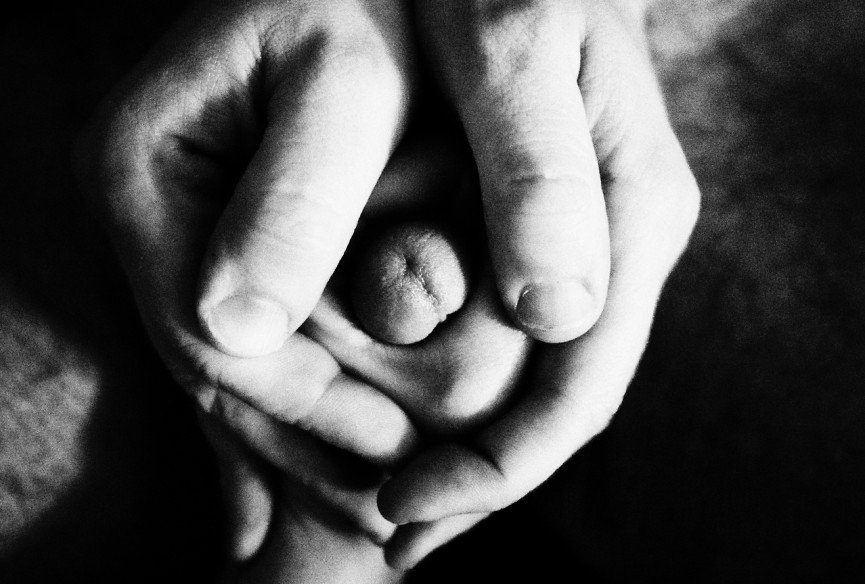
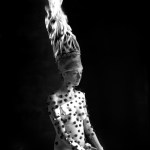
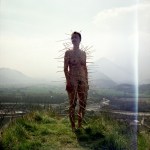
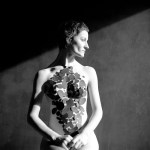
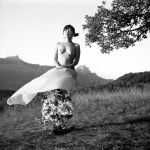
I can’t say I’m all that into Anja Gea Sladič‘s work but this is a magnificent photograph.
This is ostensibly a photo of someone with a penis masturbating. However–and I am not sure if it’s by design or because my brain is a little bit funky, but it exists as sort of a pareidolia for me; I don’t first see it as someone masturbating or even as a flower (which is actually what I thought it was at second glance), I see it–at least at first–as like one of those scenes from a Terrence Malick project where the characters are passionately and newly in love and they sensually embrace each other in the cream white light transmitted through windows in archetypal middle American single family homes.
The masculine presenting protagonist stands behind the feminine presenting love interest and they kiss and caress and at some point, hands touch her neck and circle under her chin as she’s plied slightly backwards and positioned at the best possible angle for a languid and longing kiss given the angle of the light, etc.
This clearly isn’t a chin–it’s genitalia… but for some reason I have to think of it in terms of a sensual embrace (which isn’t wrong) and as something flower-like before I can see what it is.
It’s maybe not always the best strategy to present the viewer with something it takes them a minute to parse–after all: getting someone to linger over work, to engage and think about what they are seeing is one of the prerequisites of art. This is an instance where I feel the multiplicity of interpretations actually contribute substantively to what is so effective about this piece.
Initially, the plan was to use this post to heap praise upon Allen’s thoroughly distinct and downright exceptional analog photography.
Then I read her artist statement/bio… new plan: let’s talk about how artists speak about their work.
There’s this notion–as far as I know originating with Renoir–that art ceases to be art as soon as it begins to require explanation.
Practically speaking Balthus’ 1968 retrospective at the Tate was probably the last time anyone has gotten away with the let the work speak for itself tact. Curators, gallerists and the gatekeepers of high culture all demand artist statement tributes and offerings of a modicum of veiled explanation. (I am not suggesting that instinct is entirely pointless… just that it almost always undercuts the mystery and nobility of the work. (Not to mention situates the audience in a position not only of passive acceptance but inferior receptivity where one must be educated regarding the merit of what one is has or is about to experience.)
It is very rare that an artist’s statement not only clarifies but also illuminates. Allen’s is an example.
…Sometimes
I just want to photograph things, see the pictures and burn the
negatives. It’s overwhelming at times, all these memories trapped in
36x24mm acetate frames.
..I’m
not doing this for myself, I don’t have much say in what’s going on.
When I look back at what’s come through and what’s been made, I don’t
know how I did most of it. It was another person than I am now. And
now I’m making things that one day I’ll look back on and say, I’m
another person now, once again.
…Everyone’s
a photographer. It’s not so precious anymore. The “print” is lost… on
a search to find it. Old cardboard with moisture stains and a
distressed image with a small frame around it, nothing fancy, something
cherished. I’ve got ideas, about to act on them.
…Fever. Avoiding suicide.
…There’s
actually a group of aliens making my work, I have no idea how it’s
done, they just give it to me and I present it, that’s what you see
here.
…I’m
waking up with the sun everyday, I can feel it peering over the horizon
like a cat meowing to be fed. Laying in bed, thinking about who is the
real Banksy, some article online got my brain spinning too early,
again. I have a ton of friends who are all half my age, I know there’s
something to analyze there. Watching people my age turn into their
parents, they said that would happen. I feel no sense of beginning,
middle and end, I’m living in a timeless existence where one day I will
cease to exist, taking that last breath and never saying anything more
into this world. I’m lost there, in that last breath, extending it for
as long as I can.
…Someone asked me this week what are my photos about? Okay, no one asked me, I was asking myself. And I stood there, silent.
….These
last couple series I’ve been working on, Gestures, Sunken Dream and
Earth Water are shot with 35mm film using multiple exposure techniques.
I shot fireworks, underwater sea life at the aquarium, plants and the
sea and then reshot the same rolls with a figure posing in my studio.
There’s never any digital modification on my photos. I could probably
create something similar with less orchestration involved but It’s just
too easy to use photoshop, I need to be challenged. I don’t like taking
the easy way out, I’ll get burned if necessary. I like process. I
like figuring it out. I like going to the museum and looking up real
close to the canvas and figuring out how the artist made something, and
then I want to know if they were feeling what this piece makes me feel.
I start to wonder about strangers…
… The three stages of Emotional Exile: Shock, Surrender, Catharsis.
… I’m not a fan, I’m an admirer.
… 4:20
….I used to hate photographs where the feet or hands were cut off, but now it doesn’t bother me.
…I
trust myself more than anyone else, especially when it comes to
developing my own film. My kitchen and dining area are my lab. I
photograph my friends, or will pose myself. Some of my friends are
people I’m really close to, some are people I’m not as close to but I
feel a strong connection with. All these people who are at different
places in their lives, figuring it all out.
…There’s a sense of surrender, but not in a losing sense, one who surrenders to themselves and gives up on apologies.
….When
nothing seems like everything and everything seems like nothing.
no-mans-land feels like an invisible trap door. No one, not a one. In
the ear of the great sea, I call it closer. Hear the blahs slipping
into aahs. Timing is a mother fucker.
….I’m
just really into passion fruit. I love the contradicting taste, the
sweet and the sour, the fact that it’s not easy to eat, that I have to
shove my face inside it to lick out all the seeds.
….That
moment when I go out on the road with just me, my cameras and a bag of
various clothing pieces. Into the wild, following the weather until it
brings me somewhere and then I set up the tripod, figure out what to
wear, if anything, and prepare the camera for a shot. Meter the light,
focus, filter. I have 10 seconds to run into place and then place
myself there as if I belonged. On to the next. I promise myself that
every moment I even think about photographing, I have to stop and
capture it. I’m not taking anything for granted.
….There
are a million ways I could describe myself and today I’m going to put
it like this… I’m a contradiction but I mean everything I say. The
noise of the city gets to me and I’m counting the days until I get to
where sweaters. I’m dreaming of traveling to far off places with just
me, my camera and a sense of adventure, meeting random amazing souls
along the way.
I won’t be able to enumerate all the ways this statement compliments her work. However, there is a central theme: fragmentation.
She speaks of her work as if aliens possessed her and while in control her body made the work. She also uses multiple exposures. There’s mention of how the past is discontinuous with the present, etc.
The form of the statement replicates this approach–the disjointed thought fragments in the writing mirror the visual form of her work.
David Bowie famously practiced decoupage–he’d tear up his lyrics and then re-order them looking for new patterns to emerge. Allen is doing something very similar with both her photography and her statement. In effect: making sense of her statement doesn’t so much explain the work as it offers a map of how to approach the work–that is: getting a sense of the words on the page is a process that is more or less interchangeable when applied to the work.
It all reminds me of a conversation I had while back with a friend who was telling me about a course she took where a writing professor taught a course on literary form but in a way which reduced form to graphical representation.
It strikes me that Allen’s work is very much about illustrating how to use photography to read between the lines. (And with the notion of reading between the lines there’s traces of Renoir’s notion of art being opposed to explanation–i.e. telling someone to read between the lines means that you either won’t do it for them or that you can’t because it’s so obvious that if they can’t see it, then the explanation won’t help them.)
Between the lines is actually an idea which can be graphically illustrated, actually:
Yet, it is possible to deploy the same elements of the above graphical representation in a host of manner which preserve the conceptual integrity of the original while providing more open ended interpretations:
Or:
The ratio of shadow to highlight are the same in all three examples, yet they each have a different psycho-aesthetic effect.
It’s a huge leap to realize that photography is hard wired with the ability to illustrate what is between the lines. But that fact that Allen not only realizes it but is exploring the possibilities so assiduously is goddamn breathtaking.
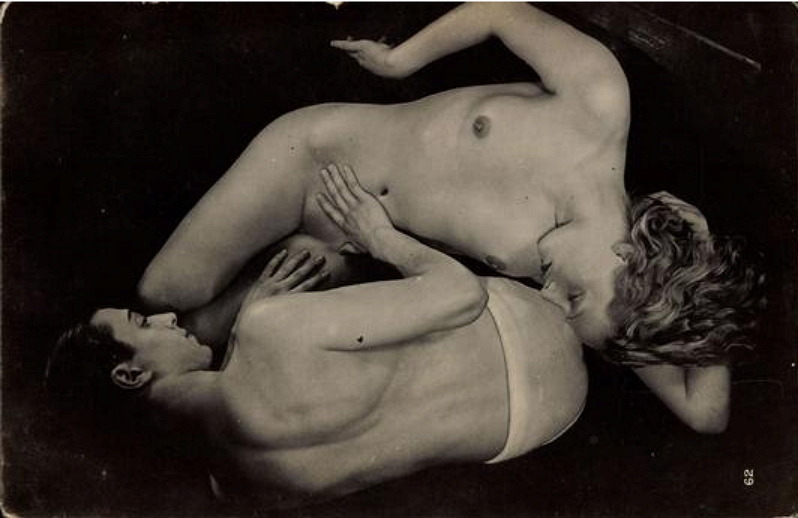
Source unknown – Title unknown (192X)
I am posting this because I love the way the two bodies relate to one another against the black negative space. (Keeping with the theme of twos–you can see both subjects hands.)
One figure is curled, the other open… seemingly presented like either a cherub or some sort of water nymph. (Note: how the positions of all four hands work together similar to the two bodies against the black negative space. The cherubic nymph hands imply a triangle with any one of the other hands–but more so with what the other hands frame.)
If you glance at the notes for this you’ll note two things: that it was probably made by Jacques Biederer–a Czech photographer who moved to Paris and became increasingly interested in nudes, erotica and hardcore BDSM/fetish pornography. During Germany’s occupation of France, he was sent to Auschwitz where he died.
Interestingly, the notes also suggest that the curled figure is a man. And while my familiarity with Biederer is admittedly limited. I seem to recall that he had a thing for portraying women as dominant–that could suggest that the commenters are correct that the curled figure is male. However, didn’t Biederer also have a thing for depictions of sapphic desire? Perhaps the undergarments are masculine in cut or design but I’m not an expert on French fashion from the 1920s and to my reading the gender of the curled figure isn’t something that can be determined with any sort of definitive value given only this image–and that’s something that is intriguing to me.
Herb Ritts – [↖] Female Nude with Black Sand, Hawaii (1989); [↗] Female Nude with Black Sand, Hawaii (1989); [↓] Untitled (1989)
If you’re anything like me you’ll ask yourself: Herb who? You already know him–I promise.
This photo of David Bowie? This photo of Michael Jackson? This one of Britney Spears? All three were made by Herb Ritts.
There’s a good bit of common ground between Ritts and Avedon, actually. Both have the same tendency of thwarting expectations. Working in a studio was less something either did as a means of de-emphasizing location as it was an effort to give personality free range to manifest. Also, both make photos that focus on the subject in the same way–Ritts merely trained his lens on larger than life uber celebrities, house name entertainers and supermodels. (Leveraging recognizability and depicting celebrity personality as its own ultra exclusive destination which you could only access as he allowed was a brilliant maneuver.)
Perusing his catalog is a strange undertaking–where you see the person both as they wanted to be seen at the time the photo was made. At the same time, ex post facto, it’s possible to look at the work and guess what the various PR teams had in mind but there’s also a way in which the work also presents a subtle wink to some of the less pristine aspects of many of his subjects lives–about which we have begun to learn.
I don’t care for Picasso at all but it’s sort of like the critic who took issue with his painting of Gertrude Stein by saying it doesn’t look anything like her and Pablo responding shortly: but it will.
Also, there’s no way to fault Ritts for borrowing so readily from others–as the adage goes it’s not theft if you take something and improve upon it. It’s difficult to say if stealing Avedon’s formula and applying it to the super rich and famous was an act of genius or not–it just works too well to judge that after the fact.
However, in the case of these photos, it’s easier to see that here he was riffing on Iwase Yoshiyuki. (Although again, he did at least pick something of Yoshiyuki’s that was truly and exquisitely exceptional…)
Francesca Woodman – Depth of field, Providence, Rhode Island (1975-8)
Woodman first appeared on my radar in either late 2005 or early 2006.
Her Wikipedia entry was much sparser then–not that it’s anything to write home about now; however, it did have one fantastic feature: there was a ridiculously chronological index of approximately 120 of her photos. (At that point it was the most comprehensive collection of her work–essentially, every photo uploaded to the Internet was centrally linked.)
Dribs and drabs of additional work would emerge as new exhibitions went up. And the spate of new and/or updated monographs in the late aughts introduced even more work.
That shifted noticeable with her 2012 Guggenheim retrospective in NYC–which if memory serves consisted of 20% new/rare photographs.
The Guggenhein show was staged more or less chronologically. Beginning with the early work–culminating in her Swan Song series; before interjecting the work she made while studying in Italy for a year (which was housed in a passage and adjacent niche), followed by the ‘failed’ fashion photographic efforts and then looping back into the first room where there was work from her time at the MacDowell artist colony.
This layout was simplistic but with the simplification driven by cleverness not torpor–allowing her work to demonstrate itself as always of exceptional quality but arranged in such a way that her incandescent genius becomes all that much more apparently as she slowly begins to fire on all cylinders. (If nothing else a strict chronological view of the work shares with the viewer a sense of hard work finally paying off when you consider a photo like the one of her as her alter ego Sloan side-by-side with other work from the same period. She was getting better, saw she was getting better and derived confidence from the awareness.)
The narrative of her trajectory has always been that she peaked during her year abroad and never quite managed to reach such Olympian heights ever again. The notion that her fashion experiments were a failure dovetails nicely with this theory.
Still, it’s always bothered me that one of my favorite photos she ever made emerges from the same period as the fashion ‘failures’–namely, this self-portrait with a wasp on her neck.
Over the last 18 months, I’ve noticed a deluge of work I’ve previously never seen emerging. (The above is an example of such.) There’s no enough of it that I am beginning to question the endurance of the narrative that she was very good but also immature, undisciplined and very lucky.
There’s a couple of things you have to keep in mind here: first, the photos that until recently have been understood as her overarching body of work were ones she exhibited during her life. The subsequent work that’s emerged has been released into the world by her parents. (This has led to issues where there exist an original print or two she made herself vs work that he father has reprinted–the latter tend to present a more dynamic range of tones, whereas hers skew much darker, as a rule.)
The notion that the fashion work was a complete failure is something I think the newly released work calls sharply into question. I won’t argue that a lot of it is bad. There’s enough of it that is at least stubbornly iconoclastic that suggests something further at work here.
Increasingly, I think that what gets interpreted as failure was merely an effort to play the can I be an artist in mid-to-late capitalism and not starve. My impression is that Woodman was attempting to fit her style and preoccupations to what she understood as the framework high fashion sought. When, really, the other way round was the way she should’ve approached it. (A more concrete way of putting it might be to suggest that whereas her early work were about self-expression, the later work is an effort to invert the ploy of inventing an alter ego like Sloan (to allow herself to explore–representation at some degree of remove) and instead wanted to filter her work in such a way that she would be perceived as belonging on the fashion scene. It didn’t work because too much of who she was involved independence and a commitment to non-conformity.
As bad as some of the fashion stuff, it is not all bad and she continued to make exceptional work–or that’s what the emerging work suggests to me. It’s almost as if the darker her vision became the more increasingly universal the reaction to and response to her work.
A while back a dear friend introduced me to Trigueros. I knew she was a photographer/image maker but our mutual friend didn’t show me her work until after we’d met.
Uh, she’s ridiculously talented y’all. Like woah!
Above, the topmost image is from her series The Dadabye Theater. It’s heavily informed by the visual aesthetic of Fernand Léger and Dudley Murphy’s avant-masterpiece Ballet Mécanique.
The lower image is from There’s No Other Like Your Mother–a series preoccupied with the death of both the artist’s parents as well as her own questions regarding whether or not to become a mother herself.
To appreciate the genius of the former you have to pay careful attention to the latter–I’m personally uncertain whether to term the work oneiric vs surreal but there is something preternatural familiar about the scenes. The compositions are clean with strong attention paid to conveying a totality of environment.
There’s also a killer eye for unity between form and function–a hallmark of high end design. (Her work reminds me a lot of Storm Thorgerson, actually.)
There’s also a lot of sort of kitschy, nostalgic and slightly off-kilter props. (My friend told me that she collects them specifically to use in her work.)
So while they are always used to excellent effect, there’s a way in which the kitsch, nostalgia and off-kilter fit even better within the frame of dadaism.
In my experience, it’s rare to encounter someone with such a strong sense of their own visual language. Trigueros has it in spades. But it’s quite another thing to be able to adapt your style to fit a particular framework. To me it’s incredibly astute that she decided to apply her preoccupations to an art movement where her interests not only fit but expand the original concept via their application.
Stéphane Fugier – [↖] Kashka from Studio series (20XX); [↗] Ludivine from Couleurs series (20XX); [<] Anne Laure from Studio series (20XX); [+] Sang Mee from Couleurs series (20XX); [>] Jean Marcel from Extérieurseries (20XX); [←] Thierry from Couleurs series (20XX); [→] Sang Mee from Extérieurseries (20XX); [↙] Delphine from Extérieur series (20XX); [↓] Jean Marcel 2 from Extérieur series (20XX); [↘] Hélène from Studio series (20XX)
I’ve been giving thought to the re-emergence of surrealism–particularly in photography/image making; I am less interested in distinguishing between ‘oneiric’ and ‘surrealist’–this may have been a utilitarian distinction at some point; however, it now seems to be a feature more of photographers/image makers vanity than anything which actually contributes to greater depth of understanding.
It’s possible that my familiarity with photo history a decade ago was of such limited scope that it might be realistic to think that I was just unfamiliar with examples of surrealist photography. While I’m sure there are scads of folks who have forgotten more about the history of photography than I’ve ever known, it seems that Joel-Peter Witkin and Jerry Uelsmann were the only game in town when I first test the waters of photography with an extended toe.
And surrealism is exactly the right distinction in both cases–since as Wikipedia astutely observes: surrealism was fixated upon creating illogical scenes borne out by photo-realistic depictions as well as a preoccupation with “creat[ing] strange creatures from everyday objects[.]”*
The above definition pretty much encapsulates Fugier’s work. Sticks, plastic bags, apples, fire and apples all employed in an exceedingly unconventional manner. I’ve not be able to find much on Fugier–even his website takes a bit of digging to uncover. However, apparently NY Arts magazine said of his work:
The viewer sees what [they] wants to see, the context contracting and
orienting the possibilities. There is no correct interpretation and
nothing that must been seen or understood. The photographic experience
(experiment) is first and foremost an encounter with a person.
This seems to be pushing back against the notion that the work can or should be deemed surrealist. I see it another way: as a shift from an object focus and a movement towards a consideration of subject. Another good question: what context informed ‘strange’ and ‘everyday’ as far as the original instance of surrealism. How have those contexts shifted in the intervening century. But I digress…
I opened this post by saying that I’ve been thinking a lot about the increasing preponderance of surrealism. It’s basically a crap shoot these days w/r/t whether or not photographers/image makers are surrealist or not–red or black, place your bets and spin wheel.
Why is that?
It strikes me that Dada was a response to the horror of WWI; and: surrealism emerged from the Dadaist milieu. There’s a tendency to see these movements as steps forward in advancement of culture. (I mean they were also EXTREMELY problematic and should be criticized, but again: I digress…)
Loosely, one might argue that dadaism and and surrealism were an effort at a binary response to The Great War–a resounding: no! Keep in mind that Dada emerged almost as if it were twinned with the emergence of fascism–a term few people understand as evidenced by folks who insisted Obama’s regime was both simultaneously fascist and socialist.
Fascism basically said liberalism and democracies are bad, social is bad and totalitarian dictatorships are good. (You’ll already see where I’m headed with this but one personal point first: one thing which never ceases to incense me is the way generally the same folks who critiqued Obama’s regime as simultaneously fascist and socialist are the same people who accuse those of disagreeing with them as being fascists. And slightly more intelligent–and therefore more offensive are the folks who use the term SJW or refer to things as PC. Yes, there are some overzealous progressives–I interact with a half dozen every week. It’s not fascist to denounce someone who is displaying bigotry as a bigot. Especially given that if you do not want to be termed a bigot, you know: stop being a bigot, perhaps? But the thing that folks who throw around the word SJW don’t like is that there perspective is not tolerated, lauded and accepted by others in direct proportion to their own estimation of their intelligence.
Which brings us back to fascism as a the opposite response to WWI from the Dadaist and subsquently surrealist–a sort of this is the way the world works, suck it up and learn to live with it.
Militarism was nearly universal during WWI–there were those horrified by it and those who in what I can only think to term and egregious nihilist sentiment believe that something of human potential was unearthed by wholesale carnage and living (or feeling more fully alive) when faced with death.
Dada and surrealism didn’t stop WWII any more than conceptual art or postmodernism prevented the global war on terror. But were’s still enacting the same cycles over and over. And I’m not sure if that’s a good thing or a bad thing. And while I think Fugier’s work could be more contemplatively realized, his shifting from considering of object to a presentation of humans as subject is at least conceptually satisfying.
P.S. My deepest and most sincere apologies for how things have been on autopilot with this project for the last couple of weeks. My final MFA application was a goddamn doozy–and while I was able to get it in just under the wire, the way those things forcibly constrict your vision is not something I care for and I’ve been struggling to get my head back into the game with this. Not sure I’m totally there yet–but my hope is to extend things out to having a queue again over the next two weeks. That should help. Thank you for your patience and for those of you who wrote in with encouragement–whether or not I responded: your words were greatly appreciated.
*Given an opportunity, I would quibble with the insistence on ‘creatures’ as it contributes undue preference on folks like Ernst; alternately, I do at least understand why the insistence is there–given that once you make it about using everyday objects in unusual ways, you’re practically demanding that someone insist that Dada and Surrealism are not separate movements.
It’s difficult to untangle all the various threads with this–largely because I read zero Japanese; also: it’s weird to me that while translations for Romance languages via Google Translate have improved marked over the last three years, it’s still only the babiest step above word salad for ideogrammatic languages. (I know ideogram is not technically the right term but I can’t think of the right term at the moment–I’m essentially pointing to the way romance languages group characters that make particular sounds in particular situations into words which name things, convey concepts, etc. vs. languages consisting of characters which a vaguely pictorial and convey concepts, i.e. Mandarin and Japanese; although it seems to me that kanji is maybe intended to be closer to the an alphabet? Don’t quote me on any of this–linguistics is one field where I will readily admit a complete absence of any sort of even baseline understanding.)
Anyway, as best as I can tell: Nawa Art is a site where someone–who seems not to want to be viewed as a collector–has archived pornographic BDSM materials that are apparently from brochures disseminated via a secret club in Japan circa 196X.
None of it is even half as edgy as what your average kink-focused Tumblr curator includes on the reg. But to my naive eye–it’s fascinating to consider the effect such material likely had in shaping the overarching vision of someone like Araki.
I really appreciate the presentation of this–there’s a physicality to it: the four holes at the right margin (seemingly from two staples), the way that it both simultaneously seems xeroxed + the way that the strips of black and white (in concert with the thin margin between the images) makes the photos appear three dimensionally stacked; additionally, I really dig the simplicity of the layout–the top half mirrors the bottom half with only a horizontal mirroring (the black and white strips makes it seem far more complicated than that but it’s actually a solid tact for making something simple look more complicated than it really is–good design usually flips that script; however, it can be used to strong effect if it’s used sparingly and in a conceptually resonate fashion).
Two other observations concerning layout: not how the upper left and bottom right image are connected by the inclusion of the dark ribbon looped around her neck, whereas the top right and bottom left are both square (vs. rectangular) and were almost certainly taken in sequence; there’s also the way what appears to be the drain of a bathtub behind Erika Yukio’s head in the top right, top left and lower right frame managed to break up what would’ve been a cloying repetition of fours (staple perforations + photos).
The other thing about this that appeals to me is that as put off as I am by mainstream porn of any kind–I am especially put off by depictions of BDSM in pornography. There is–in my experience–this fixation on both extremity and humiliation that just doesn’t appeal to me personally. (I’m not about to kink shame anyone though–you do you and know that as long as you have the utmost respect for consent; then I support your kinks).
I think it’s because I grew up in such a repressive community that I really don’t enjoy being made to feel dirty about physicality–I struggle with that enough already. But it’s more complicated than that, honestly; as much as I’m not at all into humiliation, testing boundaries is something that I crave.
I think that’s what I appreciate about this–there’s a sense of discomfit paired inextricably with a curiosity. That appeals to me greatly.
Georges Thiry – Title unknown (195X)
Thiry was Belgian and worked with a 6×6 Rolleiflex.
He demurred that his photography was little more than a lifelong hobby–yet there aren’t many hobbyist photographers who managed to make portraits of the likes of René Magritte.
The image above was part of a long running series where Thiry took photos of sex workers. He was not in the least bit shy about availing himself of their services–yet his photos focused less on their status as sex workers and instead presented them more in their own element–preferring to depict the women in their various domiciles.
If I had to guess I’d say this frame has been inverted from its original orientation.
In other words: whereas the image appears as if the model’s legs are hanging off of something, more likely she’s laying on her back on the edge of a table with her legs in the air.
Not how the little dark edge of the table you can see in silhouette in the top left corner echoes the angle of the seem betwen the wall and the ceiling in the background behind her right foot.
Also: smart money would theorize that this filtered through a jugendstil funhouse mirror served as the impetus for the frankly ridiculous scenes from LvT’s Nymphomaniac where Seligman imagines Joe’s sexual education.
Stano would’ve been 25 when he made this. LvT was in his late 50s when making Nymphomaniac. (And that’s why everyone believes Bjork and no one believes LvT–plus if you’ve seen his films you’re automatically predisposed to believing Bjork.)







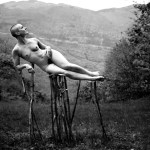
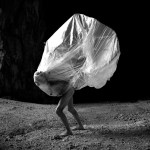


 Acetylene Eyes