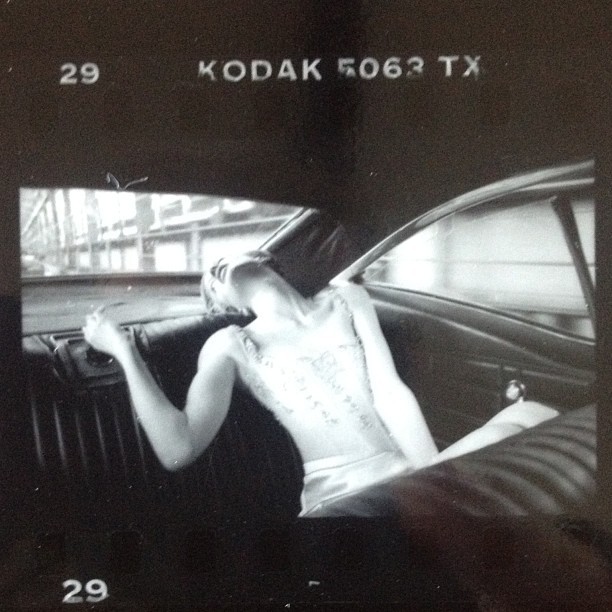
Glen Luchford – Kristen McMenamy (1993)
“You become what you think about all day long.”
–Ralph Waldo Emerson
Glen Luchford – Kristen McMenamy (1993)
“You become what you think about all day long.”
–Ralph Waldo Emerson

writing end of year blog post, feeling funny and sad sort of, grateful for this picture of me from May ish
Caiti Borruso – Self Portrait (2017)
I’m intrigued by Borruso’s work.
It feels to me like there’s substantial overlap with both Mark Steinmetz (careful control of contrast to enliven drama and emphasize tone).
There’s also a similar haunted, elegiac tone to the work of someone like Allison Barnes.
(This photo–presumably of Borruso’s best friend, were it an orphan work is one that could be thought to have been made by Steinmetz or Barnes, actually.)
Her more conventional ‘landscape’ work reminds me of Sarah Muehlbauer; compare this exquisite photo of an open gate by Borruso with this picture of dumpster in Queens by Muehlbauer.
I actually adore the way Borruso sees landscapes. I see landscapes in much the same way she photographs them–but I’ve found in my own work that when I see something in the landscape that interests me, I get the slides back and think why did I fucking take a picture of that? That’s not how it is with her–you know why she took the picture. (Whether or not it always works is another story but from the standpoint of light and form, it’s there clearly demonstrated in the work.)
But what impresses me the most about her work is the way that when she combines her sense of location with unselfconscious presentation of those she photographs–including herself–there is often a sense that her subjects are almost like aliens in their environment. They always look like they belong there but there’s always something searching in their expression. As if they know why they are where they are and how the are expected to act but they’re caught in a moment of wondering if maybe that’s not the way things really are or even should be.
I’ve never seen anything quite like it. It’s incredibly impressive.

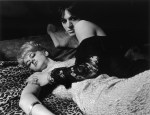
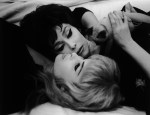

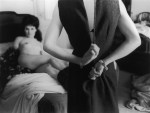
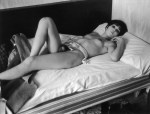
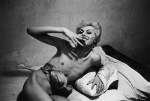
Christer Strömholm – [from first to last] Suzanne and Mimosa (196X); Suzanne and Mimosa (196X); Cobra and Caprice (1961); Narcisse (1968); Soraya and Sonia (1962); Cynthia (196X); Gerdy (196X)
Apparently Strömholm moved from Sweden to Paris towards the end of the 1950s. He took up residence in Place Blanche, at the heart of the red light district.
During his time in this locale, he befriended a number of the trans women sex workers in the neighborhood. (Many of who were working to save up money for gender confirmation surgeries.)
In 1983, he published this photos in a book entitled Les Amies de Place Blanche–of the work, he wrote: It was then and still is about obtaining the freedom to choose one’s own life and identity.

Anonymous – Two women engaged in oral sex (c. 1895)
With the invention of the daguerrotype in 1839, photography was
enlisted in the production of pornography. By the 1880s, when
developments in photographic technology brought cameras into the
middle-class home, amateurs could produce not only their own portraits
and snapshots but also the means of their own arousal. This pocket-sized
photograph is one of some 50,000 erotic images – professional and
amateur – that pioneer sexologist Dr Alfred Kinsey began to collect in
the late 1930s, working with difficulty around obscenity laws and codes
of ‘public’ morality. Taken not in a conventional studio but in a homey
Victorian bedroom, this representation of cunnilingus was probably
intended for illicit heterosexual male consumption, though one hopes
that at least a few women managed to put it to good use. The woman
sitting demurely on the bed wears an apron, indicating that male
fantasies about the sexual availability of domestic servants was
operative in the production of the image. Unlike in most erotic
photographs of the period, the face of the sitting women has been
crudely blacked out.–Catherine Lord, Art & Queer Culture (New York: Phaidon, 2013), 59.
(via @lesbianartandartists)

Igor Mukhin – Ksenia, Moscow (2011)
I’m sure there are more technical photographers out there–but for my money, Mukhin is unrivaled.
Take this photo, for instance; it works because he seems to have obvious thought forget about shadow detail in her hair, I need something to anchor the composition. (This decision has the added benefit of emphasizing the way the light on her hair to the left look exceedingly sultry.)
He realize that the rest of the room is going to blow out and opts for an aperture that will give him just enough of a slice of in-focus depth of field that the sharpest focus begins just in front of her right knee and grows ever so slightly shallow just ahead of her face–which is tilted forward slightly. (Again, every so flattering but it also serves to separate her from the table she’s leaning against.)
And Oh My! but look at the same the entire frame demonstrates what Leica optics with do in correlation with film grain w/r/t over and under exposure and shallow depth of field.

Daniel W. Coburn – Untitled from Becoming a Specter series (201X)
“Attention is the beginning of devotion.“–Mary Oliver


[↑] Eric Marrian – Untitled from Broken series (2017); [↓] Francesca Woodman – Untitled (1979-80)
Juxtaposition as commentary

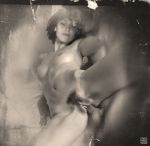
Arvids Strazds – [←] Untitled from Desires of My Wife series; [→] Untitled from Desires of My Wife series (2017)
Strazds is a Latvian photographer who pictures his wife with various paramours.
The work suffers from a cloying veneer of legitimacy–and by ‘veneer of legitimacy’, I mean to indicate creators who attempt to head off any repudiation of their content by pointing to the demand for technical expertise required by their preferred production medium as proof of intrinsic artistic merit, i.e. these appear to be tintypes (although I am not convinced they are/it appears they may depend upon some post-production digital intervention).
The clearest corollary is likely Jock Sturges, who uses his preference for 8×10 analog view cameras in the creation of his work as a means of dodging valid questions/concerns over the sexual/voyeuristic propriety of his work. (That this has flaccid proposition has succeeded in short-circuiting debate for decades represents an incontrovertible failing on the part of the critical establishment.)
Still, I think there’s more to it than that. The focus on square compositions–a format typically most readily applicable to portraiture, and therefore front loaded with a certain innate intimacy’ is definitely enhanced by use of tactful vignetting and reliance upon the same principle those of us with a ton of freckles have known for years–that any three non-linearly plotted dots will, when connected, form a triangle.
Strazds work works due to these reiterative triads. For example: in [←] the two erections and the the way the rim lighting accentuates her left eye’s acknowledgement of the lens (and implicitly both the photographer and the audience). This scalene imposition renders the composition easily parsed and effectively guides the eye over the scene.
[→] is a bit more complicated. Her downward gaze reinforces that the vertex of the triangle is the site of erotic penetration. This leads to questions over whether the other vertices are her breasts, their faces, or the solarized area under her left breast and the hallow between her armpit and his chest. (This is not necessarily something I would’ve picked up on had I not simultaneously been struggling with how to talk about this absurdist gif while also tentatively engaging with Lucinda Bunnen’s work.)
Another point of convergence with Strazds work is Chloe des Lysses’ erotic self-portraiture. I’ve always had reservations about Lysses’ work–I wouldn’t label it narcissistic but there is an element of narcissism to it. Strazds, on the other hand, seems more collaborative. And although it’s entirely possible that there is a narcissistic cuckold adjacent motivation for the work–he does allow his wife a meditative joy of expression in many of his frames that I find entirely appealing.
Lastly, although I generally frown on watermarking your visual art, I absolutely understand the impetus for doing so. My rule is that if you’re going to do it, keep in mind that one is a visual artist and therefore the water mark should be more than just typeset. (Scott Worldwide is the exception that proves the rule–but again, his logo involves solid graphic design.) Strazds has a superb watermark–riffing off of Albrecht Dürer’s signature and mixing in a bit of the sensibilities from the Japanese tradition of Zen paintings.
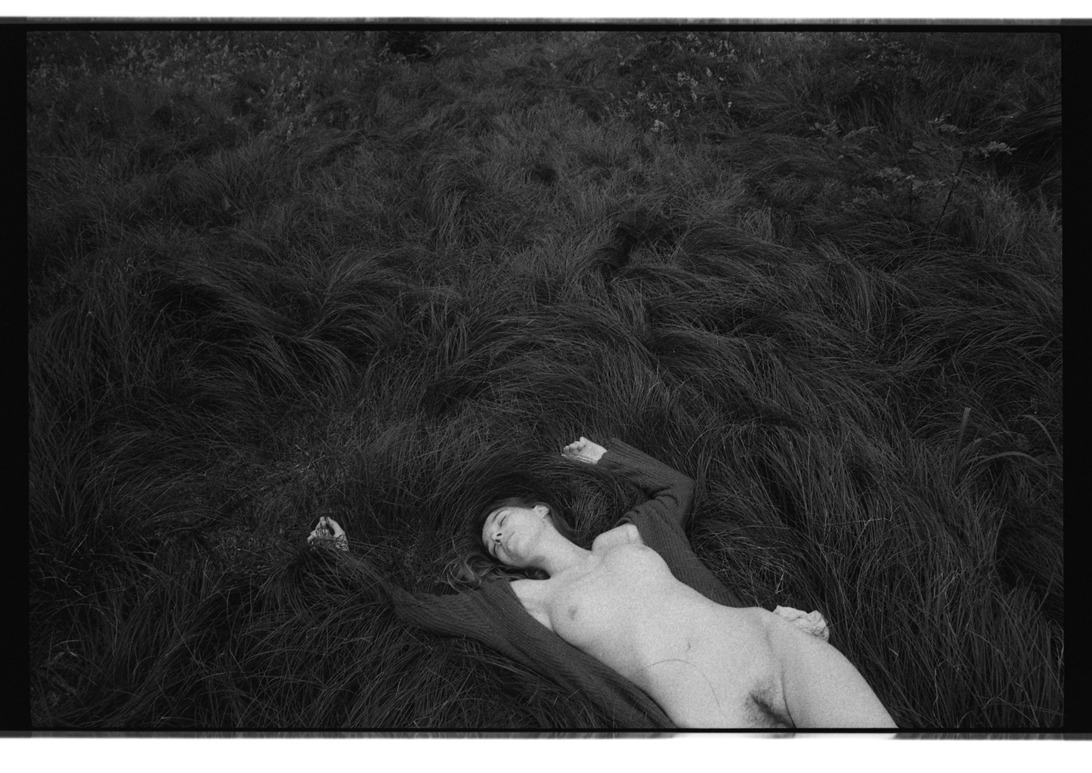
Davide Padovan – Sara Pavan (2016)
I feel like photos/images–and just to clarify this blog strives to counter the current conflation of analog processes (photography) with digital media/methods (images) of lens based visual representation–of nude/semi-nude woman reclining supine amidst lush vegetation are a dime a dozen these days.
That being said, there’s something special about this… I want to say ‘photo’–the shadows appear thicker and more viscous than I’m accustomed to seeing from digital–but the beveling at the lower frame edge seems indicative of some sort of post-production intervention… so we’re going to go with ‘image’ in order to exercise appropriate caution.
I feel like representing nude bodies in or against the backdrop of a landscape is a fairly common motif throughout art history. I feel the justification for this ranges from an urge to envision a sort of utopian realm, a preference for timelessness, a juxtaposition between the predictable solidity of the body contrasted with feral flora variegation.
Hopefully, you’ll excuse* the trotting out my overused example of Edward Weston’s famous nude surrounded by desert sand–however, I think one of the reasons they are so memorable to me is because these photos employ more than one justification for their existence:
The second notion is important because it’s a way of thwarting criticisms of catering to the art historical (lecherously entitled) male gaze.
(I’ve also suggested previously that a figure in a landscape is intrinsically narrative by default.)
Anyway, what I like about this is that it’s doing something I can’t recall ever seeing before: as the industrial world becomes more and more ‘technologically advanced’, there are increasingly insurmountable barriers between humans and the natural world–we don garments to protect against the elements, design and build structures to shelter and protect us. In effect, we are separating ourselves from the natural world of which we are an inherent part and function of.
This image seems to be embodying the same sort of openness to the environment that inspired Walt Whitman to personify nature as if it were his beloved when he wrote in Leaves of Grass: I will go to the bank by the wood and become undisguised and naked.
*The laziness in recycling this example is due to the fact that I am feverishly working on applications to a handful of MFA programs and I am honestly spread far, far too thin. (But I am committed to keeping this project up and running even if I am thoroughly overwhelmed; thank you for bearing with me.
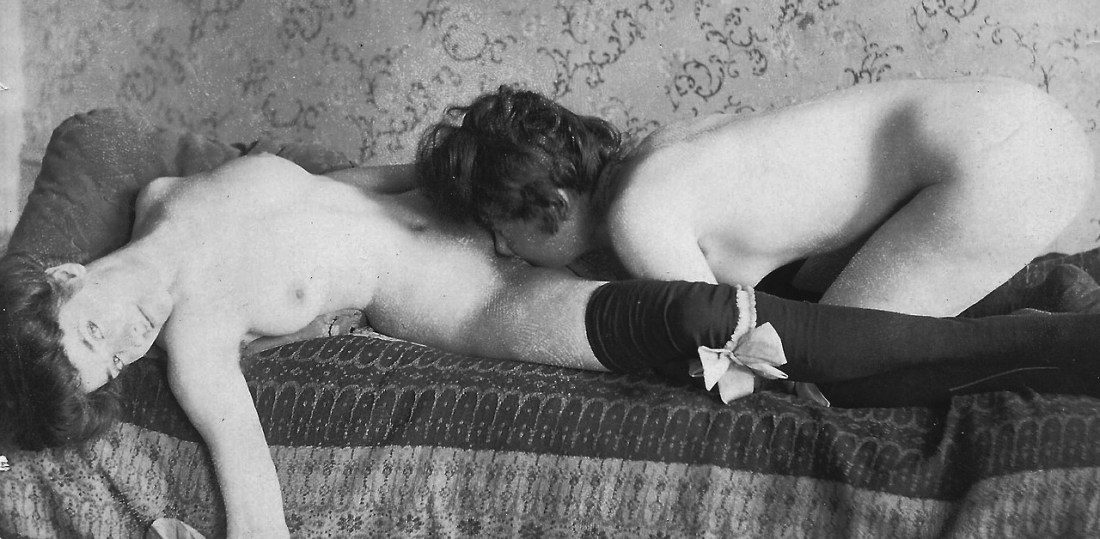
Author unknown – Title Unknown (192X?)
Things I like about this:
Lastly, a counterpoint on the why the eye parses this frame: there is no sense that there is a continuity beyond the edge of the frame, thus the exclusion of the woman on the left’s right forearm and hand represents an amputation, a symbolical removal of autonomous agency. (Her foot is similarly maimed.) No matter the cleverness of the way the work cycles the gaze–these women are definitely meant to perform for the male gaze.)
 Acetylene Eyes