Source unknown – Title unknown (1959?)

I’m intrigued by this photograph. (So much so, in fact, that I’ve spent several hours I don’t really have right now trying to learn something about it’s provenance; sadly, there’s nothing.)

The curious thing is that a lot of the blogs that have posted this generally have a lot of overlap with my own personal interests. And I have some–if we’re being polite–offbeat interests.

As far as just looking at the photo as it’s presented, I feel a lot of the things about controlling context with regards to Valerie Chiang’s All info is in the image applies equally here–even if it does work to a different end, i.e. in this case the control of context isn’t in service of clarifying anything, it’s intended to emphasize a certain enigma.

Like what I do know is that this is most likely a photo made with a 50mm lens–based on the angle of view–operated at a narrow aperture. (The focus between her chin as it’s tilted back and the ridge line in the distance suggests a wide depth of field & imposes on her a sense of being a part of the landscape a la Duchamp’s Étant donnés.)

It’s either a page from a photo album or is meant to resemble one. The 9659 is unusual. It could be a date. Sept. 6, 1959 in the US or 9 June 1959 in Europe–and to me the landscape looks straight out of central casting for Alpine Europe.

Beyond that I haven’t the foggiest. However, I do think what I find some mesmerizing about it is the contradictions it contains. There’s a level of very personal and therefore privileged/private intimacy occurring–yet the viewer is asked by the photo to bear witness. There’s the way that there is a sense that the grassy slope and trees are in the distance but with her head back like that, the distance is compressed substantially.

Also, compositionally this is absolutely the opposite of #skinnyframe bullshit–it’s intended to be read up and down and is arranged in such a fashion as to facilitated the parsing of such a reading. consider how it’s divided into five distinct horizontal bands: the sky, the trees, the area between the crest of the hill and her shoulders, between his middle finger and pinky finger with his pinching of her nipple drawing attention to both nipples and the area below watch band wrapped around the wrist of the intruding hand.

It’s a really compelling construction. And although I can’t find fuck all out about this I would very much love to know more if anyone has any pointers.

defiantly-yourssSome friendly fingers 🐶 (2017)

The above is a Fuji Instax Mini Monochrome instant photograph.

I’ve always been a fan of instant film–the unpredictable peccadilloes of the process contribute an unmediated in-the-momentness to them. It’s partly the singularity of the original–yes, you can scan them or snap a picture of them with your phone (but that one be the same; essentially, there’s only one true original.

Whether it was intended or not, this has always facilitated a special relationship between instant photography and DIY porn making.

(Honestly, if there was a browser plugin that filtered out mainstream pornography and only allowed DIY work through, I’d be thrilled. Diminish the profit motive and it seems like this girl’s enjoyment of things increases, but also ostensibly there’s less premeditation on what will sell the most units, earn the most clicks and it’s focused on what the producer likes and perhaps also what the target audience–whether a person or a small community–enjoys just seems to me to come across as not only more immersive but more authentic.)

Yet, of all things this also got me thinking about the received wisdom that art and pornography are mutually exclusive. (There’s a stellar piece, Museums, Urban Detritus and Pornography, written by Paul B. Preciado (formerly Beatrix), which has been seminal influence on this blog.)

It’s been a bit of shit week for me and I was wracking my brain for something to say about this. (A common misconception is that I just find something I like and then spew convincing BS about it and call it a post. I won’t deny that that happens on the off occasion. But for the most part, the stuff I post is posted because I have something to say about it.)

With this I knew I wanted to post it–that it belonged here–however, I wasn’t sure what I was supposed to say about it.

Then it occurred to be that while this is an explicit image, it’s not especially graphic. Genital penetration by multiple fingers is clearly implied but not graphically illustrated. And that’s kind of the strength of the photo: the basics are clear but the specifics are amorphous.

This encourages the viewer to fill in the blanks–and I use that in spite of the clumsy pun.

I started to wonder how many fingers are inserted. You can’t tell but it specifically says fingers plural. For some reason I thought of the tradition of depicting Christ in oil paintings–with his thumb extended and index and middle finger raised in a sign of blessing. (Bonus points for the art history nerds out there: apparently this was because this finger placement is like a gang sign that reads IC XC–the first and last letters of ‘Jesus’ and ‘Christ’ in ancient Greek.)

It being a sign of blessing is definitely in keeping with the above image. And that got me thinking about how ecumenical tradition tends to take extant symbols and appropriates them for religious use. Xtianity is all but a carbon copy of the ancient Mithras cult, for example.

The Xtian cross symbol originates from what is termed a Roman or Latin cross and became–after the apostle Peter demanded to be crucified upside down to prove his piety and that he was not anything like Christ–the Petrine Cross. Thus a symbol of imperial violence is appropriated by early Xtians, then appropriated again by the Catholic Church (in it’s upside down variant) before being flipped right side up again only to be re-appropriated as a bit of anti-Xtian imagery nowadays.

I realize this isn’t the most un-specious of arguments but I think it works given the way the majority of wisdom traditions have de-emphasized individual experience of the divine with a sort of ersatz groupthink instead. The fact that drugs and sexuality can–given the right environment–be a stepping stone to self-transcendent experience. The powers that be are very much invested in using religion to wall off that option from the majority of people.

Lastly, I’ve had this notion for a while that landscape oriented imagery tends to be secular in nature whereas vertical oriented stuff tends to be more liturgical–I think this digression is actually very much in the spirit of the original Instax.

wonderlust photoworks in collaboration with @kattruffautPersonae obscura (2017)

The process for this was: It was the strangest week in L.A. it rained every day I was there. It had cleared up a bit but not enough to keep us from losing the light early.

I love working with Kathleen, so we kept things going trying to do the best we could with truly deplorable lighting.

This was the last thing we did. It was just an notion: a figure behind the glass casting a shadow–I’d been thinking about the opening to the Pang Brothers’ The Eye (it’s extremely well done).

My film was massively underexposed. You could only see the vaguest hint of separation between three frames. I thought about just using the one with Kathleen pushing against the glass but it seemed underwhelming being just a minimal element amidst a sea of inky black.

The inspiration for these shots had been something moving–so I thought maybe that’s what I’m missing. (Also, I’m interested in a lot of what

I’m really piss poor when it comes to Photoshop. @jacsfishburne pointed me in the right direction and I was able to put this together. It’s the best I can do right now. And that’s probably a good thing because I see it as sort of in the same vein as Inside Flesh; I wanted it to appear interlaced and glowy. But that’s a couple instances of glitching pretty much an exact quote from them, and why would I do that. This can be better. It was an exercise. Still kinda better than I thought I’d be able to do–and that’s the secret (the longer you do it the better you get at it.)

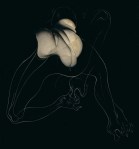
[←] Hans Bellmer – Bound (1959); [→] Ana Mendieta – Untitled {Guanaroca [First Woman]} (1981)

I have been watching from the sidelines and even occasionally wading into the melee on the topic of the responsibilities of art and makers of art in this time and place.

It’s not that I think it’s an unimportant conversation–it’s crucial. I just don’t really understand why every time we have this conversation, it seems like it’s the first time we’re having it.

I fancy myself a bit of a curatrix–y’all likely see me as a snobby poseur; still, I’ve been thinking about Bellmer in the context of Ana Mendieta and vice versa.

The idea has sort of gotten stuck in my head that not only are they fascinating artists to juxtapose–like I could put together an entire exhibit just on the interplay between their respective deployment of gender symbolism.

However, beyond even that, I think it’s interesting the way they both strove to stand against the prevailing ethos of their time without buying into an either/or arch- dichotomy.

I sort of envision an exhibition that is a joint retrospective of their respective bodies of work presented side by side. Call it something like RESIST! Hegemony.

Alas, I don’t have the clout or gallery connections to do this and I don’t know that there’s enough critical work to back my thesis–although my gut says that there’s plenty, I’m just not yet familiar with it.

Would anyone be interested in potentially seeing such an exhibit even if it’s only ever lives on this blog?

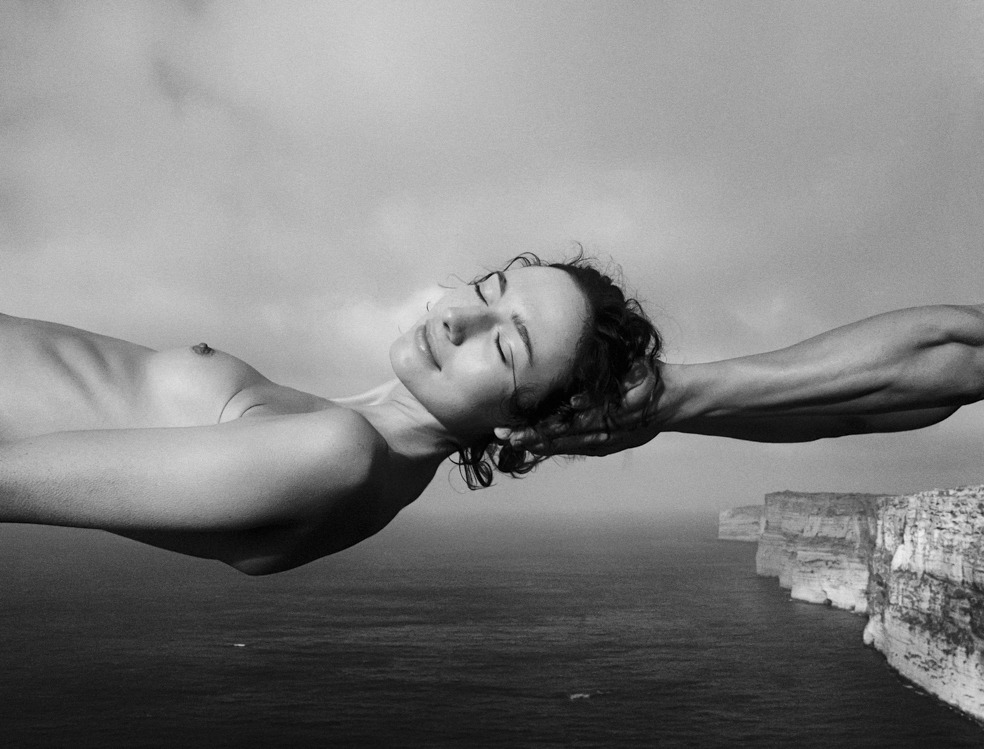
Arno Rafael MinkkinenLaurence, ‘Ta Cenc, Gozo, Malta (2002)

Honestly, this post should be relatively uncomplicated. If I had any sense, I’d point out that Minkkinen’s strongest work seems to always be the work that is–strictly speaking–the least original.

For example: Fosters Pond (2000) is unquestionably a riff on M. C. Escher’s Drawing Hands.

I’d characterize the above as Dalí’s Persistence of Memory + Klimt’s Water Serpents I remixed by Minkkinen.

But the idea for referring to it as a remix wouldn’t be mine; in this case, I’m borrowing it whole cloth from the most recent episode of Adam Conover’s TruTV series Adam Ruins Everything in which as the title proclaims Adam Ruins Art. (<—this link hits a paywall; you can find a pirated version of the episode on YouTube with a bit of elbow grease but here’s a link to the official upload of the segment most germane to this post.)

But there’s also a way in which this relates to other things which I’ve been thinking about a lot recently. From the prosaic: I’m really into Finnish metal–especially Circle and Oranssi Pazuzu (who I saw when they played their first show stateside earlier this year and remains the most incredible live performance I’ve ever seen). Minkkinen being Finnish as well–in case that wasn’t immediately clear.

And then two days ago I watched the recent documentary Burden focused on the life of proto-performance artist Chris Burden.

I was already super familiar with Shoot, 110 or 220–and his street lamp installation at LACMA (even if I didn’t immediately know it was his).

I found myself amazed an repulsed in equal measure. His unhinged behavior when his girlfriend broke up with him and he essentially made TV commercials to narrative revenge fantasies is extremely fucked up. His TV Hijack piece is equally fucked up but definitely maintains a rigorous self-critique that points out that the problematics are part of the point.

Still I find it interesting that he viewed himself as another historically great man of art. And frankly as much as Burden impresses me (at least in theory), I am increasingly put off by this great men of history bullshit.

There’s a great deal of current events that I didn’t/couldn’t include in the post preceding this. But whether it’s the current president using taxpayer funding to stroke his ego twice a day or an engineer at Google losing his job because he circulated a sexist as fuck and egregiously erroneous (his scientific claims about why there are fewer women in tech are bullshit, but he also implicit reifies the notion that here are only two genders) screed to his co-workers against diversity.

What we’re seeing happening in every corner of society right now is that those accustomed to privilege are having their privilege questioned/challenged and to them that feels a bit like oppression. Or, to put it even more plainly, consider James Baldwin:

Which brings me–of all places–to the current trial happening where Taylor Swift is suing a DJ who apparently groped her. I am not a TaySwif fan girl but I do have to say that her commentary and the way she is handling this situation are as scathing as they are stunning and astute.

Rogier Houwen – [↑] Women Kiss (201X); [↓] Title Unknown (201X)

The second photo here dates from late 2012 at the latest. I suspect the upper photo was made around roughly the same time.

Houwen’s style has morphed–with his more recent work focusing on interrogations of photographic process and deconstruction of traditional darkroom technique. It’s not exactly original or even innovative but it’s still interesting. (For example: I unfortunately can’t access the sectors of my memory banks where the name is stored but there is a notable fine art photographer who worked in almost exactly the same vein as Houwen is now who was active primarily in the mid-aughts. That artist’s work is of a much higher quality but I still appreciate Houwen’s soulfulness–it contributes a vitality to his work that I always found lacking in the work of the hot shot photographer whose name I can no not even remember.)

I’ll stay in my lane though. Houwen’s work–at least circa the epoch of the above work–is reminiscnet of Patricio Suarez. Not how both skew darker in terms of dynamic range and both feature a strong preference for backlighting. (This allows them to do some fascinating things with the boundaries between shadow and light, i.e. the way the woman in the lower photo above is separated from the background by a halo of mid-tones around her right shoulder, neck, hair and back.)

It’s not exactly correct but I think the difference has something to do with the raison d’etre for the photo. In Suarez’s case the photo is indicative of a feeling–the chicken hatches the egg. Whereas with Houwen, the feeling is the egg from which the chicken hatches.

Davide RossiAlice Daniele (20XX)

Learning is a bit like a hat hook.

Say I’m wearing a knit hat–this one for example.

Further, say I’ve been trudging around in a snowstorm and it’s rather damp, so I peel it off and go to hang it up.

I can attempt to hang it on the wall all day but unless there’s a hat hook, all my efforts to hang it up are doomed to failure.

Learning is sort of like a hat hook. You can’t learn something until you have a place for what you learn to go–for lack of a better way of saying it: counter-intuitively, the learn something you have to already have some idea of what to do with what you are being taught.

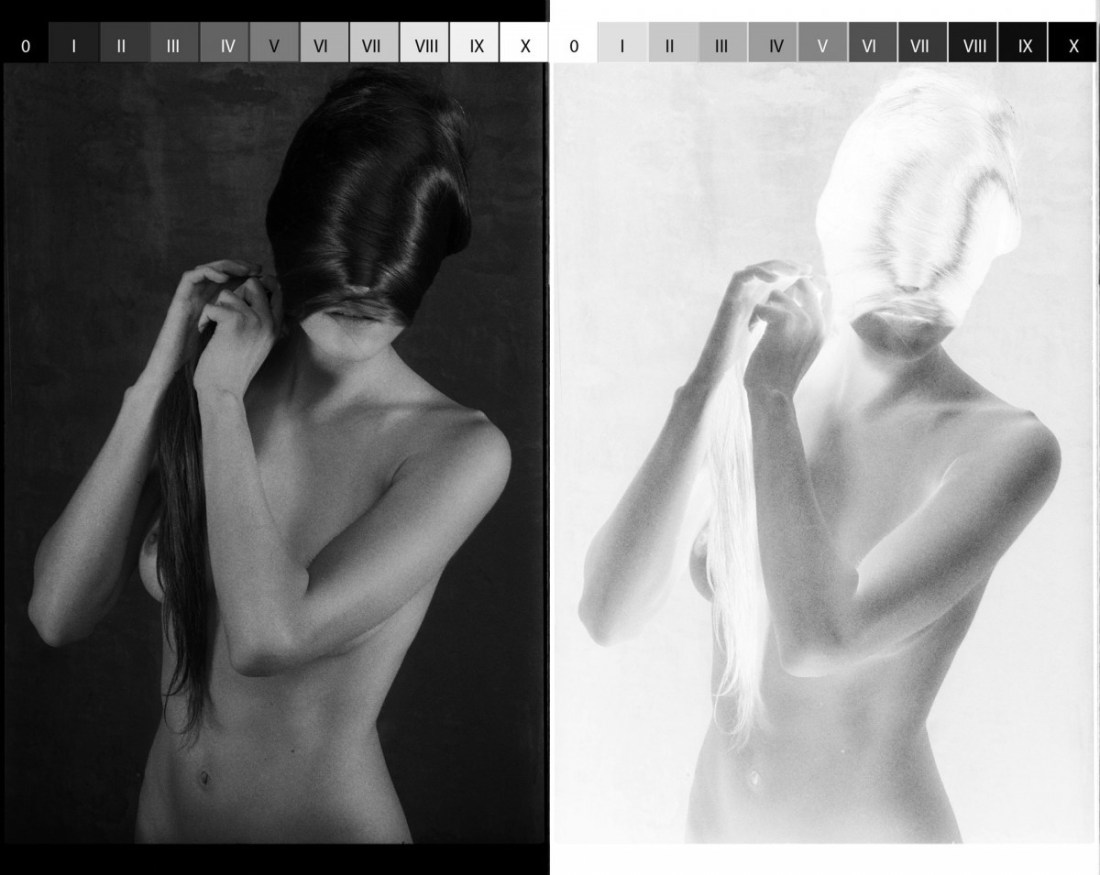
I first encountered the notion of the Zone System in a cinematography workshop back in 2004. In hindsight the teacher was awful–he introducing it as a system of determining exposure codified by Ansel Adams and read this section from the Wikipedia article on the Zone System to us pretty much verbatim.

My response was well what the fuck does this have to do with fuck all else? (I lacked a hat hook (place) for my hat (what I was ‘taught’.)

Now that I do get the basic parameters of the Zone System, I have changed my tune a bit–it is EXTREMELY useful when producing a print or critiquing/responding to monochromatic work to employ the Zone System as a framework for analysis.

The image above is actually the first time it’s clicked in my head that the Zone System has application to not only printing and analysis/criticism, it has applications to the creation of the image itself, too.

Let’s back up a wee bit to get a nice running start. If you’ve ever taken a picture with any sort of attention, you’ll know that while modern cameras can do a reasonably good job left to their own devices. BUT! Should you want something a little more polished, you have to provide the camera some information. You can roughly encapsulate such information by suggesting the camera needs to know what’s white and how much light from the scene it should capture.

Modern cameras are super super smart about identifying what’s white–auto white balance is damn remarkable. The reason that we have manual white balancing functions is because you can creatively fuck with color by say holding a green sheet up paper in front of a sensor and telling the camera to recognize green as white. (As an example, the ubiquitous cinematography trend in the late 90s and early 00s, was to call pure white, white and then shoot under fluorescent lighting–which gives everything this nauseated green cast; think: Fight Club and to a lesser degree The Matrix.)

With B&W analog–everything is based off the notion of middle grey. (Zone V in both of the above images.)

In analog photography, you aren’t able to pre-visualize or relay on a histogram to determine optimum exposure (although if you’ve got megabucks like Daddy Warbucks, you can do Polaroid test shots… sigh, if only…).

In order to judge exposure analog photographers use a light meter. That light meter can be built in to the camera itself or be an independent handheld device–either way, it conveys what the optimum setting is to render an 18% middle grey value depending upon where you are taking the reading.

That last part is important. Like White Balance, you can selectively manipulate your image depending upon what you decide the camera should treat as middle grey.

I actually took the above image and chromakeyed out the tonality of all of the zones, individually. It looks like this:

Note: the fact that Zones VI-X are not represented within this image. (This would indicate that at the time the photo was made, an 18% grey value was attributed to a tone a good bit darker than actual middle grey.)

And while this is super useful in explaining the relationship between the negative (in this case Kodak’s Tri-X rated at 320iso) and ostensibly a print, to be ideally illustrative you’d want the image on the left above to appear all the way to right and to add a photo exposed to provide maximum dynamic range. Although that might end up detracting from the point since a pristine exposure will absolutely allow a talented print maker to replicate this effect in a print; however, a less than pristinely exposed image loses some of that latitude. (It’s hard to tell because I’m looking at a scan of a negative and not an actual negative and the relationship between the value of middle grey in digital vs what the human eye interprets is fundamentally different, still, it appears that this photo was underexpose by several stops from square one.)

Crina PridaForms of life (2017)

The term form of life (lebensform) emerges from continental philosophy but is mostly tied up in the work of Ludwig Wittgenstein–specifically, his later work: Philosophical Investigations and, to a lesser degree, On Certainty.

It’s not at all a straightforward endeavor to explain what Wittgenstein means when he employs this term. Not because the concept itself is difficult to grasp–it’s not, it’s actually disarmingly simple; instead: it’s just that were in such a habit of thinking about things in a very proscribed way that seeing the point that Wittgenstein is making is unbelievably difficult. Probably the best way to think about it is: there is no conclusion that you’re being led toward, Wittgenstein is merely reminding us that when we philosophize we frequently mistake process for product–and that causes all kinds of difficulties.

So, in a nut shell: Wittgenstein takes aim at René Descartes–specifically Descartes’ Meditations on First Philosophy.

That’s the one where Descartes famously pronounces cogito ergo sum, or I think, therefore I am.

There’s no arguing that Descartes was brilliant. (And it should be noted that even though Wittgenstein is disproving Descartes, the former clearly still respects the latter’s rigor as a titan of philosophy.)

Anyway, the way Descartes arrives at his monumental pronouncement is he asks himself–how do I know, I mean really know, anything?

He proceeds to test what he can doubt–and proceeds to make a ridiculously compelling argument that everything can be doubted. He does run into a little bit of a hitch, though–he cannot doubt that he’s doubting. He takes this as the bed rock upon which he builds a world view.

In extremely broad strokes, the resulting world view solidifies the centrality of the mind-body problem in western philosophical tradition.

Descartes was so convincing in his argument that this notion of two discrete worlds–the physical and the mental has become known as Cartesian dualism.

Wittgenstein’s response is implicitly focused on blowing all of Cartesian dualism out of the water but he focuses on one point in particular. In Meditations of First Philosophy, Descartes famously asks how we can know for sure that some evil genius isn’t fooling us, i.e. just because other people move like me, act like me, etc., I can’t know what’s going on in their mind so they could be automatons for all I know.

Wittgenstein calls bullshit. But he does so in a very interesting way–by encouraging his reader to think about a quote from Augustine’s Confessions:

When  they  (my  elders)   named  some  object,  and  accordingly moved towards  something, I  saw this  and I  grasped that the thing was called  by  the  sound  they  uttered  when  they  meant  to  point  it  out.Their intention was  shewn  by  their  bodily  movements,  as  it  were  the natural language  of all  peoples:  the expression  of the face,  the play  of the eyes, the movement of other parts of the body, and the tone of voice which  expresses  our  state  of  mind  in  seeking,  having,  rejecting,  or avoiding  something.   Thus,  as  I  heard  words  repeatedly used in  their proper  places  in  various  sentences,  I  gradually  learnt  to  understand what objects they signified;  and after I had trained my mouth to form these  signs,  I  used  them  to  express  my  own  desires.

Wittgenstein takes Augustine at his words but encourages his reader to consider that if this is–in fact–how we acquire language, how might that proceed.

Thus, what Augustine has in mind is something not unlike the mythological naming of the animals in the Garden of Eden–as if names are labels for things. But then what about verbs and other more difficult parts of speech. Labeling doesn’t work so well for those.

To combat this it’s easy to say we point to indicate what we mean. In other words, the big lumbering animal with the rough skin and the long nose is an elephant and we know it’s the elephant we mean because we point at the elephant to our right as opposed to the large cat with the beard sitting around looking board to our left. We mean elephant and not lion.

Right now I’m sitting in my living room. There’s a coffee table. I can point to it and say: coffee table. But unless you already know something about what a coffee table is, how do you know that I’m pointing to the table and not to it’s color (brown), or it’s shape (rectangular), or what it’s constructed from (press board).

So what seemed fairly straightforward, isn’t. What we really mean by pointing out at something, we must modify if this approach is to work: by pointing I am not so much indicating the object for which the word I speak serves as a label but I’m pointing to some sort of internal experience. Some essentially mental essence that conveys coffee-table-ness.

How does that work? Are words like keys on a piano and by mashing a certain combination we summon the meaning we want?

That seems hell of problematic. I mean: what if I’m really color blind and I see the grass as red and the sky as green but because I’m taught that the sky is blue and the grass is green, I call them that without any way of knowing if what I see matches what everyone else sees?

That question makes a huge mistake by overlooking the fact that when I am speaking I don’t stop to question whether or not the grass is actually green. I accept that it’s green because green has meaning due to the fact that humanity has come to a consensus that a cloudless sky in a non-polluted environment appears to be the color we know as blue.

This is the idea that meaning isn’t labeling or pointing (externally or internally) it is instead words used in a particular context and the use in that given context is what bestows meaning upon the word(s).

I’ve glossed over one important point because it doesn’t really fit in the progression of this explanation but it is important so I’m going to jump tracks here for just a minute.

Initially Wittgenstein compares learning language to learning to play a game–specifically: chess. This is actually one of the more ingenious metaphors he uses.

I’ve taught dozens of people to play chess. And you usually start out with an empty board and you show the other person how each piece moves, i.e. the pawn can move two spaces off the line and then every other move it can move one space forward; it attacks diagonally. Whereas, the rook moves in a straight line left and right or forward and back; it can move as far in any one direction as their are open squares. The knight moves in an L-shape, etc., et al.

You can explain the objective–what check and check mate entail. But as check mate is something that is no one single set of moves (it’s contextual), you eventually have to play the game. (And whoever you are teaching is going to do very poorly their first couple of games…)

Language is like this but it’s also not like this. In chess a bishop can’t move like a rook, but in language a word can function in two different capacities simultaneously–think of puns, double entendres, etc.

Thus, the notion of a form of life. It’s a stunning metaphor because it emphasizes an anthropological perspective–what is the environment like, what are the cultural customs that inform the use of particular words, etc. But there’s also no form of life that doesn’t intersect with other forms of life–think about rabbits being introduced into Australia. Language–unlike rules to a game like chess–changes as it is used (similar to how life evolves).

So Wittgenstein’s trip is basically that when we think about how we do something as opposed to doing it in the stream of things, we are likely to over-complicate things in a way that we don’t when we’re speaking. (Consider the zen proverb that admonishes against putting a second head on top of the one you already have. That’s the other fascinating thing when you really dig into Wittgenstein is that you slowly begin to suspect he was actually a Zen master.)

It’s like Borges map that is so detailed it becomes bigger than the area it’s designed to survey. (It ends up moldering in the desert, as I recall.) We know how language means when we speak, it’s when we stop to think about how language means that we make mistakes like believing that I can doubt everything but that I’m doubting seems profoundly empirical but is, in actuality, something that tells us nothing about metaphysics or minds and instead merely reminds us that the if you’re doubting of course you can’t doubt that you’re doubting because that’s inherent in the concept already.