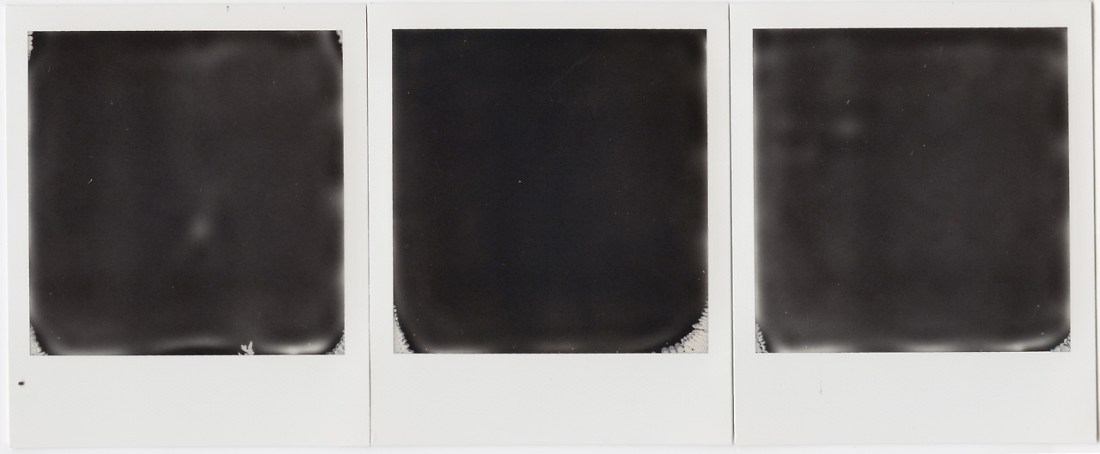
Arne van der Meer – three times nothing | camera failure. (2017)
I love so much about these: the way those striations along the right most edge of each are not consistent across all three frames; the areas in the corners where there’s that light leak like effect that’s half-tin type edging, half inversion of those black spots you get on old mirrors and the way there’s something visible in the frames (almost like a cloudy x-ray or an underexposed document of trees in a forest–if you squint a little and treat it as if you’re laying on your back watching clouds drift in the sky overhead, or some sort of monster in the shadows) on either side but just darkness in the central panel.
….
In the process of packing up my life and moving away from the city where I’ve lived for ~ 15 years, there’s been a lot of soul searching.
A couple months ago, I had a dream which I haven’t been able to completely shake: I was walking through an old neighborhood, an autumnal chill in the night air. I smelled the skunk weed before I saw another person approaching me.
He was tall with long hair and a thick bristle of a goatee. He seemed oblivious to me–except for the fact that he was holding his left hand at his side and slightly behind him as we neared each other in an effort to shield it from view with his body.
With a start, I recognized where I was and who I was seeing. It was November 22nd, 2001: Thanksgiving–and the person I was seeing was me at the age of 24. Faced with the prospect of eating Thanksgiving dinner with both my mother and younger brother, I’d rolled a joint and informed everyone I was going for a walk and then proceeded to bogart it in an effort to get stoned to a level that involved at least some degree of dissociation.
I remembered the walk, remembered hiding the joint as I was watching myself doing but I didn’t remember the person I’d encountered.
As I drew closer, I realized that this was just such an opportunity as the ones I always create for myself as thought exercises: if you could give advice to your younger self, what would you tell them? (Of course, bearing in mind that them listening to you is one thing but them believing you enough to actually put stock in what you were telling them? Rather another entirely…)
I said: In 2018, you’ll be living in Brooklyn in a beautiful apartment with fantastic light, blond wood floors and lots of plants. Also: you’re a woman–the sooner you get a handle on that the easier your life will be.
He looked at me and sort of recoiled.
I woke up with the feeling that it was less dream and more of a evanescent memory.
…
Ludwig Wittgenstein held that understanding was impossible without the equal and opposite possibility of being misunderstood.
The advice I gave myself in my dream wasn’t actually the advice I’ve always thought to give my younger self. It’s always been some admonishment along the lines of Wittgenstein: don’t be afraid to fail because failure is the necessary first step in the quest to master anything worthy of mastering. (And for fuck’s sake: the cost of those three Polaroids with nothing on them was at least $2.50 a frame.)
It’s common sense such that pointing it out seems cliche–and cliches are easily dismissed.
…
For some reason all of this lead me to make an effort to empathize with myself at previous points in my life. The sort of see if I could with what I knew at any one point, have had any sort of clue where I would end up.
What I realized is not that my faculty for logic is too bereft to predict where I was heading but that frequently my expectations have a tendency to suffer from a disconcerting impoverishment of imagination–and by that I mean that where I have ended up has always been nothing like I expected but better for that fact.
Which leads me to think that the only way to really fail is through a refusal of doing.

 Acetylene Eyes