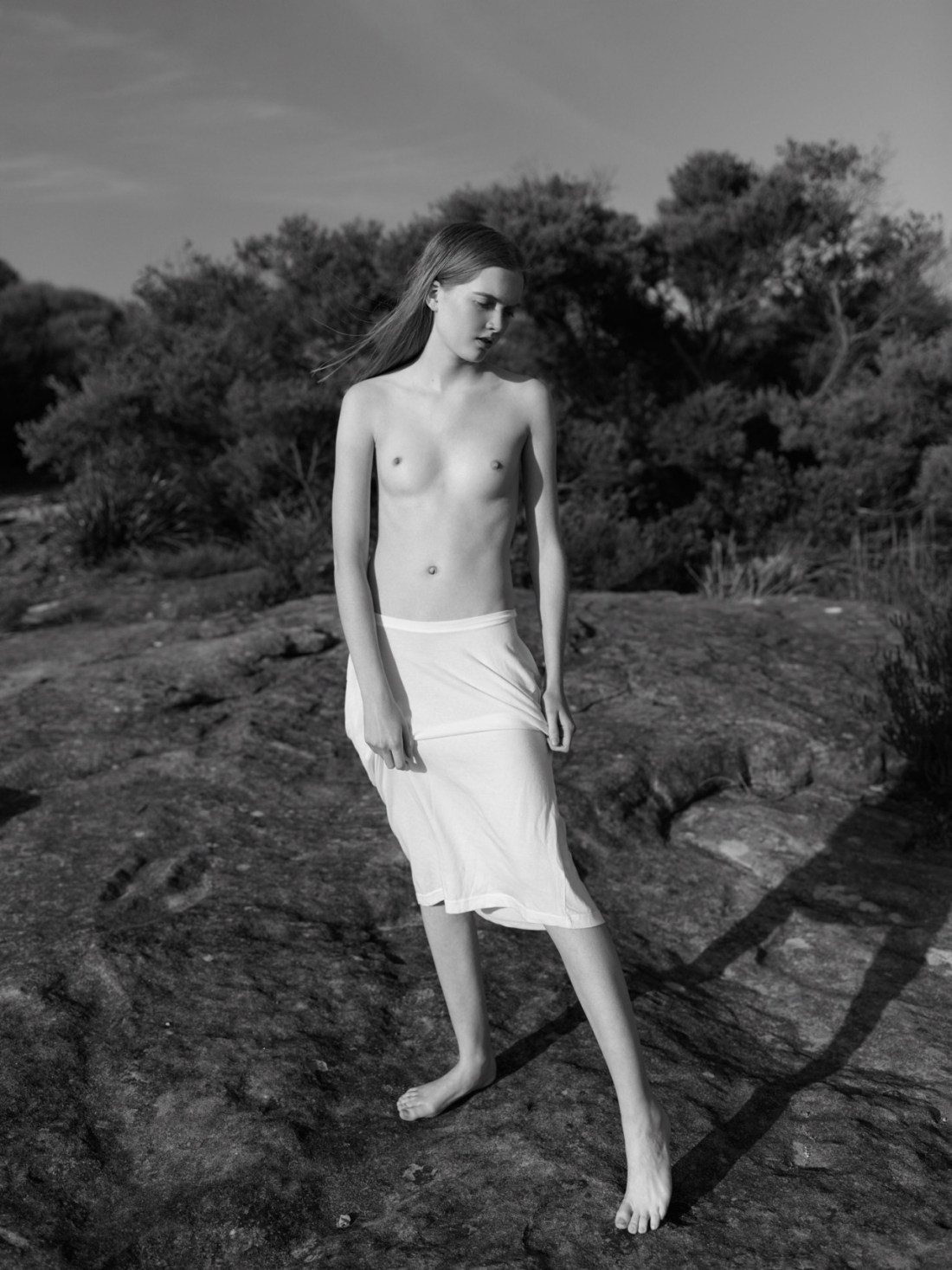
David Cohen de Lara – Ruth Bell at Curl Curl (2015)
There’s exquisite range between the brightest highlights (Ruth’s slip) and the darkest shadows (the dark niche at the edge of frame if you extend a horizontal line running left from her right shoulder).
Ruth’s pose–left foot forward, her body leaning back (ever so slightly) and to her left–casts just enough of a shadow to balance the frame.
It’s a compelling image. (I adore it.) But to beg a question I normally detest: is it art?
…
I yammer on and on a lot about things. I throw around various notions willy-nilly. In the interest of being clear, when I’m talking about fine art photography, I mean something–I think–not unlike this:

For the sake of this blog a ‘photographer’ is any one working primarily with analog processes; whereas, an ‘image maker’ pursues digital processes. (I never use the terms interchangeably–to do so, I feel, is one of the greatest failures of contemporary criticism.)
Essentially the photographer or image maker facilitates two relationships one between the subject and the photographer or image makers intercessor, namely: the camera and another between the photograph (or image) and the audience (or viewer).
There are as many different processes and approaches as fish in the see. But generally speaking, if one is an artist the relationship between subject and media is understood in terms of technique; the relationship between the media and the audience is the realm of the conceptual.
I’ve set it up this way very specifically. I loathe when photographers (and honestly, it’s more often than not image makers who make this argument, again digital is the bane of the evolution of visual grammar) suggest that their intention matters. Fuck you. The only thing you can do is anticipate the audiences reaction give social cues, cultural context, etc. (The better the artist, the better such things can be anticipated.
Similarly, the subject relates the audience and the photographer–they have a view to the conceptual but they don’t really exert influence on it. (Unless there’s a situation where the the subject is also the audience (thinking her of Traci Matlock and Ashley Maclean and their insistence that the first edit is offered to the subject by the photographer.)
(I also dig this paradigm because it cancels out folks who maintain that they do not make work for anyone else but are just pursuing their bliss. I hardcore support you and the purity of your mission–but you’re not an artist. To be an artist there must be a relationship with an independent viewer or audience. No two ways about it.)
…
About two weeks ago, I was on enough drugs to kill a rhino when I had this realization: the frame is essentially a portal and the way you see it changes depending on whether you are outside the frame or have stepped within it.
Several days later, the latest Cinefix listicle featured an interrogation of what the grammar of the cinema teaches us about the way we interpret different modes of shooting people conversing. (I have mixed feelings on Cinefix–they are neither bad nor good. I appreciate the way that they try to shine a light on the accepted canon of film nerdry. At the same time they have been gallingly sexist in the past and are frequently short sighted in their analysis.)
The point that I’ve made a number of times is that I find the establishing shot, shot-reverse shot mode of conversations jarringly self-conscious inducing when the shots are over the shoulder of someone with their back to the camera talking to someone the viewer can see and then we switch suddenly to the shot in reverse–over the shoulder of the person we were just looking at. No one moves that way. Not even in dreams–at least not in mine. (Cinefix wisely refers to this as being outside the conversation, whereas shots inside the conversation generally play like you–the viewer–could be sitting there and swiveling to focus on whomever was talking. Interesting, the swivel doesn’t need to be shown for you to get the gist. Ellipses and all…)
…
I would argue the above isn’t, in fact, art. It’s lovely–it really is, but…
It’s #skinnyframebullshit. Not in the usual way I mean #skinnyframebullshit, either–as in badly composed or composed without any kind of logical consistency; this is well composed.
de Lara has truncated the triangle I suggested and created a situation where the photographer is also the audience. That’s one of the hallmarks of work that fails the art scratch and sniff test.
Everything about this image suggests a one on one relationship with Bell. That’s not inherently problematic in and of itself. But, putting this out into the world, if you apply the notion of stepping into and out of the frame. Standing outside the frame it’s easy to wonder is this a fashion editorial, is it a portrait or is a ‘fine art’ nude. One of the baseline features of the conceptual relation is for the artist–given the context–to anticipate questions and render unhelpful/unproductive questions moot. There are two many questions I have about this, too many hinge on my not knowing what the relationship between the photographer/image maker and the subject.
But there’s also the fact that while de Lara is standing at a respectful distance from Bell. When the view steps into the frame, the viewer does so without a camera separating them from the subject. We naturally scan–in almost every situation–left to right, not up and down. The up and down, portrait or skinny frame orientation is an approximation of turning your head sideways to better see something up and down continuously.
I don’t know what de Lara’s relationship is with Bell. It’s probably fine that he’s taking a picture of her in such an objective fashion. But there’s a problem in positioning the camera the way he does: it encourages the viewer to also objectify someone they do not know.
Imagine stepping into the frame and having her open her eyes while you have your head sideways checking her out. As long as you see yourself as a stand-in for the photographer, that’s fine. But to be art, the audience cannot stand in for the photographer because they enter the scene from a completely different vantage point.
 Acetylene Eyes