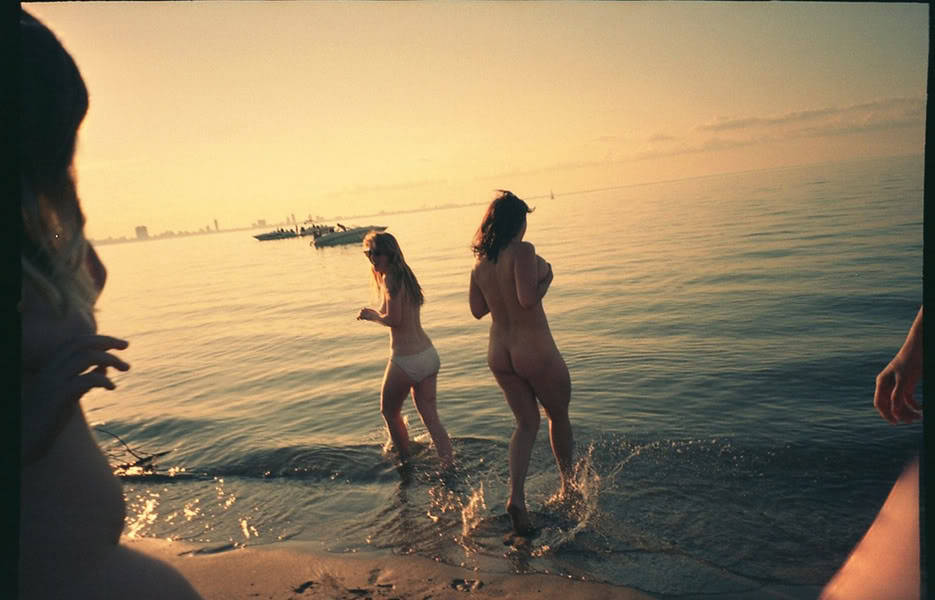
Dimitri Karakostas – Untitled (2011)
The has a great sense of motion in space and time.
For example: the woman at the left edge seems to be running parallel to the tide line, blocking the sun just enough to get that lens flare effect at the lower right corner; in turn, the flare draws attention to the hand that’s so wonderfully enters from frame right.
The running woman and the hand create a parenthesis containing the two women running into the surf–the left most who is peeling off while glancing back at the running woman at frame left while the right most woman in the white bikini bottom runs straight into the water.
I find most of Karakostas’ work underwhelming–despite his impressive sense of immediacy. Still, there’s something about his work that strikes a cord and it occurs to me that it has to do with his investiture with skate culture.
That knowledge triggers a number of ancillary realizations for me. First, it places his work within a lineage tracing its way from Ryan McGinley and Spike Jonze back through Larry Clark to Diane Arbus; second, there is the prevailing notion that there are (at least broadly) two flavors of photography: photojournalism and fine art; the former is ‘objective’, the second–‘subjective’.
I’m not sure I agree with this bifurcation. Photojournalism is only more objective in aim–but the artifice of the frame is already to have introduced notions of inclusion and exclusion; also, work that is disseminated has be prejudiced over other work for what are closer to subjective criteria. (Also, McGinley, Jonze, Clark and Arbus are–to the best of my knowledge–outsiders who are recognized and trusted in the community they prefer to document. I’m not entirely sure why there seems to be so much more trust in the art world for outside observers telling stories that aren’t their own. Karakostas is–in some ways–more in line with Nan Goldin.)
However, the main thing an awareness of the photographer as a part of skate culture is a result of spending the last six weeks interrogating my own personal approach to art making: I’ve realized what an indispensable facet of my process failure is.
It’s not a popular thing. We all want to make it seem like it’s effortless and second nature and the ideas just emerge from us like Athena springing fully formed from the head of Zeus. In reality, there’s a lot of shit that just doesn’t work–but you have to put a lot of work into that failure before you realize it doesn’t work.
(I was once told that Aimee Mann claims that for every song she releases she writes 99 songs that are awful and don’t work.)
And I think about these kids I see skateboarding from time to time in SoHo. They’ll spend hours, days and weeks repeating the same stunt–falling, picking themselves up, trying it again; you don’t learn to do a trick without at least getting a handle on all the things you can do to fuck it up and then training your body to be mindful w/r/t avoiding those mistakes. But all the failures make the minor successes all that more motivating–the eventual mastery all the more appreciated for how challenging it was to accomplish.
Show me a skater who is also an image maker and I’ll show you someone who has a ridiculously refined notion of the dynamics of motion with regard to the spatial relationships between bodies and environments. (Yes, most likely they’ll burn through an exponential amount of film–but they also will have a ridiculously good idea of what works and what doesn’t work)
 Acetylene Eyes