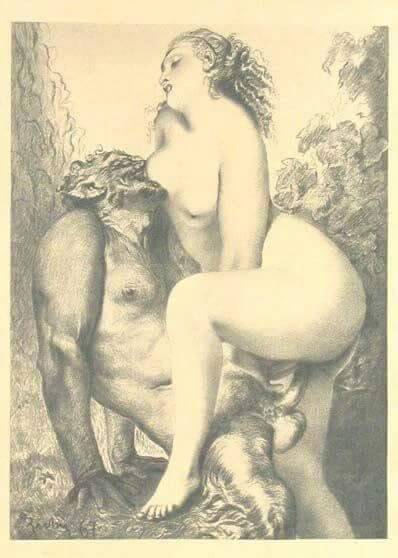
Mihály ZichyNaughty Satyr (18XX)

I’m not sure I can think of another artist as gleefully transgressive as Zichy.

Erections, cunnilingus and masturbation all feature prominently in his drawings.

There are two things I find especially fascinating about his work. Zichy essentially had two styles–his sexually explicit tableaux are always equal parts humorous/playful and presented in a distinctly Renaissance style while his more exploratory sketches appear rigorously formal, reminiscent of little more than an Anatomy text. (Interestingly, if you split the difference between these two styles you stumble upon something not altogether different than the sketches of Klimt and Picasso–both who would almost certainly have been familiar with Zichy’s oeuvre.  Secondly, although his fixation on male sexual response can come across as a bit grating to modern sensibilities–he acknowledges rather less than implicitly that women are not only able but should be allowed to derive pleasure from sex.

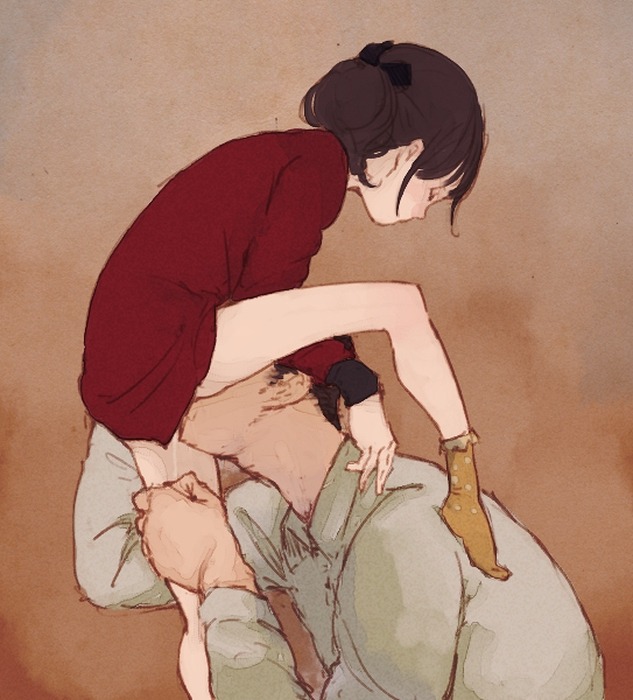
I’m not 100% certain that this image is actually called Naughty Satyr. It’s a good title though. If you remember your mythology, Satyrs were demigod drunkards. As such, Naughty Satyr is a bit rendundant. And I like to think that the reason the Satyr here is deemed naughty is not the fact that he’s sexing up this nymph, it’s that he’s enjoying her flesh and abdicating both his pleasure as well as hers up to her alone.

I would think (drunk or not) a less selfish satyr would have braced the palm of his hand on the inside of her thigh in such a way that his thumb could shuttle back and forth over her clitoris.

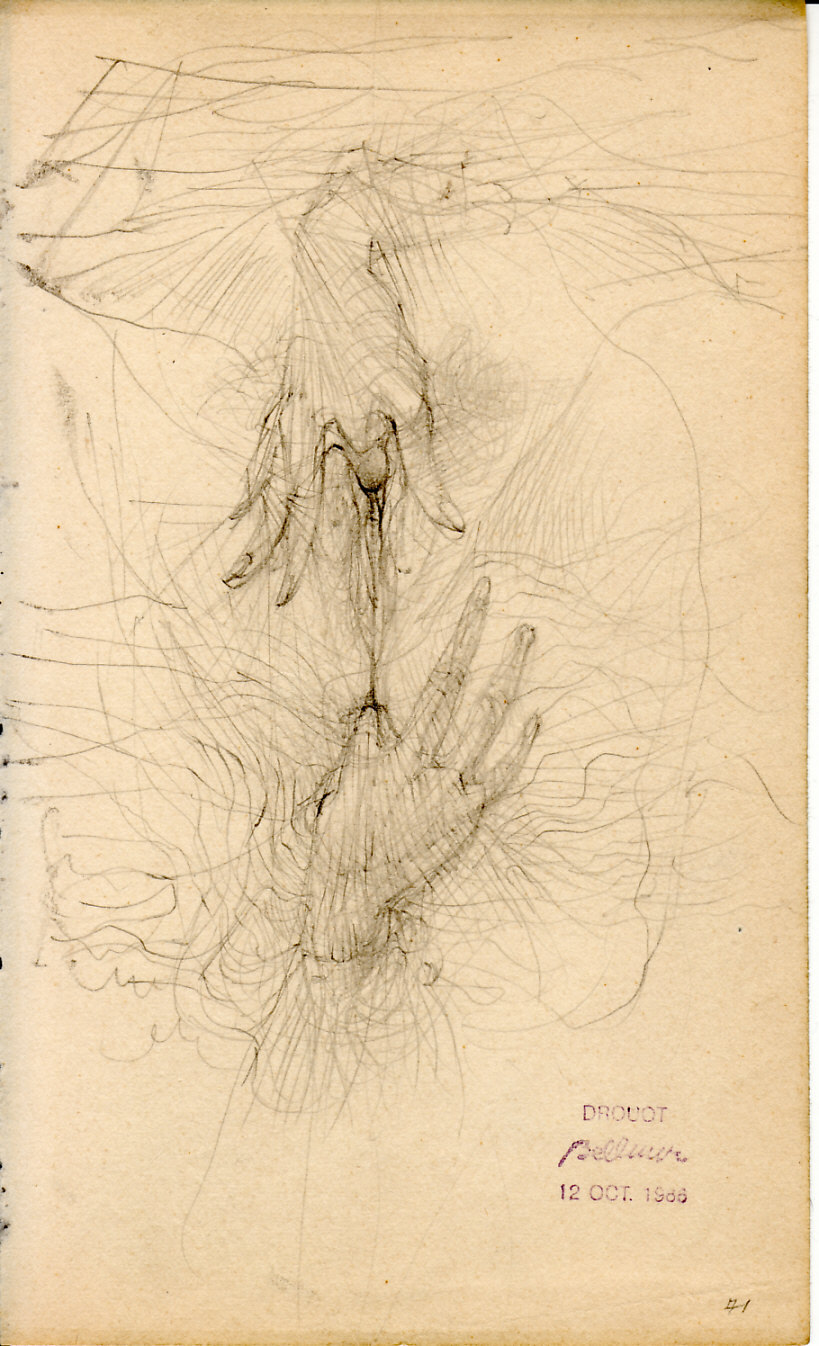
Hans BellmerTitle Unknown (19XX)

Individual perversion and obsession are so inextricably interpenetrative that it’s difficult to judge where the former ends and the latter begins.

Bellmer positions his paraphilias front and center, pulls no punches and generally gives zero fucks about your puny concern fappy ‘moral’ outrage. There is definitely an off-putting integrity to an artist who doesn’t bother to sublimate the fact that he’s fixated on the sexual potential of pubescent female bodies.

(Of note: Bellmer shares this predilection with Balthus. However, unlike Bellmer, Balthus refused to engage conversations regarding the ‘hebephiliac‘ themes in his work. As such, it’s interesting that while Bellmer is the better technician, Balthus’ enjoys wider cultural renown.)

It’s all fucking enormously problematic. And I’m never sure how to address that because there always seem to be some unshakeable truth transcending binary gender identification and either/or sexual orientation which his line work always seems to be struggling to give expression to. As if Bellmer believed in the depth of his soul the grotesque is the veil one must penetrate to truly experience the sacredness of beauty.

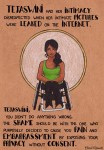
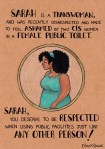
Carol Rossettiselections from Mulheres (Women) series (2014)

Rossetti is a Belo Horizonte, Brazil based graphic designer.

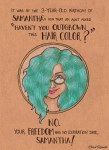
In April 2014–a month ahead of the #YesAllWomen social media trend–she began making simple yet exquisite colored pencil drawings of women which included captions celebrating individual autonomy and personal agency.

The intersectional feminist/sex-positive/body-positive/anti-slut shaming perspective along with the carefully calculated non-confrontational presentation rapidly–and deservingly–went viral.

The first time I encountered her work I cheer aloud. I was so curious about her that I navigated away from my Tumblr dashboard to learn more. I remember seeing her response to someone deeply impressed by her illustration of Babi. It was so pitch perfect–I’m not going to lie–I teared up a little.

I’ve lost track of all the times since Rossetti’s radical empathy has floored me. I’ve wanted to showcase her work for months; however, I’ve been at a loss as to how I might do so in a way entirely respectful of such ingeniously subversive work.

Emboldened by the luck I’ve had in approaching folks whose work I dig, I wrote to Rossetti–who proved to be equal to the contemplative charm of her work. (Also, she was exceedingly patient with my scattered, free-form approach to interaction.)

Acetylene Eyes:        I have this image of you as a bad ass, caped super heroine sworn to uphold intersectional feminist ideals while vanquishing sexist bullshit.

Carol Rossetti:           Hahahaha! Super heroine, that’s something I’d never [thought] of me!

AE:                              A super heroine who loves dinosaurs apparently; Do you have a favorite? (Its stegosaurus, isn’t it?)

CR:                             I do love dinosaurs, and I truly believe in Spielberg’s versions. So, of course my favorite one is velociraptor, because they can open doors. Smart asses.

AE:                              Usually I have a zillion questions about creative process but you’ve addressed that topic assiduously in previous interviews.  I’m not sure if it’s that the first image I saw of yours was Ana or if it is just especially resonant given my own experiences but it feels different than most of your other illustration. Did your approach differ at all in making it?

CR:                              Actually, it wasn’t different. I talked to some people who have been raped, and the illustration was based [on] a real person (changed the name, of course). But I haven’t been through this situation, so I pretty much tried to put some of the exact words she said to me there.

AE:                              You have noted: “none of my illustrations are made based on personal assumptions.” That’s an incredibly astute observation; one which started me thinking–a dangerous past time, I know–about the role of conceptualization in art-making. Are you familiar with Brandon Stanton’s Humans of New York (HONY) project? 

CR:                              I like HONY, I think it’s a beautiful project.

AE:                              I feel as if your project and HONY share a sort of human interest angle. Thus, there’s a built in audience. Yet, unlike your willingness to listen to a multiplicity of experiences, HONY seems devoid of a similar openness.

CR:                              I understand the critics, I think they are valid, though. I’m not sure exactly how Brandon Stanton presents it, but I think sometimes people put a lot of expectations and responsibility on an art project. Don’t get me wrong, I do understand that expectations are natural and responsibility is something that does exist. But I guess what might have happened to HONY that also happens to my work is that people put it in some kind of pedestal in which it was never meant to be. Well, at least about my work I feel a bit this way. I identify myself as a feminist, but I completely refuse the idea that I would be the “new face of feminism”, as I’ve seen around. I am not feminism itself. I won’t tell anyone how feminism should be handled, what’s the “right or wrong” way to fight the fight. There are many ways to fight sexism, racism and many other kinds of oppression, and I am not a leader or anything. I have a language of my own, which is through colored pencils drawings of different women, each of them with a story, and a non-agressive friendly text. This is a way for me to express myself, express my ideas, invite people to identify, maybe (if I’m lucky) make some people aware that sometimes they say things that are really rude, even though they might not notice at first. However, there are people who are really angry, people who are tired, people who have been traumatized, people who don’t share even half of the privileged that I know I have, people who only have anger to keep them moving on. I won’t judge these people’s ways to fight the same fight, and I’d never tell them how to handle feminism. That would be very disrespectful. I thank you for your kind words about my work, and I’m happy that it touched many people so deeply in a very positive way the way it has. This is so much more than I could ever expect! But sometimes I feel the pressure of expectations in a way I’d never thought it would be. I’m still a human being full of flaws[;] I make mistakes the whole time. This project is about representing some women, but I don’t have the pretension to represent ALL women. It is about feminism, but it’s not supposed to be a guideline of how to do feminism. It’s about representation, but it doesn’t have the claim to being the “right” way to represent people.

So, sometimes I think something similar might have happened to HONY. It was supposed to be something, but people saw it a lot bigger than it really was meant to be, and then there were more expectations and more responsibility demands. I don’t know (really, I don’t know if that’s the case at all for HONY), but I feel a bit like this sometimes. We can control what we say, but each of us [has] our own cultural and experience background that will result in a different interpretation – and that is not controllable.

Anyway, sorry, I got carried away and ended up talking a lot about something else. Back to the point. I love dinosaurs, but I never liked drawing them. Pretty hard anatomy! I’ve always loved drawing women – and always found very hard to draw men. I’m not really sure how I got here… When I say this whole project was born in a very spontaneous way, I really mean it. It was just one more project I had in mind to keep drawing every day, and then people began liking and sharing like crazy on Facebook, and my life turned upside down. In a very good way! 🙂 

AE:                              I want to jump back to feminism briefly. Did you have a feminist conversion moment—you know a sudden epiphany that the patriarchy was a total crock of shit?

CR:                              I’m not sure when I decided I was a feminist, but I know that I started getting to know feminism beyond stupid stereotypes with my husband. He started talking to me about it and it was great. I guess many feminists wouldn’t like that, but it’s true and I don’t see any problem with that. Of course it was not just him. I started reading things on my own, and finding out things for myself, and talking to people. And one day I realized I had always been a feminist. A clumsy one, for sure, but still a feminist.

AE:                             What artists light you up and why?

CR:                             Well, I do feel inspired by people in general. I think that if you learn to look around, you’ll see so many people with so many stories and so many points of view, and that’s wonderful. The human being is an endless source of inspiration. But, if we’re talking about famous people, I should probably start with Neil Gaiman and Amanda Palmer. I absolutely adore their work, they’re like amazing inspirations for me! I suppose inspiration comes from many different areas, like literature, cinema, music, photography… It’s all around. Every day I discover an artist I didn’t know before and I fall in love with them!

AE:                              In previous interviews you’ve mentioned enjoying music and TV series. What three albums and three series couldn’t you live without?

CR:                        Hm. Well, let me see. I guess Belle and Sebastian’s The Boy with the Arab Strap; First Aid Kit’s The Lion’s Roar and Banda de Pau e Corda’s O Melhor da Banda de Pau e Corda. But I feel like I’m being unfair not mentioning other thousand artists I love! And three series… American Horror Story, Doctor Who and Buffy the Vampire Slayer (guilty pleasure?).

AE:                              Have you heard of Emma Sulkwicz?

CR:                              Yes I have!

AE:                              She’s incredible isn’t she?

CR:                              I think she found a very powerful, personal and meaningful way to protest. And that’s amazing.

AE:                              Speaking of protest. I know Brazil is roughly the size of the US, but did the protests leading up to World Cup intersect with your life in any way?

CR:                              Those protests we had last year were quite a thing. It began as something, then it turned [into] something else, and then into something different. At first, I was with the protesters. Then, the whole movement was grabbed by right-wing parties and had a very bizarre speech, so I didn’t support them anymore. Anyway, it’s complicated. But the World Cup did affect everybody somehow, I guess.

AE:                              If you created a self-portrait in the style of your Mujeres illustrations, what would say to yourself?

This is a [tough] question. At the beginning, my drawings were about situations I didn’t live myself. It wasn’t planned that I wouldn’t talk about me, I just talked about issues I thought were more important. And I consider myself very privileged, so my own issues I was always leaving for later, you know? Then I decided to start making some about things I lived, and I found out that was way harder than I expected. So I made the one about not wearing any makeup, about cellulite, about the couple who decided not to be legally married, the one about tanning… I still want to make one about not wearing bras! 🙂

Source unknown – Title unknown (XXXX)

I like this v., very much.

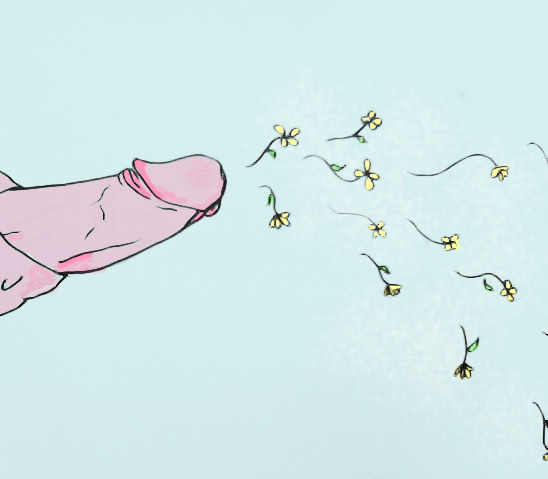
Yes, I do have a fixation upon creative, non-sexist strategies for the visual depiction of ejaculation.

& yes, there’s def/ room for improvement as far as the line work here…

…but: the core idea–the physical act of seminal ejaculation as an event resulting in beauty–reads unambiguously as-is

& this is exactly the sort of work that if I ever had a space to truly claim as my own, I’d want this displayed prominently. I gives me very warm and fuzzy feels.

(Also, I’m borrowing knitphilia’s pretty masculinity and crafty cocks tag because they are v. apropos.)

Hans BellmerGirl (19XX)

I’ll take Bellmer’s profane drawings over his Venus of Willendorf-esque, kitsch-as-all-fuck Dolls any day of the work (and twice on Sunday).

But this…this has gotten right under my skin to a degree only a handful of things–mostly music–have ever managed.

My instinct is to start by diminishing any personal interest in the hebephilic content. But in so doing, I distance myself from the work; I engage it on my own terms with a near total disregard for context. This strikes me as gallingly disingenuous.

It is fucking absurd to divorce something like this or the majority of Balthus’ oeuvre from a reckoning the relationship between the female experience of puberty and the formation of an individual sexual self. For fuck’s sake, it’s not just a pathological fixation, it’s the goddamn foundation of the work.

I won’t argue that hebephilia is a ‘normal’ sexual orientation; but I refuse to relegate it to abnormality. (Also, what the fuck is ‘normal’ anyway. whatever it is, I am sure it is fucking God-awfully boring.)

I will argue instead that dismissing the inconvenient or the problematic in a work demonstrating such rigorous mastery of craft should be tempered by two considerations:

  1. As a capital-A Artist, there is less duty to notions of social propriety and strictures and more to the abiding by the commandment: homo/mulier sum, humani nihil a me alienum puto.
  2. Be mindful of Newton’s 3rd Law of Motion, i.e. to be human is to be subject to consequences.

In her widely acclaimed Bellmer biography The Anatomy of Anxiety, Sue Taylor reports that Bellmer told Unica Zürn that without the valve that drawing young girls offered him, he would’ve almost certainly have “resorted to sexual murder.”

In all likelihood, Bellmer and Balthus as well, while were at it were probably not far off from what Dan Savage terms a gold star [hebephile].  Yet, instead of submitting to an instinctive programmed drive, they sublimated the drive and openly integrated it into their creative efforts.

Maybe I am the only one, but I find something admirable in this. Yes, it certainly makes for unsettling work–something I expect from art is a degree of terrorism. But to me, I prefer the truth to any sort of self-deception. At least, Bellmer and Balthus are out in front with it. There are the Jock Sturges’ of the world who mask who and what they are with an empty sheen of art pretense.

I’ve gotten far afield from this image–which to be clear, I fucking love. It’s partly something about the clean lightness of the lines, partly the surrealist globular floating secretions that could be either vaginal or seminal. (If the latter, then there would be a rather strong correspondence with this.)

More than all that, it reminds me of what it felt like to feel both curiosity and shame about my own body. But to have curiosity always win out and the liquid feeling of pleasure and shame that always descended in slow, powerful waves after. As well as the Freudian gender ambiguity. I am just stunned by this because it so effortlessly captures a feeling that resonates with my own memories of sexual awakening.

I wish I knew something about the origins of this drawing. The minimal line work is suggests far more detail than is actually present—a style reminiscent of Japanese manga; the rough sketch look harkening back to Schiele.

What attracts me even more is the way the scale suggest a Lolita-esque subtext.

Now—full disclosure—I am not into the whole Lolita thing. I’ve tried to read the book on several occasions and I just cannot summon a single shred of empathy for Humbert or Dolores. (Perhaps that is in fact the point.)

There is a part of me that gets the whole Lolita thing. Although it has less to do with what the idea started as and more of what it has become; namely, despite the polar differences in their intentions, a strong overlap exists between those who are attracted to pubescence (i.e. hebephiles) and those who are attracted to female bodied androgyny.

While a good many things distinguish these two types of individuals what warrants my inclusion in the latter category is primarily my deeply held conviction that explicit individual consent forms the fundamental basis for all relationships. That and the fact I am enormously preoccupied with female bodied-ness in general and female bodied androgyny in particular.

I began to regularly masturbate around the time I was eight. I had no idea what I was doing but rubbing against a pillow made me feel warm and fuzzy inside.

At the time, my home life was a mire of abuse and neglect and these pillow sessions became one of the ways I tried to fill the hole where parental and community nurturing should have been.

The worse things got the more time I would spend chasing that warm and fuzzy feeling.

I guess I realized what I was doing was called masturbating when I was eleven or so. It wasn’t until I was fourteen that it established any sort of relationship to anything more than pure sensory stimulation.

All my female friends had male friends. Boys weren’t interested in me and I wasn’t especially interested in them. But at the same time, I felt weird. I saw the ways boys looked at the girls. And I knew that it was how I looked at them too. The difference was my relationship with them was fundamentally different. My female friends shared with me things they never would staring boys. It was a privilege that I was determined not to abuse. And I refused to indulge in any sort of masturbatory fantasy involving my friends out of respect for their privacy.

When I masturbated, I closed my eyes but never imagined what it would be like to share my body with another and have them share their body with me in return; instead, I focused on generalized aspects of female bodied-ness: breasts (always flat/smallish, the exponential D’s of porn stars cup sizes have always grossed me out), clitoris’, labia and vaginas. Yet, it wasn’t the visualizations themselves that edged me closer and closer to orgasm, it was about trying to see the thing so clearly in my mind that I could feel for the briefest moment something inside myself projected outwards as if it were real. The closer I managed to come, the more exquisite my climax.

I have no idea when I first became aware of cunnilingus as a thing—perhaps in my late teens. By that point, I knew way more about the variations and varieties of sexual congress than anyone in an Xtian school should have.

I became fixated on the idea of going down on a girl. Looking back I find this strange given that even the thought of tasting my own secretions—let alone anyone else’s—was enough to induce retching. (Oh, let me number as the stars the multifarious joys and wonder of sexually repressive indoctrination.)

The first female bodied individual I went down on was my best friend some years later.

We had been messing around for about a week and I remember standing behind her in the living room of her apartment my left arm around her, up her shirt cradling her right breast in my left hand; my index finger stroking her nipple. She turned back toward me so our passion could communicate itself without words via lips, tongues and teeth.

My right arm stretched down her bare stomach, pulling holding her against my body; my wrist disappears behind the waist of her mauve panties, fingers curving clutching as my slickened fingers shuttled side-to-side over her clitoris. Her lips shook and her head fell away from my mouth making the angle to awkward for me to follow. I kissed her chin and then her throat.

Her breathless voice came in short, sharp gasps: tell me what you want.

Can I go down on you?

She pulled away from me, letting my hands slide off of her and turned away to modestly step out of the black cotton watching as I tasted the wetness coating my fingers. It reminded me of raspberry vinegrette.

With her left hand covering her sex, she lay down on the rug and spread her legs. I knelt and crawled towards her on hands and knees.

As I approached, her hand lifted then fell away to mirror the other already at her side.

A single pea sized droplet of moisture was suspended in her fiery fur. I felt a profound reverence. Not the quiet reverence of a church but the rushing clarity that comes in the crushing noise of a furious storm.

I settled from my hands and knees to my belly.

Her fingers ran through my hair and I could feel her heat on my face.

Wetness drawn by gravity traced a line along the inner edge of her right labia minora. I thought: do what you would want her to do to you, closed my eyes and followed the line all the way up as if it were melting ice cream in a cone.

Shivers shook her thighs as the flat of my tongue crested her clitoral hood. I retraced the same path down again, flicking my tongue tip once right and once left as I descended. I sucked up the drop I had first seen on the way up again.

And then I stopped thinking about what I was doing and just acted. I listened to her the pitch of her moans, the pace of her breath, the tightness of the fingers she knotted into my hair.

Of course, as her panting became more rapid and she began to move her hips in time with lips and tongue, the doorbell rang. (When I tell you that I have the worst luck ever, you won’t believe me but I shit you not after we dressed and opened the door it was, and I shit you not: Jehovah’s Witnesses.)

I am still not enamored with my own taste. Although I will admit when I am feeling alone—which is more often than not lately, I will lick my fingers after pleasuring myself.

It’s weird but it never tastes like anything.