
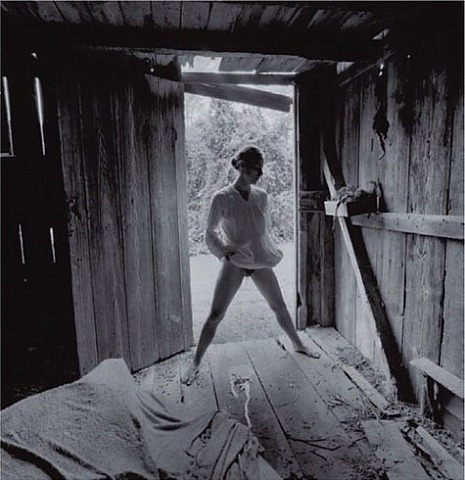
Emmet Gowin – Edith, Chincoteague, Virginia (1967)
From a macro perspective Gowin’s work—and excluding his travel/photojournalistic dabbling—features three distinct phases: the photos of his wife Edith and her family (early), the aerial landscapes (mid) and his more experimental work (recent)—which take Edith as subject once again and involving photos of her taken in Panama printed in experimental fashion on handmade paper produce a photograph/gram hybrid, i.e. this print of a photo of Edith including the outline and veins of a decaying leaf.
The more recent work is completely new to me despite being made almost 15 years ago. My initial thoughts are that it is understated and prescient in a way that would be completely unrecognizable as Gowin’s work if drastic reinvention weren’t Gowin’s exact bag.
After the early work, he took just about the most unexpected left turn imaginable and began to make aerial photos. As I recall, it was something he did just because that’s just what he did when something caught his interest—took pictures of what interested him. And while conceptually, I know that part of the consideration with the aerial photos was to contemplate at what point a the representation of a landscape tilted (on balance) over into abstraction.
The truth is the aerial stuff just isn’t very good (subjectively). It’s accepted because Gowin is an established name and the interrogative focus of the work is valid. But I just think that although he was—to the best of my knowledge—the first to contextualize these sort of photos in terms of fine art practice (and is therefore the progenitor), I’ve seen it done better–it’s not photography, it’s sculpture but Susan Hammond comes to mind, just off the top of my head.
I was actually thinking of Gowin due to a conversation I was having with a friend about the relationship between art making and audience, i.e. there is this balance between where your interests lead you and where your viewer or audience will follow you.
The prejudice is that great artists make work for themselves and therefore are attempting to converse with folks 100 years down the road instead of those in the hear and now. Except: that’s kind of elitist and untrue. I mean for all the intensely specific aesthetic considerations of the great Renaissance artists, there work was something that even someone completely uneducated in the ethos and techniques of mastery in various forms of visual representation, were still very much able to approach the work and get something out of it—whether identifying the characters in a Biblical story and associating them with famous wealthy patrons or just appreciating the way the artist envisioned the tableau.
The distance between the present and the future has grown exponentially more compact—the future isn’t 100 years away, it’s now measured in months and years at the outside.
Despite the surfeit of art makers, it’s difficult-to-impossible to make a living making art. More and more of us are working shitty cubicle jobs to keep a roof over our heads, clothes on our backs and food in our bellies. We work when we have the resources (infrequently) and hope for the best.
And I think that’s the lesson that Gowin has to teach us that is so important: I think if you see his model of producing work that attracts people to it, interspersed with deeply, personal, abstract and largely unapproachable work—there is a balance between the two.
I think that’s the most important lesson you can teach up-and-coming art makers: balancing personal passions with work that is universally accessible and empathetic. The dialectical exchange between the two efforts strengthens both immeasurably.


 Acetylene Eyes