I featured another of Zazirskas’ images in a post from almost exactly a year ago. (Incidentally: it’s probably the most popular OP in the history of this project.)
I’m still not over 100% on board with his work but I ran across this earlier in the week and I had a very strong reaction to it.
I’ll try to explain but in order to do that I do have to dissimulate–at least initially.
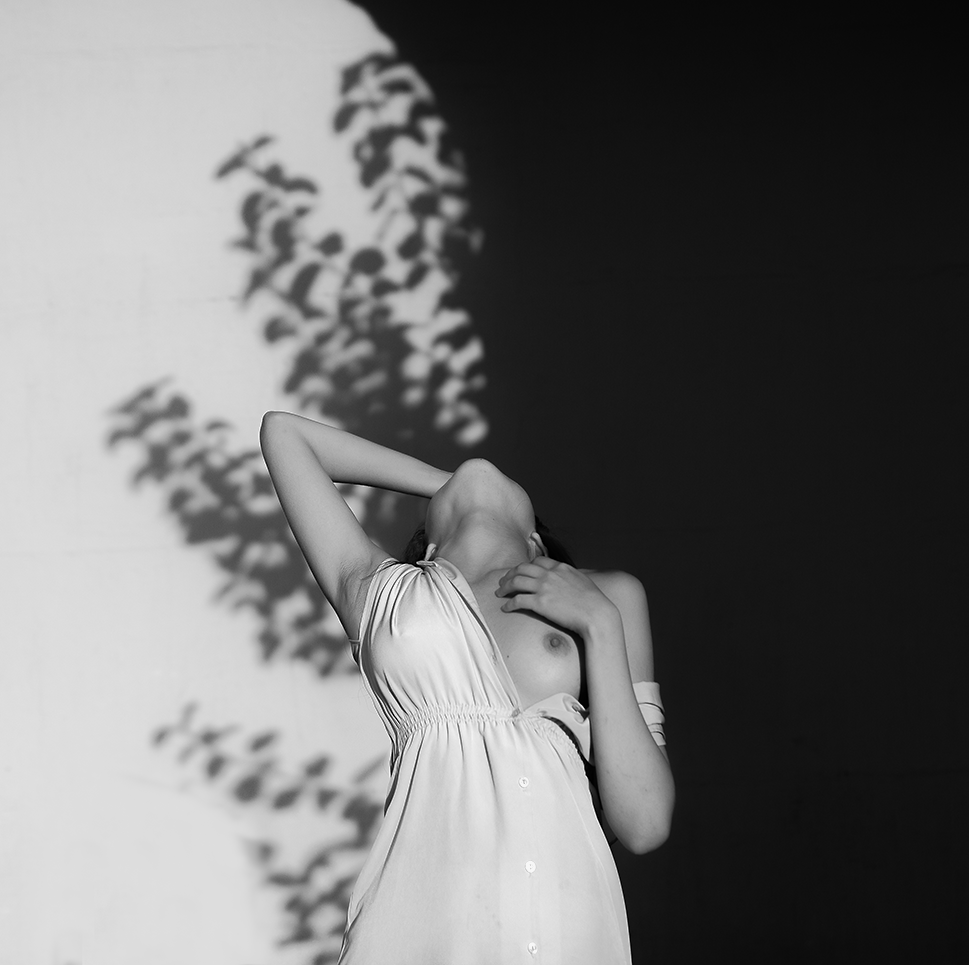
Nothing about this pose makes sense. You’re standing outside wearing a light dress. You bear your left breast while leaving the right covered touch your index and middle fingers to your collar bone while throwing your head back with the back of your palm seeming pressed against your forehead. Why?
The only thing that makes sense is that she’s trying to remain anonymous. As as much as I personally loathe images that decapitate the subject in order to preserve privacy–there is a fundamental contradiction between her pose and the mise en scene, i.e. she’s presented as being unaware of being observed but is also trying not to be seen while self-consciously revealing her breast; all with the background so carefully presented as to vertically bifurcate the frame.
That was my first reaction anyway. Running into it a year later, I’m almost willing to wager that this image is an extrapolation upon Fan Ho’s magnificent Approaching Shadow.
As far as an homage, it’s uneven. But if Zazirskas is actually spending time with Ho’s work then that would explain both my ambivalence about aspects of his work and the fact that I’m not exactly ready to dismiss it either.
Ho is a hell of a lot more formal and technically astute–however, I can’t suggest that it’s the wrong photographer given Zazirskas’ over style. The choice actually strikes me as thoroughly prescient.
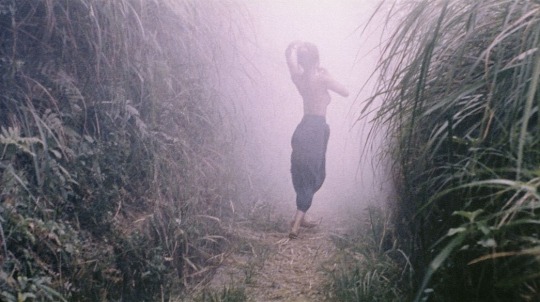
Fan Ho – [↑] Title unknown (19XX); [↓] Sichen Concubine (19XX)
I had never heard of Ho until he passed away in June of 2016.
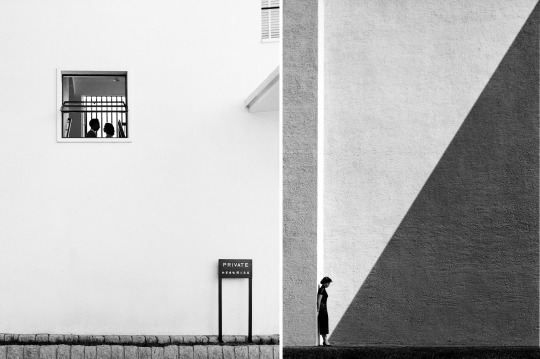
Above are his two most recognizable photos [left] Private (1960) and [right] Approaching Shadow (1954).
I could go on for the better part of the afternoon about all the little things which distinguish his work as simply effing extraordinary. However, for the sake of brevity–which they tell me is the soul of wit (perhaps they are implying I am witless)–I’m going to mention two things and before scooting along to my primary point of order.
First off, both of these photos have a similar quality to Vermeer’s best paintings. What I mean is when I look at a Vermeer canvas I have this tendency to forget that I’m standing in a crowded museum to an extent and I get this weird feeling that I’ve been strolling around Delft and while passing a window in the street, I catch a glimpse of this scene before me and I am frozen watching it; it always feels like at any moment the frozen people are going to resume whatever they were doing–and probably very soon after realize I’m staring out on the street staring at them through their window.
I feel that about these too. Like what are the man and the woman talking about in the stairwell. The location seems to suggest it’s a conversation they want privacy to conduct. (This is–of course–emphasized by the word private inscribed on the sign.) The wash of white on the exterior wall is almost perfectly identical in tonality through the entirety of the picture plain. (That is unbelievably difficult to accomplish in a traditional darkroom, y’all.) But the fact that the only shadow tones are at the base of the frame and through the window–there’s a sense that the conversation is a bit sordid. This is emphasized by the gender of the two conversants and is further tweaked by the way he stands over her and leans in toward her. The way the slats from the window in the background behind them physically separates him from her–so the sense of something potentially sinister is slightly diminished. We’re supposed to think that it’s probably a dicey situation but that she is safe.
In Approaching Shadow, there is a sense that the woman is experiencing a moment of quiet reverie and is unaware of how the world around her is drawing attention to her. (It’s worth mentioning that apparently Ho added the shadow via darkroom trickery–an easier feat than the white facade in Private but no less impressive in its execution.) When I’m looking at this one I figure if I just watch her long enough the shadow will move and she will eventually walk away. (Interestingly with this one I do wander how the shadow will move–will it cover her or creep slowing away from her; also, which way will she walk away–left, right or towards the viewer.)
The second thing I want to point out is that virtually all of Ho’s work features vertically oriented composition none of it is #skinnyframebullshit.
Interestingly, Ho was not only an acclaimed photographer. He was also a notable filmmaker. (As someone who came to photography via studying filmmaking, this is probably yet another reason why his work resonates so much with me.)
Bonus thing: he considered himself a street photographer but I suspect he meant that less in the sense of Henry Cartier-Bresson or Garry Winogrand and more in line with Atget.
Anyway, the above color photos are interesting because Ho worked almost exclusively in B&W. There is some color work available–most slide film from the look of it, that despite having chunky, ungainly grain, demonstrates a sensitivity for color and light that is truly rare to encounter.
Of the two photos, the bottom one is definitely Ho’s work. The top one–although originally posted by someone who is generally very careful when it comes to attributing work to the correct artists and also appearing to be shot on positive stock–could be Ho’s work but also it seems a bit too modern for me to comfortably state that it is his.
If it is, I would be incredibly interested in knowing if there’s more work that he did in this less street photographic style, more off-the-cuff manner.

 Acetylene Eyes