Source unknown – Title unknown (20XX)

Writing for this project, I frequently feel like my primary form of interacting with images is a this-isn’t-a-good-photo/image-but…

I mean beyond my generalized feeling that I am a bit of a broken record sometimes, this this is something about which I’m always very self-conscious.

But…

I mean I think one of the disservices we do in teaching photography (or, hell, more broadly any creative discipline) is that there’s a laser-like focus on the canonical.

It’s not that I don’t think that shit is important. It absolutely is–indispensable, in fact.

But…

It’s all sort of incestuous–in a biblical sense: the genealogies of influence flow in a clear, unbroken fashion back through history. It’s clean and full-up-to-the-gills with masterpieces of unadulterated genius.

So what’s the downside? I mean if one is trying to learn, the presumption is that one wants to learn from the best. Unfortunately, in my experience this has a limiting effect in a number of ways. If I study only greatness and my own work isn’t great (yet) then I either to be a total asshole narcissist or suffer from a certain degree of oblivion. (After all, when comparing your work with canonical masterpieces, your work begins at a stupendous disadvantage. And that disadvantage can cause you to lean on the work that’s already been done (I know so many emerging artists who view certain artists in such an uncritical light, that it’s almost as if their relationship with the work is less hippie looking to expand their mind and more blasted addict chasing the next crest.)

Truthfully, I’ve learned just as much from perusing shitty work as I have from obsessing over the greats. And it’s for that reason that I think every serious photographer should make a point to critically interrogate bad work in the same fashion they do good work.

I mean the above is not a good image. It’s been blown up far beyond the point of disintegration. It’s blotchy and ugly. Yet, even if I knew where it originated, the original is probably not that much better. Unless you’re going to go to the trouble of setting up highly precise, orchestrated lighting–or you’re one of those lucky shits with a bathroom that has a window (and therefore: some natural light)–then the light is going to look like shite.

Despite looking awful, this does do a number of things extraordinarily well. First, according to the letter of Instagram law, this is an image that is Instagram safe. (Though, I’ll admit it would probably be taken down.)

Whether or not the intention of the author was such is immaterial–and given how bad the image is, it’s unlikely that the motivations approached anything like I am about to suggest: but it doesn’t matter because if the images reads a particular way, it reads a particular way.

It reminds me of the line teachers always used to throw around to my classmates about dressing in a fashion to leave something to the imagination. the idea was you’ll be more attractive/alluring if you show off less instead of more. (The creepy implication being that how you dress is an open invitation for others to imagine things about your body.)

The same mentality is frequently utilized in distinguishing porn from erotica and erotica from art. Porn tends to leave little to the imagination; whereas erotica is somewhere closer to the middle and art allows for the assumption of chastity.

For the record, I’ve always instinctively objected to this framework. I think it’s all a great deal more muddy (and therefore more interesting) than that.

But there is something in the whole admonition to leave something to the imagination that does actually inform as to the essential nature of pornography: it’s like they teach you in Writing for the Screen 101–unless you can see it on the screen, it doesn’t go into the script.

This relates to the ‘visual’ nature of the ejaculatory orgasm (and why most porn centers around male arousal and sating)–it’s visibly demonstrable. (Here we run into the inverse of my previous argument that art students should study shitty images, pornographers should study art history, as well: because you can actually depict non-male ecstasy.)

(As a tangential note although I can’t find them now: there are a handful of popular tumblr porn gifs that I do think are exceptions to this notion: despite being close-ups–which I’m not especially fond of–they focus on the pulsing muscular contractions associated with orgasm. In one, a hand stimulates the clitoris of an Asian woman. She audibly squeals as her anus and perineum spasms. In others, ejaculatory contractions can be seen at the case of the erection.)

Now–lest anyone forgets–this isn’t a good picture but the decision to present it in such a way that it is both entirely clear what she is doing but the viewer is not afforded an unobstructed view of the typical erogenous zones. Also, the fact that we don’t do the coded porn thing of zooming in on the woman’s oh-face (a la Albert Pocej’s staid Orgasm series) and instead are presented with the tableau sans access to erogenous zones and within context, this scene is decidedly about female masturbation via orgasm.

In other words, there’s no way the viewers can make this about themselves. Unless they think that perhaps she is fantasizing about them–which is, in itself, radical as to do so demands the recognition that she is not an object and has her own individual agency, volition and inner life (to which the viewer has no immediate access.)

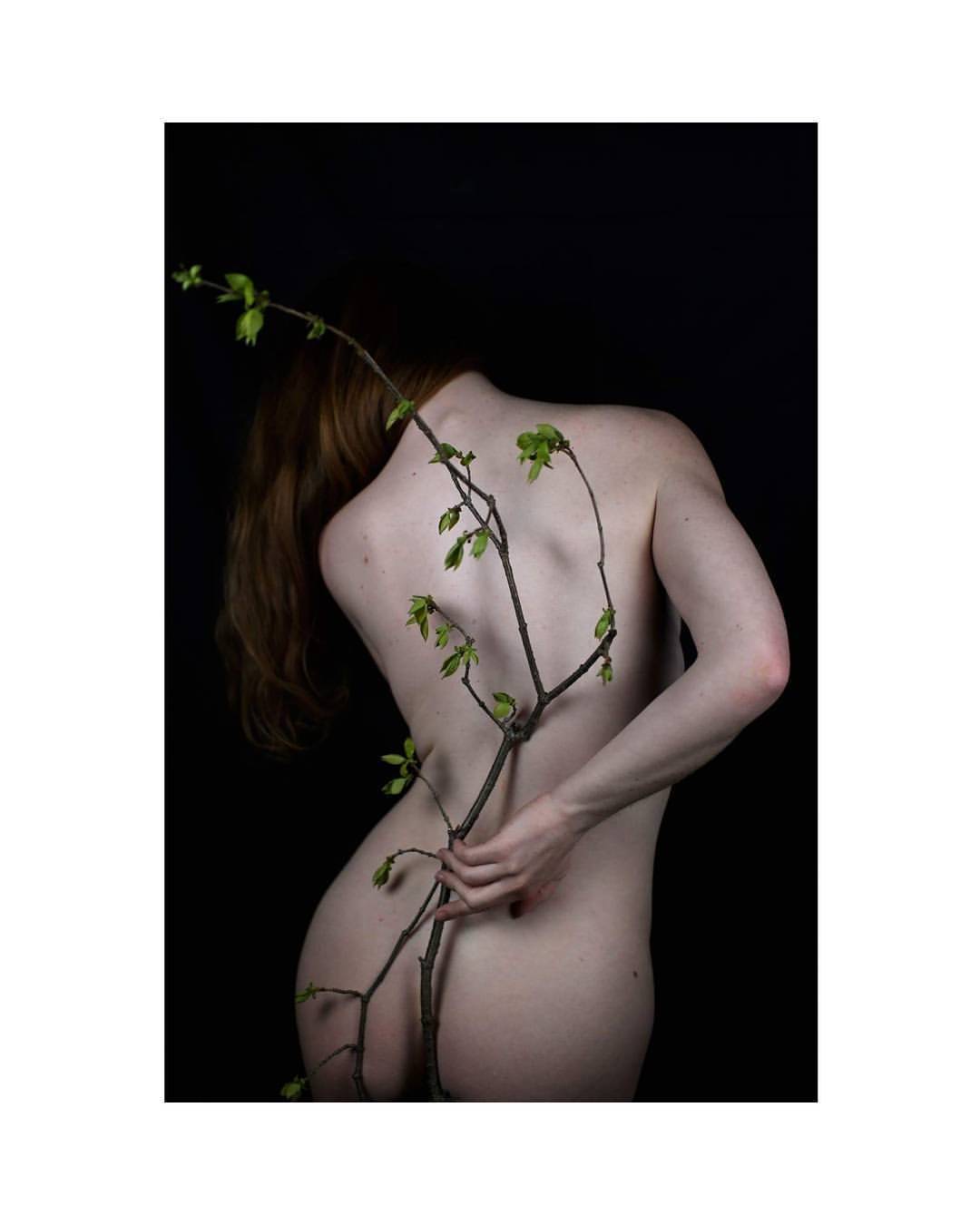
Donatas ZazirskasUntitled (2016)

It occurs to me that one of the things which hinders the teaching/creation of art is placing too much of an emphasis on originality.

I am honestly not sure where I personally fall on the whole spectrum of innovation is still possible vs it’s all already been done; however, I do know that focusing on whether or not something is original is just about the quickest death that the momentum of doing can die.

Consider Zazirskas–who favors either highly, manicured, even lighting design which restricts most of the tonal range in his scenes to Zones IV through X (a la this, also this) or a darker, moodier chiaroscuro where there’s very bright light, truncated mid-tones and very dark portions of the frame (as above).

Unfortunately, his work rarely fires on all cylinders. (And I do not mean for that to be a dismissal; I think he just needs to keep working, pick one tendencies and explore it instead of trying to embrace and enact three very different approaches to scene setting.

I don’t think this is an especially original picture. It trades in the same fierce backlighting that folks like Paul Barbera have expanded into a wistfully sensual, visual nostalgia kick-to-the-head. There’s also similarities to Hannes Caspar and STOTYM–less stylistic more in tone and content, respectively.

Point is: what interests me about this is the equivocation in Zazirskas’ handling of poses and gesture. His most technically astute image (here) is too tied to a rigidity of conceptualization, i.e. the subject’s reflect vs her poses that the rest of the image–no matter how interesting the setting, details or color (I mean god that eggshell blue is to die for)–the frame hanges loosely around the insistence on a pose that doesn’t work.

Yet, with the image above all the elements–the composition, the lighting, the floor, chair and board behind the chair with faces cut from magazines and glued to it presumably, all gathers to suggest a fluid unity of concept and execution.

Back to my point about originality, though: all the photographers/image makers I’ve linked with Zazirskas are all folks whose work I think is more prescient and refined. The thing that distinguishes Zazirskas, however, is the fact that he is very much not doing fly-on-the-wall work like the others.

The angle of the model’s left leg in this is actually both demurely shielding while also being a provocation–exercising agency over what is seen and what remains discreet while complimenting the lighting (the darker portions of the outside of her left leg contrasting with the hot spots on the outside of her right thigh).

For as much as I like the other work, I feel like this is at least more honest with itself about what it’s essential nature is. That’s rather something, actually.

Sam CoxMiss Mac (2017)

A bit of a disclaimer to start off with: Cox’s work is FAR more hardcore than I’d normally showcase.

That being said: although his work is over-the-top as far as raunchiness goes, he is innovative.

As a rule, I am dismissive of TTL metered flash-driven, ultra-contrastiness (regardless of whether it’s color, a la Ren Hang, or B&W).

Cox, however, does use it consistently to facilitate a disarming immediacy. For example, I have mixed feelings about the framing here. On the one hand, I can’t really accuse it of the usual dismemberment although there’s very clearly no sense of extension beyond the borders of the frame. The orientation of the image, very clearly implies that although we don’t fully see the handstand’s foundation, it is clearly supporting Miss Mac’s full weight. Conversely, I do appreciate the sense of hurry up and get the shot because this is an ephemeral moment. (That’s another thing for which Cox does have quite the knack.)

What I love the most about this is the way the flash casts a shadow that–in turn–creates a sense of increasing separation between Miss Mac and the wall against which she’s bracing her feet–it’s exquisite.

Rimel NeffatiTitle unknown (201X)

Death, The Last Visit
Marie Howe

Hearing a low growl in your throat, you’ll know that it’s started.
It has nothing to ask you. It has only something to say, and
it will speak in your own tongue.

Locking its arms around you, it will hold you as long
as you ever wanted.
Only this time it will be long enough. It will not let go.
Burying your face in its dark shoulder, you’ll smell mud and hair
and water.

You’ll taste your mother’s sour nipple, your favorite salty cock
and swallow a word you thought you’d spit out once and be done with.
Through half-closed eyes you’ll see that its shadow looks like yours,

a perfect fit. You could weep with gratefulness. It will take you
as you like it best, hard and fast as a slap across your face,
or so sweet and slow you’ll scream give it to me give it to me
until it does.

Nothing will ever reach this deep. Nothing will ever clench this hard.
At last (the little girls are clapping, shouting) someone has pulled
the drawstring of your gym bag closed enough and tight. At last

someone has knotted the lace of your shoe so it won’t ever
come undone.
Even as you turn into it, even as you begin to feel yourself stop,
you’ll whistle with amazement between your residual teeth oh jesus

oh sweetheart, oh holy mother, nothing nothing nothing ever felt
this good.

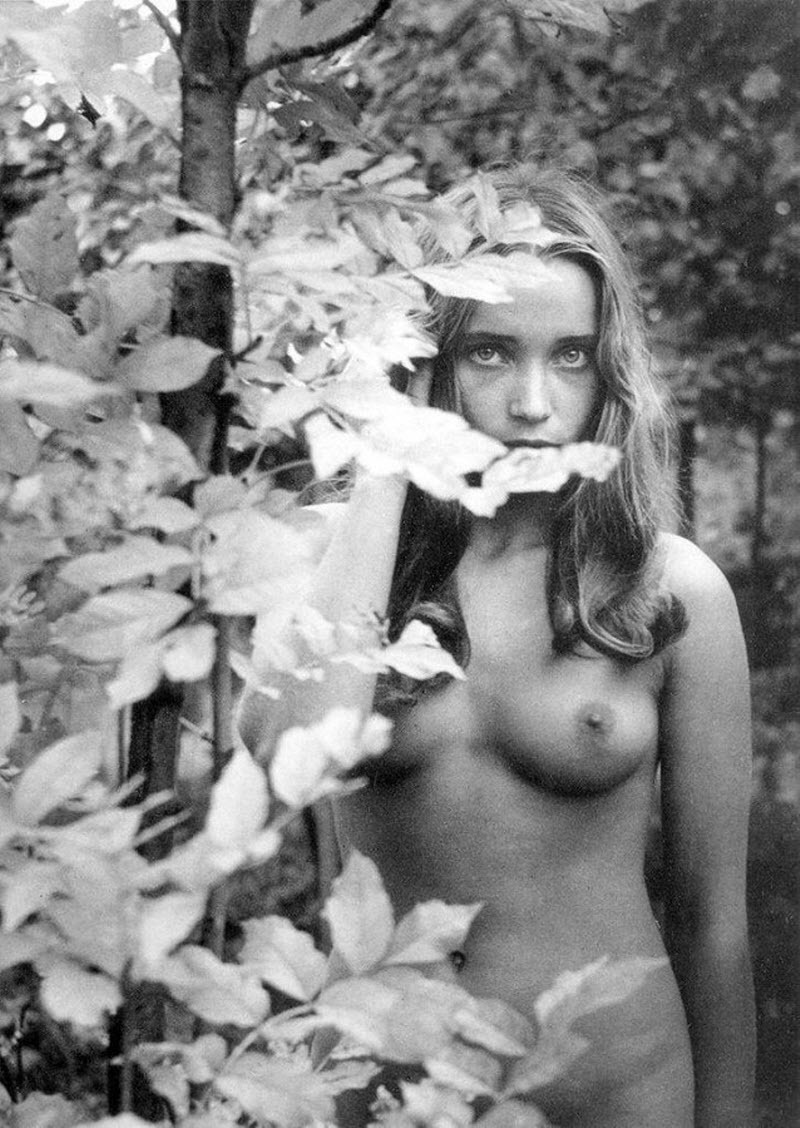
Rimantas DichavičiusUntitled from Žiedai tarp žiedų (1965-1989)

All of Dichavičius‘ work that I’ve encountered feature female nudes in nature (in fields of tall grass, walking along the shore of some eastern European lack or amidst sandy shoals and dunes).

The subjects of his images seem more like mythical nymphs than women–he likes wildly, disarrayed settings where grass, leaves and even cascading hair serves to both veil the subject and make them recede slightly, as if each belongs to the landscape more than the viewer.

Additionally, he preferences extremes of contrast–prejudicing tones at the edge of over-exposure and at the point where details in the shadows begin to flag to more measured/even tonality.

Along with his frequently surreal flattening of space and his efforts to skew perspective through composition tricks contribute an extra layer of surreal feeling to his scenes.

The work I’ve seen is all a bit too one note for me. But I’ve admittedly not seen more than the scant offerings available online. And really, the above image is thoroughly exceptional–not in that it’s far more concrete than a lot of his work.

(Further, I can’t help but feeling that this photo is likely an effort to imagine what the photo Imogen Cunningham might have taken of Twinka in Judy Dater’s reknowned photo if the photo had been an actual random encounter instead of a staged happening.)

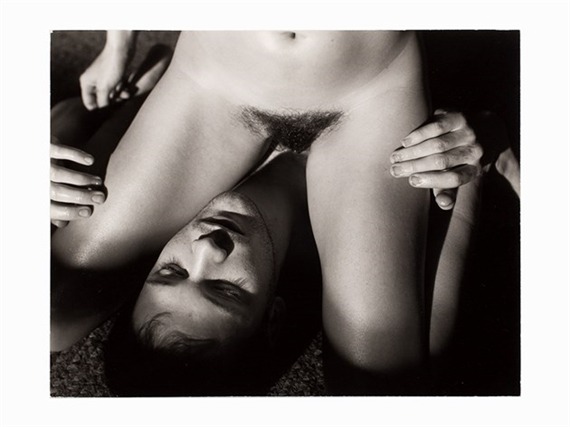
Malerie MarderUntitled from Carnal Knowledge series (1998)

I’ve wanted to post this for at least a year–but have not be able to track down anything larger than a teeny-tiny thumbnail. (I have complicated feelings about Marder’s work; over all I lean toward the fan person end of the spectrum.

Now that I can post it… I just don’t have any thoughts on it. I mean I love the direct sunlight, the way it makes the skin shine. I love the way you could likely distinguish shadow detail to a degree that would allow you to distinguish individual strands of pubic hair around the edges of the bush–but things go dark and become solid away from the edges (almost like a vague nod to something not unlike modesty, in spite of the explicit nature of the image).

I love how the low angled light stains the boys cheeks with the shadow of his lashes. The way he’s meeting his partners eyes even if the viewer can’t see them. The gentleness with the way he’s touching her things with his fingertips.

Still: looking at this I have trouble feeling the usual resonate rush of vicarious anticipation that I usually do when I spend time with it. I know why I feel this way: my fortunes have shifted rather drastically over the last year. I’m definitely in a better place than I have been but I’m a long way from OK.

And honestly, as much as the feeling of this image has always been something that motivates hope for future physical intimacy with folks I care about–that is something that it’s becoming increasingly clear is not in the cards for me. So while I love this and want to share it with you and hope you can feel something towards it that I don’t seem to be able to muster any more.

Source unknown – Nacho Vidal & Kristina Rose (2015)

This position is apparently called The Amazon. SWOON.

This gif? As much as I’m always harping about #skinnyframebullshit, I will admit there’s room to argue w/r/t still photographs/images. There’s not when it comes to video–go horizontal or stay your ass home.

Also, I had not seen the scene this is from before deciding to post it. I have subsequently seen enough of the video to know that it’s both too extreme, sexist and seemingly unconcerned with consent to be something I’m ever going to be into. Still, I do think this is gif is sexy af and the segment of the larger clip it’s from is slightly less obnoxious than the rest of the video.

Source unknown – Title unknown (201X)

I have no idea where these images originated and that’s truly unfortunate. They’re hardly flawless–the poses are a bit too marked by self-conscious contrivance; however, they do feature carefully coordinated lighting design, a clear sense of purpose and although perhaps not intentional: there’s a sense of reflexive connection between content and context (i.e. the incisive sense of well-worn procedure in tandem with the carefully considered attention to detail).

It’s possible I’m projecting my own OCD tendencies onto this photo set. I’m very much a creature of habit. I’m very predictable and if someone knows my schedule, you can predict where I’ll be and what I’ll be doing with 100% accuracy give or take a seven or so minute deviation on either side.

I’ve always been like this. It’s part of how I’ve learned to survive in the desert of the real. There’s comfort in knowing the train arrives at this time and takes this long to get me where I’m going. Any delays, deviations, etc. cause me intense stress.

I get agitated when folks with a hippy bent preach new age/Buddhist mindfulness at me. It’s like my default setting is what such folks actively pursue. I’m constantly trying to be less aware of every goddamn little piece of sensory input screaming for a piece of my immediate focus.

What’s ironic to me is that my all this rigorously circumscribed need for order, predictability and certainty is less about iron fisted control. It’s like that Baudelaire quip about remaining boring, ordered and dull in life so that you may be exceedingly violent and unpredictable in your creative work.

The regimentation I cultivate in my own life is really a means to an end. To return to the metaphor of trains–with their timetables and presumed correlation to said timetables–it’s almost always the days where I’m merely going through the motions out of habit, and am following a particular thought that takes an unexpected turn that captivates me. I’ll completely forget that I’m on a train and end up four or five stops beyond where I meant to disembark. (As much as I crave order and hate when things go awry, I never mind these lapses. What they offer in insight is more than equal to the resulting frustrations of missing my stop and running late to appointments.)

What does this introspective speculation have to do with anything? Well, I think my need for predictable rituals as a defense against the mundaneness of daily exigencies is an itch that I don’t usually feel gets scratched by explicit depictions of sexual expression. Except these images appeal (a great deal, actually) to the order seeking side of my brain.

And I can’t help but think how aspects of my own sexual expression are similarly circumscribed. As an adolescent, masturbation was highly ritualized for me. (I’m not sure if it’s the OCD tendencies or being raised super religious… I think I could also point to my druggy years with all that focus on set and setting.)

It reminds me of something my friend Amandine said to me about attraction. Trying to seduce someone by making them want you is the wrong course of action. Instead it’s better to make them feel comfortable sharing time and space with you.

That’s the other thing about this that appeals to me. So much pornography hinges on a sort of heteronormative checklist of activities being ticked in a proscribed order. It’s about showcasing particular information–without any sort of consideration as to why this information as opposed to that information. In other words, matters of inclusion vs. exclusion are dictated by notions of what will appeal to the broadest set of viewers possible.

I’m much more interested in things that interrogate why something is being showcased over any number of other things. And these images have a strong feeling of what I’m being showed are not just things that turn the author on, there’s a great deal of effort put into presenting those things as a series of decisive moments in an erotic progression.

So yes, the attention to detail in the set design and lighting orchestration speak to creating a sense of context. The presentation of decisive moments fosters a sense of documentary objectivity. (This isn’t exactly well-managed from the point of the subjects–whose poses seem self-consciously contrived.) But it does seem to be about creating a comfortable space as a starting point and emphasizing concrete ritual procedure in a carefully considered fashion. And that feels honest and affirming of my own experience in a way that porn never really offers me.

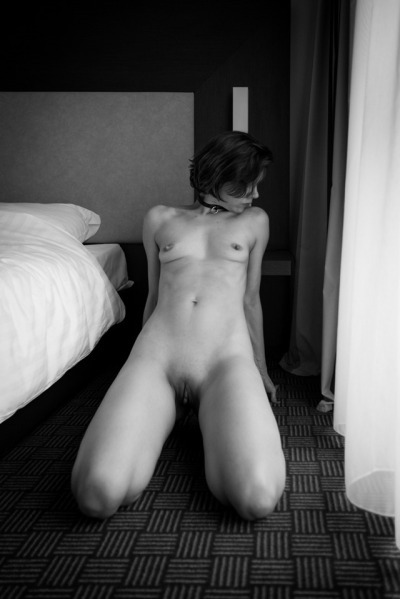
PeterVRSoleilaberlin, Bonn (2017)

I’m not at all fond of vertical orientation in photography/image making–I refer to it with the pejorative #skinnyframebullshit.

This isn’t #skinnyframebullshit. Why not?

My frustration with portrait orientation in photography/image making was born of the same thing that makes me distrust zoom lenses–i.e. the place an emphasis on results over process.

Instead of standing in one place and adjusting the focal length of the lens to provide an angle of view that allows you to convey the information you select to the viewer. It fosters a first idea, best idea approach that I think when deeply ingrained too early on becomes a huge stumbling block further down the road.

But my bias is definitely in favor or work that is more studied and/or contemplative.

Of course, at the end of the day the only question that matters is did you or didn’t you get the shot? A vital shot that is legible–will depending upon the urgency of the moment–work despite failings in visual grammar.

After a decade of looking at student work and working with novice photographers and image makers, I can say that in my experience–unless the photographer/image maker is working within the confines of the architectural genre, a vertical oriented frame is almost always self-conscious, affected and logically incongruous when considered within the context the scenes it depicts. (I’ve actually had a half dozen people tell me that the reason the chose the vertical composition was because they felt more like a photographer when they took it–which is one of the most idiotic things I’ve ever heard.)

The saying goes: you have to know the rules before you break them. Yet, by the same token: there are exceptions which prove the rule.

Intermediate practitioners love to take me to task about my strenuous objections to #skinnyframebullshit. (There are at least two internet famous photographers who disagree with me vociferously–in one case the photographer seems to have specifically built a body of work in an effort to flout my assertion. I find it ironic that this insistence is actually very much to the detriment of what would otherwise be better than average photos.)

In my own work–there have been instances where I have employed a vertical frame. I only use it as an absolutely last resort. And frequently I find a way to do it wherein the resulting image will be presented as if it were original conceived and executed as a horizontal frame.

This is partly because I am interested in more narrative or cinematic photos/images. And if you are intended to make a narrative photo/image and you frame it vertically, you’ve already missed the bus.

Another excuse I hear a lot is that the framing echoes the relationship of the subject to the space the subject occupies. This is actually dumber than the but I feel like a photographer/image maker because I tilted my camera on its side while taking a picture. Almost categorically, people who use this reasoning do so because they like the age old trick of making already skinny women look thinner through the imposition of a vertical frame. Or, they do it because they are shooting in an unphotogenic space and want to through shallow depth of field and careful staging draw attention to the subject while merely implying things about the physical space (i.e. it’s an interior with a brightly lit window.) :::masturbatory gesture:::

Most folks don’t stick around long enough to advance beyond the intermediate level. Also the gap separating a novice from an intermediate is much less than that which separates the intermediate practitioner from the advanced.

At a certain point you have to realize that the rules only apply to the well-traveled paths. They are there to keep you safe. But when you find your passion and chase it off the well-beaten path, the same rules deteriorate, clutch up and cease to offer their assistance. You begin to make your own. (And the way you’ll know whether or not someone is at that level, the ones who deny they’ve reached there are always more trust worthy than those who insist they know better.)

So why does this image work? I mean am I not contradicting myself because the framing so clearly echoes the position of the subject in space that is depicted. Well, yes. But also, not how the frame functions as an ellipses. The grading toward black at the top and bottom of the frame presents an impermeable boundary. Whereas the white on either side (bed and curtains, respectively) speak to space beyond the left and right edge that has been purposes excluded due to repetition. In other words, by seeing what we do of the bed and the curtain, we are able to extend the frame out in either side in our mind’s eye.

Anything that manages to include and engage you in the process of perceiving is a victory. But that fact is while being invited to participate is invigorating, a horizontal frame here would actually be boring. Too much white and not enough black would give it a oneirically suffused look; whereas because of our participation this seems edgy, voyeuristic and even lonely.

I’m not super familiar with all of PeterVR’s work but looking back over some of his recent stuff, he actually does a really good job of knowing when to use vertical frames. So if you’re interested, you should definitely spend some time with his work.