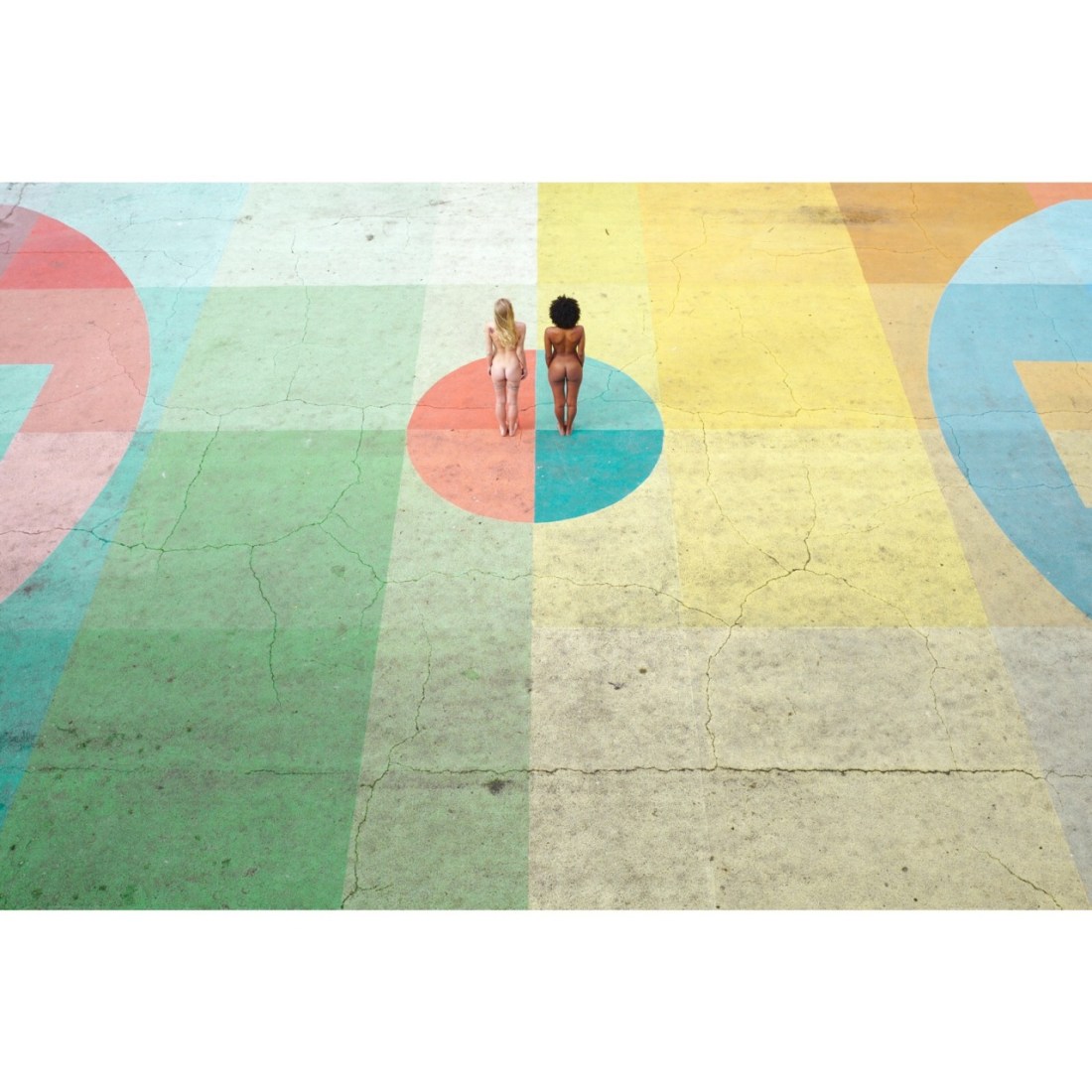
Andrea Mete – Untitled (2015)




wonderlust photoworks in collaboration with @marissalynnla – [↑] Tenebristic Curatrix; [↖] _.._; [↗] Against a Tide of Tyrants; [↙] Liminal Interval; [↘] Tightened with a Pin; [↓] Eigenstate (2017)
Back when I was first dipping my toes into the shadowy fjords of photography, I was a ridiculously squeeing fangirl when it came to work produced by Houston neighbors Traci Matlock and Ashley MacLean.
I utterly adored the ambiguity their work faciliated–mid-way between out-and-out eroticism and unblinking, it-is-what-it-is matter-of-factness.
I’d been following their work for the better part of a year before I learned how they worked; namely, when Traci made a photo of Ashley, Ashley was given the first editing pass. Allowing the subject of the photo a thumbs up/thumbs down first look–a means of allowing the person in the photo a very real degree of agency in how their visual identity was presented.
This process has become integral to my own work. With whomever I collaborate, I always offer them first look rights.
One of the interesting things about these images was that–without prompting–Marissa zeroed in on the all the same photos by which I was already captivated. (I’m telling y’all she’s not just a first rate model, she’s also a damn fine artist.)
The other interesting thing was that between shooting more frequently and being able to work in B&W in my preferred manner, it feels like my work is actually gathering something not unlike forward momentum.
Now if I can just find more folks who want to collaborate…




Chad Moore – [↑] Emma {pool} from the Bridge of Sighs series (2016); [←] Mollie & Ajax from Love is on the Dance Floor series (201X); [+] Ali {hickey} from Put the Book Back on the Shelf series (201X); [→] Untitled from Julia Montauk Hwy series (2016); [↓] Amy {sex} from I Studied You in History series (2014)
OK, so Chad Moore=my most recent photographer crush.
He cites Richard Avedon, Guy Bourdin and Nan Goldin as influences.
Those are all valid, even precocious influences. But there’s a couple things I’d like to point out: he gets closer to his subjects that Avedon, his palates are more naturalistic than Boudrin (skewing more towards the tonal or atmospheric a la infamous cinematographer Christopher Doyle) and while Goldin was also ostensibly interested in documenting counter culture–her impetus was more journalistic and driven by an existential imperative (seeing as proof of life, a document of that seeing as an ersatz memory established against the sting of time, the encroachment of death, a monument against the erosion of memory by seeking oblivion in any effort to feel a little bit alive again)–while his motivation seems more preciously nostalgic.
He apparently raced BMX bikes competitively as a teenager and between shooting fellow riders and people and places in his travels (with disposable cameras). In that way, he reminds me of Ryan McGinley. (Except his use of color is, unlike McGinley: more holistic; also: as much as Moore likes to refers to his work as that of a fly-on-the-wall perspective, he also dodges much of the criticism leveled–rightly–against McGinley with regard to fetishizing youth and beauty. His images inspire an emotional buy-in on the part of the viewer that can only happen if the photographer has invested in the proceedings with similar stakes.
Lastly, his color profiles are hugely reminiscent of Igor Mukhin’s exploration of transgressive youth culture in Russia.
I’m not accustomed to work this accomplished and nuanced with regards to interpersonal sensitivity from someone so bloody young. It’s damn impressive.
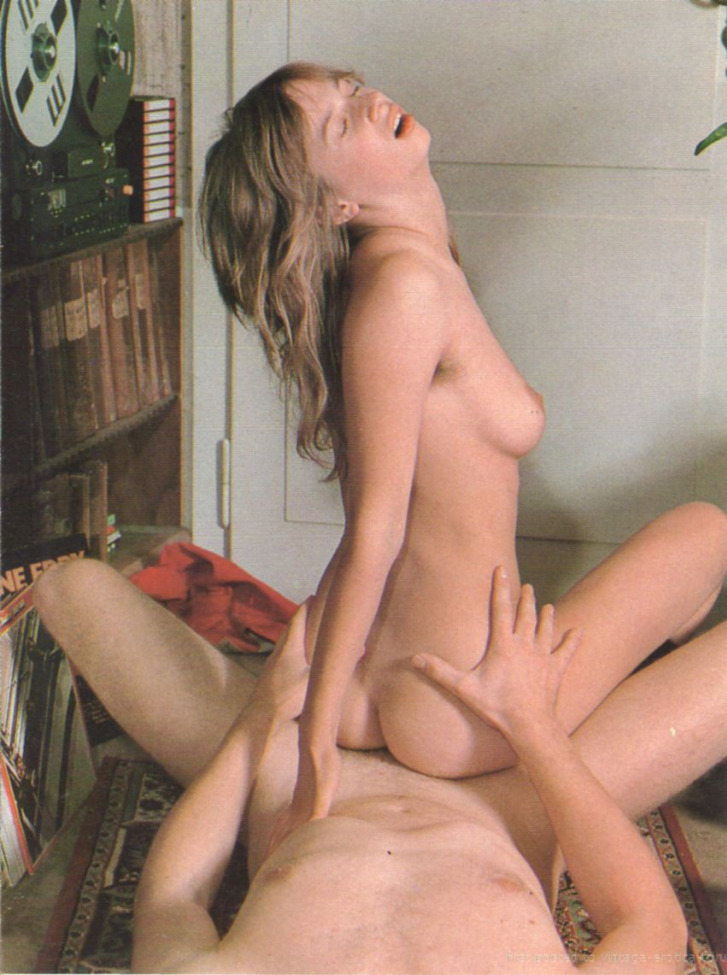
Teenager in action – Machen wir es mit Musik (1982)
Every once in a while I see a configuration of bodies in porn that strikes me as especially visually dynamic. This is one such example.
I’m not wild about the rest of it but the pose is nice. And it gets me brain spinning up about the tension between explication and implication, esp. in porn.
I mean this would be more visually arresting with more varied, naturalistic lighting. The dead white door as backdrop is a total non-starter.
But even as great as the position is, I kind of wonder if it wouldn’t be better if her right hand was braced against his chest with her fingers splayed. If it was in the center of his chest, then it would block the line of sight with the cleft of her backside (which is something a pornographer would feel was important visual information to include in the picture). On the other hand, it would almost certainly be more implicitly intriguing if her hand were pressed against his chest over his heart and she was squeezing her right nipple between the thumb and forefinger of her left hand.
Also: (and this is being super OCD about things) seeing her left leg at least enough of a hint of it to suggest it’s position would contribute something as well. There are two strategies that could be applied to allow for that. Her left knee could be brought up just enough to replicate the V of his thighs. Or, she could fully straddle his right thigh. This latter option would be more compelling from the standpoint of dimensionality–however, it would also further complicate the positioning of the hands.
Anyway, the above picture comes from @musorka‘s blog. And I’ve said it before but it bears repeating. The sheer quantity of work posted over there on the daily is mind-boggling to me. The quality isn’t always there but there are definitely some real gems mixed in with all the dreck. (And remember, engaging with the dreck isn’t without value. Thinking about what works, what doesn’t and what you would do differently if given the chance is actually a valuable exercise for your creative brain. After all, invariably when you’re making something you get to a point where you feel like you’ve screwed it all up and you have to find a way to keep going and to fix it.)

Source unknown – Title unknown (19XX)
I’m not 100% sure the framing works here–both his legs and here right shin are amputated in awkward places. While there is very much a sense of context–i.e. a boudoir, there’s a flatness to the print that does no one any favors.
On the plus side: I’ve never seen the above position enacted in porn prior to viewing this–it’s rather charming; emphasizing giving over receiving and I simply adore they way their lazily holding hands and caressing each other.
Also, that Cheshire smile she’s wearing would’ve been enough on its own to convince me to post this.

Alessandro Ruiz – Untitled (201X)
I think spending approximately 25 hours a week keeping this blog running has perhaps warped my brain to a greater or lesser extent–you know kind of like that joke Bill Murray tells in What About Bob?
Bob Wiley:
[telling a joke]
The doctor draws two circles and says “What do you see?” the guy says “Sex.”[everybody laughs]
Bob Wiley:
Wait a minute, I haven’t even told the joke yet! So the doctor draws
trees, “What do you see?” the guy says “sex”. The doctor draws a car,
owl, “Sex, sex, sex”. The doctor says to him “You are obsessed with
sex”, he replies “Well you’re the one drawing all the dirty pictures!”
Like I can’t tell you how many times I’ll be looking at something and be like wait, is that what I think it is? (It almost never is what I’m thinking, unless I’m on Tumblr and then it’s usually worse than I thought it was.)
Like with the mussed hair and pose and position of the hand above, there’s something both suggestive of masturbation and self-conscious demurring. (I can’t ascertain if Ruiz continues to have a web presence outside Model Mayhem but his work suggests that either of these readings–at a minimum–fit his works’ comportment towards eroticism.
If I were feeling pedantic I might draw a comparison between Ruiz and Erotobot–the latter is technically the superior image maker in sum but it’s a question of carefully considered composition vs. visceral immediacy. (I prefer both in tandem but since you rarely find that, I tend to favor the latter over the former.)
But while I don’t agree with the composition of this image–I do like her against the dense black background, I’d just have framed it wider than this. It did actually make me question something; namely: the notion of demureness as it pertains to social expectations placed upon women.
I’m thinking here about the religious notion I was raised with wherein the body/flesh is the locus of sin and therefore the genesis point of shame. I mean as far back as The Creation myth we see that Eve is tempted by the snake, she in turn tempts Adam and then they realize they are naked and try to cover themselves.
And it occurs to me that in the art historical, phalleocentric history of art there is a tendency to conflate a post-orgasmic languor in much the same fashion as what is the expected behavior of the properly demure.
I’m also curious as to the restraint in this image with regards to graphically explicit presentation vis-a-vis the rest of the work.
Not sure if pressed I could prove this thesis but it’s what I’m thinking about at the moment, fwiw.
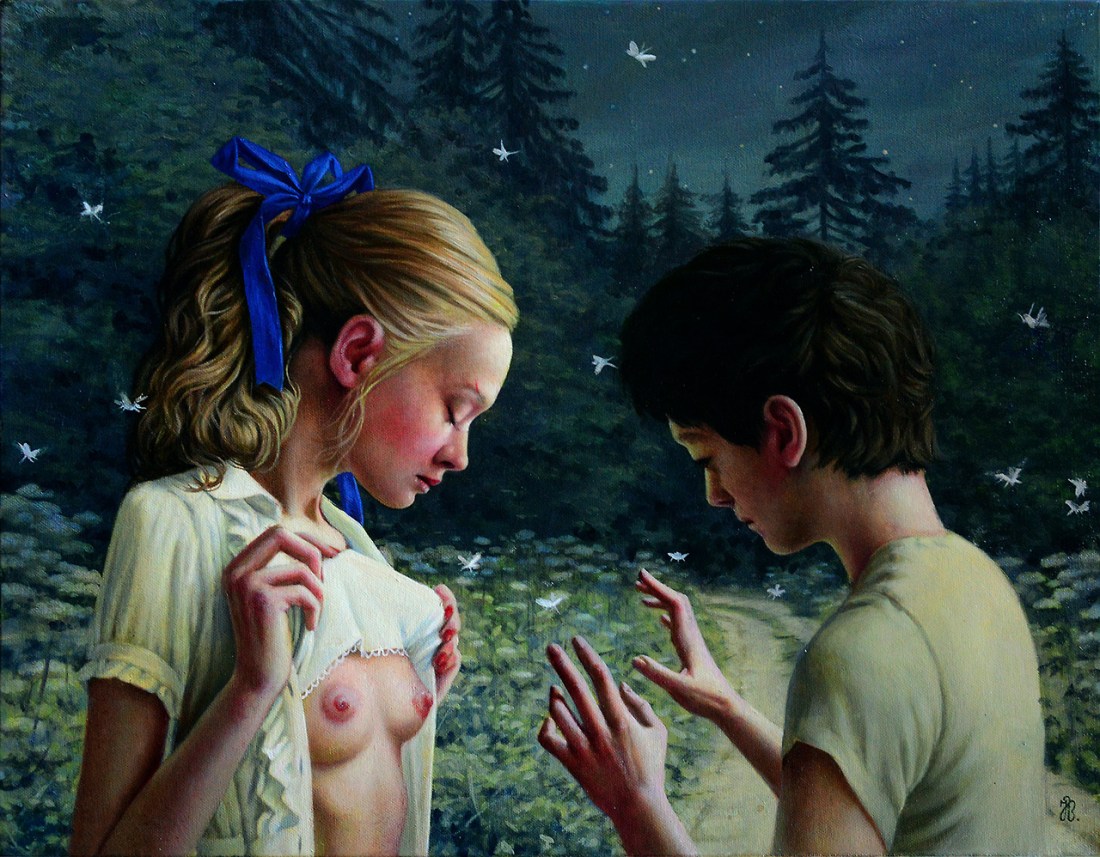
Jana Brike – first love on the edge of a deep dark forest from Anatomy of Innoncence series (2015)
This is not Brike’s best painting but it resonates with me more intensely than the rest.
In overview, Brike’s is a painter. Her work features pubescent characters with oversized heads–presumably to draw even more attention to her grasp for conveying uncanny nuance of expression.
The duality of innocence and curiosity is her conceptual prima materia. Her scenes often play out in or near bodies of water–i.e. Two Wound Angels on the Beach and Goldilock’s Holiday.
She trades in a number of thinly veiled tropes–masturbation (Gardener and the Centre of the Universe), sensuality (goodbye, Eden, Snow White and when I kissed the teacher), lesbian experimentation (anatomy lesson) and tangentially the girl-girl solidarity that is at once not sisterly, platonic or romantic but is simultaneously each of those things all at once (holiday at grandma’s place).
It’s also worth noting that while she’s always preoccupied with the first flush of physical lust, the occasionally presents it in very concrete ways. There’s an honesty to the diptych little miss sweetheart/gardener’s son that is the most concrete and unassuming depictions of nascent paraphilia this side of the girl with chapped lips from Tarkovsky’s Mirror.
A lot of her work appeals to me for these reasons. But the image I’ve chosen to post here does two things better than I think all the rest of her work combined. Too often, female sexuality potential is painted as an incitement for male sexual arousal. It’s a very heteropatriarchial framework.
This portrays something that is different. A wanting that is both a giving and a taking. The blush on her face and the demure way she is leaning in slightly while waiting for it to happen conveys a desire for what is happening to transpire but also presenting it as a choice that is completely lost on the shy but eager boy. There’s a sense of knowing there will be a debt entered into the ledger that will come due in time.
I don’t think it’s just my gender stuff; I think the audience is supposed to empathize with the young woman here. (My gender stuff just makes it more resonant for me because I have a thing where I want my lovers to see me completely, unhidden, naked and vulnerable while they are still safe and clothed.
I don’t know if it’s that I want them to have a chance to know what they’re getting into so that they can walk away if they want. So much that I know any dalliances with me are things I’ve been taught over time to accept cost far more than anyone really deems worth it.

Richard Avedon – Andy Warhol and Members of The Factory, New York (October 30, 1969)
If I were more ambitious/less of a lazy layabout, this is the sort of work that I would summon David Foster Wallace-esque footnoted footnote levels of ‘scholarly’ exegesis. However, I’m in a an unusually clearheaded place today–I’ve absconded to a more temperate clime where spring is very much in the air + it’s having a restorative effect.
Thus the only things I want to address related specifically and concretely to a direct interpretation of this large format triptych are as follows:
I tend to be resistant to spending time with the work of iconclastic. This is actually the height of irony–given my own iron clad anti-authoritarian bent. But I do possess strong enough of post-left anarchist pretenses that I rankle in the presents of efforts to make outsiderness a sort of new status quo.
As such I’ve been a late subscribe to folks like Robert Frank–if you want to be a photographer of any consequential merit you absolutely need to know The Americans like the back of your hand. (Yes, it is actually that crucial a work.)
I’ve only recently began flirting with Avedon’s oeurve–largely due to how smitten I am with his portrait of Sandra Bennett from In the American West.
I’m still on the fence when it comes to Warhol–although I am intrigued by The Factory (more on that in a bit).
I think of how the first panel is obviously riffing on art historical depictions of Adam and Eve–except with the implication of queerness in the pair of two men with a trans woman. The way the center panel captures a sort of sex, drugs and rock and roll vibe that subsequently transitions into a sort of art star as cultural gatekeeper/philosopher king trope. (And conceptually, everything that is read before you reach Warhol, essentially emerged from his efforts.)
I also think about how this is one of the earliest examples I can call to mind of fostering the illusion of a panorama across multiple frames. (And here I would be remiss if I didn’t take the chance to point you in the direction of folks who’ve continued in that tradition, a la: David Hilliard, Accra Shepp and Tom Spianti.)
Yet, just as how the progenitor of all that precedes is the last thing you encounter, these observations are really the last things that come to mind for me when I look at this triptych. What I’m really thinking about is a sort of melange of thoughts and impressions.
I guess first off I think about a chat I had with a close friend where she mentioned that although she is not queer, her understanding of queer experience is that you feel a profound sense of not belonging from a young age. And as someone who identifies as queer, my own experience is not so clear cut. I did feel I was different but growing up in an Evangelical milieu, I viewed that as an advantage for many years. I had no desire to be like those who surrounded me/to fit in. In my late teens this bearing became and increasingly dissonant point. I craved love and acceptance from someone/anyone and I was surrounded by people who insisted that I accept their general framework to receive love and affection. So what I wanted/need stood at cross purposes with what I knew to be my own personal truth; I learned to a large extent you have to play a part and/or lie to get what you want. I’ve never been able to manage that feat. (For someone who can at times be a pathological liar, I am honest to a fault.)
Honestly, art is the only thing in my life that has ever even tried to meet me halfway. (Actually, that’s not entirely true. My 30s have been a super mixed bag but increasingly there have been folks with whom I’ve shared + continue to share a mutually cultivated middle ground.)
However, in that there is a danger of building a monument to outsider-ness, an echo chamber. I’m reminded of one of the best things Brain Pickings has ever posted: The Paradox of Active Surrender: Jeanette Winterson on How Learning to Understand Art Transforms Us.
One passage in particular resonates with me:
There are no Commandments in art and no easy axioms for
art appreciation. “Do I like this?” is the question anyone should ask
themselves at the moment of confrontation with the picture. But if
“yes,” why “yes”? and if “no,” why “no”? The obvious direct emotional
response is never simple, and ninety-nine times out of a hundred, the
“yes” or “no” has nothing at all to do with the picture in its own
right.“I don’t understand this poem”
“I never listen to classical music”
“I don’t like this picture”
are common enough statements but not ones that tell us anything about
books, painting, or music. They are statements that tell us something
about the speaker. That should be obvious, but in fact, such statements
are offered as criticisms of art, as evidence against, not least because
the ignorant, the lazy, or the plain confused are not likely to want to
admit themselves as such. We hear a lot about the arrogance of the
artist but nothing about the arrogance of the audience. The audience,
who have not done the work, who have not taken any risks, whose life and
livelihood are not bound up at every moment with what they are making,
who have given no thought to the medium or the method, will glance up,
flick through, chatter over the opening chords, then snap their fingers
and walk away like some monstrous Roman tyrant.
As much as I’m intellectually against dismissing something without thought, I’m not super good at practicing what I preach. I tend to develop intractable opinions on the merit of certain work vs. other work I deem to be less meritorious. It’s not that I don’t think about these decisions, it’s that I maybe don’t think enough about them before dismissing them.
That’s one thing I adore about Tumblr–and too all the folks claiming this forum is dying, I see you and feel you, it’s not what it was (that’s for sure). But I keep being confronted with things independent of any prejudice to whether I’ve made up my mind about them yet. It’s why my opinion on Avedon has changed from I don’t care for his work to an awareness that I haven’t really explored it in enough depth to have an informed opinion on it. Also, I’m excited by the prospect of engaging with his work. This wouldn’t have happened if I were part of an ostensible community that insists upon work I would otherwise ignore.
And that’s the other side of things, the community that Tumblr provides not only causes me to reconsider my own assumptions on established artists and canonical art, it also introduces me to stuff I wouldn’t otherwise have encountered.
I’m thinking here of one of my favorite posts of all time on this blog: a documentary still from FeminismoPornoPunk’s staging of a porn variation of the experimental theater piece Public Domain.
And I feel like that’s something Warhol got right with The Factory. It wasn’t sex, drugs and rock ‘n roll for the sake of excess–although that was almost certainly a byproduct. Instead, it was about the potential in that milieu to construct a sort of interpersonal space/a ad hoc community of lived experience as informative and educational and evolutionary. A catalyst for exploration whether that exploration was transgressing boundaries or creating art. (I don’t think it’s an accident that so many art world luminaries emerged from this scene, actually.)
And I guess that’s what I am grappling with how to achieve: making this blog a sort of space not unlike The Factory. Except I don’t want to be the Warhol figure. I’d rather be just another faceless participant.


Jack Welpott – [←] 65 Ave Paris (197X); [→] Elle se lave (1973)
For all I know about photography, I have some enormous lapses. (One of the only lasting + pervasive drawbacks of being an autodidact.)
I had never heard of Welpott until I encountered Elle se lave this morning.
The first thing I noticed was the two mirrors like eyeglass lenses. (It reminded me of one of many breathtaking shots in Raw–specifically the bifurcated bathroom mirror after Justine vomits, where another girl overhears her and assumes she’s purging instead of legitimately ill.)
I popped over to Welpott’s website and immediately took note of the first photo above. It’s interesting because in both images the camera has a noticeable down tilt. I’m normally not fond of this. I prefer interior scenes like my web design: clean and minimal.
As such, I’m inclined to read the camera here as self-conscious. (To my mind, the downward angle eventually draws attention to the camera. Also, angling down when the photographer is made by a cishet male and the subject is a woman are über problematic given you know centuries of entitled patriarchal hegemony and the dependence of such modes of command and control on the subservience of women..)
Yet, the ambiguity between authority and self-doubt actually comes across in these. So there’s that. (Also, I was able to go for a walk this morning and I walked eastward with the sun in my eyes the entire way. I noticed the way I looked at the ground in front of my feet–there are sometimes snakes chilling out on this trail, so you have to watch out; and it feels to me like these images have a similar privileging near as opposed to far–which adds a-whole-nother level of ambiguity to the proceedings.)
But then I read in his bio that Welpott played jazz piano and said of his photography:
When I’m working behind a camera, I feel like I’m trying to achieve something like a jazz musician does.
(This resonates with me because one of the reasons I’m a photographer is because I lack any sort of innate sense of rhythm and that ruins my chances of being a musician. I love music. In fact, I’ve gotten higher off of experiences of sonic immersion than I ever have on drugs. Also, I’ve been actively listening to more music than I have in years–it’s a really great time to be a metal lover, tbh.)
And that makes me wonder if I find these mirrored resonances in other peoples’ work because I’m attempting to feel less alone or if assiduous efforts to understand one’s self actually causes you to see yourself in the other?
Also, I’ve been doing a shit ton of drugs… so it could just all be in my head. (Yep, it’s probably that. But–in the same breath: I do think it’s interesting that the downward angle is paired with landscape oriented frames. I think if I was a little bit more together, I’d actually be able to sharpen this into another reason why there really isn’t a justification for #skinnyframebullshit more often than I am inclined to call #skinnyframebullshit.

Source unknown – Title unknown (19XX)
There are no chaste minds. Minds copulate wherever they meet.
–Eric Hoffer
 Acetylene Eyes