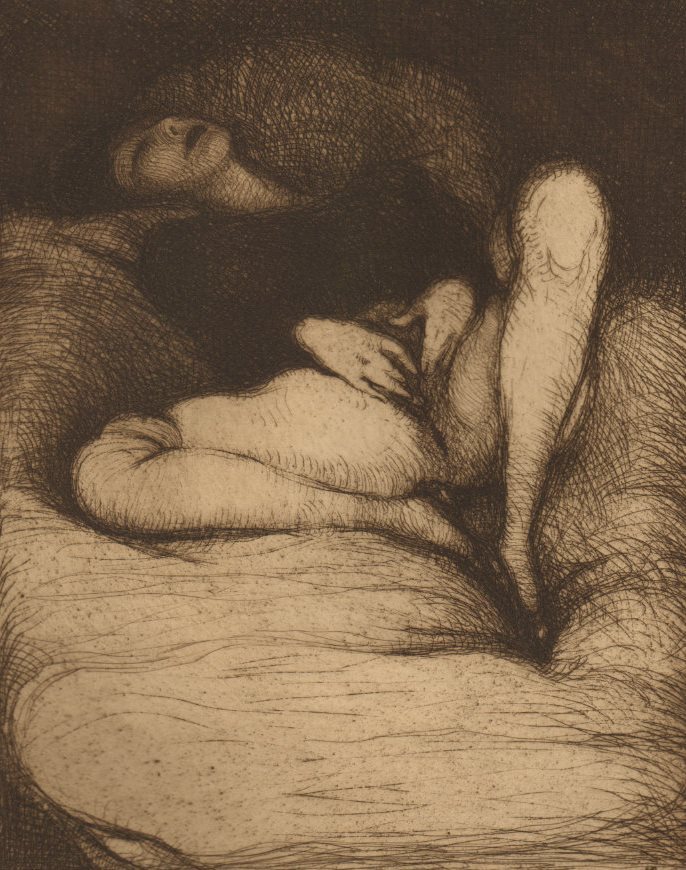
Frans de Geetere – Volupte from Jean de Gourmont’s erotic novel La toison d’or (192X)

Frans de Geetere – Volupte from Jean de Gourmont’s erotic novel La toison d’or (192X)


[↑] Oliraptor – Joel, Seattle (2017); [↓] Source unknown – Title unknown (2010)
Juxtaposition as commentary

Agnieszka Sosnowska – Lansendi, Iceland (2012)
I first encountered Sosnowska’s work through Lensculture’s underwhelming showcase of her work.
Several months later, I caught a broader cross section of her work as part of the Traces of Life exhibition at the Reykjavik Museum of Photography.
What struck me immediately was how good her printmaking chops were and how her digital presence seemed almost completely devoid of life by comparison.
Yet what strikes me looking at this photo which–excepting the stunningly luminous range in skin-tone and subtle gradations in the sky, which my guess would be were burnt in–limits everything in the frame to three zones: the textured black sand (Zone II), the dark grey rocks (Zone IV) and the sky (Zone IX).
It’s also interesting to note how Sosnowska has been working with variations on the idea of the image for more than a decade. For homework: compare and contrast the above with this photo from 2007.

Alek Lindus – Untitled (2010)
I was in time, in flight, in finiteness. The present had
disappeared, there was nothing left for me but a past and a tomorrow, a
tomorrow which I was already conscious of as past.
Since then I have
tried, every day, to cling on to something stable, I have tried
desperately to recover a present, to establish it, to widen it.
–Eugene Ionesco, Fragments of a Journal
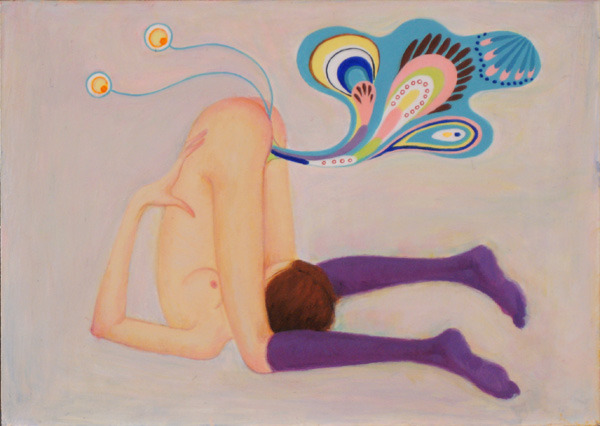
Yuanyuan Yang – Twinkle (2009)
The use of color in this is incredible. The way the purple stockings complement her skin tone and the way the cyan areas differentiate the more miasmatic elements of the image from the more tangible representation of the figures body. How the color of the antenna baubles on the left tie together with the abstract bubble on the right–all while still complementing the body.
I can’t look at this without seeing the abstract parts of the painting as resembling that snail character from SpongeBob SquarePants–with a paisley pattern shell.
I’m not entirely sure that’s so far off base. The fact that the person in the image is looking at their genitalia seems to emphasize this meaning. The same grade school mentality that renders phallic arousal as a boner or a stiffy, denigrates vulvic arousal as leaving a snail trail.
The way that we’re so open and curious about our own bodies–what we can do to them and what they can do for us. Until we’re taught to feel shame for taking pleasure in what our bodies are built to do.
So I feel coded into this image is a sort of entire history of relating to one’s genitalia. There’s curiosity–the person is studying their genitalia, shame (the contextualization of arousal with an excess of effluvia that manifests as something either cartoonish and absurd–a snail; or, something that is abstract and decorative, if not beautiful in a strange sort of way.
And looking at Yang’s other work, I’m reasonably convinced that my reading isn’t that far off base. Like I have so many feels about this watercolor that I really can’t even…
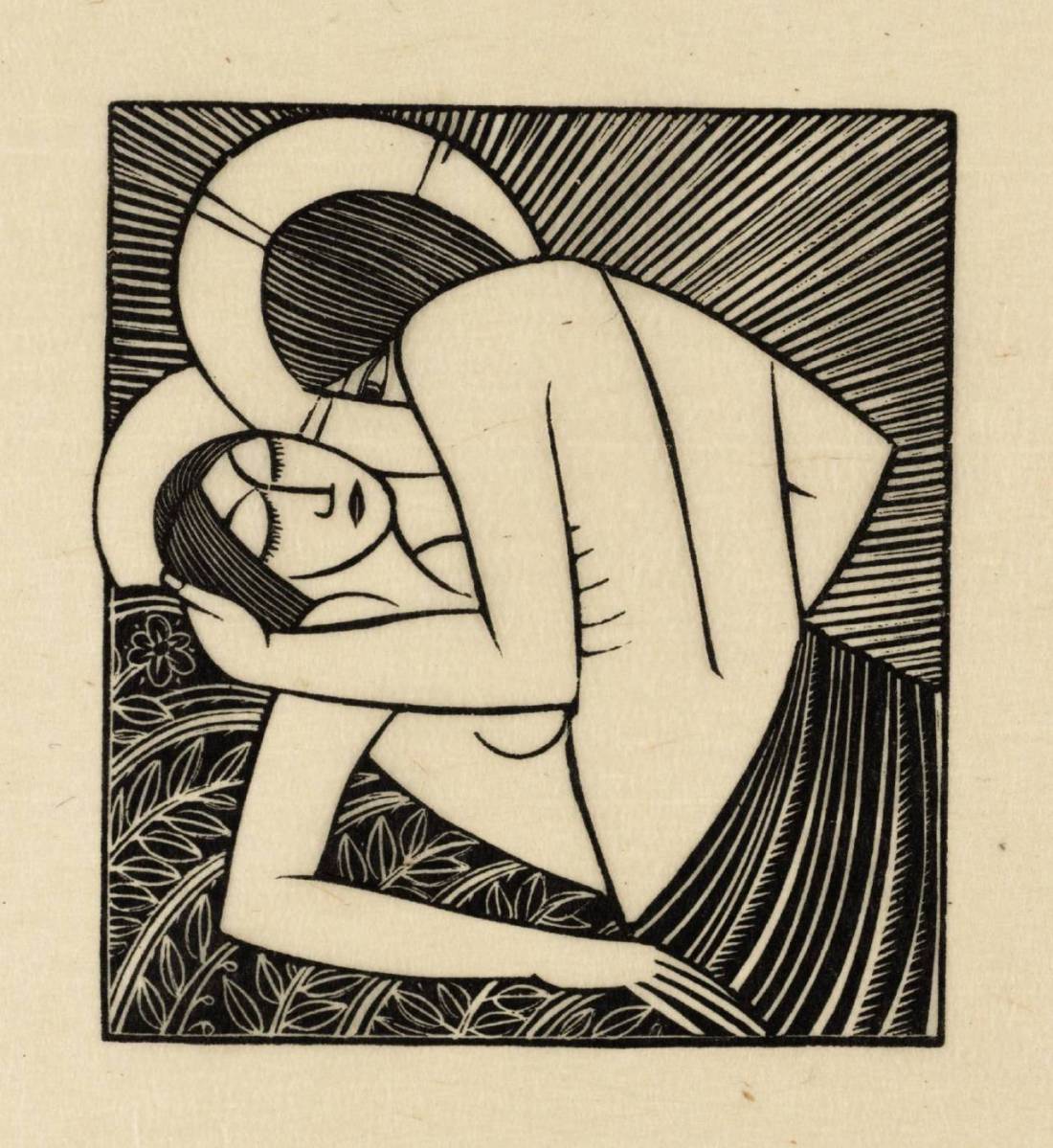
Eric Gill – Stay Me with Apples (1925)
I knew fuck all about Gill prior to first seeing this woodcut.
My initial reaction was something akin to adoration; the intersection of the sacred and the profane, and the subversive muddling of those boundaries resonates with me strongly.
…
I know I wail on the point like it’s a horse carcass but I was raised in a rigidly Xtian household. My mom dragged the family to church several times every week and insisted we attend parochial school.
It was a living hell. And while I experienced emotional, mental, physical and sexual abuse as a child, most of those experience can’t hold a candle to the sun compared to the trauma that came from merely existing in such an stridently authoritarian milieu.
Standoffishness was my default safe space. I can trace that instinct back as far as I retain memories. At a certain point, though—things began to shift. I felt more and more alienated from the proceedings.
…
I was in my late teens. I’d stopped going to church with my family and began tagging along to other churches with friends. By and large, the services were far less dour and severe—there was upbeat vitality, which helped for a time—the increase in sensory stimulation distracting from my feelings of not belonging.
Invariably, the orgiastic performance—hands held high above heads, swaying (the posture of an expectant child waiting for a distracted parent to pick them up), gibberish glossolaliac syllables dribbling from the mouths of frenzied parishioners—would lead the pastor to remark rapturously on how the spirit was strong with us this morning. How he could see it move over those gathered together to praise the name of the Holy Lamb, like the wind whipping up waves on a stretch of open water.
I never felt it. Not once—not even a little; not even at all.
For years, I thought I was defective, broken. That other people were able to experience something from which I was completely cut off.
…
I’ve been trying to write this post for several weeks. Each time I approach it, I have more to say but end up communicating less and less.
I took a step back and actually read a bit about the artist. Turns out he was a real sick fucking puppy (pun intended, sorrynotsorry)—unconscionably so: carrying on incestuously with both his underage daughters and dabbling in beastiality.
…
One of the convenient criticisms of the social justice movement is that in confronting inequality head-on, there is a tendency to perpetuate an equal and opposite form of inequality—the sort of uncritical thinking that equates affirmative action with separate but equal stratification as an attempt to remediate systemic racism.
Increasingly, we’re seeing push back to social justice-tinged critiques. Damien Chazelle’s awards season darling La La Land experienced push back for it’s overwhelming whiteness and its erasure of LGBTQ+ folks. And the pushback received push back by—primarily white, cishet men arguing that it’s still a great accomplishment in cinema regardless and that SJW folks are once again all-too willing to throw out the baby with the bathwater. (Full Disclosure: I haven’t seen La La Land; I have seen both Moonlight and Arrival and while I understand why the former has gotten so much praise–representation matters and on that account it’s huge and ground breaking–but it’s also flawed in a way that Arrival is not. I’m hardly going to dismiss Moonlight; however, those folks who elevate it above Arrival are a bit beyond the pale in my personal estimation.)
(There’s actually an emerging term being employed to name this reaction: anti-Art criticism.)
…
When I was a filmmaking student, the film department brought in a professor from the theater department to teach directors how to work with actors. It was one of many occasions where I fell afoul of The Powers That Be.
I remember being told that an actor could only convey one distinct emotion at a time. And to expect anything else was to knee-cap the authenticity of the performance.
It still ranks as one of the most bullshit pronouncements that I’ve ever encountered.
…
Something you probably won’t understand if you didn’t grow up sheltered by Xtian conservative parents is the degree of importance placed on MPAA ratings for movies. For example, I hadn’t seen a single R-rated movie until I was 15 and saw The Silence of the Lambs.
It was a revelation and I have—to date—watched it more than 200 times.
If you’ve only seen it a couple times, you probably won’t have paid much attention to the line that Lecter offers Clarice when she notes a drawing in his cell: It’s the Duomo as seen from the Belvedere; do you know Florence?
That one line combined with a fascination with the Renaissance Masters led me to fantasize for years about visiting Florence. From the age of 19 on, I would check airfare several times a year only to decide it was too rich for my blood.
Then I ended up in a Survey of Wester Art 101 class taught by this affable but deeply anxious and shockingly undynamic professor. Somehow, he saw my intense interest and while the class was a wonderful experience. It was my engaging with him that caused it to be so. I remember we really dug into Florentine art. The professor wanted us to be able to parachute in and have an idea of the lay of the land. Our final exam featured a section of slides taken from the streets in Florence and we were to make an educated guess as to where in the city we were and then using a provided map navigate to the location where a stipulated work was on display.
I never had even the foggiest inkling that I’d ever be able to use that knowledge until the planes collided with the towers bringing them toppling along with air fares.
Several days later—at a restaurant with my mother—she told me to put her money where my mouth was and wrote me a check for what I was short to finally get off my bum and do what I’d been dreaming about for years.
So two months after 9/11, I flew to Italy.
I remember the plane started its descent. We dipped into the clouds, but the ceiling was thin and as we emerged almost immediately; through the window I saw golden hour light painting the historic bridges from west to east: Ponte Vespucci, Ponte Alla Carria, Ponte Santa Trinity, Ponte Vecchio and Ponte alle Grazie.
I don’t think time has ever passed so slow in my life, landing, taxi, baggage claim, customs, the cab ride from the airport into the city.
When I finally arrived at my hotel, I literally three my suitcase into my room and bolted out into he street—following the Arno as it snaked beneath the same bridges I’d seen two hours before.
I stood at the center of Ponte Vecchio and watched the sun set; this strange feeling of both fulfillment and anticipation.
From Ponte Vecchio, I veered north. Where Via Por Santa Maria becomes Via Calimala, the strains of an aria reached my ears–an outdoor performance in Piazza della Signoria. Via Calimala becomes Via Roma; and at Via degli Agli, you round a blind corner and are confronted with the green and white marble of the Baptistry. My eyes slowly scanned right–the Cathedral with Brunelleschi’s double brick dome and Giotto’s campanile.
I was gobsmacked. I stood completely overcome. It was a full five minutes before I recalled that I had a body to which I was tethered. There was no subjective experience of an object. I was just in the thrall of a beauty that pierced me to my very soul.
In that moment, I knew what all those pastors had been saying. What it feels like to be in the presence of God. I realized that I had been wrong to think I would only ever feel that in a building made of wood, stone and brick built by the faithful. I’d felt it before in smaller ways. Watching a beautiful sunset, reading a story that moved me, listening to music, making love. I’d actually felt it hundreds–if not thousands of times before.
…
I stumbled upon an article this week about a recent study suggesting music gets you just as high as sex or drugs.
I’ve arguably done more than my fair share of drugs. So I can totally relate to this pronouncement—even if, in my experience, I get higher off of music and sex than I ever have on drugs (i.e. multiple orgasms and disc one, side one of Godspeed You! Black Emperor’s Lift Your Skinny Fists Like Antennas to Heaven on vinyl are always better than any drug I’ve ever had.)
…
Back to the anti-Art criticism thing for a minute…
Isn’t it contradictory to give Gill a pass for his reprehensible behavior while also taking issue with the pervasive whiteness in the work of someone like Richard Linklater? Or, to compare apples to apples: why is it acceptable to still appreciate the above while repudiating the work of say Woody Allen and Roman Polanski?
In some ways it’s easy. I detest both Allen and Polanski. And in fairness, I’ve been seen any of the former’s supposedly seminal work—only his more muddled, watered-down and self-indulgent early work. But with both, I do see a tendency in their work to both not only attempt to justify their behavior through their artistry but to suggest that what is problematic about their proclivities actually somehow makes them superior to those who criticize them.
But for something even more apples to apples, consider D. W. Griffith. You cannot talk about contemporary film without addressing his legacy. And he was mad problematic. But the pervasive influence of his work is undeniable.
So I reject the notion that we have to reject everything out of hand due to specific problematics. Personally, I believe that you can hold two conflicting positions in your mind—and further, I’d go so far as to say if you can’t then you do not have an especially refined critical faculty.
But I do think it’s in poor taste that we’re comparing someone like Damien Chezelle or hell, even Richard Linklater (whom I like) to someone like D.W. Griffith. Objectively neither have contributed to the medium in a similar fashion. (Although, in fairness, I do think history will be kinder to Linklater in say 50 years.) So the notion that through a selective imposition of critical theory, it might be possible to elide entirely correct critiques of problematics is just in really poor faith. (And really, when you get right down to it, anti-Art criticism is an effort to re-approriate critical theory in the service of maintaining the hegemony of a dominant whiteness in art and media.)
…
Honestly, I don’t know enough about Gill to say whether those problematic things about him can sit side-by-side with his work and result in his work still being considered meritoriously. His biographer Fiona MacCarthy seems to think it does.
For my part, I do not read the above work as advocating incest or deviant sexuality. It seems more as a general suggestion that contrary to religious proscriptions, sexuality—much like music and drugs—does provide access to realms where the membrane between the desert of the real and the experience of self-transcendence are thinner, more permeable.
So I don’t have to give Gill a pass to acknowledge that this image appeals to me because of my own entanglement with the cult of sex, drugs and rock ’n roll. But I also won’t obfuscate the problematics. My praise for Gill will, in other words, never be full-throated so much as reserved and carefully considered.
And my experience of sex is like the obverse of that experience of music, whereas the hearing of music is something I feel, sex is a means of aligning all of my senses in a single pursuit. The experience of sharing my body completely with a partner or partners is the closest I know of approximating a self-transcendent experience.
That’s why I adore this image–it deals in my bread and butter, the mystical cult of sex drugs and rock and roll.

@house-of-fortitude – Untitled (2014)
This blog gets it’s fair share of garden variety Internet trollery. After that, the most common query I receive is people making reasonably cogent arguments that I present myself as an infallible authority.
Uh… no. I’m wrong. Frequently. However, the frequency is less a function of idiocy and more a matter of the fact that I really do put my ideas out there a lot–which presents more opportunities to be wrong.
(For the record: I encourage everyone to take what I say with a Gibraltar sized grain of salt. Always think for yourself. If you think I get something profoundly wrong, drop me a line. I have zero qualms with substantive disagreement–the point of this project is actually to facilitate dialogue that I find to be currently lacking and which I feel is both vital and important to have within the medium and those who appreciate the medium.)
Case in point: very early on, El Desouky submitted a photo for publication. I don’t really accept submissions–although I have something in the works that won’t necessarily change that but will shift it slightly. (Hoping to make that announcement during the back half of the month. Stay tuned.)
I turned up my nose at it.
Now? Well, now I feel like an arse about it.
I mean I’m super hard pressed to name another photographer with as singular a visual voice, who works in both B&W and color in ways that underscore the necessity of that particular image preferencing one medium over the other and who can be bothered with the notions of melancholy as neither inherently positive or detrimental so much as necessary or perhaps even suggestive of a form of radical self-exploration.
I freaking L<3VE the above photo. It’s partly the simplicity of it. A cluttered kitchen and a woman. Nothing about this is in any way so complicated as to be prohibitive to arrange. Yet, there’s something magical about it. It really does look as if she’s drifted off into quiet reverie as a result of looking at snapshot. The snapshots–splayed as they are on the table, clearly legible as photos but not clear enough to distinctly discern what the portray–suggest a glimpse into the woman’s thoughts in a way that let’s the mystery be.
Then there’s the light–which as far as I can tell comes from two sources. An ugly, bare overhead bulp as well as a single very direct light source just beyond the left edge of the frame angling down on the table, her face, neck, shoulders, back of the chair and the little leak filtering through the shadowed triangle formed between her neck, shoulder, bicep and forearm, drawing attention to her left breast, accentuating the nipple.
The magic of it is that anyone with a camera could have made this image but only El Dosouky could make it in a way that is both insinuating of a narrative and resistant to such interpretation, that feels so vibrantly alive and authentic. It’s a scene that is so mundane, we might overlook it we happened upon it unaware. But now we get to revel in it’s glorious wonderment.


[↑] Helen Levitt – Squatting Girl / Spider Girl (1980); [-] Valeria Lazareva – 4950212141_148b6fe702_z (2010); [↓] James de Leon – Title unknown (2013)
Follow the thread.
Rodolfo Asin – Noelia (2013)
A black and white photograph (and I say photograph specifically because no matter what your opinion on digital, there is no damn reason anyone should be working in B&W in digital–it’s just poor form) can convey a lot of things. It can be sinister, moody, clinical, severe, etc., etc.
In other words, a B&W photograph no matter the concept or execution carries a sense of shining a light onto a scene in a such a way that allows the viewer to discover the foreign in the familiar.
Color just doesn’t work like that. A photo or image can be in color and be good and important and sumptuous without really even being about the color.
So every B&W image is at a certain level monochromatic in the same way and every color photo or image appears in color in a different way.
Loosely speaking, when we are interrogating color images there are two sorts of photos/images: those in color and those about color.
To my mind, William Eggleston is really the only photographer who ever managed to cobble together a body of work managed–largely–to accomplish both.
Eggleston established a beach head that allowed other photographers–like Stephen Shore, Jeff Wall and Joel Sternfeld to emerge. These photographers were interested in trying to bridge the gap between color as facet of the image and color as intrinsic to the images manifold meaning.
Yet, most work post-Eggleston color work seems less interested in solving a problem like color than dealing with issues of color fidelity, depicting mundane normalcy (for some reason B&W always seems more immediate and authentic, even though it’s not how we naturally perceive the world) and the employment of color as a means of orchestrating emotional response.
Whereas, folks like Harry Gruyaert, focused on color itself.
Now what I find interesting is that to a certain degree Shore, Sternfeld and Gruyaert and desaturate their photos, the images lose some of their punch but they still work. (With Gruyaert, you have to bear in mind that he titled his images. Also, I’ll concede that this might be splitting hairs since both Shore and Wall both work in both color and B&W.)
Eggleston desaturated is just fucking pointless–the color is effectively the glue holding everything together.
These days–sadly–most of the raft of internet famous photographers & image makers produce images in color or B&W and more likely a combination of the two. But I’m hard pressed to name anyone who like Eggleston is making work that only works in color. @pru-e is the first person who comes to mind. (But that’s also not entirely fair since she’s arguably one of the best up and coming image makers in the world.)
Asin, like Shore, Wall and Sternfeld, loses a good bit of his punch in a desaturated reimagining of his work. But he is doing some extremely exciting things with color. The work absolutely loses some of its punch in B&W but it also loses a vitality that the color contributes to the scenes.
I’ve featured another of his images several years back and I was just as taken with his use of color then as I am now.

 Acetylene Eyes