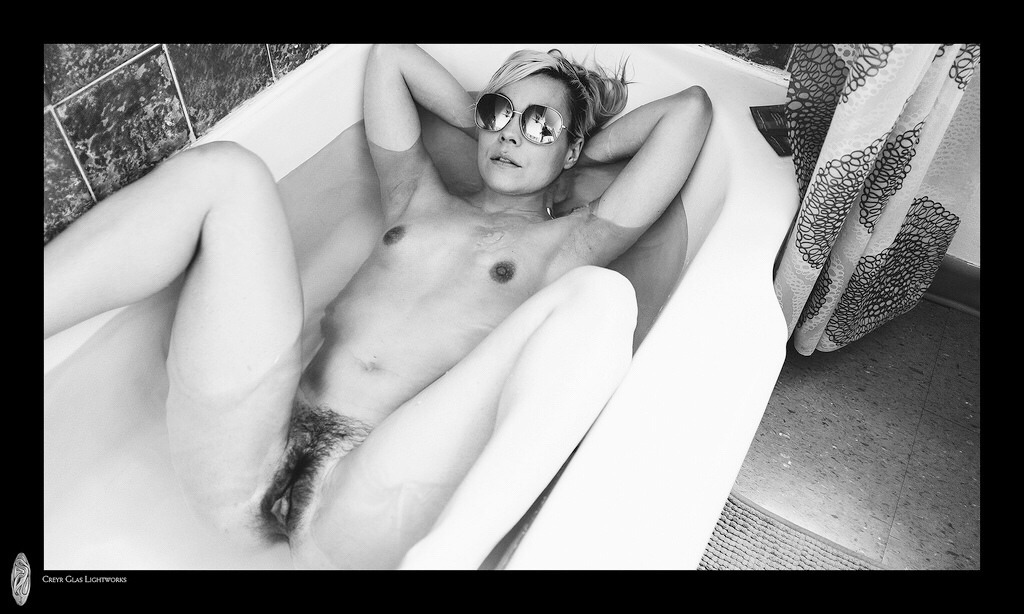
Creyr Glas LightworksIsola Bathing Nude (2016)

I find it positively odd how many photos of people in bath tubs there are on Tumblr. I mean, if you want to think of a room with decent lighting bathrooms are not the first option that comes to mind. (Perhaps it’s because I live in New York City where most bathrooms are windowless, feature only overhead lighting and are so small where if you turn around too fast, you’ll run into yourself.)

Most of these photos tends to strive for the sort of ideal frame within a frame as exemplified by Lee Price’s Pink Cupcake along with his latest series Surfacing.

The rest seem to juggle having a high enough angle to see into the tub while also being close enough to the subject so as to not have the composition overwhelmed by bathroom related scenery.

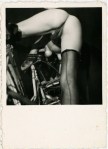
Chip Willis’ extremely clever use of a mirror to open up this incredible image of Nathalia Rhodes is a personal favorite. And I’d wager Creyr Glas Lightworks is familiar with it based on the image above. The pose is reminiscent and the mirrored sunglasses suggest further points of comparison.

Compositionaly the angle of the tub edges lead the eye at an upward angle toward Isola’s face, the shower curtain calls out, demanding attenting and we’re aware of the fall off of light as we move away from the tub, the eyes snap back, drifting back and forth between her genitalia and her mirrored shades.

The rule of thirds informs this shot. The inside edge of the tub at the top and the inside edge of the shower curtain.  The top of her right leg is also more or less aligned with a third segment of the frame.

I just really do not like the fact that her legs are amputated at the ankle. It implies a lack of mobility and given how wide the angle of view is I suspect the image maker lined up the shot to perfectly observe the rule of thirds and then leaned in closer to give it a little bit edgier feel. That edgier feel does not vibe at all with the tone and feel of the image. (Isola seems pretty comfortable and devil may care about what anyone else thinks about her or her body in the moment presented.)

I have no idea regarding the image makers background but this was taken with a Fuji X100T (a great for the price, MFT rig). But it’s digital and the black frame is something you’d not have the option for if you were working in traditional B&W–although it would work for B&W slides (further the mirrored sunglasses are positively made for B&W chromes, but I digress). That ultra bright bath tub edge in the lower right foreground would have to be substantially burned in to read on a traditional print, which would make getting a more or less even white across the entire bathtubs visible surface a nearly day long process in and of itself.

Still, despite the considerable flaws, it’s a memorable image in a way that 95% of the tubshots I’ve featured previously just do not accomplish. That’s worth noting, I believe.

Hans BellmerStudies for Georges Bataille’s L’histoire de l’oeil (1946)

Beyond a generalized outline and the Freudian psychoanalytic babble about the more unsettling aspects of his work–erotomania, pedophilia, etc.–my gut feeling is that the majority of art historians really get Bellmer all wrong.

It’s a bit too facile to call him a perverted pedophile–I won’t argue that his work doesn’t support these claim but only pursuing it to the point of dismissing him for his proclivities is perhaps cutting of one’s nose to spite one’s face. (Especially when you realize that almost all of his work that incites cries of pedophilia was a response to the cult of the perfect body in Germany circa the 1930s.)

The thing I think it’s important to keep in mind is how Bellmer repeatedly situated his work to stand firmly in a position counter to authoritarianism.

I find the Freudian analyses of him and his work even more frustrating–with their insistence on interpreting surrealist images as coded subconscious projections, i.e. Bellmer was a repressed homosexual (at that I have to question whether the person making that claim has ever even really looked at his work in more than a cursory fashion, he’s very much obsessed with female sexuality in a way that no gay man I know is…)

There’s talk of oedipal anxieties and fear of castration–and while both fit into the anti-authoritarian locus of his work, I read things differently. I feel a sort of shared experience with Bellmer–an overarching sadness at AMAB status and a sort of erotomania as the only perceived means of recovering some of the experience of what it might be to experience sexual awakening in a manner suiting your actual gender identity.

I feel like so much of Bellmer’s work is actually more literally anti-authoritarian than most people realize–because it channels a frustration with authoritarianism where your experience is limited by being born into the wrong body.

Further, non-consensual interactions are the bread and butter of both authoritarianism and pedophilia. I don’t know for sure that Bellmer had his head entirely screwed on straight in this regard–but I can’t see that he wouldn’t have been unaware of it. And while the stories of him hiring young girls to pose provocatively for him are unsettling, I’m reasonably sure that the resulting images would most likely be to unsettling to serve as pornographic material and I think that fact is crucial in understanding Bellmer and his work.

On a slightly different note, given the ascendancy of Drumpf in my own country, I think Bellmer is an artist not only due an in depth re-evaluation but who also has a great deal to offer on the subject of how art should strive to fight fascism. (If there are an gallerists reading this: Ana Mendieta is another artist who needs a major retrospective stat.) 

Source unknown – Title unknown feat. Flora & Fauna (2016)

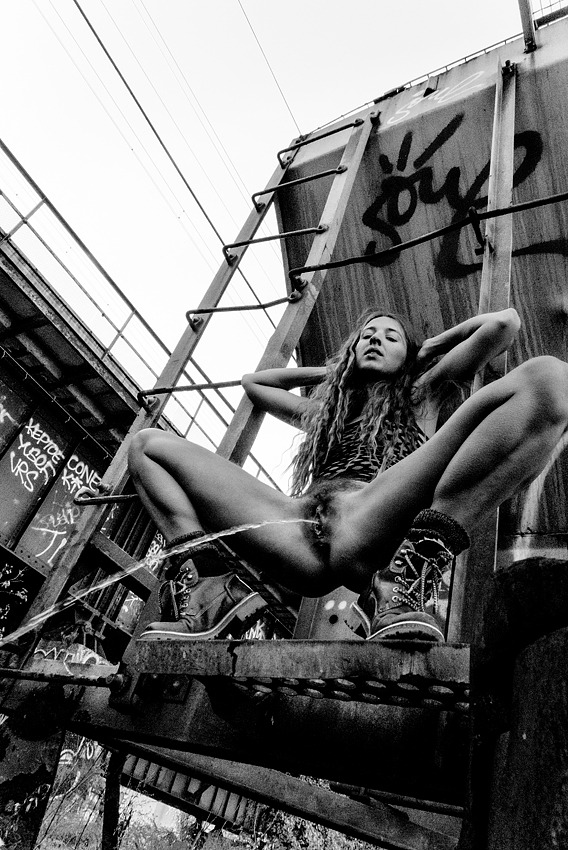
Any one making an artsy image of someone pissing is firmly standing in Emmet Gowin’s formidable shadow. (Especially when it’s a B&W image like above.)

I’m referring specifically to one of my favorite ever photographs that Gowin made of his wife Edith peeing in the open doorway of a ramshackle shed.

There was an article in The New Yorker several weeks back about this photograph that’s more than worth the two minutes it takes to read.

I’m not willing to place the above image on even close to the same level as Gowin’s photo of Edith. But the article winds down with a sort of lamentation on the fate of depictions of intimacy in our current mass culture of oversharing:

I wonder, sometimes, about the fate of this kind of photographic
intimacy in the age of Instagram, when users are encouraged to share the
granular details of their lived experience, their most nominally
intimate moments, but on a platform governed by likes and clicks.

To me, the above image may function in the fashion described but despite some pretty gnarly technical flaws (#skinnyframebullshit being a huge one), there is something carefree and playful about it that turns what might otherwise be a salacious image, into something much more matter-of-fact.

It’s also worth mentioning that the model in this image is doing some crazy great work. I’ve never seen anything quite like this amazing image of her by stef-des.

Hector PozueloKarina (201X)

This is a great example of using color as a unifying compositional tool; unfortunately, it’s also some insipid #skinnyframebullshit.

But, wait–you counter–I’m reading this top to bottom and not left to right: how is it #skinnyframebullshit?

Well, it’s one of those instances where either (and in this case I think both apply equally): the skinny frame was less about contributing legibility to the image (instead it was about using the slow gradiations of the sky in combination with the color of the towel to get some really exceptional skin tone) and the vertical orientation was an effort to erase as much of the exterior context as possible.

I am convinced that given that she is making eye contact in such a way with the camera and the fact that essentially the grade as the sky rises from the horizon encompasses both the same hues as the towel and her irises, I think cutting the sky as it approaches the same color as the towel and then letting the towel and her eyes effectively communicate the same color range would also be a more contemplative use of color (i.e. less knee jerk and easy-peasy).

Also, it’s rare to see eye contact like this in an image. My eye wants to shift left or right and then drift back but the frame doesn’t allow that sort of movement and once I encounter the eyes, I no longer read the image top to bottom–I can only read it left to right.


Lúa OcañaUntitled from Don’t Break series (2011)

I first featured Ocaña’s work roughly a year ago. I liked it quite a bit but it didn’t really reach out and grab me by the throat like say Allison Barnes or Sannah Kvist, and after just a single encounter I compulsively spend days meditating on the work.

This popped up on my dash the other day and I’m glad for that because I have been meaning to spend further time with her photos–it’s just that frequently in the rushed fuss and bustle to keep this blog running, work that I like but doesn’t necessarily immediate worm its way under my skin falls (unfortunately) by the wayside.

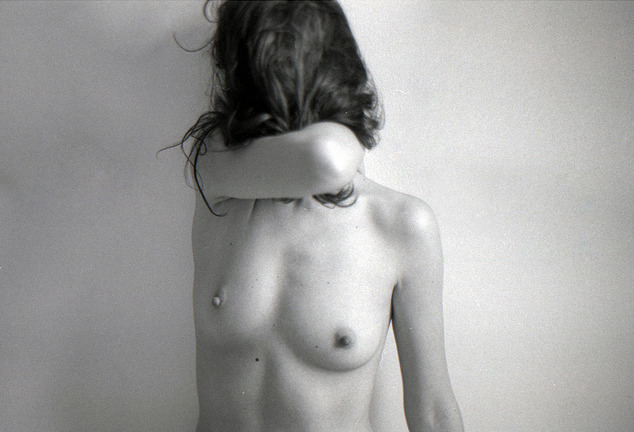
For now I have two additional observations to offer regarding Ocaña‘s photos. First, it’s interesting how her visuals play with the ubiquity of a certain minimalism embraced by hordes of internet famous image makers–a naked model against a white wall in medium close up with light falling in such a way that you know a window is just beyond the edge of the frame.

However, there is an intense vitality to Ocaña‘s work; a vitality absent from 99.9% of thematically adjacent imagery. I think the best I know how to point to that vitality is to refer to it as ‘intense introspection as a route to surreal experience’.

This leads to the second point: there is another image maker working in a similar style: Els Vanopstal. Yes, her work is a bit more varied and formal. But I can’t look at this image and not automatically connect it with Ocaña.

Alexander PrischepovUntitled (201X)

I have A LOT to say about this image but I want to admit upfront that I am several steps over the burnt out line and as a result I am extremely brain fogged, so bear with me.

I wasn’t certain of the attribution on this for a while–it just doesn’t really look like much else Prischepov has made; but if you look here, you can match the model and the curtains.

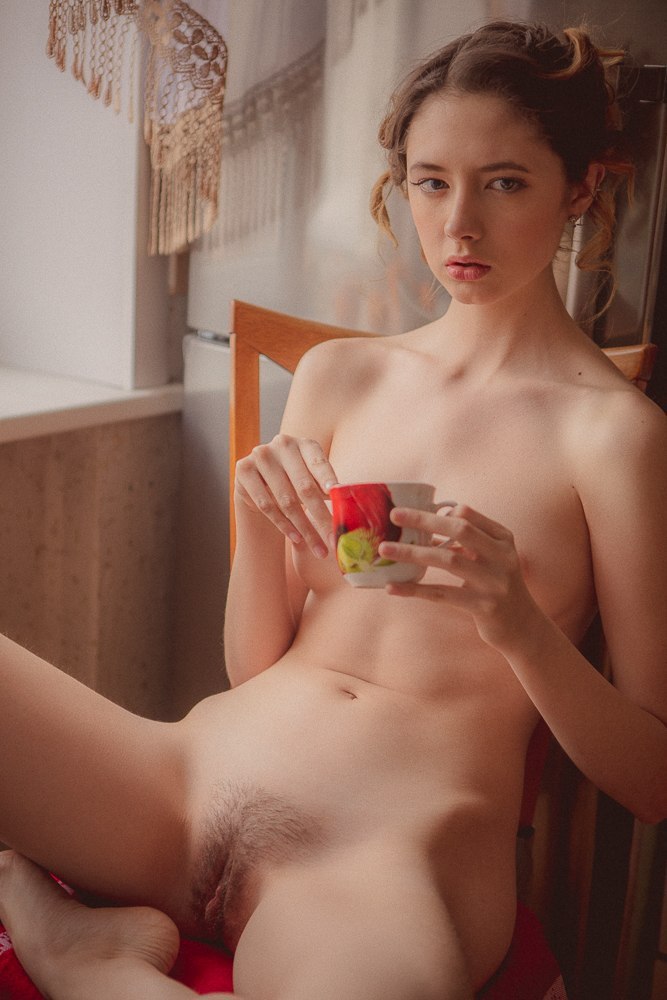
I feel like a broken record every time I say this but–le sigh–this is not a good image: the angles are such that the slight variance between the frame edge and the inner window jamb are not squared and with this wawkerjawed-ness becomes more exaggerated as the your eyes scan the frame. (For example: left-to-right you have the left frame edge (0°), the inside window jamb (2°) back of the refrigerator (5°), edge of the refrigerator door to the right of the line of her neck (7°) and then the door handle (9°).

From the standpoint of composition this does push your eye left to right across the frame–but by doing so it doesn’t really encourage prolonged examination. And with the slowly increasing cant, the eye is drawn left to right and then down. The clear focus of the image is absolutely intended to be the well manicured fur on mons pubis.

Don’t get me wrong all vulvas are beautiful and deserving of considered appreciation. But the way this is set up compositionally is entirely ubiquitous as far as the art historical male gaze and it’s essentialized, objectifying orientation.

What I find fascinating and commendable about the image is the way that despite how it’s organized, it–to my eye at least–subtly subverts such a  mentality.

I don’t think it’s intentional on the part of the image maker. But there’s a contrast between the super styled and fully made up production design against the casual way she’s sitting. (I mean she looks super comfy. And it occurs to me as I sit her writing this that I am sitting in a similar position and am just as naked and comfortable. The only difference is I’m drinking coffee not tea. And she’s prettier than I’ll ever be…)

She’s also not making eye contact with the camera. She’s staring at something the viewer can’t see–intently lost in thought. (It’s very difficult to objectify someone when you acknowledge that they have an inner life which you cannot access unless they choose to share it with you.)

Further–as I tell folks who are interested in avoiding objectifying imagery–think of the labia as eye lids and the vagina as if it had an eyeball, if that eyeball is staring directly into the camera, then, yeah, it’s highly likely that the image is objectifying. (This is a general rule. There are exceptions. Steph Wilson comes to mind but her approach is more one of re-appropriation of the trope. Same with this one by Becky Flanders–which probably was a predecessor to Wilson. )

I’m also looking at this and recalling the question that @suspendedinlight made during her guest curatorial stint a bit over a week ago. She wondered allowed whether “[It’s] possible
to desire someone without objectifying them?”

I’m gonna steal a line from Bjork’s Immature:

How could I be so immature ?
To think he could replace,
The missing elements in me,
How extremely lazy of me.

To employ an analogy desire is to objectification as joy is to happiness. Joy is something that happens in a moment. It’s something experienced not controlled. Happiness is the effort to transform joy into something continuously uninterrupted.

It’s the same with desire. There are a myriad of flavors but insofar as your understanding of desire involves gaining something from someone else as opposed to sharing your self with them and reveling in their sharing of themselves with you, then yes desire is inherently objectifying.

I, for my part, reject that kind of desire.

As far as depictions of desire go, yes it’s complicated. An image is permanent and unwavering. In effect, by trying to depict desire visual with non-moving images, you are fundamentally objectifying. But although largely true such a perspective egregiously fails to acknowledge that just as the meaning of a word evolves as its use shifts, the interplay between visual grammar and concept and execution provides ample opportunity to interrogate such considerations–whether or not the image maker intended those responses.

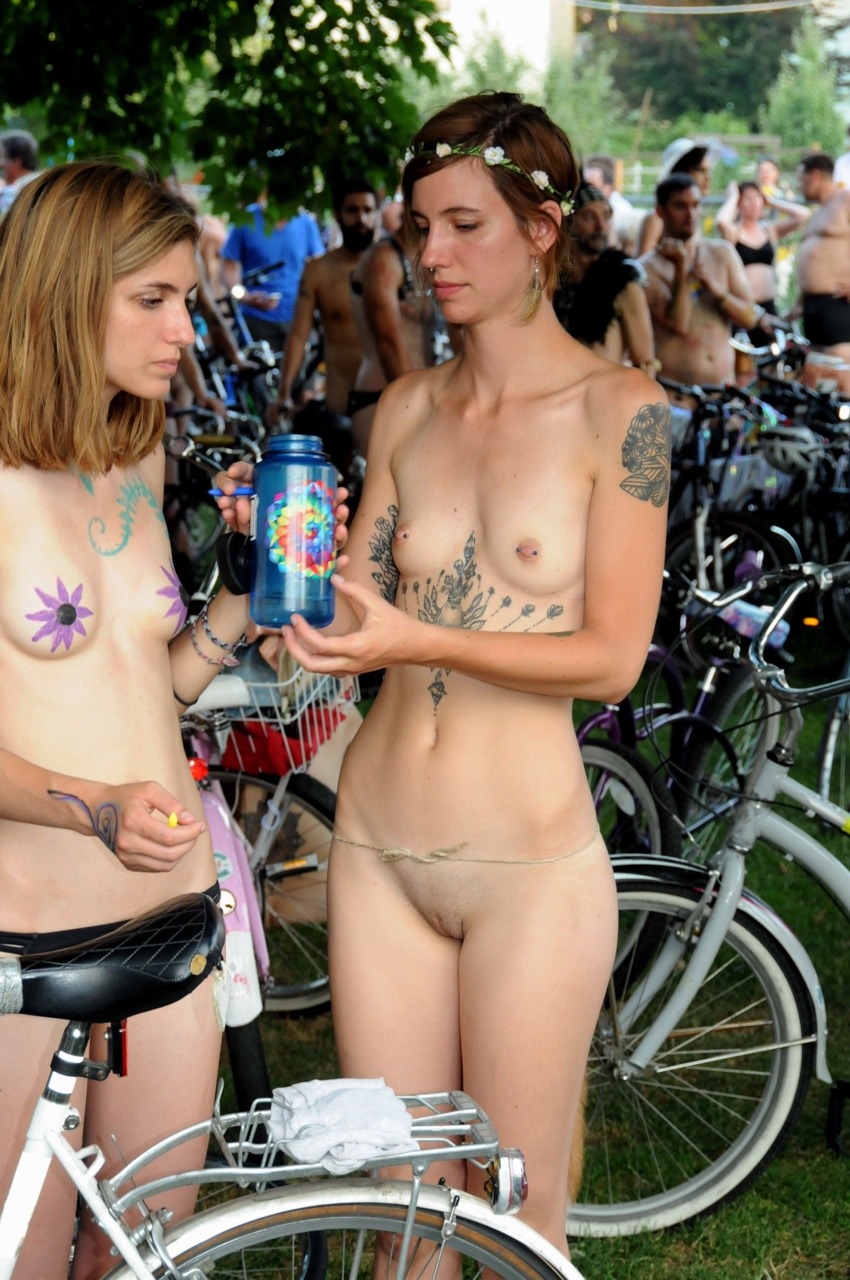
clikr73DSC_3901 (2015)

This isn’t a good image but it gives me all sorts of warm fuzzy feelings.

It’s from the 2015 World Naked Bike Ride in Portland–and event I promise myself that I’m going to do each and every year and then chicken out at the last minute each and every year.

It’s a complicated thing. I’m super fascinated by intersections of ‘private’ experiences in public spaces. But I get intensely put off by the whole nudist/naturalism scene. Not that I have anything against nudism/naturism, I’m just more interested in the transgression of the boundary that says being nakedly embodied is not something appropriate for mass consumption. (Nudism/naturalism seems to drift toward the extreme of trying to normalize and de-transgressionate public nudity.)

Also, if there was a closer match between how I see myself–a dyke-ier version of the woman here with the fabulous ink–I’d probably be more into these sorts of things.

Mostly what gets me about this is the way that these two are obviously close friends. They are sharing water from the same nalgene and are sharing space in one of those casual, unconsidered ways that friends do. I’m jealous of that, honestly.

I’d like to have friends that feel comfortable being naked around me and whom I feel comfortable being naked around. Bodies are great and I don’t think we should have to hide them and I don’t think being naked around other people always has to be sexual, I just think that it’s more honest in some ways. (If that makes sense.)

I do also realize that this is a very male gaze-y sort of thing. I mean the way it’s focused on the woman with the ink as opposed to anyone else and the way it’s framed so that you can see the knee jerk cishet assumed erogenous zones is kind of grating. But I do have to admit the twine tied around her hips gets me all kinds of hot and bothered, if I’m honest.

wonderlust photoworks in collaboration with Kelsey Dylan– [↑] Not a Place–a Feeling (2016); [-] The Anchorite’s Niche (2016); [↓] Opia (2016)

Kelsey and I were able to pull together a quick session while she was in New York in November.

There was nowhere near enough light and I only had 100 speed film on hand but I think we still managed some good snaps.

Also, I think I’m getting a better handle on how to communicate with photographic collaborators. And I’m super excited now that my B&W slide lab is back online. (Can’t wait to get back into serious B&W work again.)