Paula AparicioUntitled (2010)

Aparicio is a 25 year-old photographer based in Buenos Aires.

Her photos elide any too obvious debt to her influences mostly because of the meticulous care with which she handles both sexuality and nuances of nudity.

But there’s also the characteristic sense that within her frames seduction and consummation are done; leaving in their wake that palpable feeling of  impermanent post-coital stasis, the waning of ecstatic satiation and the waxing hunger of wanting more.

Source: Unknown

As best as I can tell, this image was originally from one of three different photo shoots featuring this couple.

It was probably commissioned by one of those dime-a-dozen paid membership amateur porn sites who tout the ability to download unedited photo sets as a selling point.

A certain Motherless user–who I am not going to even bother identifying–shunted the images over to his account on Halloween 2012.

From there, a Serbian tech geek added all three sets to his lo-fi website.

I spent about an hour and a half browsing through them the other day–that time may or may not have featured two self-love sessions–and although they aren’t what I would call ‘good’–heteronormative sex doesn’t really do much for me–there are some things I appreciate:

  • The boy at least seems somewhat mindful that the staging of the scene is runs counter to his partner’s needs–even if he doesn’t really go to any great lengths to compensate for it;
  • The money shot in every set avoids the ubiquitous porn facial that I so hate; she brings him to orgasm via fellatio, letting just a little bit of his semen dribble between her lips to visually signal ejaculation;
  • There are some awkward and poorly planned shots but they come off as strangely sincere and maybe even awkwardly endearing.

Maybe a handful of the images make for pretty decent photography–this is probably the best of the bunch and marginally not #skinnyframebullshit to boot.

The image I’ve posted is not the best-the tile seam between their heads is distracting and emphasizes the frames questionable compositional logic.

What I like are the nuances in their interaction. Her along with her face is flushed; the fringe of her hair, damp. Due to her position, her center of gravity–three inches below her navel–in under his body; her shoulder is turned in to his body.

The way her right hand is holding him is not conducive to anything greater than a teasing level of stimulation. This combined with the way she is cradling his testicles conveys a profound sense of bodily acceptance but also simultaneously proclaims you are mine and I will do what I want to you; you can’t stop me and you are completely safe in this space.

The way he is reaching towards her, kissing her with unfeigned, intoxicated passion is lovely.

The nakedness of the wanting and being wanted is always something I find incomparable erotic. 

Gustav VigelandKneeling Man Embracing a Standing Woman (1908)

When it comes to sculpture, there’s a steep drop off in my familiarity compared with cinema, painting or photography. I can differentiate between Michelangelo, Bernini & Rodin but that’s about it.

As someone who reads oodles and oodles of Scandinavian crime fiction, I am familiar with the connection between Vigeland and Oslo’s Frogner Park. I’d never (embarrassingly) bothered to look into his work because I am (shamefully) lazy and laziness in combination with depression facilitates a both comfortable and cloyingly complacent apathy.

I’m not exactly enraptured by his work, but this is just fucking devastating.

With the female bodied figure standing over the supplicant male bodied figure, the discrepancy in respective elevation feels like a subversion of the Pietà motif.

Also, there’s an interesting ambiguity w/r/t whether or not the embrace includes a sexual component. Both figures are nude and the male-bodied figure seems to need out of some profound feeling of loss. Whereas, the female bodied figure might be attempting to push his head further from her genitals, closer to them or merely adopting a posture exactly halfway  between bodily acceptance and rejection.

It’s a completely atypical presentation of gender and I adore it for that and the craft is beyond on point–the detail in her braid, his face and texture.

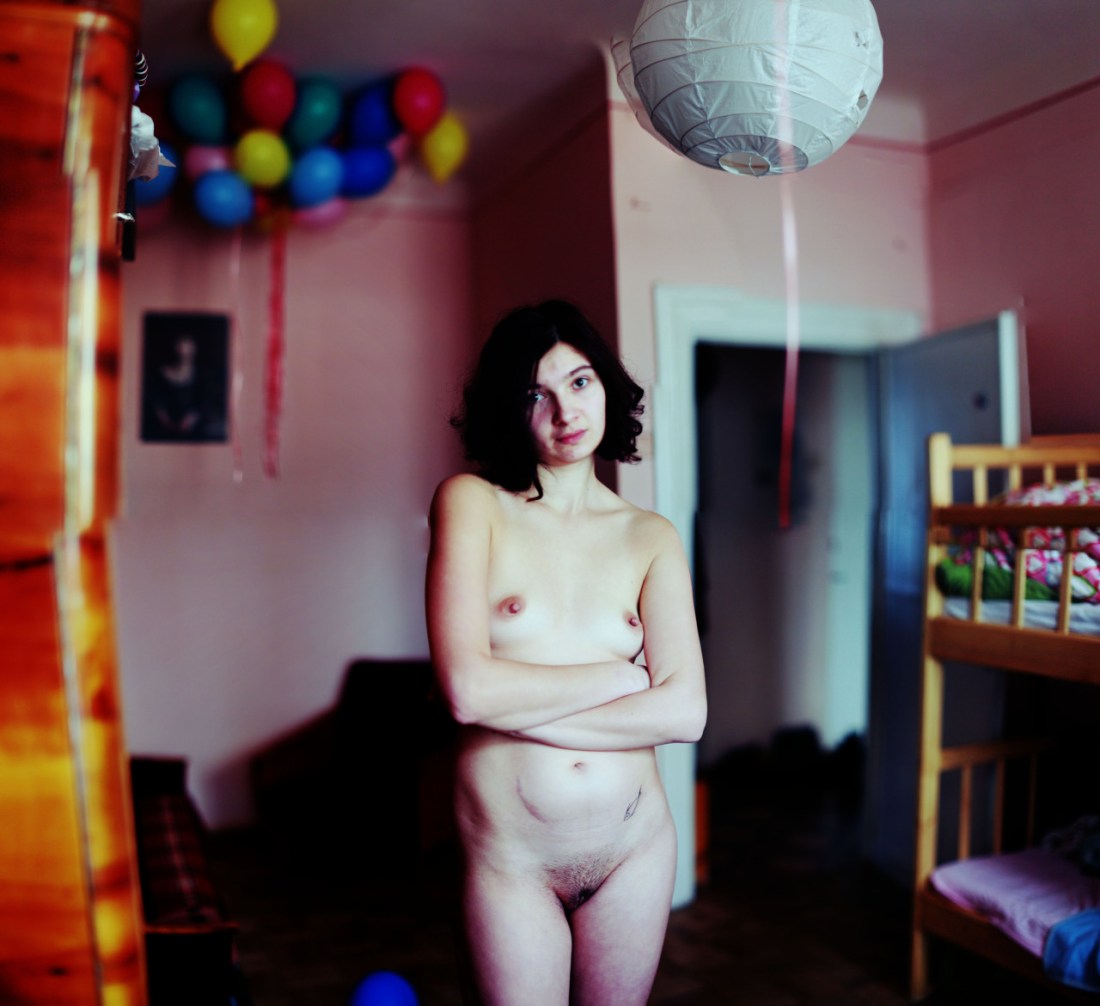
Oles RomanyukTitle Unknown (2014)

This is a wonderful reminder that making great work sometimes demands saying: ideal, schmideal.

For example: this is probably a stop and a half overexposed and shifts her skin tone so that it echos the wall’s magenta.

Her body is emphasized; yet, unlike a lesser image, emphasis does not entail isolation–the wood paneled whatever at the left frame edge, the balloons and the pistachio green blanket all jump up off the picture plane. With the subtle bokeh, a convincing dimensionality manifests.

No matter how killer the colors or compelling the presentation of space, what gets me is the way the image focuses my attention on the feelings this work illicit.

I have a very strong sense that this young woman belongs here–this is her space.

The feeling is something that while I am sure there regardless; but without the nudge, I likely wouldn’t have paused with it long enough to tease out how to articulate it.

I think that is crucial, actually; given the young woman’s posture/expression–crossed arms, head tilted slightly, eye contact–she appears a little uncomfortable.

If she were separate from her surroundings, her discomfort would entail all sort of unsettling implications given her nudity.

Her belonging in this space colors the discomfort with a playfulness. As if the photographer–who is also her lover–begs her to pose nude and despite lingering misgivings, she agrees.

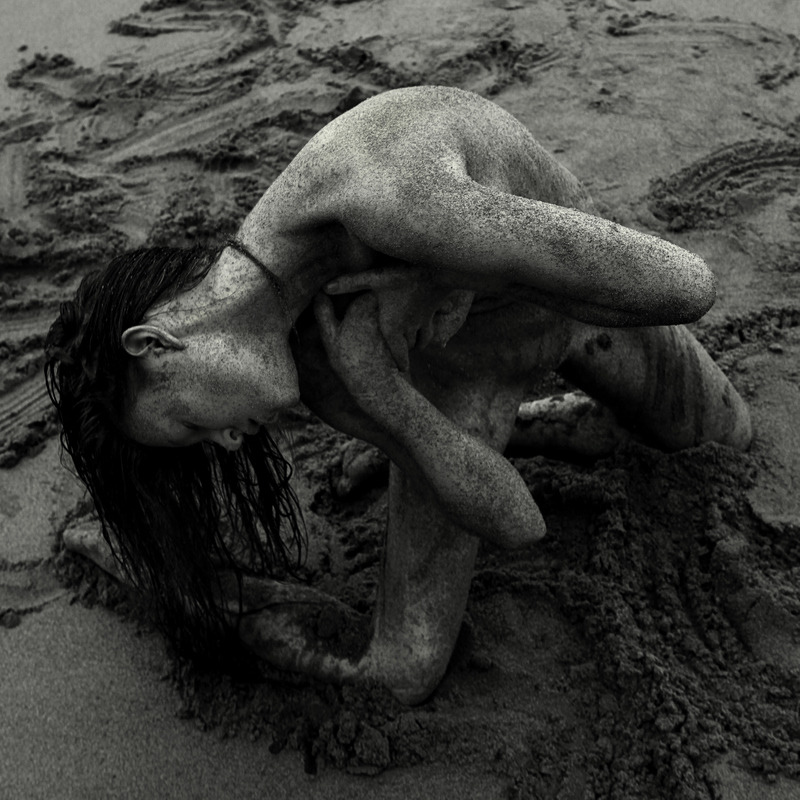
Miloš BurkhardtTitle Unknown (XXXX)

You know how a movie that is just plain bad is somehow always better than a film that squandered such great potential?

That’s how I feel about Burkhardt’s work–he images have potential but almost always come off as dull in their staid repetition of the female nude as a landscape within a landscape conceit.

The above is an exception. So much so, in fact, that I question Burkhardt’s editing eye–this flatly doesn’t belong anywhere near the photos with which it has been surreptitiously grouped.

Note the subtle shadow-to-highlight gradation between foreground and background sand. With the exception of her left elbow, the image is compressed to mid-tones/shadow ranges; accentuating the curving line of her back flowing into her neck and dark cascading hair. The line of her right leg jagging the eye rightward, following the angle of her thigh

Her contorted pose reframes her face and pubis within the larger composition–the focus is definitely sharper on her face.

I love the way the one strand of her hair is straggles along the back of her neck toward her throat. And I can’t really justify it but something about the position of her hands brings to mind both Gabriel Orozco’s My Hands Are My Heart and Pina Bausch’s brilliant choreography for Stravinsky’s Le Sacre du Printemps.

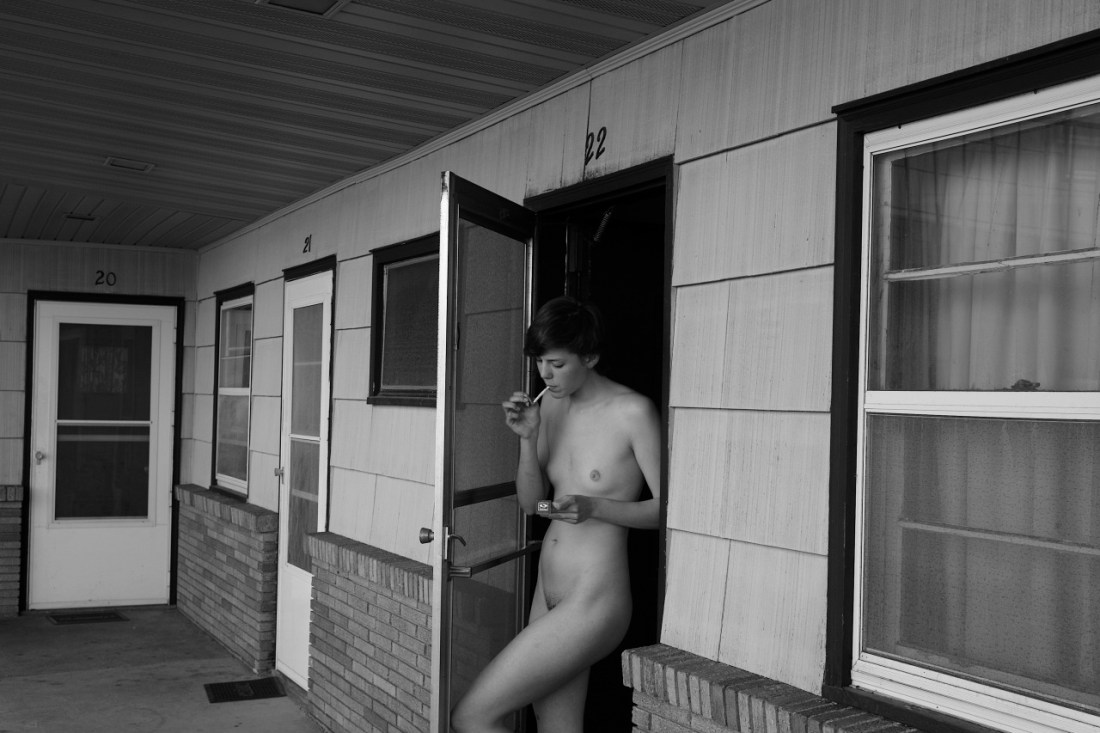
D. Robert StanleyEmily (2010)

I appreciate the effect this is chasing; an ex post facto insinuation wherein the moment portrayed implicitly addresses the events immediately preceding it:

  1. The image maker stares out across an empty parking lot, a Leica M8 dangling from a strap around his neck;
  2. He hears the screen door opening to his left. A young woman–not wearing a stitch, presumably his companion–stands in the doorway, a cigarette hanging from her mouth and fumbling with a book of matches;
  3. Registering the base elements of An Image, the image maker sights through the viewfinder while pivoting, rocking focus hard right then slow left as the match head flares, drifts upward;
  4. As the flame touches cigarette tip, he triggers the shutter.

Although I am tempted to refute the assertion that this is a ‘narrative’ image–it’s not; there far are more urgent fish to fry.

Here: I want to point out once again that I dig the idea underlying this. I really do.

I am bothering to reiterate that point because I am afraid what follows may really harsh the image maker’s buzz.

First, I am very sorry but this is not a portrait. Welcome to Name That Genre, I am your host Jon Rafoto. And oh, I’m sorry you said ‘portrait;’ the answer we were looking for is: street photography. (EDIT: Unfortunately, I got a ahead of myself here and started playing fast and loose with the terms. What I meant is that the perspective of the image is closer to street photography than portraiture but I conflated how with the what and that led me to attribute (wrongly) the content to the genre of street photography. This was a mistake.)

See: a portrait preferences the subject over their surroundings. This preferences the surroundings over the subject.

Sure, I’ll see the ’environmental portrait’ call and raise with a ‘the tendency of a sitter in a portrait to acknowledge the camera’.

All that doesn’t even matter though because in this case I am holding pocket aces in ‘the camera that made this image was hand-held’. Now, that’s not to say portraits can’t be hand-held, they certainly can. But the failure to square the frame against the verticals of room 20’s door jamb to and the rightmost window edge is either shoddy composition or an effort to emphasize the pivoting pan of the photographer–suggestive of street photography.

Further, squaring the frame would have made the questionable compositional logic gallingly obvious.

That being said there are some insightful inclusions. There is an effort to include the texture of the roof as a compositional feature. As is, it doesn’t play. But the instinct to include it was excellent.

What was needed was either for the photographer to take two steps back and square the frame. Or to have a half-step left and squatted down. The former option would have shifted things even more toward street photography, the latter would have shifted it closer to portrait.

Both would have had the additional benefit of not bloody making the most annoying newbie mistake in the book–if you have to amputate with the frame edge do so in between and not at joints.


JoLee KirkikisUntilted (2014)

Browsing Ms. Kirkikis’ work, I associate it instinctively with Erin Jane Nelson’s early work.

Both capture themselves/friends in wistful moments, awkward spaces between presence and absence. Both tend to use image making as a means of documenting performances related to text or sculptural elements. Both have images featuring finger traps.

It feels to me as if both build out off a similar foundation: a sort of belief that the world is too big to feel small. In Nelson’s case, she led with her angst–as if her creative process were an interrogation room scene, with her playing the good cop, the bad cop and the suspect.

Whereas, Kirkikis is more circumspect; evincing a confidence perhaps not yet in her work but certainly in the searching nature of her nascent process.

It’s interesting to me that it appears Nelson has disavowed her early work. That’s a mixed blessing. Yes, most of her work was disturbingly uneven and much of what worked seemed a fortuitous accident. Still, she made a handful of images which indelibly seared themselves onto my mind’s eye. (I find it interesting the degree to which the work she is making now is aggressively confrontational.)

And while Kirkikis’ work would benefit from culling her extensive output to something learner, more focused… unlike Nelson, I think we’ll probably still see the above image recur as she matures along with her work.