Source: Unknown

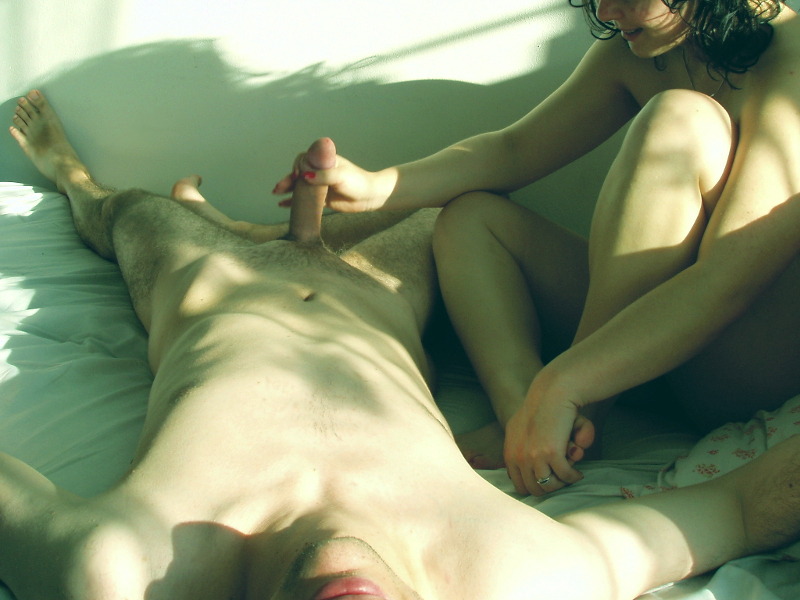
This is not an objectively ‘good’ image. Overexposure leaches color from an already truncated palate; while the framing–presumably orchestrated to preserve anonymity is painfully awkward. (Scooting the camera back as little as two inches and squaring the level would have done wonders.)

Still to my eye there is something magical here–although I am not entirely sure how to explain my meaning.

It seems–in my head, at least–more of a still from an amateur sex tape than a discrete image; I keep imagining how things will proceed from here.

Not knowing the source, it seems inappropriate to project my own sexual predilections onto an image that has fuck all to do with me, instead of reading and interpreting things at face value.

Here’s somethings things that grab my attention:

  • Both are smiling in playfully curious/knowingly smirking way,
  • He is laid out, open and on display while she is more curled into herself,
  • His pubic hair is carefully trimmed,
  • Her red lacquered nails draw attention to the slightest bit of motion blur, suggesting teasing strokes,
  • Her hair is a mess, having what could be a either bed head or post-coital, shower wet hair that has dried unevenly over the course or further lovemaking sessions,
  • And, she’s wearing what may well be a wedding ring.

All of it taken together suggests to me the crucial distinction between the taking of pleasure and the receipt of it. One is a central tenet, the prerogative of patriarchy; the other: demands a willingness to surrender, to become vulnerable, to let go and in letting go, letting another.

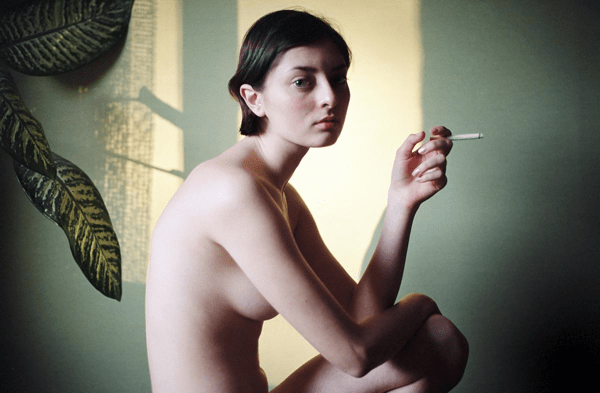
Holly BurnhamJacs Fishburne (2013)

This is my favorite image of Ms. Fishburne; it is painterly, enigmatic and fucking regal as all hell–it gives me chills.

Truthfully, I don’t care for Burnham’s overwrought, hyper-produced aesthetic. But I do find this image incredible. More and more, I think it’s due to Ms. Fishburne.

I am a not a model so I am wary of assuming any sort of understanding of technique or process. Yet, what I see as a mostly failed photographer is as if wildfires were capable of daydreaming and Ms. Fishburne somehow embodies such dreams in the moment the shutter snaps–not at all unlike Toshiro Mifune’s turns as Sanjuro.

In addition to modeling, Ms. Fishburne is a talented photographer, Her work shares a similar tooth and nail determination to remain present and unselfconsciously aware in a moment. (Actually, her images remind me of Traci Matlock & Ashley MacLean’s collaboration as Rose and Olive, only more searching,)

To do this sort of work–let alone to do it well–requires a well-developed, incisive inner life. It’s not exactly a full access backstage pass, but Ms. Fishburne reblogs work she digs/finds inspiring over at The Imaginarium of Jacs Fishburne.

Really anyone with an interest in the intersection of edgy art with pop culture should check it out. (It’s wonderful and I end up <3’ing about ten percent of what she posts.) But what really thrills me about it is seeing the way that the art and artist sees shapes both who they are and the work they go on to make. This is one of the truly mind blowing applications for Tumblr and Ms. Fishburne is out in front, miles ahead of the pack.

Margo Ovcharenko01 from Without Me (2008)

‘Intimacy’, ‘vulnerability’, ‘trauma’ and ‘stories’ are terms which recur in Q&As with Ovcharenko.

Although entirely befitting, they’re ultimately terms of abstraction.

In other words: what does one mean by ‘intimacy’: loneliness, togetherness, expressions of passion, etc., etc.

Don’t misunderstand: I am hell of fond of her work’s aestheticization.

Still, deep in the mix there’s something either coy and waffling; or–worse–intellectually dishonest.

I think it has to do with the way Ovcharenko speaks about her work.

In any interview with The Calvert Journal she offers the following explanation as to the implications of sex and violence in her work:

Sex and death are two of the most sensitive subjects for humans. The fear of death and the desire to prolong life by the passing on DNA are at the heart of everything. All of the social constructions that allow us to live in cities, such as the police and government, lead to perversions of these basic instincts. I am interested in how that works. I’m like a little girl poking a dead frog with a stick: I am sad and frightened but curiosity wins out. (Emphasis mine.)

It’s an adroit response that eschews abstraction. Viewing her work it’s easy to see her as a well intending child poking a dead frog with a stick.

Yet it runs counter to something on her website. (Note: I may be wrong in attributing the remark to Ovcharenko; how the quote appears is ambiguous due to a muddled layout. It could be attributed to the attribution is the author or several subjects.)

Pornography is an ugly and disgusting phenomenon. Erotic can be beautiful, porn–never.

Besides patently disagreeing with the statement, it contradicts her own admitted impetus for creating: what drives us to pornography except being sad and frightened but having curiosity win out in the end.It’s not merely that I disagree with her here.

Also, given her interest in depicting androgynous/non-gender conforming/homosexual folk, I find the absence of any explicit statement supporting LGBTQ rights considering the total clusterfuck in Russia at the moment to be somewhere between naively, tone deaf and irresponsible/exploitative.)

The last thing rankling me about Ovcharenko needs to be unpacked.

Remember that Wired article to which I took such umbrage: 10 Photographers You Should Ignore? It bothered me that the underlying point wasn’t that you can’t or shouldn’t learn from renowned fine art photographers; it was: unless you are making the work you want desperately to make then fuck off and die because you have no business behind a camera.

Fine art photography is a starting point; a set of initial vectors for approaching material. At some point the process and material will demand a very deliberative departure.

The problem is–just like religion–fine art photography is taught as if it is little more than a trigonometric function.

Until I come up with a pithy term in line with #skinnyframebullshit, I am going to call this approach to fine art photography as a trigonometric function as ‘photography as a function’.

The notion arose earlier this week while I was trying to write about Harley Weir.

I’ve run into her work a handful of times. It’s clean, solid. There’s a unity of content and form, muted colors, grounding in art historical perspective/scale considerations–it is what I expect fine art photography to look like.

But I felt fuck all for the work itself. Until I saw this; my brain did this thing it does where it leaps free associative and anchors images to music. I heard that line where the song says: 

But for now we are young
Let us lay in the sun
And count every beautiful thing we can see

I realized this feeling of being young, in love and overwhelmed by the beauty of everything was the raison d’etre for Weir’s images.

Now: why isn’t that made obvious by the work? Perhaps because there is too much emphasis placed on aestheticization and not enough on simplicity and clarity of effect.

(I dig Heidi Systo but her work is just as much photography as a function as Ovcharenko or Weir.)

I do feel an undeniable connection with Ovcharenko, though. In fairness, while the above dates from 2008, and while her newer work does little to avoid repeating the aforementioned pitfalls, it is at least much sharper.  For example, I am in love with 07 from her Hermitage series. It stands out from the rest of the images as a young girl who is bored with poking a dead frog with a stick, so instead she pokes it because she’s suddenly curious about why poking it makes her sad and frightened.
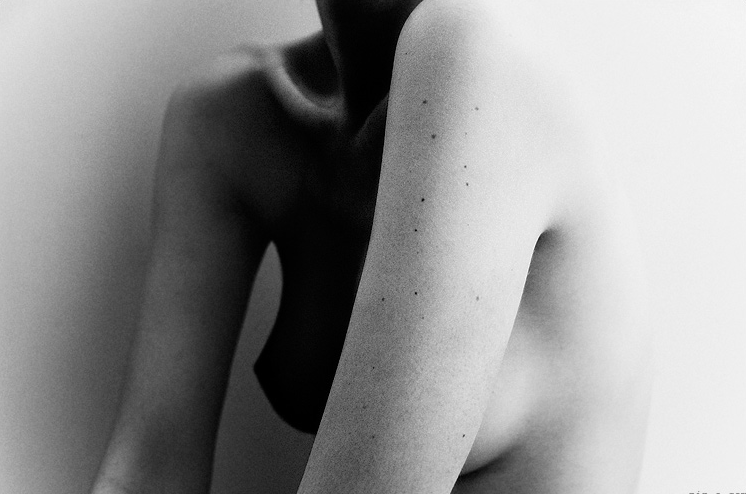
Nina Ai-Artyan10 (20XX)

What draws me to this image is ultimately what alienates me from it: the impossible-ness of the boundary between middle-grey and nearly-black running along the inside of her left arm.

It’s meant to look like an analog print–although I’d wager it’s a digitally post-processed negative scan.

There are two dead give-aways:

  1. Although it is possible to exert God-like control over a traditional darkroom wet print; even with Edward/Cole Weston caliber perfect prints, the result will never be as clean as this.
  2. The white at the right-edge and especially in the upper right corner would not produce a tone distinguishable from the paper backing.

Ai-Artyan has done traditional darkroom work. Yes, her prints are sloppy; but accompanying the mess is a sense of struggle, of painstaking labor, a sense ennobling the resulting work in a way from which her remaining work is bereft.

I don’t mean to be overly harsh–the necessary raw materials for greatness are present. All that’s missing are some shift in perspective–inspiration maybe, more likely desperation–and a commitment to the truth underlying the image above everything else.

Dane – Johanna Stickland (2013)

First off: this is really the first time I’ve put a face to the name Johanna Stickland and Jesus Harold and Maude Fucking Christ on Christmas she is breathtaking.

Looking back I’ve seen oodles of her work before but it’s never clicked until this that it’s the same young woman in so many wonderful images.

I won’t lie: I am completely taken with this. If you’re a regular, you’ll ask: but what about your intractable opposition to #skinnyframebullshit?

It’s not #skinnyframebullshit. Why? Well, the composition doesn’t echo the model. Instead, the frame is oriented in this fashion to compensate for both the lack of room (the area between the shrubs and the chain link fence is quite narrow); also, if the camera were landscape oriented it would create all kinds of problems–there would be even more of the bokehed fence (which as it is teeters at the edge of too much), not to mention the shrub which you can see jutting into the lower-right corner of the frame would appear in the frame and distracting from the loose one point perspective that constantly refocuses the eye on Ms. Stickland and her intensely penetrating stare.

Lastly, this fence–like so many of its brethern–is slightly canted. Ms. Stickland’s pronounced lean away from the fence combined with the upper arm intersecting so precisely with the first horizontal third expertly balances the frame.

I am curious to know more about the image maker responsible for this but I can’t find fuck all about Dane anywhere. Alas.

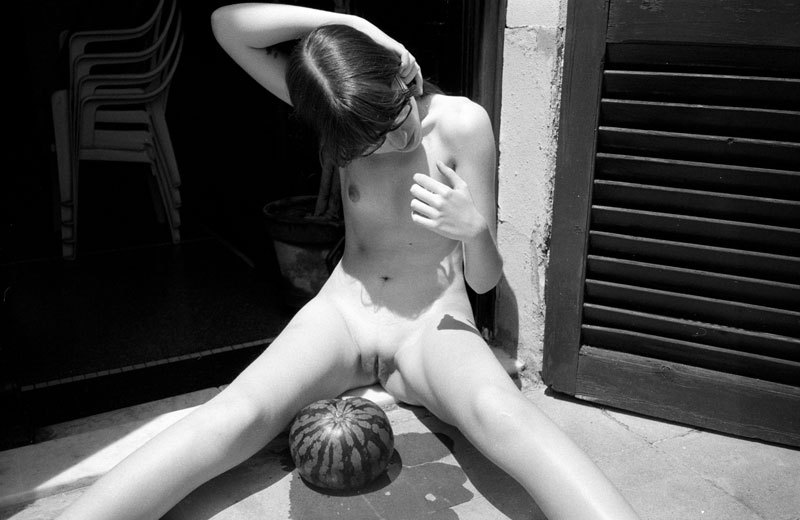
Giangiacomo PepeUntitled (2013)

PART I

Much of this rocks my socks: it’s shot on film, contains explicit nudity and the model is my ‘type’ to a T–thin with small breasts and geeky glasses; for good measure: throw in my permanent association of watermelons wjth Tsai Ming-liang’s brilliant (screw the critics) and perverse The Wayward Cloud.

There are at least two things about it that bother me, however. I don’t want to bring the body hair fetishism fire down, so let me start by saying: when it comes to body hair I believe–without equivocation– your body, your rules.

The trouble is due to the ubiquity of utterly depilated female bodies, undue cultural pressure against body hair exists and by existing it makes it more of a struggle to go your own way.

There’s the matter of her amputated legs, too. (Such is never justified–especially in the context of images featuring full-frontal nudity–but at least there is a compositional sense to it–her navel marks the center of the frame, the upper frame edge just misses her raised forearm and the concrete door jamb running along the second vertical third.)

I feel compelled to compare/contrast Pepe’s work Lina Scheynius, Igor Mukhin and Ren Hang. Yes, there’s extensive variations in styles, themes and tone: Scheynius is playful, Mukhin, insular and unflinching and Hang walks a fine line between confronting taboos and centering them on his audience.

In a similar vein, Pepe leads with his fetishizing of the female body.

The feels such fetishizing gives me are a complicated knot I’ve been wrestling to unravel for more than half a decade.

(PART II)

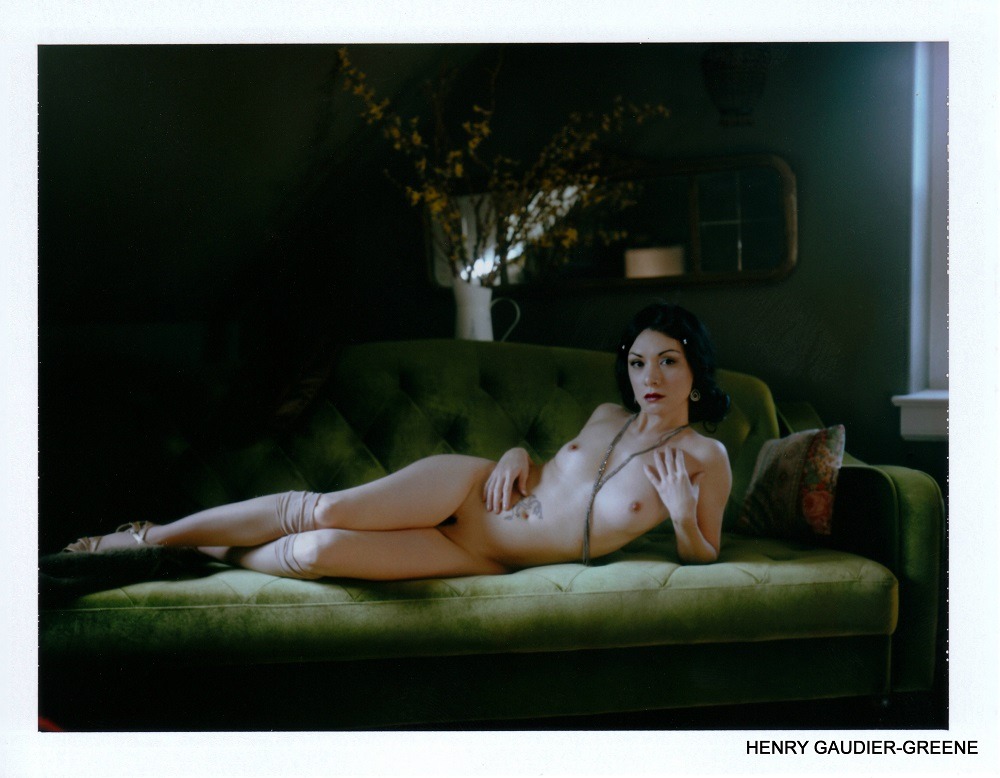
Henry Gaudier-GreeneTanya Dakin: Absinthe and Caviar for Breakfast. (2013)

One (1) of six (6) 4×5 Fujiroids created by Gaudier-Greene and Dakin appearing in Issue 7 of the always comely analogue only art-zine 62nd Floor..

Tanya Dakin is a Philadelphia based model/photographer/provacateur writing a book about her vagina; she shares explicit photos depicting her DD/lg relationship and has the most beautiful ink I’ve ever seen. 

Gaudier-Green is a photographer who shares my commitment to film and shoots with Pentax 67ii.

I dig their respective work with limited reservations–Dakin is a competent image maker but I am far more taken with her no safety net approach to life and the uncompromising openness with which she shares herself; Gaudier-Greene’s has preternatural aptitude for color work and any sort of instant film he touches becomes a medium for the transmission of god-like beauty; thus the lack of specificity in his B&W film work is never something I quite know how to reconcile.

They remind me of Luis Buñuel and Salvador Dalí: individually I respect the quality and care with which they craft their work; however, it always feels as if their personal work suffers from the echoing absence of the things that render their collaborative endeavors so effortlessly transcendent.

That’s not to say this image is free of problems and distractions–it isn’t. But between the attention to color and light, the wawker-jawed composition gets its volume turned down by the ‘realness’ of a fully-experienced unmediated moment in which two impressive talents merge into a single, uninterrupted and timeless genius.

Source: Unknown (Initial posting here, maybe?)

With depictions of desire, why is it at best & always a little of the good and a little of the bad?

I want to like this. That’s not fair–dismemberment of her right forearm and both legs by frame edge & #skinnyframebullshit aside, I like it: I swoon over freckles like it’s my job and I prefer giving over receiving. Credit should also be given to the bokehed emphasis of her expression/face as opposed to her body and her lover’s hand shielding her is a delightful gesturing.

Still I am hesitant to embrace; I think because it strikes me as a clumsy half-measure.

Yes, shifting depictions of sexual pleasure away from the usual male-bodied locus and onto female-bodied individuals is out-fucking-standing; but this well-intentioned effort only serves to reinforce the traditional one-dimensional view of female bodies as the singular site of all that is sexual.

The unfathomably talented Sarah Polley–who, duh, I LOVE–implicitly calls bullshit on the double standard with regard to depictions of nudity in her film Take this Waltz. It’s depressing how shocking it is to audience to have female nudity presented in the way male nudity is: i.e. as incidental and unconnected to sexual behaviors. This reprehensibly simple-minded conflation of female bodies with sexuality is fucking everywhere.

And it’s not not that female bodies are not or shouldn’t be sites of sexuality; they are and will be forever and ever amen. The fucked-up thing is they shouldn’t be the only such site.

Again credit to those out in front of this issue. I’m thinking of Beautiful Agony, Clayton Cubitt’s Hysterical Literature and clever work like this; or, any effort really to present sexuality as an extension of an interpersonal totality and not the requirement of a body.

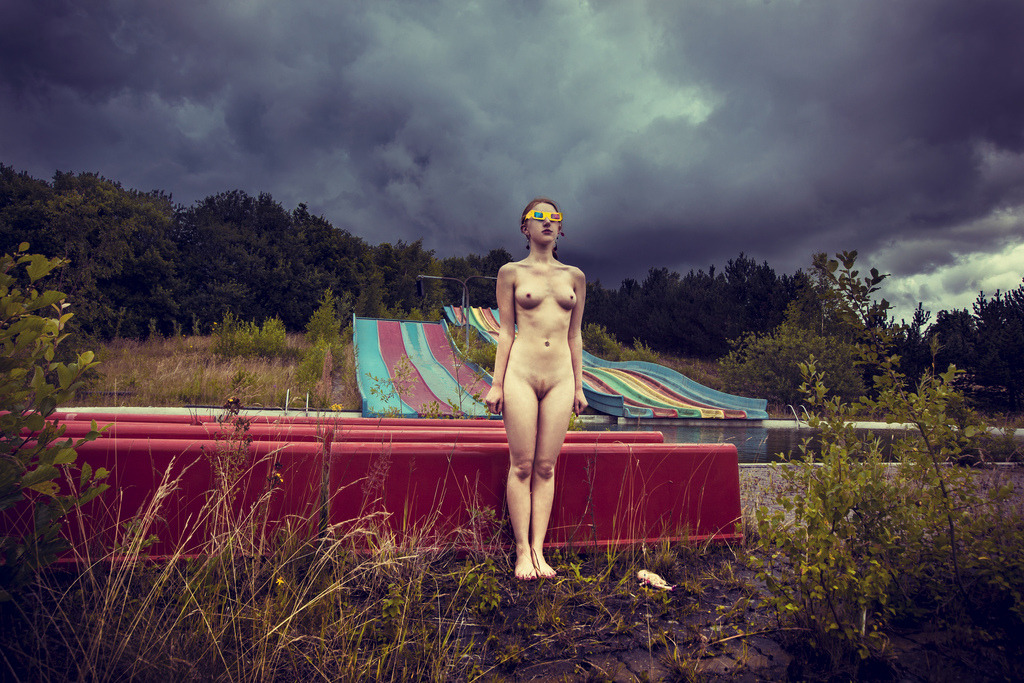
Jan Emil Christiansen – Book II (20??)

The colors in this are in-goddamn-sane. the punchy yellow of the 3D glasses…

…the cream + peach + magenta of the skin tone against the red plastic…

…and the exhaust blue + gun metal grey of the storm-roiled sky.

Still, something is missing…something about those glasses triggers a series of questions:

  • Why is she wearing them?
  • What is she seeing?
  • Isn’t she worried about the weather?
  • Why is she nude?
  • How in the hell did she get here?

For me, the patent lack of answers is not charmingly ambiguous, it’s fucking frustrating.

So… I breeze over to Christiansen’s website since his Flickr no longer has any shared content.

Frustration rapidly transforms into confusion. + I don’t mean confusion in the usual sense of being lost or uncertain. I mean more: how in the exact fuck did this cat ever make such a killer image?

Le sigh.

Jan Emil Christiansen is an Urban explorer; the above, ostensibly (not that you can realy tell) an Urbex image; making it the least Urbex-y Urbex image I’ve ever seen–which probably also makes it the best. (I give negative shits about Miru Kim’s ‘thinly veiled’ narcissism.)

Not to be all Debbie Downer on Urbex. I vaguely orbit the scene + in truth urban exploration environs figure prominently in my own work.

This issue is making images in such environs demands a hodgepodge of bastardized and otherwise degraded photographic conventions: a little bit o’ landscape, some documentary and some architecture thrown in for leavening.

Put another way: if an urban explorer is there  has a camera, there is a sense that the resulting images have an in-built relevance.

Mostly he abject wonder that motivates most urbex folks to bother taking a picture usually serves the resulting work. The trouble arises when airs emerge + pretense begins to take root.

Christiansen thrills at mixing his beloved hobby with a gumbo of contradictory ends in mind: documentary, horror films, erotic + portraiture. Excepting this image the single unifying aspect of his work its the appalling discontinuity between concept and enactment.

To see these tendencies in this image, you need to look no further than what stands out the most in the frame: the 3D glasses. They do tie the frame together fabulously.

But as has been noted, their presence suggests questions for which the image contains no answers. This has to do with Christiansen’s pick and choose approach to image making blissfully unaware that the glasses shift the image away from an uncomplicated ‘document’ and veer toward a mise-en-scène, of sorts. + the audience has no recourse to fill in the blanks necessary to suspend their disbelief, unravel the story and surrender to the image.

This could have been so fucking lovely; but all just sound and fury, signifying nothing–a fact which depresses + infuriates me me all at once.