The Monochrome Idattempting wonder, being watched (2016)

There are a host of problematic aspects with this:

The light is flat/dead, akin to the sort of light you get from a side table lamp where you have the hot hour glass spot pattern caused by the way the lampshade shapes the light but also as the diffuse spill the shade itself transmits.

The dynamic range is noticeably compressed–the darkest area being the shadow cast by the young woman’s chin; the brightest area is the triangular reflection (a skylight, would be my guess) in the mirror behind her right shoulder.

It’s some EGREGIOUS #skinnyframebullshit, too; further, the problems are compounded by the fact that– as I’ve talked about before: a frame’s functions is either restrictive or indicative (and really it’s at it’s best when it is a bit of both.)

The trouble here is that this frame is restrictive–with the exception of what I’m calling the reflection from the sky light–there is no sense of space beyond the frame being relevant to the information in the frame. This being the case, the frame lines are amputating the young woman’s legs rendering her immobile and unable to get up and leave the frame if she chose to do so.

I do have to give the image maker some props, though.  Despite the awkwardness of the angle of the young woman’s head there is a sense conveyed that she wants to be here and seen like this–the shadow cast by her eyelashes against her cheek, and the way her mouth (whether or not you can clearly see it) suggest her lips are ever so slightly parted and that she’s trying to tune into the sensations of the vibrator pressed against her subtly glistening clitoral hood.

Despite the numerous technical flaws, this does deserve some praise due to the fact that it manages to capture the vulnerability that comes from letting go of any sense of self to grab onto the visceral experience of pleasure with both hands. That aspect of it is crystalline in it’s clarity here.

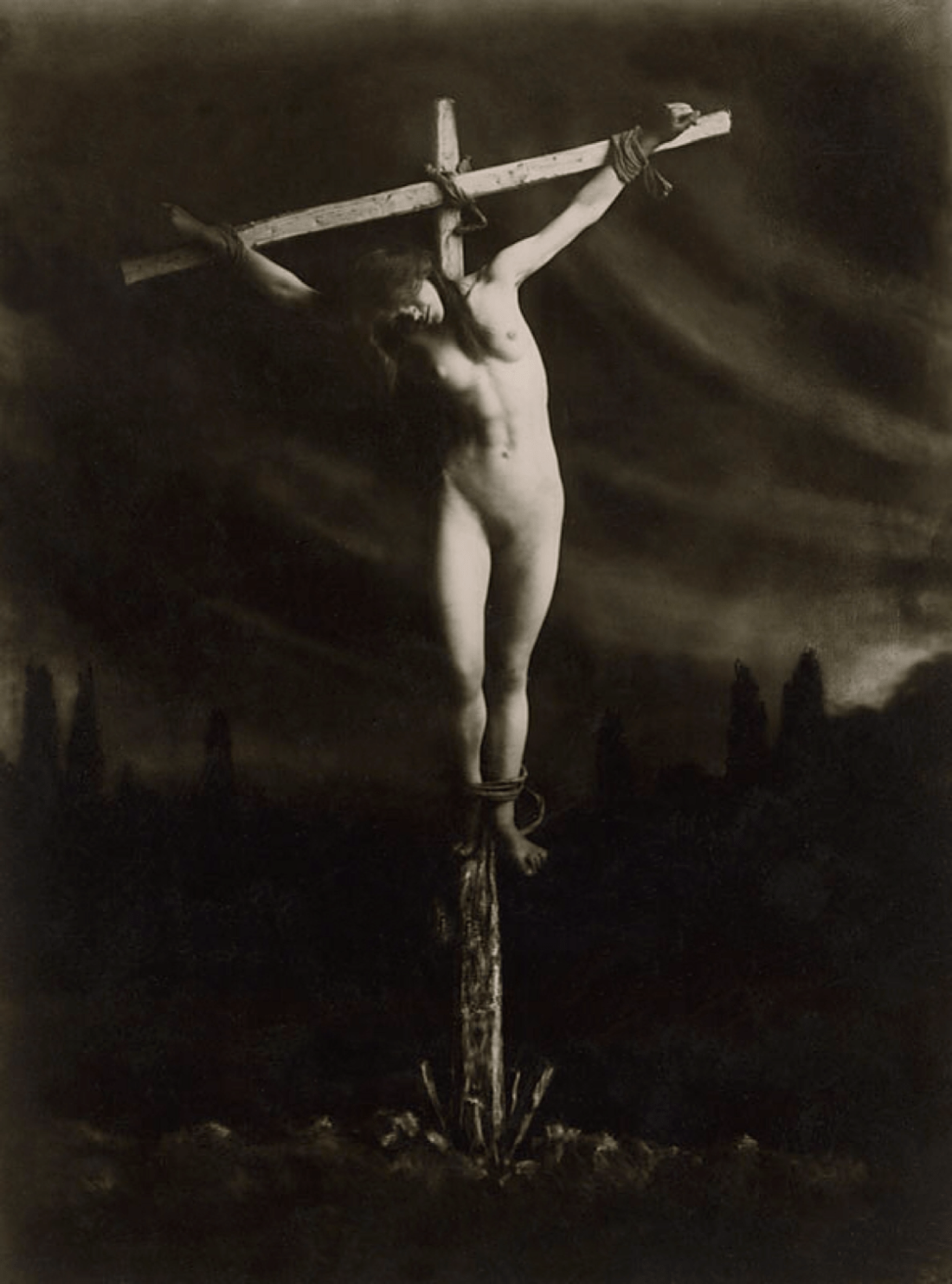
František DrtikolEstudio de la Crucifixión (1914)

My BFF was out of town visiting his poly partners. Ahead of this he arranged for me + a friend who is a trans woman to hang out.

It really wasn’t the best time for a number of reasons–the least of which is I am literally off the charts as far as being an introvert, I have social anxiety and I’m just generally not a people person.

Anyway–that’s all just set dressing–she asked me what I’d been working on and I showed her Gabriel Palencia Ubanell’s painting Martydom of Saint Eulalia.

Her response was instant: Ewww, gross. The last thing the world needs is so much as one more martyr. No thank you.

In the early and mid-90s, I was an obsessive comic book aficionado. I didn’t know who Clive Barker was at the time. (In all fairness, I still don’t really know other than he created Pinhead from those Hellraiser horror movies.

There was a quote that stuck with me from an interview he did with Wizard Magazine wherein he mentions that although he isn’t an Xtian, he keeps a crucifix hanging in his office because to him it is an aspirational image as far as the purpose of horror.

I think most maladjusted, troubled kids go through some dark patches. I had mine. I was supposed to write a position paper on the death penalty in sixth grade: pro or con.

But in classic me fashion, it ended up being a rigorously detailed explication of the various methods of capital punishment. (This was well ahead of my obsession with serial killers phase, FYI.)

I remember some really morbid details from that project. For example: death by firing squad leaves a hole the size of a grown man’s fist and essentially rips the heart out of the body.

You have to be careful when you hang someone; there is a ratio between height, weight and the length of slack in the rope. The goal being to fracture the spine in such a way that although your brain is screaming to your lungs to breath, the signal doesn’t ever reach them. Too much slack and there’s a very high risk of decapitation. (It’s theoretically not the worst way to go–especially if you consider that there’s anecdotal suggestions that as many as half of the victims orgasm in their death throes.)

The gas chamber was little more than al means of fomenting asphyxiation. Still, it pales in comparison to the electric chair–which it boggles my mind how the fuck that was ever deemed uncruel and usual. :::Shudders:::

The guillotine wasn’t a bad idea, actually. Except that the blade was frequently used so much it was dull and they had to drop it multiple times to sever the spine.

Crucifixion was not a pleasant way to go. As a kid I didn’t understand enough to understand the mechanics of it. I guess I romantically thought that the personal surrendered to public scorn and shame–which is what I think many Xtians actually believe.

However, crucifixion is actually a means of causing death by suffocation. Due to the way the body was hung, the condemned had to use their legs and their arms to pull themselves up in order to take a breath. Think about it like this: you can’t breathe unless you do a pull up and you can only breath so long as your head is above the bar. There’s no getting off and resting.

The way the romans typical crucified folks involved letting them go for a day or so and then breaking their legs to speed up the process. Now, bear in mind that you’ve been nailed to a tree and that you are essentially having to pull yourself up by the fresh wounds to stay alive.

As far as Mr. Barker is concerned, I’d have to disagree with crucifixion. Being burned at the stake was hardly a good way to go out but you did at least stand a good chance of dying from inhalation before the flames ever got to your body. The so-called Brazen Bull was an attempt to increase the suffering of the condemned while also adding the novelty of a spectacular unhinged voyeuristic thrill.

I think part of the reason I’ve been thinking about this is a result of several states in my own country going to extreme measures to execute those sentenced to capital punishment.

There’s legitimate question about whether or not the drugs are as ‘humane’ as we’ve been led to believe. There have been alarming accounts of botched executions, of people strapped in and writing in seeming distress.

Many of the companies that make these drugs have refused to sell them to state governments. Some states have bought them illegally. Others stockpiled them planing to use them far beyond their shelf life, in several cases block out hospitals that needed the drugs for legitimate medical and life-saving purposes.

Several states have opted to buy them through shady private pharma operations–with no regulatory oversight. These drugs have routine proven to be well below average as far as potency. Yet still the executions continue…

Conceptually the thing about crucifixion is that you essentially die how you lived–just at a substantively accelerated pace.

Whereas the concept of hell, emerged around the same time as we in the western world started burning folks at the stake.

While I was out in California last week, I said to one of my friends that I don’t really believe there’s a god because if I believe in that god, I also have to accept that he made this world and a hell on top of it, so essentially two hells. (To show my work I was unconsciously refering to this quote from Annie Dillard about the singularity of the giraffe in terms of creative impetus and this article about the current trend in horror movies away from torture porn–thank fuck and towards a fixation on existential dread.)

The trip out west went mostly better than I’d expected. I had purposely avoided placing expectations on it because I needed low-key and restful.

Unexpected, it became clear to me that despite the onslaught of doubts I’ve been having about whether or not it’s a good idea to completely up root myself and move, I did manage to get clarity on one thing: the Bay Area is where I need to be.

Beyond that, I don’t know. There was some other things that transpired and I’ve been thinking again if maybe I should step away from this project–if not to dedicate my job to an actual paying second job (like I have the time or energy for that) but it’s also becoming increasingly farcical that I write what’s essentially a sex blog. It’s artfully aware but it’s about smut mostly.

And it’s become apparent that’s just not something that’s ever going to be a part of my life. I am just too undesirable and broken.

There are days like today where doing this feels like nail myself to a tree and just waiting to suffocate. But I keep telling myself at least maybe one or two of you out there gets it and feels less alone.

I doubt it but it’s just another lie I tell myself to keep on going.

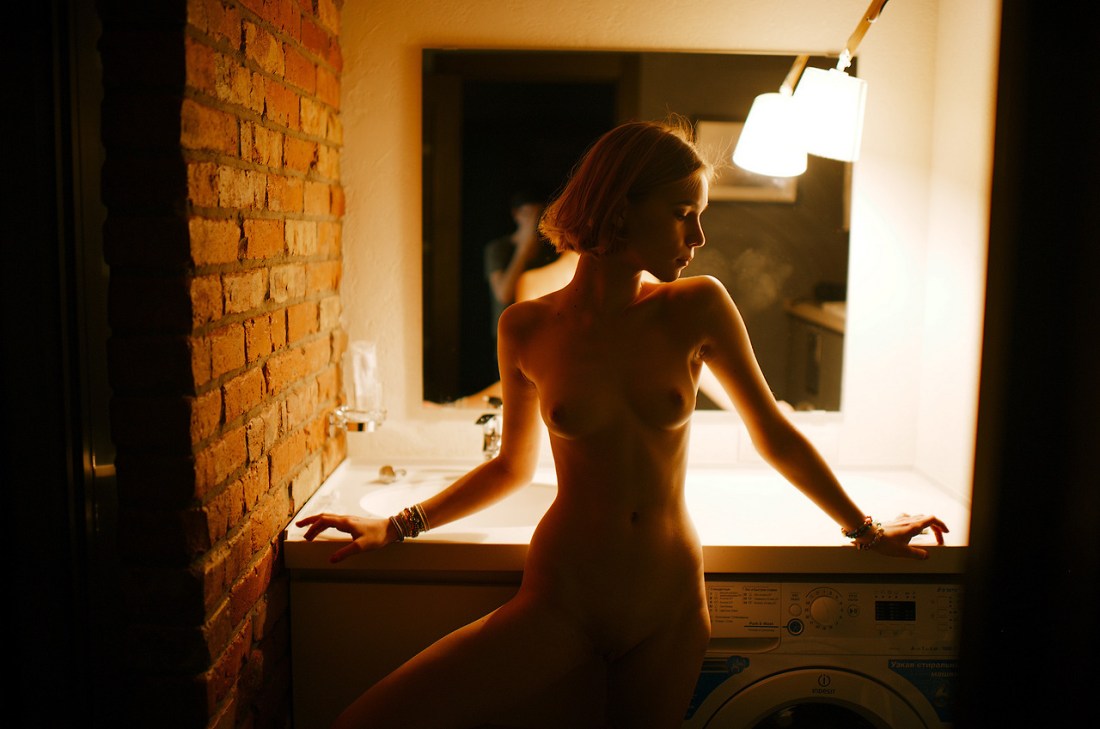
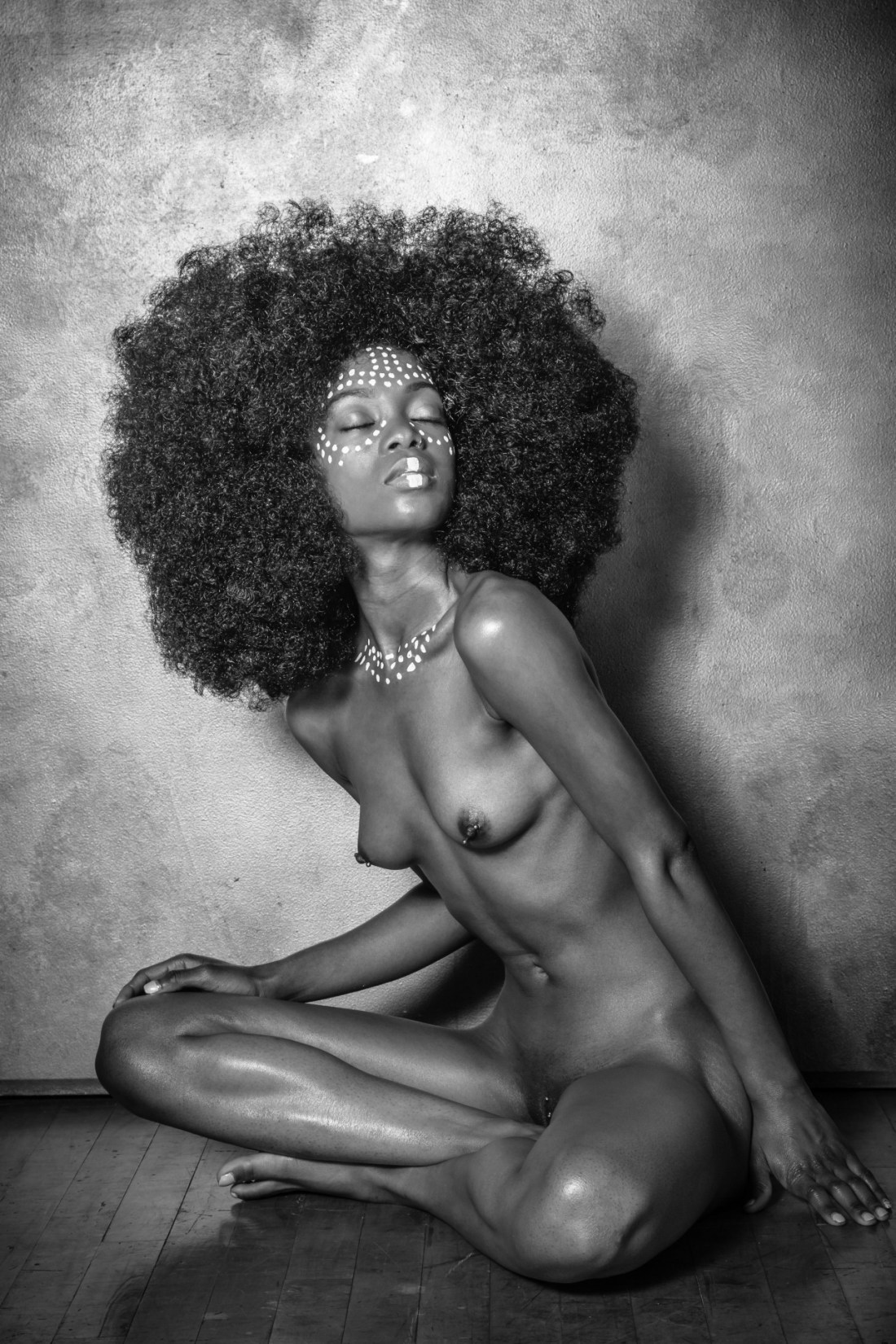
Marat SafinCamapa (2017)

This image has been shuffled around in queue for more than a month.

Initially, I wanted to focus on Safin’s knack for consistently presenting the women with whom he works–regardless of whether or not they acknowledge the camera/viewer–as reveling (for lack of a better word) in their own femininity; since, you know: that is the one consistent piece in his work.

This rapidly degenerated into a morass of attempting to balance an unbalance-able equation of problematics to virtue, however.

Next, I figured it was damn time I called out Brooke Shaden again–seriously her work is fucking inexcusably god awful. (The connective tissue being how both use over-the-top post-process intervention to justify their images’ existence. On the one hand, Shaden guilelessly embraces the Lynchian conflation of the grammar of surreality with the grammar of the oneiric–not that Lynch is inherently bad, it would just be better if more folks considered his work as a cautionary tale warning against any sort of casual and/or unconsidered aping of his style. Safin’s manipulation are similarly egregious but they integrate holistically with the images and never insist on themselves.)

For a while, I had it following this image in an effort to point out backlighting and then present something backlit and subsequently drawing attention to an aspect other than the backlighting. (A good teacher–and what else is a curator?–makes efforts to build occasions into the lessons where the student gets to feel smart but by paying attention/staying engaged.)

Yet… all the time the only thing I want to talk about is the fundamental Russian-ness of his work.

I mention this all the time but I’ve yet to define it in any sort of non-abstracted fashion. I think I may have found a way to do it–not now, but maybe at some point down the road.

See: looking at this image, I’m reminded of Igor Mukhin’s color work with the Leica AG M9 (an absolutely fabulous camera if you can stomach the astonishing cost)–specifically the vivid blacks it renders.

Safin is using a Nikon d700 with a 35mm f1.4g lens–as far as I can tell it’s the lens he’s used for most of the stuff he’s posted in the last year or so.

A good 35mm lens is an interesting beast. It’s wide angle without adding too much unattractive distortion–the wider the lens for example the more unflattering it is to say the dimensionality of the human face, for example.

Yes: Safin is not using it on anywhere near the level of precision and care as Mukhin; but credit is due for managing what he does with a camera that’s a fraction of the cost as Mukhin’s top of the top of the line kit.

An idea occurred to me in the process of unpacking all the above: I began to wonder about respective influences of these two artists.

All I’ve managed to find regarding Mukhin is that he studied with Alexander Lapin and that he cites Alexander Rodchenko and Lou Reed as influences.

Rodchenko is actually super useful in getting at what I mean when I point to essential Russian-ness of a photo or image. (It occurs to me that it might be interesting to create an infographic wherein the historical influence of Rodchenko is mapped.)

Lou Reed is more interesting. I dig The Velvet Underground just as much as the next arty fucker. And I’ve heard literally all the correctives about what a heinous human being he was. (Anyone who worked at Film Forum in the mid-to-late aughts can tell you stories that will strip paint off walls.)

But, as far as I know, Reed believed rock and roll could save the mortal soul. (I think this is one reason his work appeals to me so very much; I would not be here now if it weren’t for music, in general–but specifical Rock and Roll.)

I found the mention of the influence of Rodchenko and Reed in a blurb about Mukhin penned by A. D. Coleman. I don’t agree with all the author’s conclusions; namely: I’d bet a tidy sum on the fact that Mukhin was intimately familiar with Robert Frank before he began documenting youth culture in the Soviet Union in the 1980s, the notion that Mukhin is somehow inherently more conservative for not being familiar with/embracing the work of someone like William Klein is disingenuous, a bad faith engagement with Mukhin’s work and prejudices America’s role in the advancement of the photographic medium in a fashion that’s a little too imperialistic to be allowed to stand.

Interestingly–and I promise I’m working my way back ‘round to Safin, Coleman does at least imply the dual role of culture and individual taste in the creation of work. To the extent that Mukhin has lived in Russia all his life, his life has been impacted by state censorship then and now. I’m not entirely sure that his gravitation towards youth culture and it’s stock and trade in activities, practices and documents banned by the state was entirely innocent. (We move towards what moves us–so my thought is that Mukhin either already had access to western work most others wouldn’t have seen or he gained access to them through this path.)

But the question of how freely information flows and how it impacts questions of artistic influence is something to consider–all the more in the light of Mukhin vs. Safin; or: pre-Peristroka state censorship vs post-Soviet surgical censorship.

There’s a very fine line between doing the work and feeding the work. A better way to say it is that Andrei Tarkovsky always claimed that he was a better artist for having to navigate around concerns of state censorship–in other words: being able to convey his premise in both the shape, form and manner he intended while not running afoul of anyone.

I feel like as long as you are doing your own work and feeding the doing by critically, appreciatively and contemplatively looking at other people’s work–that’s a good place to be. The problem is that with so much information out there, part of the work becomes feeding the work and it’s dangerous to fall into that trap because that’s where it’s very easy to began aping the work of others.

And at the bottom of it I think that’s what I mean by essential Russian-ness the attempt to balance scarcity with abundance. Because speaking of mapping influence–an interesting project (and if anyone does this and does a good job I will actually post your work here): would be to map Marat Safin’s influences because I can’t think of another image maker whose work is such a who’s who of paen to virtually all the top notch internet famous photographers and image makers active today.

Danny LaneJohn Yuyi for Purple Magazine  (2017)

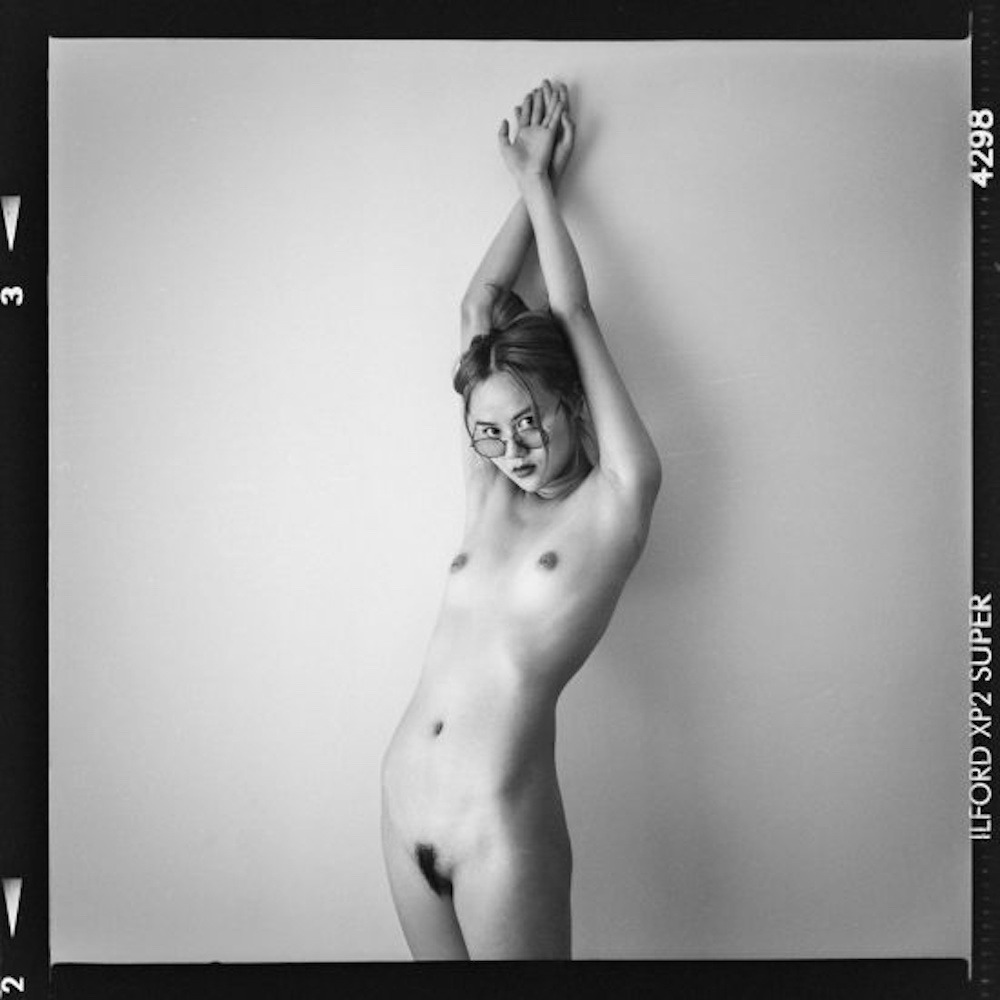
Perhaps the primary reason I’m less than fond of studio/studio adjacent work is that the point is–to greater or lesser extent–emphasizing decontextualization.

It’s sexy knickers on a model in a catalog vs you finally trying them on in front of a full length mirror.

If you’re going to make studio work, it’s a good idea to embrace the decontextualization and to show the viewer something about why the absence of more context was a necessary precondition of the work.

The above photograph succeeds marvelously at this task. It’s simple. A beautiful model, in front of a plain white wall. Light left to right, after the Baroque fashion. The pose is unusual, dynamic–fashionable in its artifice, but open, confident.

It’s an astute use of space–the balance between the positive space of the Yuyi’s body/posture vs the wall and shadows cast on the wall.

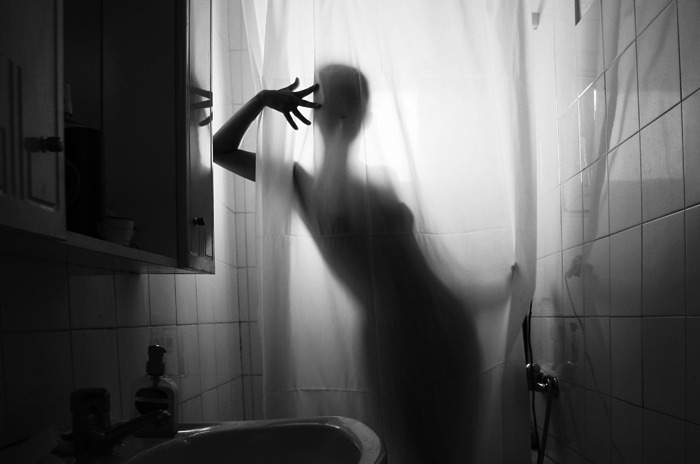
Diana Bodea#1 The Shadow from Touched by light series (2008)

Looking at this my first response isn’t to pedantically point out that it features backlighting.

As I am sitting here struggling to wrap my head around how to write about it, I am uncertain where else I might start.

See the problem isn’t noticing it’s backlit; the problem is focusing on the backlighting emphasizes technique over a more organic handling of the unity between concept and execution.

And what I want to talk about has more to do with the dynamics between the technical and the conceptual in this photograph.

Two days ago, Amandine spent a lovely day sharing time and space as well as practice our respective crafts–me trying to capture the interplay between color and fog along the coast, her drawing and painting dunes, people walking in the distance and the subtly variegated beach grasses.

Driving back we were talking about music. She asked me what I thought of Joanna Newsom. I said I had liked The Milk Eyed Mender. Then back-tracked that I was only really familiar enough with the track Sadie–which I adore.

My ex hated both Björk and Newsom because of their eccentric vocalizations. I felt the same way about the former–at least initially (she’s subsequently become one of my all-time favorite artists) but I wasn’t familiar enough with Newsom, so I sort of missed her work.

Amandine was telling me about how amazing she was and how I really should check her out. But she offered a caveat that one of her favorite of Newsom’s songs contains a mistake.

See the song Emily contains the following lyrics:

That the meteorite is a source of the light
And the meteor’s just what we see
And the meteoroid is a stone that’s devoid of the fire that propelled it to thee

And the meteorite’s just what causes the light
And the meteor’s how it’s perceived
And the meteoroid’s a bone thrown from the void
That lies quiet and offering to thee

She has it backwards, Amandine insisted. I mean it’s poetic and beautiful and brilliant but it’s the other way around, really.

I don’t know enough about it to comment but I do know–subsequently having listened to the album it’s on several times–it doesn’t matter, I don’t think.

Like maybe she created the lyrics based on being told it the wrong way around–which contributes to the meaning of the song, actually. Or it’s a John Donne-esque metaphysical metaphor of the soul–which again, contributes to the song. Or, it’s a rejection of science–again, something that fits with the song.

Whether it’s right or wrong, it works. And that’s kind of a rare and wonderful thing.

But it occurs to me that backlighting is the wrong thing to focus on in the photo about for the same reason it’s a mistake to get caught up in whether the rhyme about the difference between meteors and meteorites is right or wrong.

When I used to teach lighting workshops I would show kids how to set up a quick and dirty three point lighting setup. I’d explain that this is the key light, this is the fill light and this is the back/rim light. I’d then show them what each looked like independent of the others.

I’d then turn all the lights back on and explain the rationale behind this setup–it’s a stylization of how we experience light in the world around us. Like: if I’m standing in a field facing a camera and the lighting is behind the sun is behind the camera relative to my position–unless it’s straight on (a poor strategy if you’re trying for an aesthetically pleasing image because the light is too bright and people naturally squint when the light is in their eyes), then there’s one side that is incrementally brighter than the other. So natural light presents with a key and a fill light.

But light also falls on the ground behind where I am standing in said field. Yet, that light is like the fill light except it reflects enough light back towards the camera that because the body separates the light reflecting off the ground from the camera, it contributes a dimensionality to my body.

The point is–what we see we see only in relation to the way light interacts with it. The only source of light in this is presumably the window behind the shower curtain and the subject.

It’s interesting that backlighting combined with other lighting contributes dimensionality–yet we normally think of backlighting in terms of silhouetting. There’s a surprising amount of dimensionality in this. That’s partly due to the one point perspective imposed by the tile.

But the visibility of the mirror and the reflection of the hand, as well as the white sink gives a stark solidity to the image.

It’s a mistake to say: this is backlit and then just leave it at that because it’s how it’s backlit (how this is used formally and contextually to foster a sense of dynamic unity to between generally opposing elements).

An exquisitely refined work. Impressive and thoroughly unforgettable.