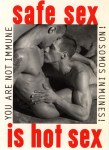
Steven Meisel + Bruce WeberSafe Sex Is Hot Sex campaign (1990)

Generally speaking, I am loathe to take taxis. My legs aren’t broken and with enough time I can walk just about anywhere I’m inclined to go. (Or, I can walk to a subway that will then take me to where I want to go.)

Recently, thought my flight got in super late and I had to be at work at 7am the next morning–so I cabbed it. Since I don’t take taxis, I don’t know if it’s just a NYC thing but the cab played this like 7 minute loop of commercials again and again.

One of them was an anti-drug campaign encouraging parents to talk to their kids about drugs. The premise was these teens in idyllic teen settings being–ostensibly–teens before asking the camera overly earnest questions about drugs.

The only reason I even noticed the commercials was because I was seeing it for like the fifth time. And like the third time I saw it, I’d remembered how it occurred to me late last year exactly how appallingly racist a lot of the anti-drug propaganda was in the mid-to-late 80s.

So it was through that filter that I saw the commercial and I realized something about almost all anti-drug adverts: their bread and butter is conflating drug use and drug abuse (two linguistically distinct terms–and that’s for a reason).

When you see things that way there’s only one option: eradication and selling that entails an abstinence only message. (Anyone who’s bothered to do any research into methods of decreasing drug use and abuse, knows the only statistically proven means of accomplishing this is through emphasizing harm reduction/education.)

But there’s more to it than all of that. The thing that struck me about the commercial I saw in the cab was that the kids in it were impossibly uncool. Like I remember seeing ads of this ilk when I was a teen and I just thought they were normal kids like me.

Yet watching the commercial I was like–these kids are lame as fuck. There’s this charmed naivete that each almost certainly had to be coached by the director to achieve. The notion that nothing bad ever happens in this world, nothing ever hurts and that if you trust in society’s virtue, you will be rewarded. And that’s just–such bullshit.

It’s not that abstinence (whether referring to drugs or sexuality) is a bad thing, it’s just how folks are or aren’t wired. The notion that if you teach someone about something they are more likely to do it is such rubbish. Education allows you to make more informed choices–it’s that simple.

And that’s what I love about these ads. Instead of being like sex is scary and should be avoided their like: sex is awesome, have as much as you can but be safe. It’s refreshing to see someone get it right for once.

Source unknown – Title unknown (201X)

My thought with this was originally merely to add one of those diagrams of what areas of the tongue register what kinds tastes. However, as it turns out, that notion has been thoroughly debunked.

First off, there’s no longer just bitter, salty, sour and sweet. There’s umami–which refers to something that is savory (I always think of it as the craving you get for a veggie burger cooked exactly to your preference.

Also, apparently these days they are thinking that fat may actually be a sixth factor contributing to taste.

Interestingly, it’s theorized that receptors designed to register sweetness are binary–they only register whether something is sweet or not? Whereas something that is bitterness has a vast spectrum of distinct variations.

Mike SteegmansKatrin Tonin (2016)

This was labeled as a Polaroid–but it’s not: Polaroid only made 1:1 and 1:21 aspect ratio instant film.

This is a 1:1.6 and change, making it Fuji Instax Wide.

Instant film (Polaroid/Impossible and/or Instax) is… well, let’s call a spade a space: a right royal pain in the arse to use. With Instax you’re talking roughly $0.75 cents a sheet and Impossible Spectra film is approx. $3 per sheet.

The Spectra gives you a bit more control but is EXTREMELY finicky; and as long as the flash doesn’t fire and you’ve positioned yourself to account for the shortcomings as far as the Instax Wide’s fine focus capabilities, it’s slightly more forgiving. (A caveat is that while I’m uncertain if they’ve fixed it in the new 300 model, the 210 featured one of the most lamebrained design snafus I’ve ever seen: the camera doesn’t have an off switch and as such it’s very easy for you to accidentally activate the lens without meaning to and if the lens cannot extend or retract unimpeded, it takes like ten seconds for the gear and groove mechanism to strip.)

All things being equal: it’s really a trade-off. Spectra can be much sharper than the Instax. But part of the allure of Instant formats is their limitations–a plastic lens is only gonna get so sharp. But that same plastic lens causes color diffusion–one of the reasons that a well executed instant film photo looks like nothing else.

(I used to say if cost weren’t a consideration, I’d use only instant film for color work. I’m learning that’s not entirely how I really feel. A well executed instant film photo presents color the way I personally see it–I tend not to notice color individually, I notice it in terms of opposition to or compliment for other colors. Yet when it comes to looking at representations of color, I’m more interested in conveying something experiential to the viewer (slide film is the better vehicale for that, I’ve found). A less abstract way of saying it might be to say that instant film always feels to me like This Is What I Saw vs slide film as this is what I saw joined with how what I saw made me feel.

Untitledhttps://embedr.flickr.com/assets/client-code.js

Emily WhiteUntitled (2016)

My life is so weird sometimes and the truth is I don’t even really think about it. It’s sort of like stepping onto a scale to check your weight everyday. If you do it–which I don’t recommend–then any weight loss or gain is gradual. You don’t think you’re making any progress, even though (over time) you are. (Similarly, when someone sees you in person and you haven’t seen them in a while and they’re like, gurl, you’re hair has grown so long! And you’re like, oh yeah, I guess it has… I see it every day so I lose track.)

(Bear with me, I’m taking the scenic route back to the above image.)

In the weird thing that is my big gay life I’m actually internet friends with my favorite photographer. Mostly she shares pictures of her adorbs daughter, we kvetch about sexist men/how much bullshit this patriarchal society is, etc. She’ll remind me that I still need to see that Diane Arbus documentary she’s been recommending to me for months. I make sure she doesn’t miss new Björk videos when they drop–we both are perpetually stumped on the question of whether we want to be Björk or be with her…

Anyway, I showed her Emily White’s work and overall she was underwhelmed/dismissive. We’re usually so in sync–it was strange to have such differing perspectives.

One of the things I’ve always been adept at is explaining why I appreciate something. It’s rare that I’m ever going to say: I don’t know why, I just love it. I can usually give you half a dozen extremely concrete reasons even if you put me on the spot about it.

With White–for example: there’s a sense of narrativity. A bit like Lauren Withrow–whose aesthetic I dig but the impetus in her work is always so unequivocally narrative driven that I often fell that the work is more aspirational than accomplished. Like it’s open ended. Withrow cultivates a young, haute and rebellious cast of characters because she’s hoping that the people she’s making her work for will relate and sort of super impose their experience and expectations upon the characters in an effort to relate to what they are seeing.

It’s a narrative tact. But is it a good one? I’m decidedly in the detractor camp. I have this idea that every story contains a moment where if that moment is photographed you can even though you only see a fraction of a second in time you can extend a cinematic timeline in your mind that reaches forward and backward. You can tell how you arrived here and discern a bit of what is going to happen next. It’s a bit like Cartier-Bresson’s decisive moment–which I’m also a detractor from: it’s all too fatalistic for me. I prefer the latitude for various interpretations in Vermeer’s decisive moments that use universal tropes and familiar experiential anchor points to suggest a tonally cohesive narrative arc with multiple potential readings.

Withrow’s characters are effectively cardboard cutouts for what she feels are her audiences projections. Therefore it’s only narrative post-active engagement by the viewer. Whereas Vermeer is narrative to start.

Back to White: I find her work audacious because whether it intends to or not it presents a critique of both Withrow and Vermeer’s implementation. Intentional ambiguity and a range of universal and certain interpretations are replaced with uncertainty. (And I think there’s something that could be written on how she’s effectively deconstructing the Lynchian conflation of the surreal and the oneironautlical as interchangeable–they aren’t and shouldn’t be but Lynch has made a spectacular career out of playing fast and loose with the blurring of those boundaries.)

In her work, we know how we got up to the point in time we are asked to bear witness to. How? Well, if you’ve followed Deviant Art and Flickr famous young women photographers–the angst, alienation and efforts to exercise individual autonomy all resound. But what makes the work effect is that it avoids the ubiquitous exhibitionism for something that reminds me of something I read recently in a novel titled Black Mad Wheel (the second novel from Josh Malerman who wrote the incredible Bird Box–which I highly recommend; BMW, is largely and unfortunately execrable.)

Some cultures believe that when you take a photo, you’re saying this period, this phase, is over with, [s]o if you enjoy your life as it is, mourn.. Because now it will be as it was.

There’s this weird way that White’s images are cut off from the history which clearly informs their construction. And although there is not a sense within the image of anything sinister, the prevailing feeling of uncertainty with regards to where things go from here contribute both a beauty and terror to the bodies she trains her lens upon.

White’s work is–I’ll concede to my friend–not yet fully formed. And it does suffer from nearly a decade of angsty undergrad grrrl art. But if you can look past that, there is something ridiculous precocious in her work. Also, it’s nuttier than squirrel shit and probably has more to do with her going to a WASPy liberal arts college, but I swear to fucking Christ that I’ve been to several of the locations she’s uses in her more recent work. I know I haven’t but the sense of familiarity is utterly unnerving–and I like it very much, that feeling…

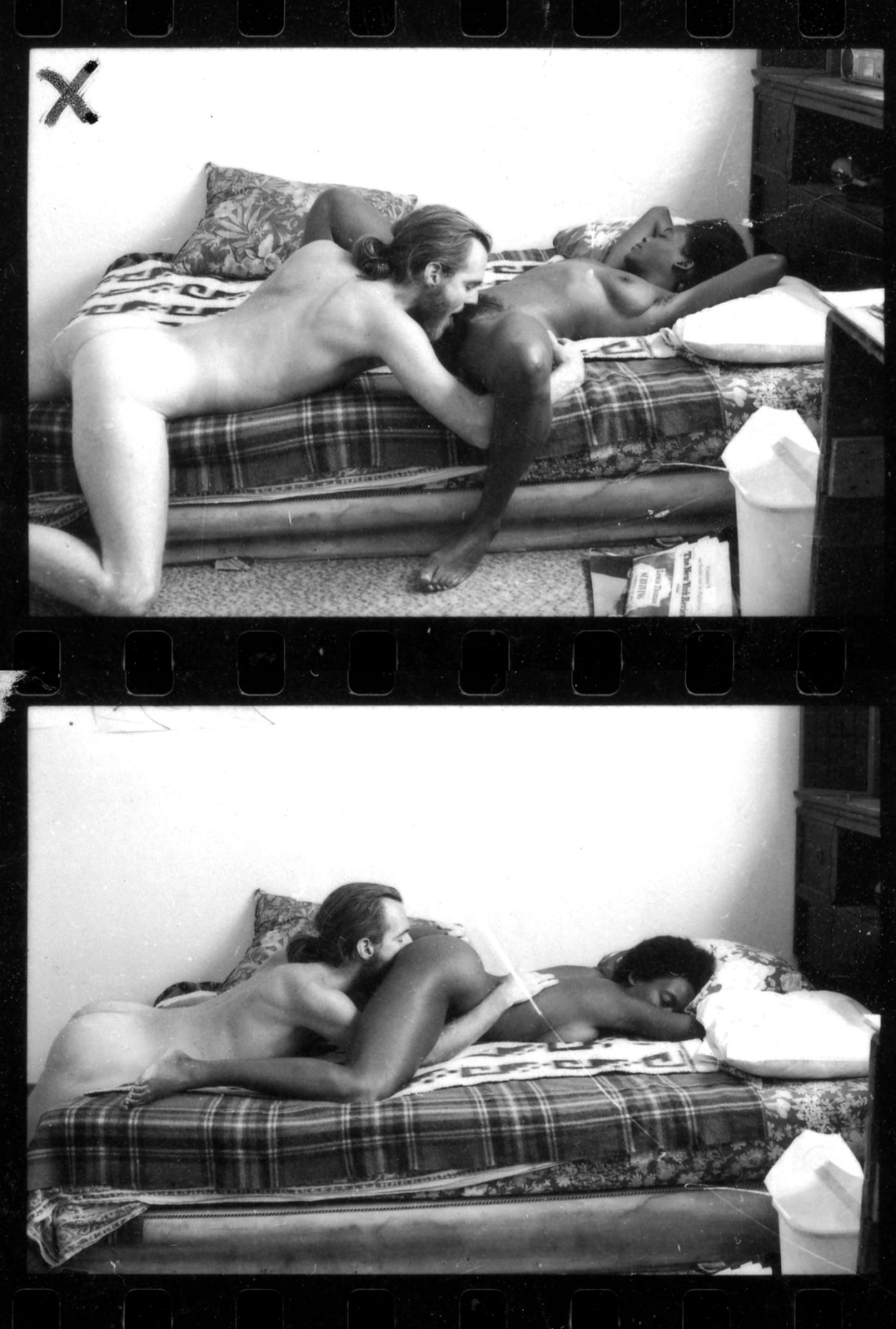
Source unknown – Colorado cunnilingus (1980)

There is a language
older by far and deeper than words. It is the language of bodies, of
body on body, wind on snow, rain on trees, wave on stone. It is the
language of dream, gesture, symbol, memory. We have forgotten this
language. We do not even remember that it exists.
                   —

Derrick Jensen, A Language Older Than Words

Source unknown – Title unknown (201X)

There’s this notion in acoustics called the Precedence effect.

Given two identical sounds in rapid succession, the two distinct sounds fuse into what is perceived as a single tone.

Interestingly, as long as both sounds can be heard before there is any echo, the sound will always be heard as if it is emerging from the first source, even if the second source is positioned on a drastically different axis.

I think there’s something similar with the notion of pornography. If an initial reaction to something is instinctively a knee-jerk, clutch the pearls OMFG, that’s pornographic, then I think the tendency is to lump whatever follows into the same category. Like that’s not something I think about that’s something I don’t care to see or want to jack/jill to.

Unlike acoustics, however, the porn precedence effect isn’t a result of biology, it’s a product of acculturation. I’ve always found it more interesting to ask questions like

What about this do I find arousing? What do I find off-putting? Why?

This leads to the questions what is done well? vs. what could be done better?

I think this is interesting because my first thought is not that this is pornographic. And it’s interesting that not seeing it immediately as porn widens the scope of my reactions to it.

I think about things like mutual desire, consent. How’s she’s presented completely in the frame–bearing in mind that this has almost certainly been cropped from a horizontally rectangular orientation.

(It’s also a bit sloppy. His arm is blocking her light but that mistake somehow contributes a great sense of personal agency and given her position and movement within the frame–which is compellingly dynamic–there’s no way this could’ve been shot from a different angle so as to not interfere with the light.)

This conveys a feeling of tenderness in intimacy for me which I think is as rare as it is adorbs.

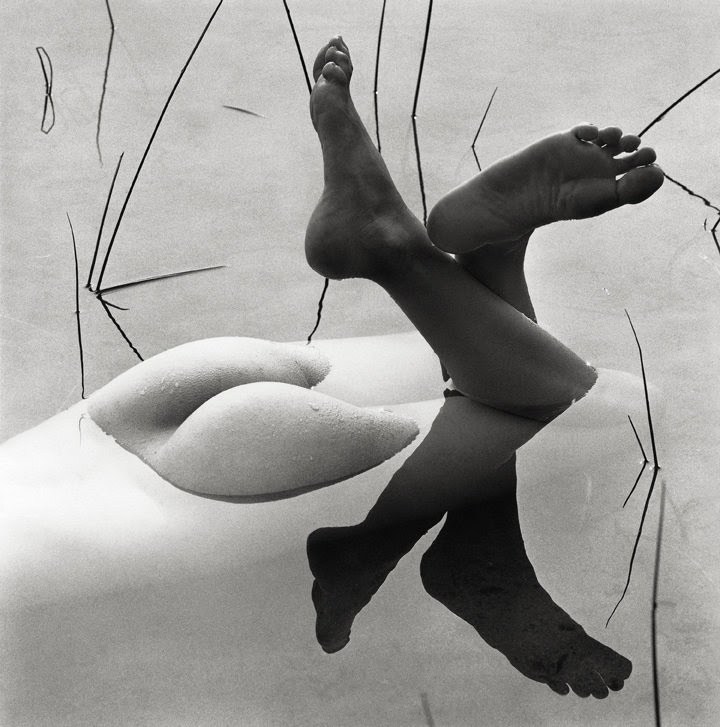
Cem EdisboyluFRG3519 (2015)

I’m trying to figure out how to talk to you about Edisboylou’s work.

As best I can tell the work is primarily digital monochrome. There’s no one unifying thread. Yes, there’s a consistent focus on the solitude-isolation spectrum and a fascination with an arguably too rigidly circumscribed preoccupation with femininity as form–which is, yes, you guessed it: problematic.

It’s been said that the edges of an image’s frame are like a thumbprint. In other words, through attention to what’s included vs excluded, it is possible to reliably determine authorship.

No one is every going to confuse a Richard Avedon photo with one made by Robert Frank.

Avedon and Frank aren’t really the best examples. Genre-wise Avedon was a fashion photographer/portraitist and Frank was a documentarian. (Salgado–a fellow documentarian would have been a better choice…but I digress.)

Edisboylou doesn’t combine his work to one genre. A few of his images qualify as portraits, the rest are mostly distinguished by lofty, fine art aspirations.

The thing I keep coming back to in struggling to figure out how to encapsulate his work is an analogy to alchemy.

Generally, we’ve come to think of alchemy as some bent back old nutter with a Fu Manchu beard pouring bubbling concoctions from one test tube into another and then holding them up to light streaming in through a single clerestory window into a dank, moldering basement lab.

Of course, we think that the alchemist struggling to untangle the riddle chrysopoeia is hogwash. Although alchemy as a metaphor for leading a fulfilling, creative life is entirely valid–and arguably one of the less fundamentally detrimental metaphors for leading a better life; we take transmutation of lead into gold as literal, therefore deeming it inexcusably absurd but give Xtianity (a profoundly flawed metaphor at best) and Catholicism (with its transubstantiation, bread to flesh, wind to blood–an appropriation of alchemy) a pass.

It has always fascinated me that virtually all ancient traditions have a tradition of 4 or 5 most basic elements. And there’s a surprising overlap in that they all consider fire, water, wind and earth to be. (The eastern tradition includes metal as an element.)

Interestingly, these 4 (or 5) elements prefigured the eventual discovery and implementations that eventually became The Periodic Table. (The proposed fifth element in the western tradition, aether, informed early manifestations of Newton’s thinking on gravitation.)

So while yes, water and earth both figure prominently in Edisboylu’s work, it’s really aether to which, conceptually, I keep circling back. I’m not sure I can explain to you exactly why. But I think it might have something to do with potential vs. limitation.

I’m not a mathematician–I don’t have the chops for it (although number theory intrigues me), but it strikes me that the alchemical systems tend to be open ended whereas science is focused on replicability and that which is measurable–empiricism. (I can’t help but revel a bit in the fact that Rene Descartes, essentially the father of science, retroactively applied scientific precepts to interpolate ‘truth’ as to the interpenetration of the physical by the metaphysical, the perniciously resilient mind-body problem, Cartesian dualism et al.)

Alchemy is about potential, whereas science is about limitation. Or maybe, the better way to put it would be that alchemy aspires to outward expansion whereas science seeks accuracy and precision. (And it occurs to me that I’m further complicated things by setting this notions up as a diametric opposition. I’m not sure that’s helpful. It might be better to say that one is a hammer, the other a screwdriver; each has specific uses and secondary uses, including substituting the tools for each other in the absence of the other. Am I the only one who’s used the handle of a screwdriver as a hammer and vice versa?)

Kurt Gödel‘s incompleteness theorem famously used math tor prove that a system of symbols cannot be proven as true utilizing nothing more than the symbols intrinsic to that system.

There’s a great deal that one might reverse engineer about psychology with all this mess but I’ve meandered rather off the beaten path and I’d like to get back to the image above.

Perhaps one of the reasons I struggle to talk about style using more than a few distinct handholds here and there is because style is a category and by delimiting a category into increasingly specific subcategories, one eventually ends up with a category that holds only one thing–and what use is that beyond specificity for the sake of specificity.

A good category is one that is specific enough to group things with a prevailing theme or concomitant purpose without excluding a panoply of related overlap or intersection. It’s for this reason that I think stream of consciousness is actually one of the few truly useful categories. I loathe Joyce, for example. Have mixed feelings on FaulknerThe Sound and The Fury can bite my ass but As I Lay Dying is effing brilliant. Yet I adore Virgina Woolf. (Part II of To the Lighthouse is one of the most incredible bits of writing I have ever encountered and I’m trying to convince myself to actually excavate enough time in the near future to write that essay I’ve always been meaning to write on the Influence of To the Lighthouse on Antonioni, specifically the ending of L’Eclisse and Tarkovsky’s Mirror.

To those who actually read through all this: thank you. I realize this has been inexcusable intellectual masturbation (not to mention self-indulgent af) but it seemed disingenuous to just deem it aethereal without showing my work w/r/t how I arrived at that conclusion.