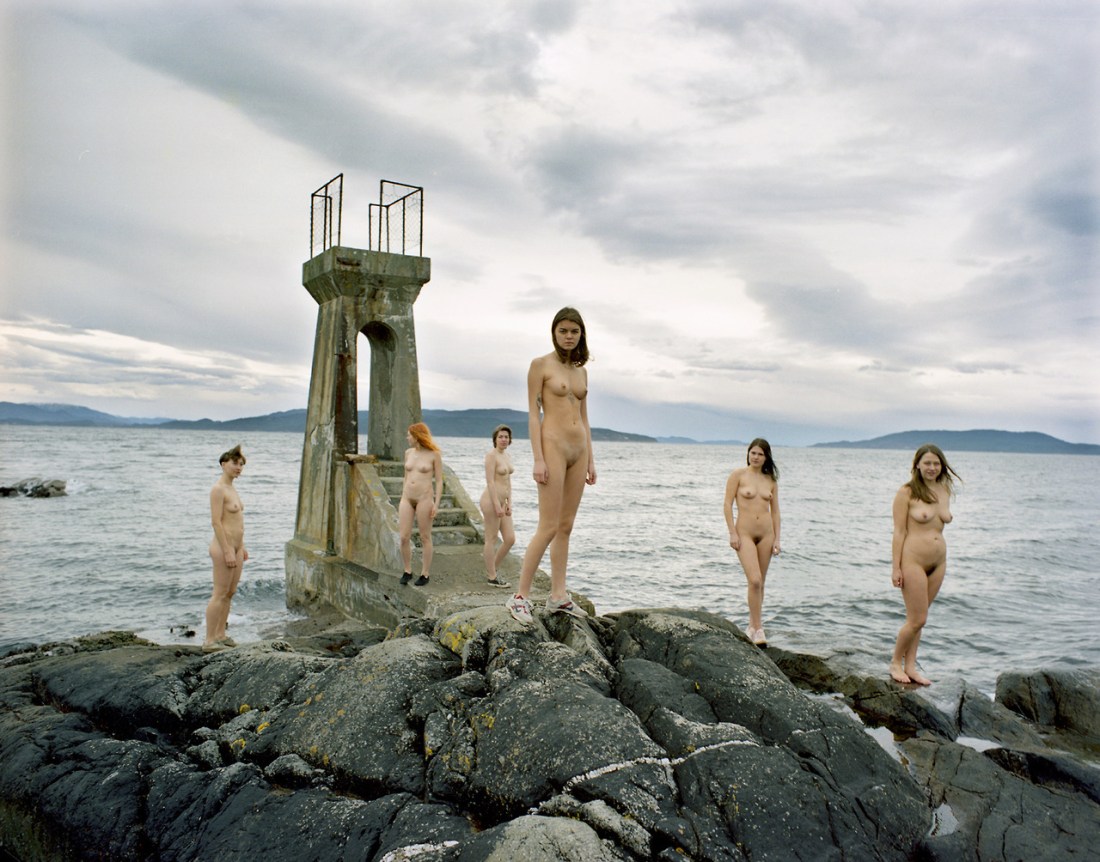
Linn Heidi Stokkedal – Haunting Hertevig (2017)
I have all sorts of #feels for Stokkedal’s work.
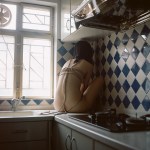
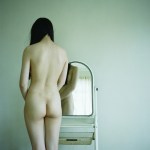
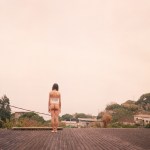
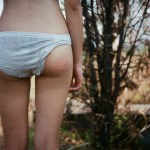
She hails from Scandinavia–specifically northern Norway. She favors film. (The above is Kodak’s ubiquitous Portra stock.)
In the course of this project, I’ve encountered her work on three separate occasions, each years apart.
My impression upon first seeing her work was–to borrow from Minkkinen’s ingenious Helsinki Bus Station theory–that she’d returned to the station a few too many times.
At first, her work was a mix of the sort of thoughtful but not necessarily innovative work of initial exploration upon picking up a camera for the first time. (What I’m beginning to refer to as the honeymoon period of learning the art of photography.)
Her work was a mix between fashion/glamour inflected editorial, portraiture and travel photography. The conceptual facet of the work was far more interesting than the execution–the fashion/glamour work evincing an unusual empathy, her portraiture suggesting a beginner conversant in both canonical luminaries like Robert Frank and Richard Avedon as well as crucial outsiders like Catherine Opie.
I browsed on–more or less forgetting about her until I stumbled onto some of the photos from her Felipe’s Cabin series. And while I’m generally not one to prop up the trying-too-hard-to-actually-be-a-thing notion of The Female Gaze ™–not because I don’t like the work that’s come out of such consideration, more that the notion is recursively self-justifying and as such tends to produce work that is limited in vision, execution, scope and impact. (Another way to say it, might be to note the work to which the term is applied and notice what artists reject it and which wear it like a gold medal–the former are almost categorically the only work of any lasting merit or consequence.)
There was a way in which Stokkedal growing interest in female nudes came across as authentic and ingratuitousness in a way that I’d not really seen before. Almost as if nudity wasn’t so much the point as just another possible fashion decision–I’d say another outfit but that would seem objectifying in a way that clashes with that to which I’m trying to point.
Her editing was super off kilter, ; with a fixation on self-conscious awkwardness. A diminution of technique and form in favor of immediacy of mood and tone.
Returning to her work now, I’m struck by a number of things. Her editing is still something I consider so endlessly bizarre as to be counter-intuitive. However, I’m beginning to see hints that there is a method informing the madness–a rejection of accepted norms with regard to posing, gesture and expression. (Something I relate to as a photographer who always wants the people I make photos of to act normal, not always point their toes and maybe even slouch a little–being themselves instead of stand in for some arbitrary at best socially accepted ideal.)
Stokkedal also has a rare knack for posing groups. (The above is a stroke of genius, actually–clustering the three women farthest from the camera together with the structural element in the background and then spacing the three other women who are more in the foreground closer to the camera, against the more prominent negative space of the landscape. Whereas normally you’d by more inclined to group the three women who are closer together more in the foreground to balance against the dominant concrete structure. This works partly because of the line of the clouds which drives the viewers eye left to right; also: there’s an understanding of the way the eye naturally interprets the six figures in different triangular relationship groupings given where the eyes is within the frame. It’s an attention to detail that very few people possess.)
Further, I’m intrigued by the fact that Stokkedal has an advanced degree in art history. I’m not surprised. No one with this level of attentiveness is ignorant of art history. But whereas most folks slavishly recreate the wheel–it seems as if she’s striving to strike out in her own direction.
Of particular interest is the fact that the title of the image Haunting Hertevig, as best I can tell is a reference to Norwegian painter Lars Hertervig. The difference in spelling seems like a deal breaker until you actually consider the paintings. In which case, there’s definitely overlap.
Here my brain sort of jumps the tracks a bit. Because I actually sort of dig Hertervig’s work. It reminds me of the Hudson River School (especially Thomas Cole) with a great big old caveat: the Hudson River School bores the crap out of me. Hertervig and Stokkedal are captivating.
This has been an issue with my own work. For years, I’ve resisted the label of my work as landscape–simply because landscape work tends to be an eyes glaze over rapidly, immediate turn off.
I think Stokkedal’s work has actually showed me a bit of why that is. It has to do with the argument John Berger makes in the first part of Ways of Seeing, where he talks about how there’s the first time seeing the Grand Canyon. But that for someone who has been there, in fact, lived there their whole life–it becomes mundane, regular and every day and the only way to reclaim that experience of seeing it for the first time is to watch someone else share it for the first time.
I’ve always struggled with this suggestion. The metaphor doesn’t completely work. It’s great for illustrating the relationship between the maker of a work of art, the subject of the work and the audience. Yet, watching someone else experience something for the first time is something in so far as we replacing seeing the thing with seeing someone else’s reaction to the thing–which is hardly the same.
Yes. That seeing for the first time–seeing as it were with the Eyes of God is indispensable. We need it for the total experience of art. But I’d rather go for a hike than look at paintings hanging in some stuffy gallery. I’d rather see it myself than experience it via mediated forms.
And I think that’s what Berger misses and I think why landscape work made by non-Americans does hold a big more interest for me: there’s a way in which boredom and the tomb of habit are an obstacle to my own creativity. The work that I make that means something to me is the work that manages to harness some bit of the initial magic of seeing with my own eyes for the first time. And it’s something I see in both Hertervig and Stokkedal’s work, actually.
(Lastly, writing this post has been the first time in years I’ve missed the peer mentorship of studying photography in academia. I’d do just about anything to have someone who made work like Stokkedal’s in my cohort–straight up.)







 Acetylene Eyes