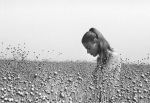
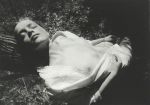
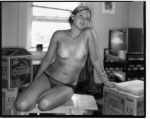
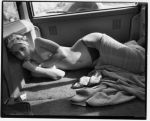
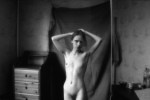
Taras KuščynskyjUntitled selections (196X)

Viewing Kuščynskyj‘s work it’s easy to get caught up in interrogating the anxiety of influence.

For example, you can’t see an image like this and not think of Arno Rafael Minkkinen; or, consider the way he frames subjects against backgrounds as a sort of revisionism of Koudelka where fixation on the relationship between perspective, space and people positioned in it it becomes less concrete, more oneiric fleeting/unstable.

Really though what ought to be celebrated about Kuščynskyj are his poses. And I think his work is only as good as the singularity of the poses he presents. The above all work because the way the subjects inhabit the frame is an organic outcropping of the environment. There’s a meditative lack of self-consciousness, an unnerving unity of form and function.

It’s probably not entirely inaccurate to draw comparisons with the Czech New Wave–since Kuščynskyj was making most of his work concurrently. However, I think arguable a bigger influence would’ve likely been André Kertész–who was also unparalleled at presenting people in moments of uncontrived immediacy.

(Another interesting exercise: there’s almost no way Emmet Gowin wasn’t familiar with Kuščynskyj. It’s fascinating to see the way Gowin uses the same sort of end–documenting unselfconsciousness–by adopting a wider palate of from non-contrivance to stylistically over contrived than Kuščynskyj. Yet, Gowin never managed to make an image that provided such a singular and perfectly realized pose as the middle image in the right column above.)

I find it galling Kuščynskyj‘s work isn’t more widely available. There’s some clips of his work laying around if you care to search for them and they suggest that what’s available of his work online is of shabby quality compared to the original prints.

Paul von Borax – Selections from SOOMBRE (2015)

Ninety percent of Borax’s work represents–to me–all the tendencies in contemporary image making that I consider inartful, tactless and conceptually bankrupt.

It’s not that SOOMBRE transcends those flaws–quite the opposite: it doubles down on them: presenting style as substance.

Typically, such a gamble doesn’t pay dividends. Here it does in at least some measure.

It’s honestly the aesthetic that gets me: the gummed edges indicating peel apart film, the soft focus, the replication of the sort of flat tableau that informed so much of Victorian photography–the way the artifice of constructing a set actually manages to increase the authenticity of the aesthetic. (In fact, I’m reasonably certain that the sets used in SOOMBRE were almost certainly predicated on a production design concept similar to Mark Romanek’s brilliant work on // | /’s Closer music video.

The other thing that works well is the implicit provocation of the staging. In the top image, the poses would be indecent were it not for the way the shadows play over the scene; the women maintaining eye contact with the camera makes a degree of voyeurism explicit–their expressions suggest that both are aware of being watched and aren’t bothered by the fact but also aren’t especially interested in it.

The bottom image toys with the same ideas but in a manner that is arguably more perverse. To me this photo hinges on two things: the position of the rear woman’s hands–less her right hand than her left; the latter being exactly on the line between contrivedly staged and unsimulated. The awareness of that boundary and the willingness to press up against it, in addition to the way the one woman seems aware of the camera while the other does not and the askew composition, gives a very real feeling that the scene is less presented for a camera’s aperture than a glimpse through some sort of illicit peephole.

Also, it would be disingenuous of me not to mention that fact that while I am typically into anything that fucks with the notion of the sacred vs. the profane, the use of crucifixes in this project is some milquetoast, weak tea bullshit. I’d kill to see what someone like Plume Haters Tannenbaum would do with this location. Like although there are definitely a few intriguing things about Borax’s work on this project, I don’t feel it reads as even a tenth as transgressive as it seems the creator would hope. Whereas, Tannenbaum would’ve made you feel almost deliciously dirty for looking at the images with such unrestrained wonderment.

Untitledhttps://embedr.flickr.com/assets/client-code.js

Camilla CattabrigaUntitled (2015)

I’ve said it before but it bears repeating: if you are a young photographer who wants to work in B&W, invest the time and energy necessary in learning to use analog.

Digital is garbage when it comes to B&W–especially at higher ISOs. (If you only have a digital rig, then you should unequivocally set it to some sort of monochrome setting before firing the shutter. Desaturating in post is always going to produce a tonally muddled image; monochrome settings aren’t much better but every little bit helps.

Also, an image maker it smacks of lazy, knee-jerk, half-assery when you stamp your work with a text-only watermark. I mean, an image maker is ostensibly a visual artist, so it’s just a wasted opportunity. (And that’s completely glossing over my rabidly anti-watermark idealism.)

Still, overlooking those concerns, there’s something fascinating about Cattabriga’s work.

She uses what I’d term wide or establishing shots and extreme close ups. With both, she pursues relatively flat compositions–alternating classical one-point symmetry and more minimalist, De Stiji at a cant asymmetry.

I could point to dozens of young, internet famous image makers she riffs off. But I think what’s most interesting about her work is the aforementioned alternating between wide vs tight shots.

I like her wide shots well enough. They demonstrate a rare contemplative patience. These type of shots tend to outweigh the closeups by a rate of about 4 to 1. This allows the close-ups to convey an unusual immediacy.

As much as I think that like the term post-rock is generally (and rightly) derided by the bands whose music is so labeled, it does at least point to some incredible music.

I feel similarly about the oft touted term ‘female gaze’. Generally, the people who embrace the term are full of shit. (Looking at you, Masha Demianova.) But I can’t look at Cattabriga’s close-up work and not be 120% convinced it applies.

And I’m not sure she sees it in her own work. The above image does not feature in the Nicole E Flavia series of which it is a part. I think generally a tighter edit would’ve added punch to the images but there is something to this image that pairs a little too well with some of the other close-ups, primarily I’m thinking of this one (which is effing incredible).

Also, I love how the image above depicts a state of eroticism that is independent of the audiences experience of titillation. The image doesn’t exist as any sort of invitation, it’s merely a record of white skin, touch and the proximity of bodies in a confined space.

I don’t think there’s ever a justified reason to decapitate people when making an image, but here’s a case where it almost works as long as these images are considered within the context of the entire series.

Source unknown – Title Unknown (20XX)

There’s no stretch of imagination wherein this could conceivably be considered a ‘good’ image.

Still, it gets me extremely hot and bothered (given that a scenario like this is one of my top five unfulfilled fantasies).

Yes, like so many fantasies/paraphilias there’s the pure carnality of the proposition. In this case there’s something more subconscious–a sort of instinctual resonance.

I’ve vowed to try to explain it but it’s probably going to be messy–so I apologize in advance.

Two weeks ago, Andy Wachowski came out as Lilly. Together with her older sister, Lana–who is also transgender–The Wachowski Brothers, filmmakers responsible for Bound, The Matrix and my personal favorite Sense8–are now the Wachowski Sisters.

Apparently, Lilly wasn’t exactly ready to be publicly outed but a British tabloid had begun nosing around–so it was only a matter of time and Lilly decided to release a statement to a local Chicago news outlet.

It’s extremely well-written–clear, measured, thoughtful and profoundly sensitive. I can’t recommend it enough, really.

One of the things that stuck with me is the following quote attributed to Jose Muñoz:

Queerness is essentially about the rejection of a here and now and an insistence on potentiality for another world.

In truth, I’ve thought of myself as queer for longer than I’ve known their was a word that described my precarious relationship to other beings in this world. I’m lucky in that I’ve had some amazing queer folks with whom my narrative arc has intersected.

All of those folks have been far more comfortable identifying me as queer than I’ve felt with using the word to self-identify. Lately, however, that’s begun to shift.

I’m not a competitive person. The closest I get is pissed off and irritable when mediocrity gets elevated to ‘greatness’ by the tasteless masses. (See: Humans of New York.)

I’ve never understood the heterotypical mating game. I don’t want to win you because I don’t want to own anyone else. I want someone who chooses to be with me and who I choose to be with in return. I’ve always thought that it has to be one person. Increasingly, I know it doesn’t.

Between Complex PTSD and/or autism spectrum tendencies, I’m decidedly neuroatypical. I have friends who tell me about their perfectly compartmentalized lives–friends divided into spheres of influence: work, school, extra-curricular interests; and then potential lovers–which are sometimes not even one in the same with those who are sought for romantic entanglements.

Hearing them talk about it exhausts me. (I can’t even begin to fathom how someone would enjoy living that way.)

Given that with the most rose colored prognosis I’m socially awkward (and borderline anti-social is probably more accurate), those few people that I care a great deal about while I don’t think our entanglement has to necessarily be sexual, I don’t understand the imaginary boundary that renders sexuality off limits.

I guess I just see it like this: sometimes a carefully considered kind word is enough to comfort someone, sometimes it takes a hug or holding hands through a shoulder wracking sobbing fit. And it seems there are times when someone is lost and that giving them pleasure, just seems to be the only thing that might possibly help sooth the hurt. But not just as a means of fighting against the darkness of sad times, as a way to share joy, express trust, etc.

I believe in the possibility of another world. For the last six and a half years, it’s felt like it’s only me that feels this way.

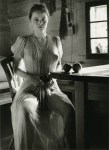
Ted Partin – [↖] Dallas (2008); [↗] New Have I (2004); [+] Brooklyn (2004); [↙] Brooklyn (2004); [↘] Brooklyn (2004)

I’m flabbergasted at how little of Partin’s work there is floating around out there in the interwebz–almost none of it on Tumblr.

Scanning the critical exposition on it, it’s easy to understand why–sadly, there’s a roughly two decade lag between what the gatekeepers of fine art will publicly endorse and great new work that is being made in the here and now.

Part of the problem is that critics–and I’m accusing myself just as much as anyone else–tend to shout about the easy connections. Folks want to contextual Partin as the heir apparent to Goldin and Clark.

It’s not that such connections are inaccurate it’s just that placing them side by side like that you emphasize a sort of insider’s perspective into the experience of counter culture youth. And that relationship simply isn’t borne out in the work.

Two more appropriate corollaries might be Ryan McGinley and Mark Steinmetz–the later as a result of the unmediated/unrehearsed immediacy of framing and McGinley’s fascination with youth culture is more in-line with the work than Clark; although even McGinely is problematic as he tends to fixate on fetishizing youth whereas Partin seems more interested in a sort of humanistic elegy.

Or, if you’re looking for brownie points: you could argue for interpreting the work as an allergic reaction to Winograd’s Women Are Beautiful.

Any way you slice it: it’s nearly meditative work that makes up for what it lacks in maturity and breadth of scope with a precocious and raw intimacy that somehow manages to avoid both documentary sterility and voyeuristic fixation.

Source unknown – Title unknown (201X)

From a technical standpoint, these images are rull bad–over exposed (most likely due to a low-end digital device with limited dynamic range), the framing seems pretty much random/offers limited context regarding setting (most likely due to limitations presented by the layout of the room) and there’s no evidence of any kind of blocking/staging.

Now, that third bit ends up working–to a certain extent–in favor of the images. The more or less cluttered composition and technical limitations draw attention to gesture and expression. For example: I absolutely adore the way the young woman on the right is watching her friend attentively while her friend seems pretty much focused on her own personal interior experience. (It’s charming the way the young woman on the right is pretty much always trying to touch her friend’s skin–even if it is only a small part of her leg. Also, note how both their legs drift open as the sequence progresses.)

There’s something else I noticed that I think warrants comments. It’s difficult to see but I thought for the longest time that the images we posted out of order. I mean: in the first frame it looks like the young woman on the right has already discarded her underwear, whereas it’s definitely still on in the second image. I spent about five minutes looking back and forth to realize that she’s pushing the vibrator down the front of her undies in the first image. I really like the way that the young woman on the left is less apprehensive about being more undressed but seems more shy about masturbating in front of someone else, whereas the young woman on the right seems perfectly comfortable with masturbating but less so with being nude.

I feel as if this is one of those images that while decidedly not art in it’s present instantiation has a great deal of potential to be–with better craft and execution–Art. The subject is resonate, the interpersonal dynamics incisively rendered and whether intentional or not the staging of the sexual action away from the camera at worst sublimates the typical issues of the art historical male gaze; or, as I would argue: frustrates them.

And I will offer one piece of unqualified praise: even with the intense overexposure the attention to color is astute–the pillows contrasted with the sheets. The matching pink of the pink top and the other woman’s pink knickers vs. the orange top and purple knickers.

Kerstin DrechselUntitled from if you close the door series (2009)

With the exception of The Cabinet of Dr. Caligari, I’m not all that fond of expressionism.

In fairness, I can’t imagine Drechsel fancies herself an expressionist. But I think there’s an argument to be made that while if you close the door starts off more classically photo-realistic as it becomes more enmeshed in the private experiences of loves, it begins to disintegrate into something that shares elements of expressionism.

I love how the work is at once both graphic and implicit. The sometimes fumbling awkwardness of the exchanges.

Take this image: I can’t get over the matching knickers. The way each partner is stimulating the other and holding the other at a distance. (The one on the left in an effort to watch her lovers body and the one on the right because she is approaching orgasm–note the way the partner on the right has her lips parted but at the same time this expression is partly elided by the clumsy shadow her partner is casting across her face.

I also really like the vaginal shape of the composition. It’s not at all subtle but in the context of the work it’s a powerful statement about whom and for what purpose the work was created (i.e. it wasn’t made for white cishet dudes to objectify).

Magdalena Franczuk – [↑] Untitled from Body Language series (2014); [←] Untitled from The Needle danced with the Thread (2014); [→] Untitled from Sailing the Big Sea (2014); [] Untitled from Mathilde and the other girls (2015)

What the eff is going on in Poland?

Seriously… for better or worse, I have become a curator. And whereas I’m frequently asked by folks I interact with AFK about various issues pertaining to photography/image making, I’m generally going to address specific considerations (i.e. the nature and functionality of color in lens based fine art will elicit references to Prue Stent), the female gaze (Arvida Byström or Ashley Armitage) best American fine art photographer (unequivocally Allison Barnes).

But if you ask me to create a top ten most exciting image makers in the world right now, I swear to fucking Christ, the list is probably going to be half women working in or connected distantly to Poland (ex. Allison Barnes is of Polish descent).

I’ve not done the above images justice by removing them from their rigorously-cultivated respective contexts. (It really is very much worth your time to click over to Franczuk’s page and tuck in. It’s goddamn breathtaking.)

In choosing images, to pass along to you I very much wanted to focus on both the incredible production design which went into making these. But, that’s also telling because the production design is merely an organic facet of the whole. There’s this constant balancing between curiosity and caution, between fantasy and reality.

And it’s all surprisingly racy–but whereas the rote pathway for most erotic work follows the line between explicit and graphic depictions of desire/sexuality, there’s a careful duality in Franczuk’s work; less implication than uncertainty with regards to where on experience (say: intimacy) ends and where another (say: arousal) begins.

For an artist in her early twenties, there’s a distinct visual voice and a strong sense of faith that the process of mastering technique and contemplating concept will result in a sometimes strange but always unshakable sense of something fundamentally true.

Absolutely amazing work.

Anna CladoniaVarious Portraits* (2010-2015)

I’ve been thinking about Emily Dickinson a lot lately.

Not due to any connection between It Sifts From Leaden Sieves and the fact it’s snowing balls outside right now. (Although I am hardly oblivious to the synchronicity.)

But, on that note, why do we teach Dickinson to middle schoolers by introducing them to the myriad complexities and nearly infinite scope of her work via the aforementioned poem and A Narrow Fellow in the Grass? It’s no wonder I hated her work until I revisited it in my twenties and immediately fell in love with the work and the incredible woman who made it. (Seriously: the think-question you tend to get asked on first dates about what person living or dead you’d most want to have dinner with, yeah… Emily Dickinson all the way. Even if I have grown to strongly prefer Bishop’s body of work.)

I promise… this seemingly self-indulgent ramble does relate to Cladonia’s devastating photographs–bear with me a bit longer.

My objection to the way Dickinson tends to be taught is that it tends to emphasize the allegorical (nature imagery) over the more metaphorical work. You’d do much better to start with the exquisite, goth-before-goth-was-a-scene I Felt a Funeral in my Brain… Couple that with the fact that the window to Dickinson’s bedroom overlooked a cemetery and even twelve year-old’s can easily grasp the incisive eye which uses words to describe the landscape of a morbid imagination.

However, once you dig into Dickinson–I mean really dig in–one line of hers takes on profound resonance: “my business is circumference.”

It’s an odd claim–especially from a woman who never traveled further than a day away from the house in which she was born. Yet, the acuity of her perception and her openness to the world and experiences in her immediate surroundings taught her in a fashion not unlike that of a storied traveler.

Cladonia exhibits a similarly circumscribed scope. Her photos are ostensibly portraits–largely shot in ramshackle Moscow apartments. But within those narrow parameters there’s evidence of an encyclopedic familiarity with the history of photography.

Beyond the essential Russian-ness of her work, the astute viewer can easily recognize winking references to virtually every Russian image maker I’ve ever posted on this blog–but especially to Igor Mukhin and Evgeny Mokhorev.

But there’s also grace notes from David Hamilton and Duane Michals.

Having and wearing your influences on your shirt sleeve doesn’t necessarily make for good work, unfortunately. But what Cladonia manages is less homage than a point of loving departure–she takes a great idea that resonates strongly with her and makes it her own.

In and of itself–that’s the mark of a truly great photographer. But there’s also the way she embraces and eschews obtrusive image grain, her spare and gorgeous use of autochrome-esque color (I + II). And that’s not even getting into her revelatorily explicit handling of masturbation and sexual expression.