Lightsong StudioEmma and Katja (2015)

One of the benefits of learning my way around a traditional darkroom when I did was that so many people were adopting digital that there were times when I would have a darkroom with 10 enlargers all to myself.

I kept trying to figure out interesting ways to manipulate my prints. My first experimental efforts was to make a perfect print of a diptych with images from two different negatives. (This is much more difficult than it sounds.)

I figured out how to use a print to make a contact print that rendered a print that reverted to the look of the original negative.

And then I discovered Witkin and Uelsmann and wasted an entire month trying to among other things: seamlessly splice half of one negative together with half of another, composite a scene from elements taken four different negatives. I made progress–but it was slow and cost prohibitively expensive.

Eventually, I realized that as much as I enjoy printing and am in some ways better at it than I am with a camera, I’d rather work with real people, on location and try to as much as possible produce the desired look in camera.

Thus I’m not really fond of this image makers work. The vast majority of it at least draws attention to if not serves as a comment upon its own artifice.

For example, the above image has been burned in to suggest a stylized vignetting. The skin has been ever so carefully toned so that the woman acknowledging the camera stands out by comparison to the woman with her eyes closed. And don’t get me wrong–I only wish I could achieve grading like that in my own work. But perhaps part of the reason I can’t is because the effect is achieved by obvious, heavy handed manipulation of the rest of the frame.

It’s unfortunate because there is something simultaneously post-coital and womb-like about this image. (And it would be stronger without the vignetting to goose the viewer.)

But looking at this something else occurred to me that should be presented as a basic rule of photograph to compliment the rule of thirds and the rule rergarding an odd number of subjects in the frame always being preferable to an even number–namely, if you have to have an even number of people in a frame, have only one acknowledge the camera.

Hans BellmerStudy for Georges Bataille’s L’Histoire de l’oeil (1946)

Bellmer is one of a handful of artists that I don’t really know how to talk about.

I know more people are put off by his sadistic bent and his obsessed penchant for depicting sexualized pubescent female bodies.

I’ll never argue that the vast majority of his work isn’t pornography and I think that to the extent that it includes children, such work is actually unconscionably irresponsible.

The trouble is that the work is of an unusually high quality. Much of it has–rightly, in my mind–earned the distinction of Capital-A Art.

So the question is: does being of an exceptionally high quality give the work a pass when it comes to elements that toe over the line in terms of child pornography?

My background is academic. But–if I may confess something: I’m not a good academic. I have no patience for genuflecting at that Freudian shrine. Yes, the man suggested and subsequently implemented a ‘functional’ framework for quasi-scientific analysis. But the framework was gallingly sexist, heteronormative and largely misguided.

The criticism on Bellmer bends itself into pretzel shapes similar to several of his Dolls, trying to use Freudian notions or Sue Taylor’s ‘feminist’ defense of the artist or Catherine Grant’s Bellmer as ‘queer doubler’ tact.

I can abide pieces of each attempt to justify Bellmer but I can’t really follow them down the garden path to their various conclusions. It’s too much heavy lifting for something that in my mind doesn’t require it.

To my way of seeing, history is Bellmer’s justification. Think of that Picasso quip made when his portrait of Gertrude Stein was criticized because she did not look like her image: she will.

Bellmer’s rage against fascism and the cult of the perfect body do not read as if they’ve dated in 70 years. They very much fit in with the Tumblr erotica vein and with the current emergence of this sort of misplaced hipster nostalgia, these images could have been made a month or two ago. (Note: they’d still stand head and shoulders above similar modern images.)

Ultimately, what I appreciate about Bellmer is that–like Balthus–the mission of his work was to disturb. However, unlike Balthus–who one has the feeling was almost always the smartest person in any room her entered–Bellmer was open and in your face about the considerations underlying the work, while Balthus strenuously avoided any attempt to fuel equivocations about his motivations.

I find it curious that critics are so willing to give Balthus a pass but grin and rub their hands together when it comes to crucifying Bellmer. Yes, Balthus’ work is arguably of greater quality. But there’s something tempestuous, resonant and grotesquely messy to Bellmer. It’s as if Balthus sought to prompt people to ask better questions so that they might receive better answers; while Bellmer was more interested in leading folks to nothing more than being happy with better questions in the face of a world which is incapable of providing anything like what we think of when we think of an answer.

Take Me To Your BedroomUntitled from A Bottle of White series (201X)

From the outset, I should mention that I have way, waay too many feels about this image to approach it critically. There are a number of things that in all probability are highly problematic with this frame–but I’m not really able to go there.

Why? Well, where to even begin…

I flat out do not understand why the parameters for being ‘normal’ and ‘well-adjusted’ so frequently demand a sort of pre-dissociative state. It’s like this is the compartment where my work experiences go, so let me put on my work person-mask and get down to tit. Oh, this is the cubbyhole where my personal experiences go, let me put on my personal person-mask. We are ourselves perpetually for the time between our mothers and some maggots, why are we so damned and all fired determined to equivocate?

I know it’s not always that simple to dodge such equivocation. I mean consider our language. What percentage of our words describe visual stimulus? There’s words referencing a spectrum of light to dark, the totality of color, texture, etc. With sound we have a widely varied set of linguistic indicators–but (and I don’t know this for certain, I’m merely thinking out loud) there’s probably half the available words that describe what we hear than the total of words to name what we see. Smell and taste being a physiological response with overlap, feature much of the same language–which again is only a fraction of the total available sound describing words. When we get down to touch–what’s left: hot, cold, dry, wet, hard, soft, rough and smooth, essentially.

I know there are exceptions and that I am committing the most grievous sin of generalizing here but it feels like we use this sort of either or dichotomy when it comes to touch as a means of ordering shades and tonalities that do exist between extremes but are very difficult to fit to words.

For example: it’s very difficult to express concern, empathy and sympathy to someone who is grieving. We reach for stupid cliches–I’m sorry for your loss. How the fuck can you be–the nature of my feeling of loss is goddamn singular you fatherfucker! That’s part of what sucks so much is it’s a burden that only one person can carry.

I know there’s the whole sexist society coloring things as far as the experience of physical things go–the bullshit virgin whore dichotomy–another either/or for you. And you can’t discount that as it seeps its toxic way into everything. I’d like to think there’s another way, somehow.

It’s easy to point at monogamy and other aspects of patriarchal heteronormativity as roadblocks. And I’m aware that a counter-criticism can be leveled against me that I’m just cratchety because I am terminally unrequited. But honestly, although it’s true that I do feel terminally unrequited, I do not sit around all day bemoaning the fact that no one wants to fuck me. What frustrates me is that I almost never know the right words. I’ll frequently try to explain what I’m thinking or feeling to someone and they’ll be like, yeah, sure, I get it. And I’ll be like do you? I have no idea. With touch it’s clearer… or maybe that’s a poor way of putting it. If touch is misunderstood, the misunderstand is like a jolt of electricity–there’s no ambiguity as to whether or not things haven’t been muddled somehow.

As usual, I’m abstracting. Let me try to be concrete: during my Junior year of college was one of the three times in my life I’ve been suicidal. I was very close with my flatmates–even though I’d known not a one of them prior to moving in with them. Amadine (not her real name) had the room next to mine. I wasn’t as close with her as some the other five, but she was always staggeringly kind to me.

Everyone knew I wasn’t in a particularly good place but I think Amadine was the only one who picked up that it was actually a far worse place than I was letting on. With only maybe two exceptions, for three months, she would get up just before I was leaving for the day and stand in the hallway between me and the front door. She’s spread her arms and say sleepily: hug. And she wouldn’t budge until I complied.

The first couple of times I was furious with her. Everything about it felt manipulative. But since she always went out of her way to be so exceedingly kind, I couldn’t really justify how angry her insistence made me.

At first, she’d end up just hugging me. I refused to hug her back. She’d hold on until seconds before I felt like I might actually murder someone and then she’d step aside and let me leave.

By the end of things, I virtually lived for those morning hugs. She’d always be the last one to let go and would hold me for as long as I let her.

Her hugs weren’t passive either. She was attentive with something I can only refer to as openness and presence in the moment. Sometimes it felt as if she was trying to comfort me, other times calm me, other times still it was very clear that she felt sad and needed to feel connected to someone.

So while the polyamory/group sex implication of the image above appeals to me, what I appreciate most about it is the emphasis on touch and the ambiguity as to whether or not it’s merely intended as physical or if it’s also sexual (and if it is the latter, the openness to reciprocation absent any expectation for it.)

I’d like to be this open about myself, my body and my desires with those who matter to me. There are just for me times that words will always fail to convey what a touch (simple, sexual or otherwise) can. Sometimes you need to hug, be hugged, slap or be slapped, kiss and be kissed, come and be made to come. It doesn’t have to be about romance or love or lust, it can just be a profound need to communicate something in a way that is immediate and entirely clear.

lesbianartandartists:

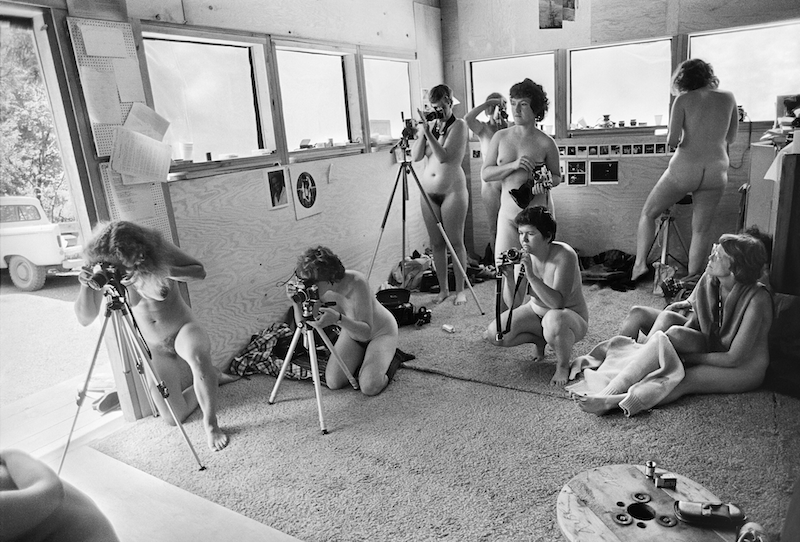
JEB (Joan E. Biren), Photographers at the Ovular, a feminist photography workshop at Rootworks, Wolf Creek, OR, 1980, Printed 2011, Digital silver halide C-type print, 12 x 17 in.

This perfectly illustrates what I hold to be the golden rule for photographing nudes: thou shall not photograph nudes unless thou art willing to be photographed nude.

The first rule when it comes to making pornographic art, never ask anyone to do anything they wouldn’t request of you were roles reversed.

Zsuzsanna Ujj – [←] Untitled (1989); [+] Untitled (1989); [→] Untitled (1989)

There’s not a lot that about Ms. Ujj to be found. She’s Hungarian and began making subversive self-portraits in the 1980s pretty much covers the extent of it.

She’s clearly preoccupied with the relationship between a woman’s body, how the woman sees her body and how society views a woman’s body. However, in this work, given the interactions of shadows (and the probable Jungian implications) and reflections (the resulting bifurcation of physical representation/ sight turned against itself), there’s more going on here than is readily discernible.

The dislocation is interesting and although I want to connect that to Picasso’s frequent mutilation of women’s bodies and while I know there’s an obvious metaphor with the individual vs. collective that relates to communism, my first thought upon seeing these was of the images of shadows burned into walls after the bombing of Hiroshima.

These images go a great deal deeper than most and they offer no ready made solutions or easy answers. In many ways, this reminds me of another work that is ostensibly about reconcile existence and beauty with the horrors of the nuclear age–Inger Christensen’s Alphabet (which is by far the best volume of poetry I’ve ever encountered).

Anastasiy Mikhaylov [AKA Estergom] – *** (2013)

Mikhaylov’s images look as good as digital B&W can be expected to look–awful when compared with analog B&W–and are ordered according to crisp compositional logic.

I nearly had a heart attack and died from not-surprised when I learned Mikhaylov was trained as a cinematographer.

If photography is English, then cinematography would be English spoken with a nearly impenetrable Scottish inflection.

Seeing Mikhaylov’s work is like running into someone who speaks with the same accent. Someone whose words you understand in a nearly prelinguistic fashion.

In other words, the familar pretty-pretty and consistent evocation of scale attracting my eyes like ball bearings to a magnet.

Cinematographers are as a group less than astute when it comes to the nuances of conceptual art. (Two prominent exceptions that spring most readily to mind are Sven Nykvist and Harris Savides.)

Yes, echoes absolutely exist in relation to matters of visual storytelling and figuring out how to inveigle unruly images to sit politely side-by-side around the table like some many birthday party kids cracked out on sugar rushes. But I think there’s an inherent notion of what a photographer does that gets instilled in us; it transitions a bit too easily into an explanation of what photography entails.

For everything Mikhaylov does well, there’s always a corresponding deficiency. The most obvious is his inconsistency in including/eschewing eye contact. There’s no rhyme or reason to it unless you step outside any critical space and instead start from an acritical exposure to visual culture. In other words, don’t ask why does this look the way it does; begin instead by insisting this is what an image should look like.

There’s some overlap with an Matt Singer penned op-ed over at The Dissolve earlier this week in which he compares and contrasts the visual indelibility of the latest Spider-man blockbuster and Jonathan Glazer’s gorgeous and incomprehensible Under the Skin.

Referring to yet another essay by HitFix’s Drew Mcweeny, Singer notes:

McWeeny concludes his essay by imploring Hollywood to “make the stakes more personal” while “telling good stories that also happen to be amazing to look at.”

Pretty-pretty is all well and good but it is ultimately not enough. Something more is needed. In the above image, for example: it’s a matter of tone–a cishet male positing lipstick lesbian schtick as same-sex attraction.

Ultimately, despite it speaking my language convincingly, I feel like this is an image that is comparable to a seedling needing partial shade that was planted in direct sunlight. It’ll grown, but it’ll need extra attention.

Technical merit isn’t enough. And it irks me that the extra care it requires needs hinges equally on the artist’s ego and the irrigation of lusting arousal as the only viable means of fully intoxicating the viewer.