

Source Unknown (.gif by Sumptuous Daydreams)
In solidarity with Evan Rachel Wood.
And OMFG: freckles.
Also, the bottom one sends shivers bouncing around in my tummy.
Source Unknown (.gif by Sumptuous Daydreams)
In solidarity with Evan Rachel Wood.
And OMFG: freckles.
Also, the bottom one sends shivers bouncing around in my tummy.

Photographer Lina Scheynius , Bandeau by Saint Laurent
Scheynius’ images make me feel all twitterpated and woozy-in-my-tummy. If I ever met her I’d become a shy, stammering mess of looking-down-at-my-Docs + kicking at dirt that wasn’t really there.
I don’t know what I find her more: talented or winsome. Then again, I don’t do well distinguishing between them.

Those who peruse what I write will be aware of how much I loathe fucking gratuitous/illogical use of portrait orientation.
I never tire of calling that bullshit out. But, for the sake of avoiding redundancy and not beating a dead horse on the subject, I am going to henceforth distill these criticisms to a pithy hash tag: #skinnyframebullshit.
#skinnyframebullshit should be applied here. Further, the awkwardness is compounded by the top frame line’s amputate the young woman’s legs. (And if one was inclined toward hair splitting: an argument can be made that with the angle of light it would’ve been preferable to swap the position of her head and feet.)
Even with these shortcomings, I dig this image a lot. Mainly because it dodges the usual questions of subject/object and exhibitionism/voyeurism back loaded into visual depictions of masturbation. It has the sort of masturbation as punk rock/do it yrself sex positive vibe I adore.
Normal
0
false
false
false
EN-US
X-NONE
X-NONE
/* Style Definitions */
table.MsoNormalTable
{mso-style-name:”Table Normal”;
mso-tstyle-rowband-size:0;
mso-tstyle-colband-size:0;
mso-style-noshow:yes;
mso-style-priority:99;
mso-style-parent:””;
mso-padding-alt:0in 5.4pt 0in 5.4pt;
mso-para-margin-top:0in;
mso-para-margin-right:0in;
mso-para-margin-bottom:10.0pt;
mso-para-margin-left:0in;
line-height:115%;
mso-pagination:widow-orphan;
font-size:12.0pt;
mso-bidi-font-size:11.0pt;
font-family:”Garamond”,”serif”;}
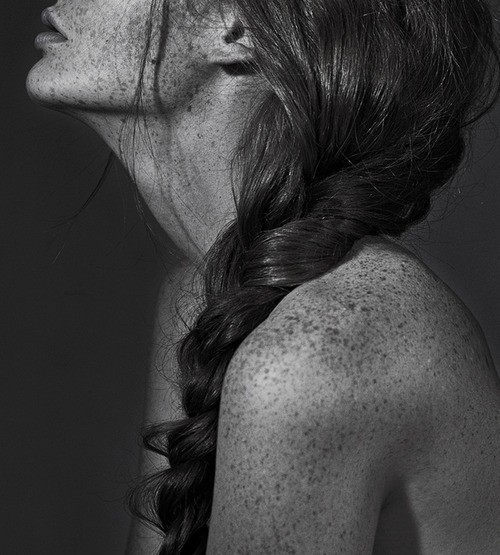
Great googly moogly aren’t freckles goddamned sexy as fuck?
And their effusion on this young woman’s shoulders and face is truly resplendent.
Now I could follow my usual knee-jerk rabbit trail with regard to composition—a horizontal frame would have almost certainly improved this photograph—but the freckles seem more the point.
Photography and digital imaging distill the space and time of a select visible area down to a two-dimensional representation. In the process, a great deal is changed and/or lost completely.
To a degree, image makers exercise control over what remains in the picture. For that reason, I am constantly unnerved that given a field of so many options the results of what stays and what goes tend to be so starkly homogenous.
Most images provide a record of an objects position in a particular spatial field at a given moment in time. How often though is the object treated as more than an insinuation representation of itself? Or, to say it in a less abstract way: when was the last time you say an image wherein skin was presented as more than the container for representation identity or a symbolic placeholder?
It’s not just pictures of people, it’s fabric, wood, everything. Photography fails more often than it succeeds to give solidity to its representations. A means of accomplishing that is beginning to think less strictly visually. There is this amazing sensory overlap between sight and sound—a sort of synesthesia that everyone shares: the sight of different textures affects our eyes differently, in a way that is—in fact—somewhere between seeing and feeling.
For example, consider this image of coffee beans ground to varying coarseness. By looking at them you see the different visual texture but that impression is processed in some fashion as an awareness that each feels different.
That’s ultimately what I adore about this image: her freckles add texture to her skin and thus weight and solidity to her body. She is not a representation; she’s a living, breathing, dreaming being with fears, hopes and ideas who also happens to be breathtakingly beautiful.
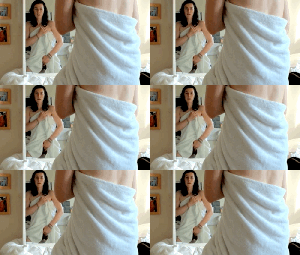


Artfully depicting masturbation is not an easy feat.
The act is private, sequestered. Thus, the question of how one came to be able to witness such goings on becomes a central—is it voyeurism, exhibitionism or a bit of both?
The more voyeuristic the image, the less intentional it appears and the more it relies upon the reputation of the image maker to supplement its ‘artistic’ merit.
The more exhibitionist the image, the less artful it appears. Exhibitionism being rooted in self-consciousness; the efficacy of the work of art being so frequently measured on its ability to dissolve notions of self and other.
These clips of a larger piece suggest an altogether ingenuous way of subverting this dichotomy: fuck with the distinction between subject and object. What’s the easiest way to do that? Point the camera at a mirror. (And I do not mean any of this teen-girl-shooting-her-reflection-in-the-bathroom-mirror Tumblr noise. I fucking HATE that shit!)
Now, I will not for a second argue that she is unaware of the camera—I am almost certain she is. But is she looking at it or looking at herself in the mirror? This becomes about the spectator watching her watch herself cause and experience her own pleasure.
For me it also has the effect of focusing me on her growing arousal—which while certainly mirroring my own is continually refocused on hers.
 Acetylene Eyes