
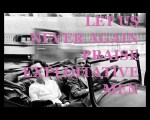
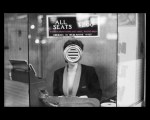
Garry Winogrand – Photo night at the Ivar Theater (1982)
Call me an iconoclast if you must but I really detest fucking Monet.
I won’t argue his technical accomplishment as far as applying paint to canvas–at that he was an indisputable master. And Woman with a Parasol is exquisite.
However–by and large–I find his paintings intolerably cloying and consider the impetuses for his stylistic affectation specious at best, at worst: entirely contrived.
At the same time, I would never challenge his art historical import.
I feel similarly about Winogrand–except there maybe merit in the conversation about whether or not he deserves to be as lauded as he has been and in some circles continues to be.
He made some great photos. I adore New York, 1969. And Mark Steinmetz has repeatedly referenced Utah (Wyoming), 1964 as one of the first photographs that truly captivated him completely.
In a painfully overlong, overwrought, overwritten and sparsely edited essay entitled Standing on the Corner – Reflections Upon Garry Winogrand’s Photographic Gaze – Mirror of Self or World?, Carl Chiarenza manages (despite these significant faults) to provide valuable observations and insights; namely: Winogrand produced far more shit than shine and he was godawful when it came to sexualizing/objectifying women.
Yet, with an image such as the one above, anyone with any sort of partially developed critical facilities should take issue here. There is nothing particularly studied about the frame. In fact, it appears like a crap snapshot any idiot with a basic understanding of how their camera works could have produced.
That we look at it today independent of the context of vintage pornography is solely due to the name of the reputation of the person who made it.
But that shouldn’t be where an analysis stops. Frankly, I find this image disturbing. Chiarenze addresses this better than I will but was entirely preoccupied with photographing the world around him in such a way that it allowed others to see the world the way Winogrand himself assumed it ‘really’ was.
The above image is unequivocally about photography. At least three men are taking pictures–the two we see and the third who created the record that allows the viewer to witness the other two.
I get messages all the time from people who think I’m a raging dickhole when it comes to critiquing framing. But take this as an example of two things I’m always going on about–whether or not the image space given suggests a continuity or discontinuity with the space/reality surrounding it and the issue of decapitations/amputations w/r/t frame edges to preserve anonymity or for any other reason.
The frame here is analogous to a peephole where the aim is not the setting but the occasion–a naked women. Thus, there is no suggestion of space beyond the frame edge.
As such, the decapitation is a calculated act of violence. And I can’t help but see a similar act of violence in the patrons–who are equally absent feet and legs which would allow them to get up and leave. The implication of this image is because those who are sexually desired cannot think since they are presented sans heads (minds, facial identities) are essentially interchangeable.
The sex object merely is a sex object, in other words; there is no recursive abilities. But the men–who are presented with head’s–are rendered impotent by their sexual attraction. They couldn’t leave where they are to walk away because they are presented without feet and legs to do so.
Whether Winogrand meant to or not, this image clearly blames the stripper for the existence of this purgatorial tableau–an implication I find fucking repugnant.
Unfortunately, once you begin to see this less-than-subtle misogyny in Winogrand’s work, you can’t help but to begin to see it in everything he ever did.
…
While in Berlin several months ago, I got up early one morning. Unlike in Brooklyn, where one can get a decent cup of coffee at any hour. Coffee places generally do not open until 9am. I decided that since the sun was coming up and the light was golden and lovely, that I would walk around with my camera for an hour or so.
In truth, although I started out walking around looking for interesting things to make pictures of, increasingly–despite the fact that I am technically a landscape photographer (for better or worse)–I don’t know what to do without people in the frame. I tried a POV shot of myself throwing away a beer bottle in one of those strange brown glass recycling mounds. I tried to treat an abandoned lot as if it were a landscape.
I tried several angles but was increasingly aware that a rough looking forty-something was making a B-line for me. I mean, it had to be me, since there was no one else around.
He queried me in German. Then Dutch before I got out that I only spoke English. He demanded to know what I was taking pictures of. I tried to explain the light was nice and I was looking for shots but he wasn’t interested. He said that I had better not be taking pictures of people; that to do so was illegal and I should know better and if he caught me pointing my camera at him or anyone else he was beat the piss out of me.
I was quite taken aback but he’d already continued on past me, looking occasionally over his shoulder as he moved away.
It turns out that he wasn’t entirely wrong. The legality of street photography in Germany is very much in question at present.
Of course, my initial response was that’s absurd. Street photography is a respected fine art tradition. Making that illegal is detrimental to capital-A Art.
I’ve subsequently come to question that response, however.
These days we are quick to decry invasions of privacy. We rally around Edward Snowden for allowing the world a peak behind the curtain. Yes, that was mostly regarding data accessed from within the privacy of our homes. But in the same breath we fault Apple for tracking our every move and lament the growing security (theater) state, we still defend the virtue of street photography–the whole point of which is to surreptitiously invade personal privacy.
It occurs to me that maybe this isn’t okay. That perhaps my defense of street photography is–ultimately–a defense of the patriarchal straight, cisgendered heterosexual status quo. Since so much of street photography has traditionally hinged on an absence of consent.
Which is not to say all of it. Helen Levitt, doesn’t make me feel creepy. Alternately, some of Vivian Maier work is ethically super suspect from a standpoint of consent.
I don’t know the answer but I know that a great deal of what is considered technical mastery in photography and image making emerges from photojournalism and subsequently street photography. Given the inherent potential for the transformation of photographic documentation into voyeuristic experience and considering the predominance of patriarchy and institutionalized sexism (misogyny, rape culture, et al.), I’m pretty sure street photography doesn’t deserve a pass. In fact, I think it should be aggressively interrogated with regards to this considerations going forward.


 Acetylene Eyes