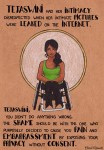
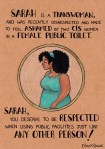

Carol Rossettiselections from Mulheres (Women) series (2014)

Rossetti is a Belo Horizonte, Brazil based graphic designer.

In April 2014–a month ahead of the #YesAllWomen social media trend–she began making simple yet exquisite colored pencil drawings of women which included captions celebrating individual autonomy and personal agency.

The intersectional feminist/sex-positive/body-positive/anti-slut shaming perspective along with the carefully calculated non-confrontational presentation rapidly–and deservingly–went viral.

The first time I encountered her work I cheer aloud. I was so curious about her that I navigated away from my Tumblr dashboard to learn more. I remember seeing her response to someone deeply impressed by her illustration of Babi. It was so pitch perfect–I’m not going to lie–I teared up a little.

I’ve lost track of all the times since Rossetti’s radical empathy has floored me. I’ve wanted to showcase her work for months; however, I’ve been at a loss as to how I might do so in a way entirely respectful of such ingeniously subversive work.

Emboldened by the luck I’ve had in approaching folks whose work I dig, I wrote to Rossetti–who proved to be equal to the contemplative charm of her work. (Also, she was exceedingly patient with my scattered, free-form approach to interaction.)

Acetylene Eyes:        I have this image of you as a bad ass, caped super heroine sworn to uphold intersectional feminist ideals while vanquishing sexist bullshit.

Carol Rossetti:           Hahahaha! Super heroine, that’s something I’d never [thought] of me!

AE:                              A super heroine who loves dinosaurs apparently; Do you have a favorite? (Its stegosaurus, isn’t it?)

CR:                             I do love dinosaurs, and I truly believe in Spielberg’s versions. So, of course my favorite one is velociraptor, because they can open doors. Smart asses.

AE:                              Usually I have a zillion questions about creative process but you’ve addressed that topic assiduously in previous interviews.  I’m not sure if it’s that the first image I saw of yours was Ana or if it is just especially resonant given my own experiences but it feels different than most of your other illustration. Did your approach differ at all in making it?

CR:                              Actually, it wasn’t different. I talked to some people who have been raped, and the illustration was based [on] a real person (changed the name, of course). But I haven’t been through this situation, so I pretty much tried to put some of the exact words she said to me there.

AE:                              You have noted: “none of my illustrations are made based on personal assumptions.” That’s an incredibly astute observation; one which started me thinking–a dangerous past time, I know–about the role of conceptualization in art-making. Are you familiar with Brandon Stanton’s Humans of New York (HONY) project? 

CR:                              I like HONY, I think it’s a beautiful project.

AE:                              I feel as if your project and HONY share a sort of human interest angle. Thus, there’s a built in audience. Yet, unlike your willingness to listen to a multiplicity of experiences, HONY seems devoid of a similar openness.

CR:                              I understand the critics, I think they are valid, though. I’m not sure exactly how Brandon Stanton presents it, but I think sometimes people put a lot of expectations and responsibility on an art project. Don’t get me wrong, I do understand that expectations are natural and responsibility is something that does exist. But I guess what might have happened to HONY that also happens to my work is that people put it in some kind of pedestal in which it was never meant to be. Well, at least about my work I feel a bit this way. I identify myself as a feminist, but I completely refuse the idea that I would be the “new face of feminism”, as I’ve seen around. I am not feminism itself. I won’t tell anyone how feminism should be handled, what’s the “right or wrong” way to fight the fight. There are many ways to fight sexism, racism and many other kinds of oppression, and I am not a leader or anything. I have a language of my own, which is through colored pencils drawings of different women, each of them with a story, and a non-agressive friendly text. This is a way for me to express myself, express my ideas, invite people to identify, maybe (if I’m lucky) make some people aware that sometimes they say things that are really rude, even though they might not notice at first. However, there are people who are really angry, people who are tired, people who have been traumatized, people who don’t share even half of the privileged that I know I have, people who only have anger to keep them moving on. I won’t judge these people’s ways to fight the same fight, and I’d never tell them how to handle feminism. That would be very disrespectful. I thank you for your kind words about my work, and I’m happy that it touched many people so deeply in a very positive way the way it has. This is so much more than I could ever expect! But sometimes I feel the pressure of expectations in a way I’d never thought it would be. I’m still a human being full of flaws[;] I make mistakes the whole time. This project is about representing some women, but I don’t have the pretension to represent ALL women. It is about feminism, but it’s not supposed to be a guideline of how to do feminism. It’s about representation, but it doesn’t have the claim to being the “right” way to represent people.

So, sometimes I think something similar might have happened to HONY. It was supposed to be something, but people saw it a lot bigger than it really was meant to be, and then there were more expectations and more responsibility demands. I don’t know (really, I don’t know if that’s the case at all for HONY), but I feel a bit like this sometimes. We can control what we say, but each of us [has] our own cultural and experience background that will result in a different interpretation – and that is not controllable.

Anyway, sorry, I got carried away and ended up talking a lot about something else. Back to the point. I love dinosaurs, but I never liked drawing them. Pretty hard anatomy! I’ve always loved drawing women – and always found very hard to draw men. I’m not really sure how I got here… When I say this whole project was born in a very spontaneous way, I really mean it. It was just one more project I had in mind to keep drawing every day, and then people began liking and sharing like crazy on Facebook, and my life turned upside down. In a very good way! 🙂 

AE:                              I want to jump back to feminism briefly. Did you have a feminist conversion moment—you know a sudden epiphany that the patriarchy was a total crock of shit?

CR:                              I’m not sure when I decided I was a feminist, but I know that I started getting to know feminism beyond stupid stereotypes with my husband. He started talking to me about it and it was great. I guess many feminists wouldn’t like that, but it’s true and I don’t see any problem with that. Of course it was not just him. I started reading things on my own, and finding out things for myself, and talking to people. And one day I realized I had always been a feminist. A clumsy one, for sure, but still a feminist.

AE:                             What artists light you up and why?

CR:                             Well, I do feel inspired by people in general. I think that if you learn to look around, you’ll see so many people with so many stories and so many points of view, and that’s wonderful. The human being is an endless source of inspiration. But, if we’re talking about famous people, I should probably start with Neil Gaiman and Amanda Palmer. I absolutely adore their work, they’re like amazing inspirations for me! I suppose inspiration comes from many different areas, like literature, cinema, music, photography… It’s all around. Every day I discover an artist I didn’t know before and I fall in love with them!

AE:                              In previous interviews you’ve mentioned enjoying music and TV series. What three albums and three series couldn’t you live without?

CR:                        Hm. Well, let me see. I guess Belle and Sebastian’s The Boy with the Arab Strap; First Aid Kit’s The Lion’s Roar and Banda de Pau e Corda’s O Melhor da Banda de Pau e Corda. But I feel like I’m being unfair not mentioning other thousand artists I love! And three series… American Horror Story, Doctor Who and Buffy the Vampire Slayer (guilty pleasure?).

AE:                              Have you heard of Emma Sulkwicz?

CR:                              Yes I have!

AE:                              She’s incredible isn’t she?

CR:                              I think she found a very powerful, personal and meaningful way to protest. And that’s amazing.

AE:                              Speaking of protest. I know Brazil is roughly the size of the US, but did the protests leading up to World Cup intersect with your life in any way?

CR:                              Those protests we had last year were quite a thing. It began as something, then it turned [into] something else, and then into something different. At first, I was with the protesters. Then, the whole movement was grabbed by right-wing parties and had a very bizarre speech, so I didn’t support them anymore. Anyway, it’s complicated. But the World Cup did affect everybody somehow, I guess.

AE:                              If you created a self-portrait in the style of your Mujeres illustrations, what would say to yourself?

This is a [tough] question. At the beginning, my drawings were about situations I didn’t live myself. It wasn’t planned that I wouldn’t talk about me, I just talked about issues I thought were more important. And I consider myself very privileged, so my own issues I was always leaving for later, you know? Then I decided to start making some about things I lived, and I found out that was way harder than I expected. So I made the one about not wearing any makeup, about cellulite, about the couple who decided not to be legally married, the one about tanning… I still want to make one about not wearing bras! 🙂

[↖] Mark VelasquezUntitled (2013); [↗] Vlad Kenner [aka VK Photography] – Lady Sensuality (2014); [↙] Tomi KnoxLight the way (2013); [↘] asp photossecret beach (2014)

I distinctly remember my first encounter with the top right image. Few and far between are the images which command my attention like woah, got damn that’s bad ass!
It wasn’t the explicit nature of the image so much as the way that undercurrent seemed so inextricably entwined with an unapologetic–even confrontational–sense of self.
 
There was also enough playfulness to thoroughly unbalance–her expression of over-the-top offense that might be feigned but is maybe legitimate; indicating a seismic threat lurking just beneath the surface.
 
I noted her pseudonym–Lady Sensuality–and have actively followed her work ever since.
Despite having only worked as a model for a year and a half now–getting her start working with Mark Velasquez–she’s crafted a portfolio featuring collaborations with a veritable Who’s-Who of Tumblr image makers and is also beginning to shoot her own work.
After the unexpected success of my shot-in-the-dark that turned into an interview with french indie image maker Chill, I decide what-the-hell and reached out to Lady Sensuality about whether or not she’d be amenable to being interviewed.
She graciously agreed to answer a handful of questions.

Acetylene Eyes:It feels to me as if at least some of your work is preoccupied with pushing your own personal boundaries. How do you ensure those shoots happen in a safe space for you?
 
Lady Sensuality:If I decide to test my boundaries at a photo shoot, it is always either discussed prior to shooting and with someone of high credibility or photographed by someone who is close to me in my personal life. There are certain photographers who have become very dear to me who I will do more explicit work with. Erotic modeling boundaries are not always about what you are comfortable with sharing on the internet. Sometimes I would be comfortable with a photo of a certain pose or act being online, but not comfortable with a stranger photographing it.
 
AE:    Being a model and an image maker, do you have any advice image makers could employ to make a model’s job easier?

LS:      Firstly, be open with me. It makes it easier for me to help the photographer get the shot they are looking for when they communicate their vision with me. Secondly, letting me know what you are photographing. I like when photographers let me sneak a [peek] at the images during shooting so that I’m aware of the mood the lighting is creating, so that I can pose accordingly. Or if you are only photographing my face, or my shoulders and up, or my thighs and up, let me know! Then, I can give full attention to that instead of all little things that collectively make a big difference on the ease of the experience and how the photos turn out.
AE:     Who is your favorite artist?
LS:Deciding on a favorite artist would be impossible for me. I’m going to keep it relevant by listing a few models and photographers that I’m currently very interested in. Models include Echo Nittolitto, Jacs Fishburne, and Katlyn Lacoste. Photographers include Sebastian Rut (who I am very excited to work with in October of this year), David Miller, and Aeric Meredith-Goujon. There are at least a dozen other people I wish I could add to this list.

AE:Speaking of Ms. Fishburne, maybe two months ago she posted an impassioned declamation of signing model release forms prior to the end of a shoot. Even though he’s a fucking terrible photographer, I remember reading once about how Jock Sturges avoids model releases in favor of an implicit policy where the model has a degree of agency in when, where and how the subsequent images are used. It’s maybe not the best system but model releases strike me as inherently non-collaborative. Do you have any thoughts on a way the de facto model release position might be modified to be more egalitarian?

LS:      I have no problem with signing a model release. Because I am paid during the time of shooting, I have no issue with giving up my rights to sell the images at a later point. That is the photographers [sic] opportunity to make money off of the collaboration. Occasionally, you run into a situation where you are giving your time to a photographer for free (trade for print) and they still have you sign a model release. This, I do not agree with. It doesn’t seem fair to me that both the photographer and model are giving equal time and effort to a collaboration, but only the photographer is able to benefit from it financially. But again, in most cases (where I am being compensated at the time of shooting), I have no quarrels with signing a release.
 
5.     Frank Ocean did this interesting exercise earlier in the year where he explained his current situation to himself five years ago offering wisdom, advice and perspective. What, if anything, would you want impart on yourself of five years ago given the chance.
 
Honestly, I am so perfectly happy with my life right now, I wouldn’t want my 5 years younger self saying anything to put me off track. I feel as if I’m exactly where I need to be at this point in my life and that is a beautiful feeling.

Chill is a freelance, self-taught image maker living in Strasbourg. He purchased his first camera while studying for a computer science degree.

His work first came to my attention when the lovely knitphilia re-blogged a photo set featuring Chill’s image curated in such a way that bodily form was abstracted to something not unlike typography.

A bit later I stumbled upon Arousal Visions’ impeccably curated highlighting of Chill’s intricate executed depth of field and the ultra-vivid color he summons from scenes as if by magic.

I’ve wanted to comment on his work in some way; however, the overall quality demanded much more than an OMFG, lookie at the pretty colors!

Since Chill follows this blog, I figured it couldn’t hurt to reach out to him in an effort to learn more about his process.

To my surprise, he not only responded but expressed excitement at the prospect of addressing a handful of questions.

AE:         Right off: I am en-goddamn-thralled by the interplay between color and depth of field in your work. It’s almost as if the dominate hue permeates the frame so completely it becomes sort of liquid—not unlike amber encasing an object. Short of Uta Barth, I’ve never seen anything that conveys 3D space in a 2D medium quite like your images. Could you talk a little bit about your technique? 

Chill:   Your amber metaphor is fabulous (and unusual). I really like [it]. I’m very [sensitive] to the way [things are seen]. This picture of a liquid enveloping everything is pretty and poetic. I’ve always been attracted by vivid colors and natural light. There is a particular energy and a pleasant atmosphere in it. I love close frames, it reinforce details you want to highlight and naturally goes hand in hand with intimacy.

I always [meet] the person before the session. In a nice place, [getting to know] each other, talking about what we like, what we don’t, exchanging some ideas, answering questions, etc… I think it’s normal and human « step » before making pictures. It also helps me ([and] the model) to feel more comfortable.

I work as much as possible in natural light, which makes me dependent on it. Scene colors, clothes that the model will wear, skin tones… influence substantially the result of my photo sessions. Every meeting is unique, and that pushes me to adapt regularly. Anyway, it’s never pleasant to cancelling a session when the weather is really bad. I [applied] myself seriously in photography when I bought my Canon EOS 40D. It was my first DSLR and I really enjoyed [using] it for 6 years with [the] 50mm lens I still have. I have [had] a full frame camera (Canon EOS 5D) for a little over a year. My shallow depths of field, my highlights and my frames are natural. I don’t post-process [my pictures much], my motto is to keep my pictures as natural as possible.

AE:      I am going to be a bad interviewer and digress into personal biography. Similar to you, I am a self-taught image maker. I’ve also taken photography courses at an MFA level and in my experience there is a near total disconnect between traditional so-called fine art photography and autodidact practitioners—the form and content of the respective works are different + the conversations surrounding them couldn’t be more opposed. (The DeviantArt/Flickr/Tumblr crowd raves about Traci Matlock and Lina Scheynius whereas the MFA kids seemingly can’t shut the fuck up about Eugene Atget and Robert Frank.)
         Beyond your manipulation of color with depth of field what interests me about your work is that it feels like it’s standing in the middle of that bridge of impossible crossing dividing non-traditional and traditional fine art practice. In form and content your work is pointedly non-traditional; however, my own response to it skews much more towards engaging critical and conceptual concerns instead of pondering why the work interests me and/or whether or not I like it.  I am curious as to how you arrived upon such a rare middle ground.

Chill:   Your analysis is very interesting, I hadn’t seen the things like that and I’m truly touched by it. I discovered photography during my studies, far away from the artistic environment. A sideline which quickly captivate me and became my main passion. I grew up in a family where there wasn’t any particular interests to photography or visual arts. The fact that I fell in it by simple curiosity still surprises me now, so much [that] I…feel like…it [now] forms integral part of me.

Being…very curious, I quickly realized that everything was possible in photography and it was necessary for me to control my equipment to succeed in doing what I wanted to. …[M]y technique became a kind of personal signature. I developed my skills in a rather naive way…according [with] my tastes and my desires. I try again and again, different things, randomly or with a precise idea. I correct. I start again. I think it’s in this way I developed a certain rigor in my photographs over time.

AE:      What artists do you consider to be indispensable influences?

Chill:    I’m an admirer of Helmut Newton (Newton’s glamour and erotic style is unique), Richard Kern (for the natural and living side), Larry Clark (I like the way he has sometimes to disturb through his works, and his manner of filming. Rough and true.), Ryan McGinley (for the timelessness, unique ambiances and dreamy pictures) and many others…

AE:      While she was a terrible fucking person—not to mention the unsavory whiff of implied slut-shaming—there’s this Margaret Thatcher quip: Power is like being a lady…if you have to tell people you are, you aren’t.
            I mention it because I feel it is apropos to straight, cisgendered men who shoot erotic/nude work and waste a lot of breath pontificating on how much they respect women; meanwhile their work suggests a patently sexist agenda. In other words: if you respect women, no need to pat yourself on the back, it’ll show in your work—end of fucking story.
            Your work comes across as at the minimum cognizant of feminist concerns w/r/t the politics of representation/depiction. And that makes me wonder to what extentif anyyou are consciously trying to subvert the art historical trend of privileged straight men objectifying the female body? Do you identify as a feminist ally?

Chill:    I’m into body photography in [intimate] environments. Of course, I’m conscious that many pictures I make are glamour and sensual, and can be, unfortunately, …interpreted or quickly…catalogued as being a part of the art historical objectification of women by privileged straight men.

I would…identif[y] myself… as a a feminist ally, because I’m completely against [such] objectification of…woman and it’s always very unpleasant to receive those typical male comments about my photographs. I find that disrespectful for the persons I photograph and…my work.

AE:      In an interview appearing in issue 6 of Koch Magazine you mention that nudity presents the opportunity to capture a certain ‘timelessness’. I am curious as to how that is perhaps counter balanced by your expressed interest in shooting in the model’s environment whenever possible.
            Grounding the shoots in modern, personal spaces seems to contradict such ‘timelessness’. Could you talk a little about how these two features of your process connect?

Chill:    The fact of photographing the model in his place, when it’s possible, reinforces the intimacy, and that’s what I try to show firstly. The environment is significant to the intimacy of the person photographed, and nudity becomes a means of enriching this intimacy.

To make timeless nudity possible, the environment has to be neutral and minimalist. Thus emphasizing only the body and not the body being a part of the place.

AE:      You are stranded on a desert island. A desert island that counter-intuitively (and conveniently) has electricity, a phonograph and a DVD player. You can bring only 3 albums and 3 DVDs. What can’t you live without?

Chill:    Albums

PJ Harvey’s – To Bring You My Love (1995) – Her voice has so much power. I can listen to this album over and over, tirelessly.

Leftfield’s – Rhythm and Stealth (1999) – Because it’s one of the first electro albums I’ve listened to and I’ve been immediately hypnotized by Leftfield’s cadencies

Dr.Dre’sThe Chronic (1992) – I used to listen to a lot of hip-hop when I was a teenager, and this classic album is definitely one of my favorites. You can even feel the heat of L.A. summer.

DVDs

Ridley Scott’s Alien, the 8th passenger (1979) – Masterpiece.

Sean EllisCashback (2006) – I love pretty pictures, I’m attracted and embroiled by them. And every scene of this movie is one.

Guy Ricthie’s Revolver (2005) – Because of the actors, the strange story, the soundtrack, the photography, the humor and the style.

AE:      What was the last book that really blew your mind?

Sandcastle (Chateau de sable) by Frederik Peeters and Pierre Oscar Levy (comic book) – A closed session between 13 persons on a beach, who will face an inconceivable event which will [raise] many questions about themselves. I can’t tell more.