MœbiusAngel Claws cover (1993)

I was super into comic books in my late teens–roughly circa 1991 through 1997.

I followed the spate of hot shot upstart pencilers–who would go on to become Image Comics’ freshman class–Dale Keown, Jim Lee, Rob Liefeld, Todd McFarland and Marc Silvestri.

I was aware of the edgier stuff out there: Neil Gaiman’s run on The Sandman; the Frank Miller/Geoff Darrow collaboration Hard Boiled–alternately, I never got what the fixation was with Alan Moore

I fell out with the medium for two reasons: it became too expensive of a hobby for me to keep up with–there were also more things that I wanted to read each month than I could afford to acquire myself. And, my more professional interest in it waned.

At a certain point, I entertained the notion of writing and perhaps drawing sequential narrative work. I was especially partial to Jim Lee’s dynamic frames and diversity of depiction. His figures seemed solid in a way that others didn’t, his poses more considered. (Although in hindsight her frequently favored what in filmmaking you’d call insert shorts a wee bit too much and his economy of frames and layout were sometimes questionable.)

I was really taken with his Deathblow style reinvention. It was much darker, more abstract–with heavier lines, looking often more like a photographic negative than a comic book panel. I obsessed about this style; so much so: that when we were ordered to write a report on an artist my junior year of HS, I picked Lee.

This was pre-Internet. And it was daunting to find enough sources to build out a workable biography, let alone find information on development and growth of style and technique.

I managed to find enough information that I could stretch it to make the project work. But what I enjoyed most was selecting samples of his work and drawing an exact copy of one of his pictures and then drawing something using his style but applied to an original work.

My copy was a redux of the gatefold cover to X-Men #1. (Yeah, I’ve always been super ambitious/or a glutton for punishment, depending on your perspective.) My original in-the-style of was a riff on Cyberforce’s Velocity character in Lee’s Deathblow style.

I was ridiculously proud of it. I mean it wasn’t a masterpiece by any stretch but I’d applied myself in a way I rarely did on projects and if nothing else it showed a stubborn potential.

Things didn’t go so well. You’ll remember I went to an Xtian HS. And my art teacher was unspeakable offended by the degree of inappropriateness that my project demonstrated. I was ordered to give my presentation to my classmates as per normal but I was required to give a disclaimer that I had picked an insanely inappropriate artist and that I was very apologetic for bringing such filth into a place founded for the worship of and bringing glory to the name of God.

I was given after school suspension for a week–where I would sit with my art teacher, she would drape her arm around my shoulder and we would take turns praying that good would forgive me for the sins of the flesh I had committed by allowing this stuff into my head.

Since then, I’ve never been able to draw. It makes me violently nauseous.

Anyway, it’s nice to actually re-encounter Mœbius though. Logically, the preponderance of his work popping up on Tumblr likely has to do with the current ramping interest for Besson’s upcoming Valérian and Laureline adaptation (another Franco-Belgain comic book classic).

I have little interest. Besson hasn’t appealed to me since 1995. (However, in fairness, Léon: The Professional is what ended up making me a film student not ten years later.)

Also, does anyone else notice the degree to which Apollonia Saintclair has been influenced by Mœbius? It’s kind of cray-cray…
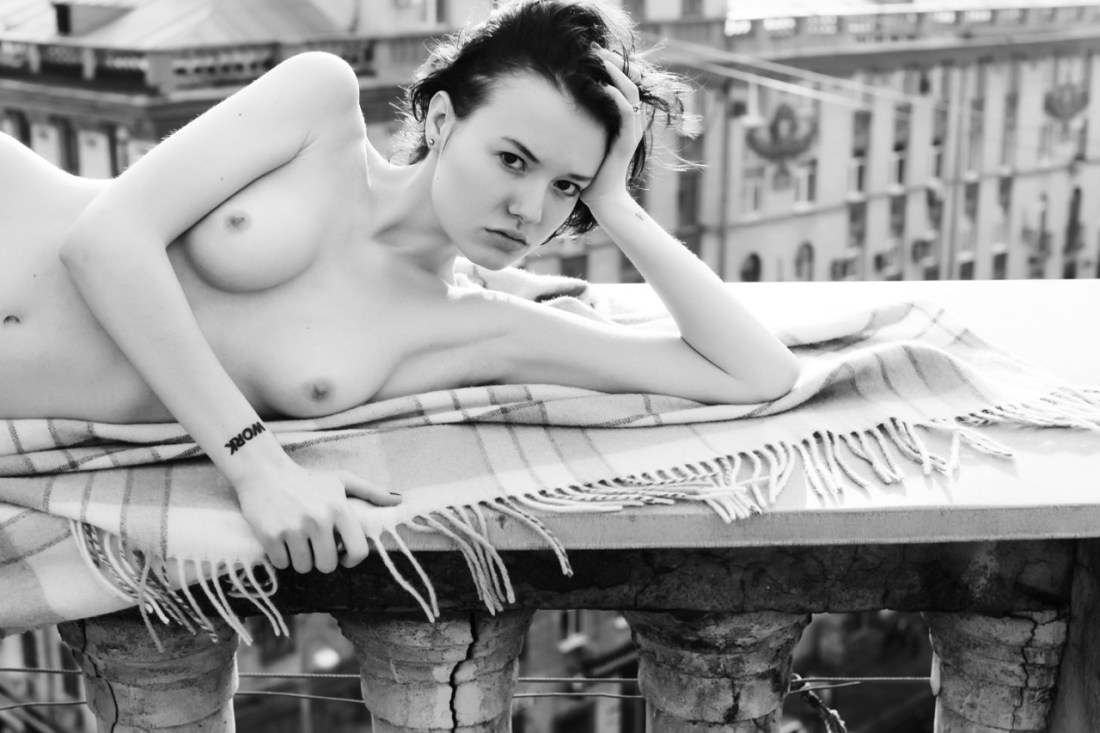
Anastasia TikhonovaUntitled (2014)

I’m intrigued by Tikhonova, or as she calls herself: Antipictures.

‘Anti’ meaning to stand against and also a clever contraction based upon the first two letters of her given name and patronymic.

It’s the exactly the same sort of multivalent turn upon which most of her work hinges.

She introduces her self in her anti-artist statement, as follows:

Photography is
a survival mechanism for me. My generation was the first to come of age
following the collapse of communism – my youth coincided with an
esthetic and existential wasteland experienced on the national scale. We
were caught between the institutional aesthetic of the Soviets and the
gaudy taste of the nouveau riche, and there was no established cultural
norm, no expectations to rebel against. That lack of expectations was
disorienting, but also liberating
– and I focused on drawing out the
sublime from the surroundings both vulgar and mundane. Photography is a
way to carve beautiful moments out of the habitual, and I live for that.

Projects followed, with magazine deals and exhibits. I moved to London
and sought to give a conceptual focus to the most basic of my drives –
to reveal the beauty and to show it to those who share a similar sense
of life… Yet the yearning for prestige and recognition gave me nothing
but panic attacks. I am back now – we haven’t met yet but take your
chances.

The added emphasis is mine because it hits upon something I’ve been trying to pin down for years; namely: the sort of It-factor that allows you to spot a mid-career Eastern European or Russian image maker from thirty paces is exactly that space between ruins and crass, resplendent decadence.

It’s a prescient observation. Unfortunately, it’s much more in keeping with say Igor Mukhin than Tikhonova.

I’m only halfway intending to knock her though. For example: the image above is–without question–pretty. Beyond that I’m not sure what it’s purpose is. There’s not enough context to determine what’s being said about notions of public vs private. And the ‘work’ tattoo on the subject’s right wrist suggests there might be something to do with notions of images as means of person expression vs agency-less objectification. But it’s all too muddle to decrypt.

Still, even though I don’t necessarily like all of her work it still resonates with me. I think she has excellent instincts. For example: I appreciate her artist statement for the fact that it functions in a way that mirrors the majority of artist statements splayed on gallery walls–except it replaces superficial pretension with something real. (Every statement I’ve ever written has made a similar gambit.)

And although it’s unspeakable poor form from the standpoint of webdev standards and practices (animated splash pages are just the worst, y’all), I do appreciate the way Tikhonova overlays her images with quasi-religious/meditative aphorisms. It underscores the degree to which her work is preoccupied with searching.

Ultimately, I think that’s what appeals to me about her work. I think, I’ve mentioned before that my training is as a film maker. Essentially, I stepped away from that world because I had developed extensive, existential doubts about narrative structure and the authentic telling of a story. A decade later, I’m still wrestling with messy questions but the crux of the debate boils down to two questions:

  • How do you known where to begin?
  • What details are inescapably relevant/what details are extraneous?

Looking at Tikhonova’s work I can’t help but think that she’s still trying to resolve for herself:

  • How do I know when a picture is worth taking?
  • Is the point to remember the moment or to render the moment intelligible to those who will only ever witness it second hand and in a heavily cloistered form?

These may not be the questions she’s asking herself exactly but despite some of her works failings, with regard to the process with which she’s addressing these considerations, her work is shockingly forthcoming if you’re willing to put in the time with it.

I can’t think of another contemporary image maker who show there work more faithfully and completely. So even if her work isn’t quite there, her process is very much on point.

danish-principle:

foxphotoart

Fox Photo-ArtGlass Olive [from the Voyeurism Series] (2013)

Initially, I see the stone wall and sapling filtered, dappled light. All of it pulls up a step or two short of full blown flashback to strolling around Fort Tryon Park on a summer afternoon.

This feeling motivated me to look into Fox Photo-Art.

Le sigh. What is it with image makers bearing vulpine monikers and their privileged insistence upon producing self-important, creatively stunted dreck and deeming it ‘art’?

Usually, this attitude causes me to dismiss the work in totality; however, it somehow increases my appreciation of the above image even if there’s nothing especially inspired about it.

Yeah, the composition is solid: the angle of the ledge leads the eye to Glass Olive; her body is situated parallel to the focal plane so her legs can remain open toward the camera.

Unlike the more natural, obviously comfortable positioning of her legs, her upper body is rigidly posed in order to facilitate reflection of light from the bright white pages of Margot Mifflin’s Bodies of Subversion onto her face.

To my eye there’s a startlingly nuanced yet fraught conceptualization at work here: using Ms. Olive’s face to establish a counterpoint to the focus on her pubic area.

Glossing over the implications with regard to matters of heteronormative gaze and sexualization/objectification of female bodies, this strategy somewhat succeeds. Although, it should be pointed out this counterpoint unbalances the image; and only works due to the dimensionality contributed by the angle of Ms. Olive’s legs balanced against the essentially decorative negative space occupying the left third of the frame.

I am almost always appreciative of clever framing. But what fascinates me here is the degree to which the subject remains completely indifferent to being seen in spite of all the visual cues pointing to the precision with which the scene has been staged. The most obvious being that no matter how much you fidget, wiggle or kick, even given the audacity of sitting in such a way in a dress sans undergarments, dresses only fall like this as a result of being carefully arranged.

It’s like the Fox Photo-Art can’t decide whether he’s dealing in conventions of public nudity or upskirt shots.

Speaking of the latter: recently, I’ve seen some commendable efforts (like this) to recast an otherwise exploitative genre in a more consent-driven, body positive/sex positive manner.