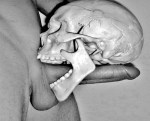
[↑] Kerbcrawlerghost – Detail from cover art for Weregoat’s Pestilential Rites of Infernal Fornication (2016); [-] Christian Martin Weiss – Untitled (2017); [↙] Source unknown – Title unknown (201X); [↘] Chitra Ganesh – Girls with Skulls (1999)
My initial thought had been to just throw this out there as an Acetylene Eyes All Hallow’s Eve themed post. But I’ve been pondering transgression a lot lately, so…
If you consider the Xtian belief that humans were given free will but in order for us to truly be free we had to be presented with the option to choose slavery by eating of the fruit from the Tree of the Knowledge of Good and Evil…
Except that’s already functionally wrong. The notion that freedom is less than intrinsic and is instead given or revoked suggests an overarching framework of command and control structures–which isn’t freedom, it’s authoritarian.
After the Biblical Fall, humanity is supposedly saddled with a sinful nature. (Again, logically this doesn’t track given that evangelical theology posits that Jesus was the both God and Man but if by being born he became human, then his sinful nature would’ve precluded his distinction of being without sin. The idea that Jesus was born with a sinful nature but never surrender to its temptations is truly a semantic dodge for the ages.
But what interests me is the inter-penetrative nature of sin and salvation–the latter both precludes and is necessitated by the former. If you remove either concept, the other becomes essentially meaningless.
There was this enormous tug-of-war in the Evangelical community when I was in high school in the 1990s. The notion of once saved always saved–by which rational I am still a Xtian–and the sin and salvation two-step (commit a sin, ask for forgiveness, sin again, ask for forgiveness again).
I don’t know how that ever shook out because I 100% stopped caring shortly after I became aware of this schism. (Judging by most Xtians these days, I’d say things landed decidedly on the side of once saved, always saved but that’s not at all scientific.)
But it occurs to me that sin is such a prerequisite for salvation, that perhaps sin is salvation.
The assertion seems like pablum until you stop and carry out a grammatical investigation of the way the concepts are used in context. A sin is wrong doing or making a mistake. I prefer the latter way of framing it. Because when you make a mistake–you either learn from it or continue making the same mistake. (There’s that famous criteria for insanity–wherein someone performs the same action again and again each time expecting a different outcome than the one that manifests.)
I don’t like the way that Xtianity situates sin as something motivated by guilt instead of a desire to learn and grow. (This manifests in other ways–where Xtians believe the world is going to end soon and do not really give more than half a shit about what they leave in their wake for subsequent generations.)
And I guess that’s my point here–I wish you all on not just today (but especially today) that you may not be afraid to trangress in favor of discovering that what you’ve been told isn’t a transgression or that it is and why it is so that you can learn and grow–so you become more instead of less.











 Acetylene Eyes