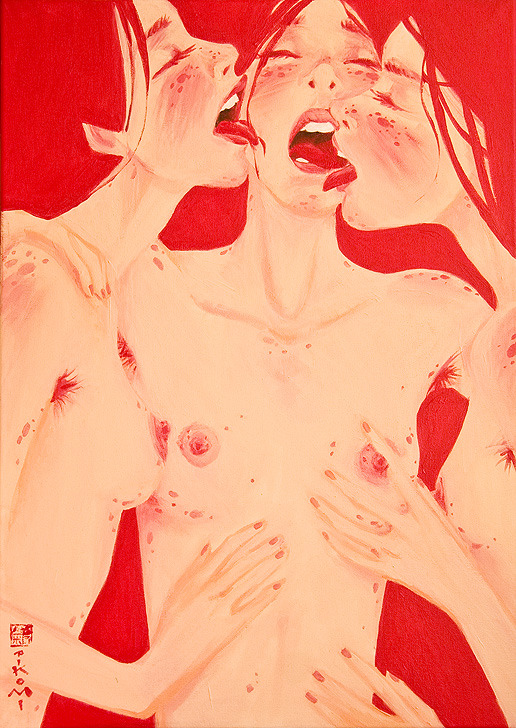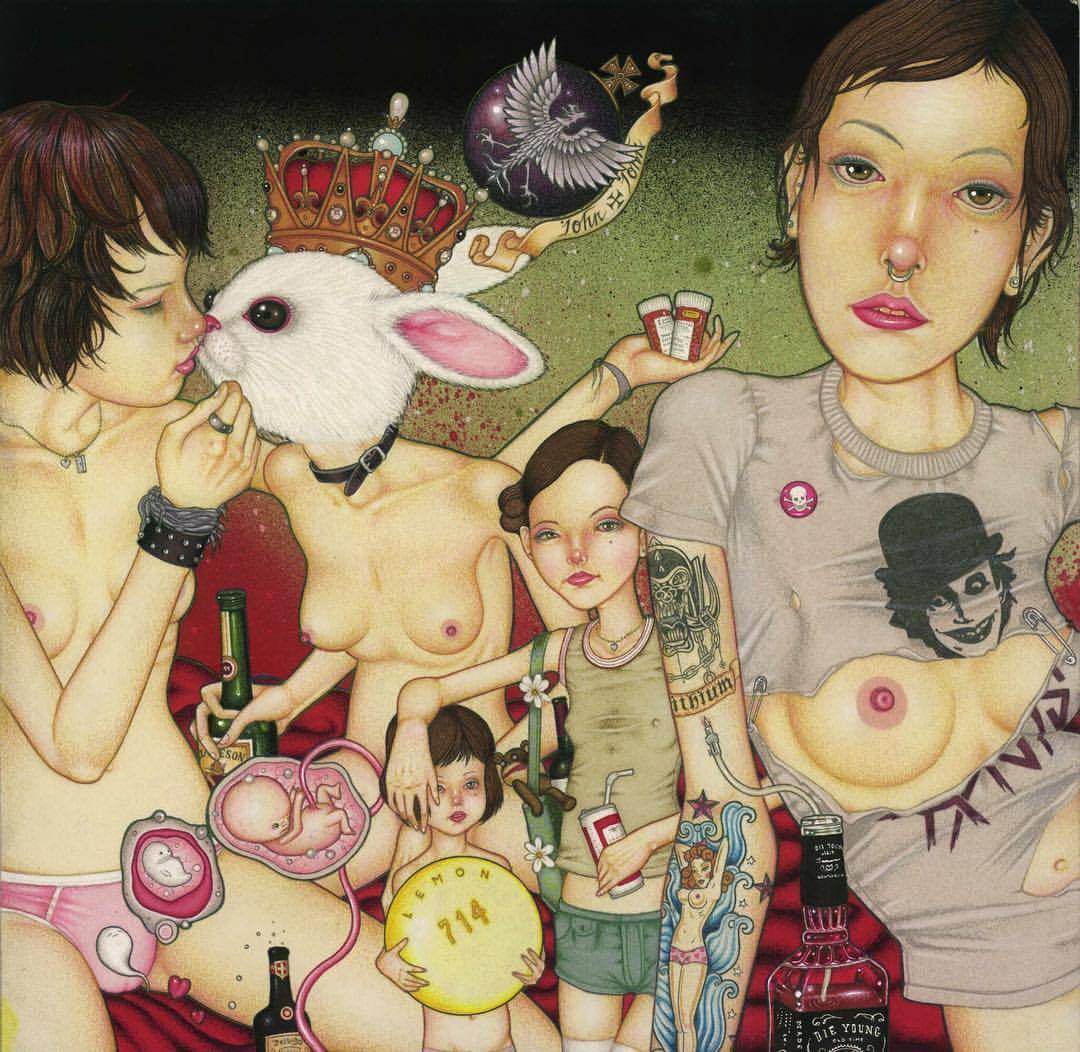
John John JesseCradle to the Grave (2005)

I feel like John John Jesse takes the worst bits of Klimt (the tendency to over encumber his paintings with decorative elements) and Ernst (decalcomania) filters them through the lust, depravity and mania of drug-fueled debaucherous punk rock themed orgies.

It’s like the first reaction to any painting is to move beyond the improbably ripped (and oft-ineffectively safety pinned shirts) revealing even more improbably perfect breasts and shift into a sort of Where’s Waldo spot the drug references–in this case: five (5) bottles of booze (Jameson in the right hand of the rabbit headed lady, some sort of cognac between the legs of the pink knickered woman at frame left, a bottle of wine in the knapsacke of the woman in the tank top, the Budweiser in her hand and then a bottle in the style of Jack Daniels of Die Young (presumably whiskey) that has been turned into an 80 proof alcohol IV), a big old Bill Cosby’s Secret Ingredient and two prescription bottles.

I’m going to completely gloss over the ghost/homunculus/fetal alcohol syndrome fetus with umbilical cord. (Like WTF-even?)

Now, by all accounts I’ve done more than my fair share of drugs in my life. Hell, I continue to enjoy a number of illicit substances. And really the in-your-face punk-rock flavored transgressive nihilism that Jesse trades in is unquestionably seductive to me.

But it’s easy to point to the sex, drugs or rock and roll-ness of the work as being what attracts and repels the viewer in equal measure.

What I keep coming back for is honestly the way he depicts women. It’s been noted repeatedly that most of the folks he paints are his friends. And to me that feels like the most important take away from his work.

I’m not sure what it says about me–probably more about my being born in the wrong time (New York’s Lower East Side in the 80s would’ve absolutely been my scene, you have no idea), but the way the women he paints can look simultaneously self-possessed, stoned to the gills, standoffish, available and maybe like they aren’t sure whether they are trying to feel something other than numb or numb their feelings, resonates with me in a way that leaves me entirely unnerved.


Source unknown – Title unknown feat. Anina Silk and Joy (2010)

I’m not 100% on the attribution here but I’m pretty sure the year and performers are correct. (If anyone knows where they real clip originates, I’d be interested in seeing it actually.)

Ass play isn’t really my thing. It can absolutely shorten the length of time it takes me to climax and it changes my awareness of what muscles do what when I’m orgasming. Neither of those things really add anything to the experience for me.

If my partner is into it, I’m willing to experiment just so long as my partners mouth as well as my mouth don’t go anywhere near an anus or anything that’s been inserted into an anus. (I know everyone on Tumblr swears about how wonderful analingus is to give and receive, but yeah… no thank you.)

Thus, it’s a little odd that I’m including this in some ways–considering it’s ostensibly a warm up for anal fisting. The reason I like it is two-fold.

First, it reminds me of being five. I had a friend in my neighborhood named Dirk (not his real name but his real name was also disturbingly phallic in hindsight).

Dirk liked to play a game called ‘butt work’. One person would pull down their pants and lay face down on the ground the other person would pull the cheeks of the butt apart and look at, blow on, tickle or insert a finger into the other’s rectum.

I liked the shameless curiosity of it. The experimentation involved.

It was also turn based. I’d lay there hidden from view of the adult world by bushes while someone probed my body. It wasn’t the most comfortable thing but I knew there’d be a chance for me to be equally curious about their body if I was patient.

It’s that sort of I won’t ask you to let me do anything to you that you also wouldn’t ask me to do to you mentality that appeals to me.

I’ve been thinking about this a lot lately. Although I would also like to make porn at some point, I’m currently interested in pushing my personal photographic work in a more erotic direction. But I am patently uncomfortable with asking anyone to do something unless there’s some sort of mutuality to it. I have zero interest in pursuing anything exploitative.

I’ve not made much progress on figuring it out. But I did want to point to the mutuality that radiates from this image and to point to that feeling as something I’d like to learn how to encourage and foster in my own work.

Source unknown – Title unknown (201X)

The eye moves left to right over this frame; the action flows in the opposite direction (right to left)–like walking into the ocean when the tide is pushing in against the land; or, as if the arrow were pushing itself against the bowstring of its own accord–seeking that perfect tension wherein it can only be loosed free and true on target.

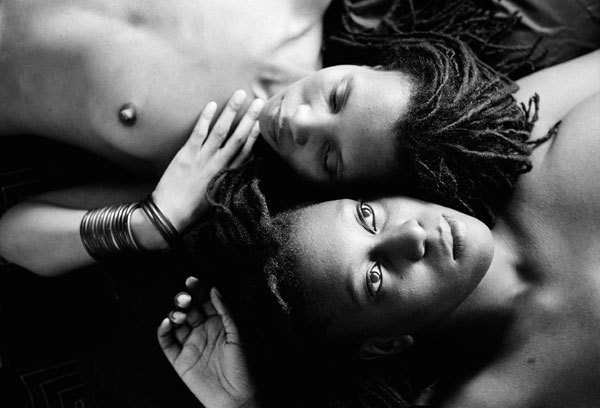
Zanele MuholiBeloved II (2005)

I’ve pointed to Muholi’s splendid work before.

I purposely limited my commentary to factual tidbits. This was partly due to the fact that–contrary to how things may appear with my writing here–I don’t think expression is always the best response. Sometimes it’s necessary to sit and be silently present with resonate work. (If you’re a creative individual, a strong sensitivity precedes the development of vocabulary to explain in detail the way in which you respond to the work that moves you.)

The other reason is that although I am hyper-aware of pervasive (and entirely fucking justified) concerns over a lack of diversity in the arts and entertainment, I have no interest in participating in the who’s more ‘woke’, ally pissing contest that is just an elevation of gross tokenism to the status of virtue.

However, looking at this image, my brain automatically jumps to issues of representation. Specifically, like just about everyone else on Tumblr, I’m fond of the series Black Mirror.

When Season 3 was released several months back, a plurality of folks fell all over themselves telling me I had to drop everything and watch the San Junipero episode.

I resisted until I realized it was Black Mirror’s ‘gay’ episode and in the wake of the election and the subsequent spike in hate crimes, and then it seemed like the only thing that seemed like it might be worth watching.

I’m not interested in spoiling it. I’ll only say that I’ve since watched it a half a dozen times. It is every bit as good as I was led to believe. But, there’s something more bittersweet to it that I haven’t be able to put my finger on…

Looking at the image above, I realize what it is–for all the things San Junipero gets right (and trust me, it does get a lot right, a whole lot), the post-coital conversations are flat. I mean they’re shot flat, under too dim lighting. But the interactions are flat, too–I mean compare these scenes with the scenes where they are sitting outside Kelly’s beach rental and talking about their real world lives–some of the most on point dialogue in ages.

Charlie Brooker, the Black Mirror show runner, originally wrote the script to feature a hetero couple. But opted to change it–partly to be subversive (gay marriage wasn’t legal in 1987) and partly for issues of representation. And it works because it’s guided by a fundamental sense of empathy.

Yet, where it falls short, is the assumption that just because self-transcendent love looks the same no matter the race or gender of the lovers, the ways people in that sort of love reach out to each other might as well be as distinct as a thumbprint. These scenes adopt a hetero-post-coital conventional coding–which comes off as flat and lazy.

And that’s why we desperately need greater diversity in not just the characters that populate the stories we see on big and small screens alike; we need the people guiding those stories to tell their stories not according to tradition or convention but from deeply felt personal experience.

Imagine if Yorkie asking Kelly when she knew she was bisexual, had played out in a shot like Muholi’s above instead of the shot-reverse shot of the episode as it is? That would’ve been something because of separating the characters–from each other–you show them together negotiating the context that will come to be their mutual reality as a couple. Small, seemingly insignificant things like this make a world of difference. Or, to borrow advice I was given by someone much wiser than me: sweat the small stuff, the big picture’ll take care of itself.

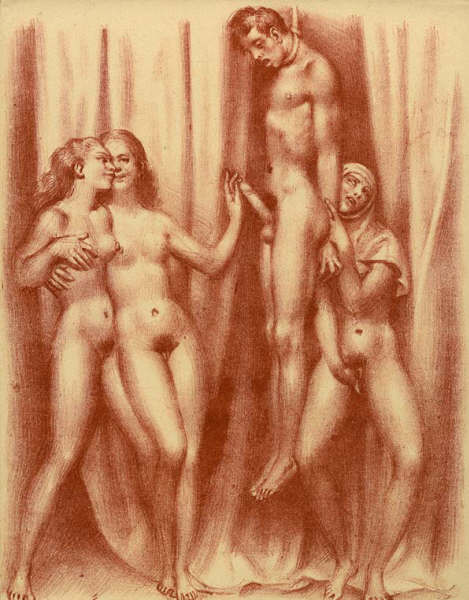
Suzanne Ballivet – Title Unknown (194X)

Angel lust (aka post-mortem priapism)

(Also, this reminds me of the opening scene in Deadwood: where the guy in the who is supposed to hang is worried about how he’ll die of strangulation instead of a broken neck and Sheriff Bullock says he’ll give him a hand. Bullock subsequently strings him up, kicks the platform out from under him and the guy looks bewildered and betrayed until Bullock reaches out and jerks the lower part of his body down violently, snapping his neck. The masturbating nun in the image above appears to not only be holding his hands behind his back but to also being dragging him down; there’s a sort of visual symmetry between her orgasm and his death.)

Untitledhttps://embedr.flickr.com/assets/client-code.js

Camilla CattabrigaUntitled (2015)

I’ve said it before but it bears repeating: if you are a young photographer who wants to work in B&W, invest the time and energy necessary in learning to use analog.

Digital is garbage when it comes to B&W–especially at higher ISOs. (If you only have a digital rig, then you should unequivocally set it to some sort of monochrome setting before firing the shutter. Desaturating in post is always going to produce a tonally muddled image; monochrome settings aren’t much better but every little bit helps.

Also, an image maker it smacks of lazy, knee-jerk, half-assery when you stamp your work with a text-only watermark. I mean, an image maker is ostensibly a visual artist, so it’s just a wasted opportunity. (And that’s completely glossing over my rabidly anti-watermark idealism.)

Still, overlooking those concerns, there’s something fascinating about Cattabriga’s work.

She uses what I’d term wide or establishing shots and extreme close ups. With both, she pursues relatively flat compositions–alternating classical one-point symmetry and more minimalist, De Stiji at a cant asymmetry.

I could point to dozens of young, internet famous image makers she riffs off. But I think what’s most interesting about her work is the aforementioned alternating between wide vs tight shots.

I like her wide shots well enough. They demonstrate a rare contemplative patience. These type of shots tend to outweigh the closeups by a rate of about 4 to 1. This allows the close-ups to convey an unusual immediacy.

As much as I think that like the term post-rock is generally (and rightly) derided by the bands whose music is so labeled, it does at least point to some incredible music.

I feel similarly about the oft touted term ‘female gaze’. Generally, the people who embrace the term are full of shit. (Looking at you, Masha Demianova.) But I can’t look at Cattabriga’s close-up work and not be 120% convinced it applies.

And I’m not sure she sees it in her own work. The above image does not feature in the Nicole E Flavia series of which it is a part. I think generally a tighter edit would’ve added punch to the images but there is something to this image that pairs a little too well with some of the other close-ups, primarily I’m thinking of this one (which is effing incredible).

Also, I love how the image above depicts a state of eroticism that is independent of the audiences experience of titillation. The image doesn’t exist as any sort of invitation, it’s merely a record of white skin, touch and the proximity of bodies in a confined space.

I don’t think there’s ever a justified reason to decapitate people when making an image, but here’s a case where it almost works as long as these images are considered within the context of the entire series.