Edgar DegasTwo Women (1876-1877)

Most of the canonical oil painters from the mid-19th century onward can hardly be said to have produced entirely chaste work.

But what I find interesting is the extent to which sexuality is implicit in the quote-unquote masterpieces and explicit in their sketches, BTS experiments.

Seeing this sketch absolutely gives me a better grip on Degas’ work. (The feeling that I’ve always had that his bathers are prostitutes, washing up between clients–now seems far less preposterous and the so evocative rendering of his dancers suggests a fixation on sexuality associated with bodies and/or nudity.)

Gustav Klmit, Egon Schiele and Picasso all made v. similar sketches, actually. And the thought that suggests to me is that Schiele was probably the most honest about what he was up to–since there’s less discrepancy between what he exhibited publicly and what he mediated upon privately. Klimt and Degas were more interested in attempt to present sexuality organically within a proscribed context–one facet in a many faceted presentation. (And the Picasso drawing in the ambiguity of the depiction of the person performing oral sex on the woman preserves an undifferentiated, ambiguously gendered person that can serve as both signifier of a woman or a place holder for a man–which seems to be entirely in keeping with Picasso’s legendary misogyny.)

Source unknown – Title unknown (19XX)

Free love? As if love is anything but free! Man has bought brains, but
all the millions in the world have failed to buy love. Man has subdued
bodies, but all the power on earth has been unable to subdue love. Man
has conquered whole nations, but all his armies could not conquer love.
Man has chained and fettered the spirit, but he has been utterly
helpless before love. High on a throne, with all the splendor and pomp
his gold can command, man is yet poor and desolate, if love passes him
by. And if it stays, the poorest hovel is radiant with warmth, with life
and color. Thus love has the magic power to make of a beggar a king.
Yes, love is free; it can dwell in no other atmosphere. In freedom it
gives itself unreservedly, abundantly, completely. All the laws on the
statutes, all the courts in the universe, cannot tear it from the soil,
once love has taken root.

Emma Goldman, Marriage and Love

Source unknown – Title unknown (201X)

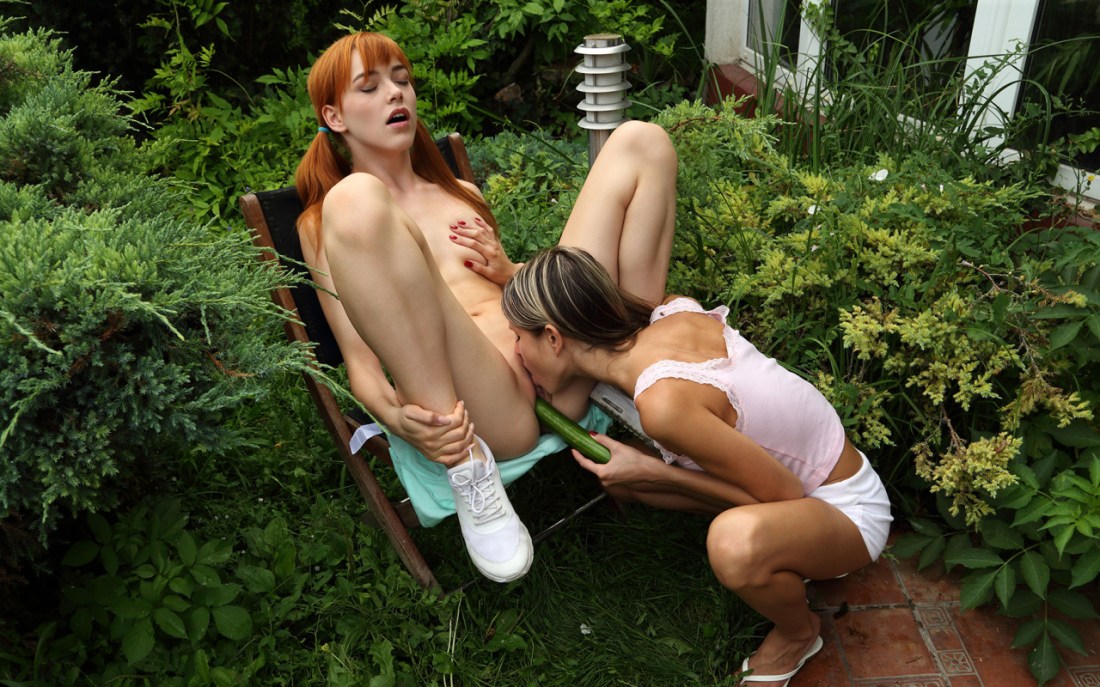
Unlike most of the porn I post–which tend to be images with a certain audacity I appreciate, honest immediacy I crave or a libidinous savoir faire that resonates strongly with my own weird desires–I think this image ticks all the right boxes but also suggests something about the nature of the question of pornography vs art.

This image is constructed to convey context. I love that with the exception of the woman in the pink blouse’s left flip-flopped foot, both women are presented in their bodily entirety within the frame.

It’s not just my own personal preference here. Pornography–and especially pornographic moving images–there is this tendency of embodying the laziest and worst short cuts offered up by cinema. Establishing shots that suggest the scene is in a famous city that then later cuts to environs built up in sterile soundstage; or, worse, the excessive use of close-up inserts (a tact which only works when kept to a bare minimum since each instance is intended to cause the viewer to take special notice of the object or action depicted, porn tends to gravitate towards something on the order of 65% inserts–pun intended, sorrynotsorry.)

From the standpoint of form, it’s sloppy technique. But, since the advent of DVD players–if not before–a viewer has been able to zoom in on a portion of the frame at will. With the telescoping of increasingly absurd resolutions, there’s really no reason to have a scene play out in extreme close-up. With moderate thought given to composition and blocking, a wide shot could be filmed in such a way that it could subsequently be parsed by the viewer to focus on what interests them.

Back to the question of pornography vs art. I think a better dichotomy might be questioning whether the image is a document or a product. Let’s use the above as an example to show how such an analysis might go.

This is clearly someone’s back yard. And that invites questions of public vs private–in this case a private space that verges on public. The down tilt of the camera emphasizes this. It’s not quite high enough to be the view of a neighbor looking over their fence–but it’s still not entirely possible to shake that feeling that the camera is a stand-in for a voyeur. (In and of itself, the camera functioning as a voyeur does not exclude the the image from being a document. However, in this case, the fact that the woman in the pink top has carefully pulled her hair over her right shoulder so as not to block the camera’s field of view.

Given the absence of body hair, my gut is that this is intended as less a document than a product. Yet, I’m not completely willing to disqualify it from being a document. The use of color is mad on-point. The spectrum of reds–hair, lips, respective skin tone, bricks; greens–bushes, grass, cucumber; the pastel magenta shirt and the aquamarine cushion. There’s also that super-saturated, contrast-y color you get when it’s overcast.

Also, the composition doesn’t quite work–the brushed nickle lighting pylon and the windows and bricks, skew the balance so that frame right is almost twice as heavy as frame left. Still, it’s a solid idea with better than average execution.

Given the opportunity this is exactly the sort of scene I’d like to use as inspiration for a fine art image.

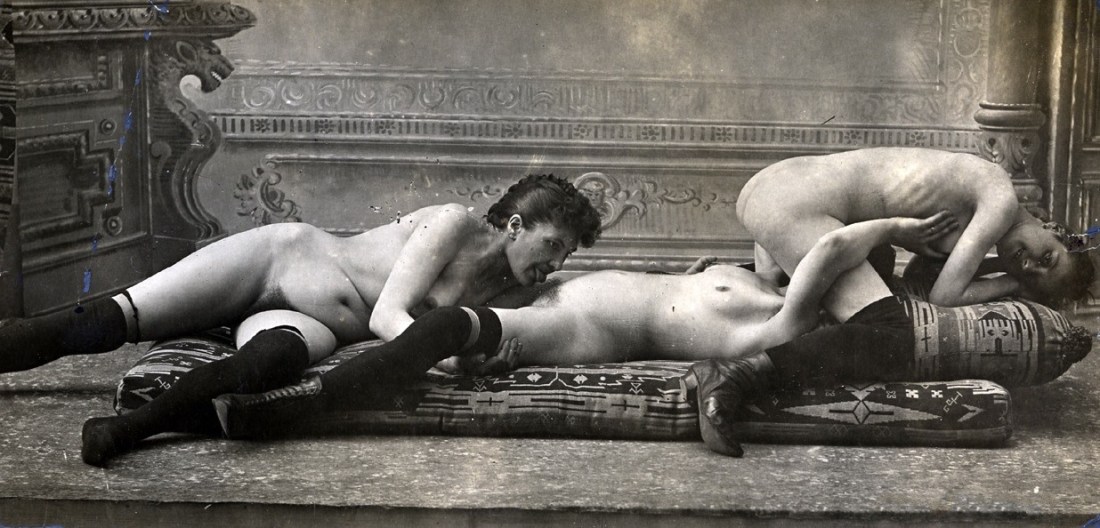
Source unknown – Title Unknown (19XX)

Narrative this image is not. In fact it’s pretty goddamn contrived–a cishet male photographer appropriating lesbianism for erotic effect.

But that realization serves as a narrative spark and I can’t help but think that as these two women were leaving post-session and one of them–probably the one on top (the woman on the bottom with the protruding tongue is a little too lipstick lesbian for me to believe she has any personal experience with cunnilingus) works as a prostitute but is a lesbian. She accepts these photo gigs because they pay the same as sex work and she doesn’t have to deal with men.

Yet the sessions themselves are the closest she gets to tracing the outline of her true desire and as such she frequently jokes with other woman with whom she is photographed about how ridiculous the way heterosexual men think about lesbian sex is and hoping that the other model will just once nod a little too knowingly and one thing will lead to another.

Source unknown – Title Unknown (20XX)

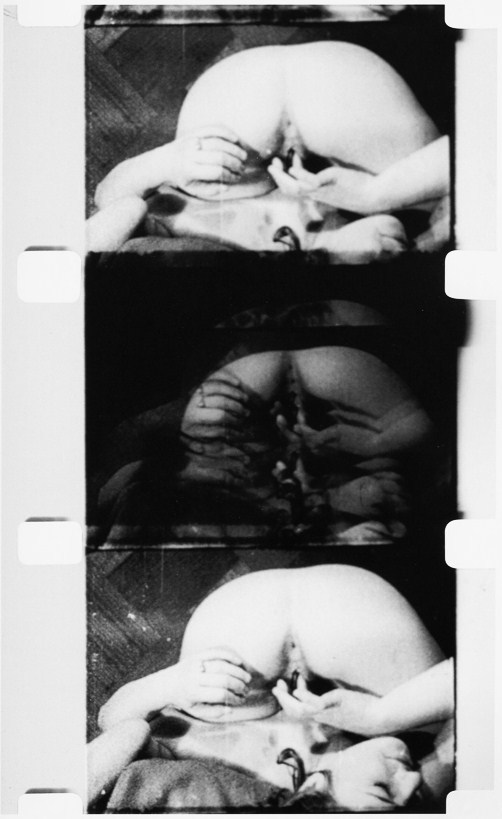
There’s no stretch of imagination wherein this could conceivably be considered a ‘good’ image.

Still, it gets me extremely hot and bothered (given that a scenario like this is one of my top five unfulfilled fantasies).

Yes, like so many fantasies/paraphilias there’s the pure carnality of the proposition. In this case there’s something more subconscious–a sort of instinctual resonance.

I’ve vowed to try to explain it but it’s probably going to be messy–so I apologize in advance.

Two weeks ago, Andy Wachowski came out as Lilly. Together with her older sister, Lana–who is also transgender–The Wachowski Brothers, filmmakers responsible for Bound, The Matrix and my personal favorite Sense8–are now the Wachowski Sisters.

Apparently, Lilly wasn’t exactly ready to be publicly outed but a British tabloid had begun nosing around–so it was only a matter of time and Lilly decided to release a statement to a local Chicago news outlet.

It’s extremely well-written–clear, measured, thoughtful and profoundly sensitive. I can’t recommend it enough, really.

One of the things that stuck with me is the following quote attributed to Jose Muñoz:

Queerness is essentially about the rejection of a here and now and an insistence on potentiality for another world.

In truth, I’ve thought of myself as queer for longer than I’ve known their was a word that described my precarious relationship to other beings in this world. I’m lucky in that I’ve had some amazing queer folks with whom my narrative arc has intersected.

All of those folks have been far more comfortable identifying me as queer than I’ve felt with using the word to self-identify. Lately, however, that’s begun to shift.

I’m not a competitive person. The closest I get is pissed off and irritable when mediocrity gets elevated to ‘greatness’ by the tasteless masses. (See: Humans of New York.)

I’ve never understood the heterotypical mating game. I don’t want to win you because I don’t want to own anyone else. I want someone who chooses to be with me and who I choose to be with in return. I’ve always thought that it has to be one person. Increasingly, I know it doesn’t.

Between Complex PTSD and/or autism spectrum tendencies, I’m decidedly neuroatypical. I have friends who tell me about their perfectly compartmentalized lives–friends divided into spheres of influence: work, school, extra-curricular interests; and then potential lovers–which are sometimes not even one in the same with those who are sought for romantic entanglements.

Hearing them talk about it exhausts me. (I can’t even begin to fathom how someone would enjoy living that way.)

Given that with the most rose colored prognosis I’m socially awkward (and borderline anti-social is probably more accurate), those few people that I care a great deal about while I don’t think our entanglement has to necessarily be sexual, I don’t understand the imaginary boundary that renders sexuality off limits.

I guess I just see it like this: sometimes a carefully considered kind word is enough to comfort someone, sometimes it takes a hug or holding hands through a shoulder wracking sobbing fit. And it seems there are times when someone is lost and that giving them pleasure, just seems to be the only thing that might possibly help sooth the hurt. But not just as a means of fighting against the darkness of sad times, as a way to share joy, express trust, etc.

I believe in the possibility of another world. For the last six and a half years, it’s felt like it’s only me that feels this way.

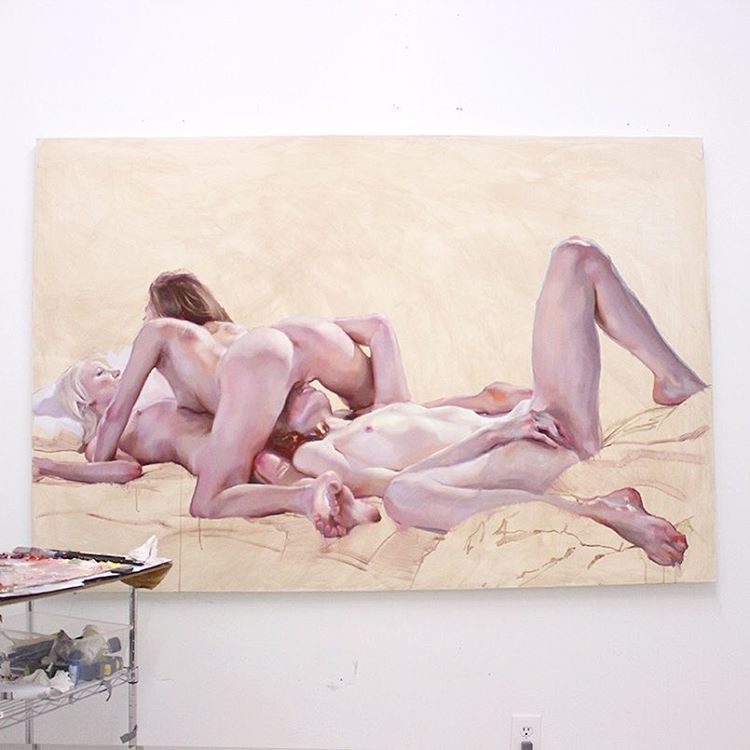
Ivan AlifanThe three graces (2016)

This does several things very well.

Although much of oil painting art historically centers on mythology (Greek and Roman or Xtian), most renowned oil painters were decidedly secular humanist in nature.

The tropes of mythology and religion were widely legible, there was built in interest (due to the universality of public familiarity) and generally if someone had money to hire an up and coming painter, depending upon their particular bent–mythology or religion could be counted on as a source of inspiration.

There was also certain visual coding associated with either. Whether it was the saints or a bible story or an incident from the Illiad, there were interesting technical considerations about staging, technique, etc.

But there was also the way many artist filtered the making of their work through their sexuality. I’m thinking here mainly of Leonardo and Michelangelo, but I’m pretty sure you can follow the trajectory of painting while illuminating this tendency.

What I find clever about this is the way that it–instead of making the myth/religion its pretext, it places its interest in the sexual front and center.

However, in doing this, it’s accomplishing a clever sleight of hand. Because if you know, The Graces were Aglaea (Beauty), Euthymia (Grace) & Thalia (Good Cheer/Festivity).

The first bit about this is to note that all three were Zeus’ daughters and therefore this isn’t just a lesbian menage a trois–it’s incestuous to boot–something you aren’t going to know unless you understand the mythological context.

It’s interesting to play attribute the correct name to the correct figure. My best guess is right-to-left: Aglaea (beauty is inherently untouchable), Euthymia is straddling Aglaea having her clitoris sucked on by Thalia–grace being a singular experience and good cheer requiring both being merry and making merry.

But what I think I like the most is that this is staged to titillate the voyeuristic viewer, but the angle is such as to thwart any sort of expectation that this scene was staged specifically for the so-called male gaze.