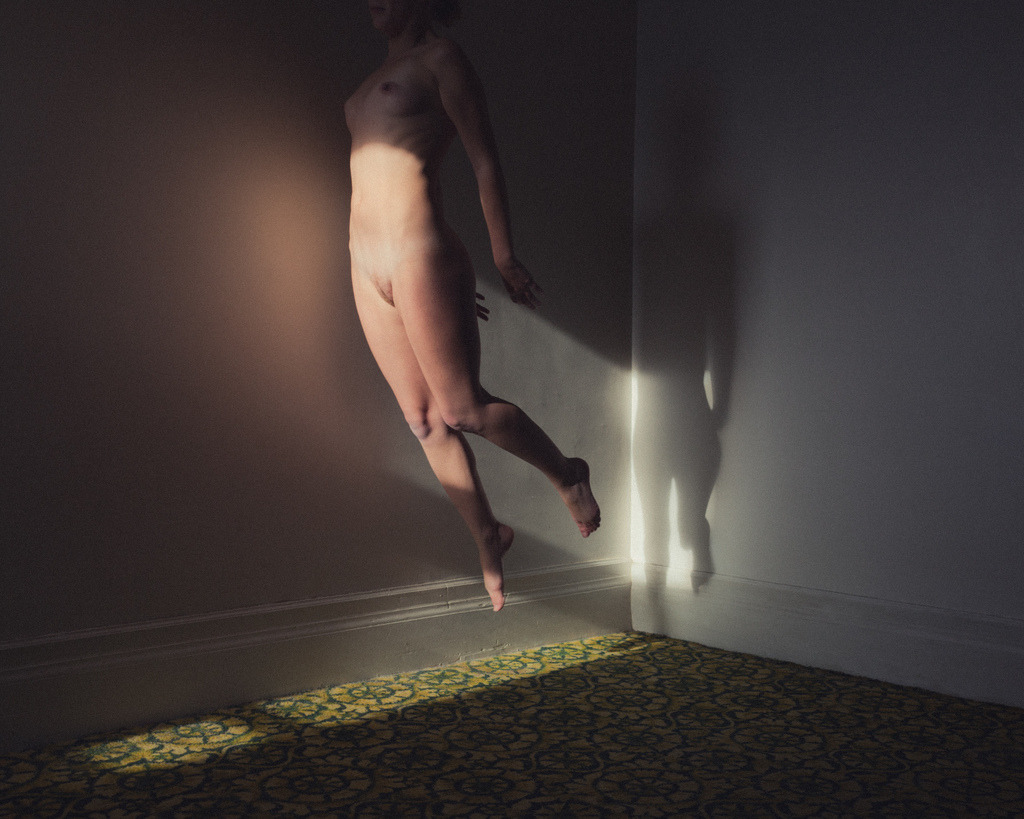
Andrés Castañeda – Untitled (2014)

I see a lot of Castañeda’s work featured on a lot of the blogs I follow.

Until the set of images from which the above image emerges (and is the best), I’ve liked a handful of his images but have remained mostly ambivalent about his work.

Encountering this made me realize that what makes one image and breaks another is Castañeda seemingly pathological obsession with capturing raucous colors.

The difficulty–at least for me–is given the more explicit focus of the majority of these images, the lush profusion of color for the sake of color, or colorlust, if you prefer is inconsistently (at best) and haphazardly (at worst) applied.

In the case of the above, the riot of colors cause the orange stockings to pop. However, in popping they compliment the diminished range of skin tone which actually shifts attention to the unspoken focal point of the  the image: the suffused, milk-white light.

In other words, the fixation on color in this image is less raison d’etre and more conceptually unifying than most of the work.

Also, I was reading something on typography a few days ago and it observed that the best typeface choice is the one you don’t notice. I haven’t quite worked out the corollary but I have a feeling this suggestion also works when considering notions of composition. Too often, Castañeda is (Stephen) Shoring when he should be (Jeff) Walling.

Igor ChekachkovAbove (1 of 24) from Daily Lives series (2013)

There’s no sidestepping comparisons with Florian Beaudenon’s Instant Life.

Chekachov uses light in interesting ways but his composition chops lack Beaudenon’s rigor.

Yet, this image does two things Instant Life doesn’t: it demonstrates a patient reverence for the electric current of sensuality underlying bodily instantiation and an openness to being alone, together in the sometimes mundane, sometimes tempestuous sea of being.

JoLee KirkikisUntilted (2014)

Browsing Ms. Kirkikis’ work, I associate it instinctively with Erin Jane Nelson’s early work.

Both capture themselves/friends in wistful moments, awkward spaces between presence and absence. Both tend to use image making as a means of documenting performances related to text or sculptural elements. Both have images featuring finger traps.

It feels to me as if both build out off a similar foundation: a sort of belief that the world is too big to feel small. In Nelson’s case, she led with her angst–as if her creative process were an interrogation room scene, with her playing the good cop, the bad cop and the suspect.

Whereas, Kirkikis is more circumspect; evincing a confidence perhaps not yet in her work but certainly in the searching nature of her nascent process.

It’s interesting to me that it appears Nelson has disavowed her early work. That’s a mixed blessing. Yes, most of her work was disturbingly uneven and much of what worked seemed a fortuitous accident. Still, she made a handful of images which indelibly seared themselves onto my mind’s eye. (I find it interesting the degree to which the work she is making now is aggressively confrontational.)

And while Kirkikis’ work would benefit from culling her extensive output to something learner, more focused… unlike Nelson, I think we’ll probably still see the above image recur as she matures along with her work.

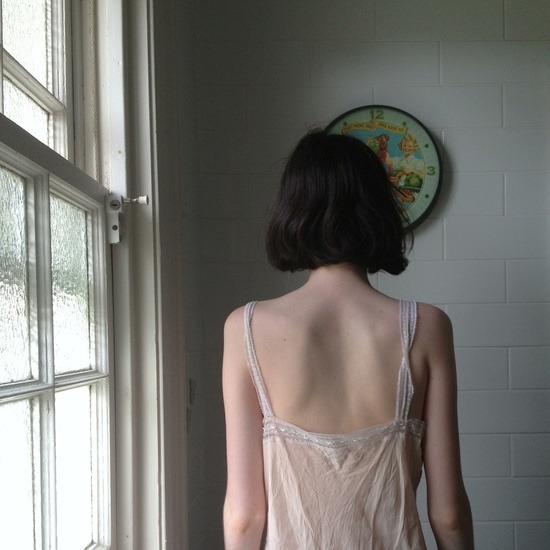
This is a self-portrait made by Zoe, a precocious, articulate and self-possessed sixteen year-old who blogs as Posh-Lost.

I admire her spunk.

Admiration aside, I have misgivings about posting this—not the least of which is the image maker being too young to ‘legally’ browse this site. Also, does displaying her work alongside more explicit content unnecessarily sexualize it?

Laurie Penny uses an ingenious coinage to refer to the well-intentioned worry we shower on the behavior of teenage girls: concern-fapping.

It is patently fucking absurd to think young women are not foundationally aware of the degree and extent to which their bodies are sexualized by society.

Further, anyone looking at this picture should know better. This is not some cell phone bathroom mirror selfie; light shines in through a window visible along the left edge of the frame, a la the Dutch Baroque. Further the staging speaks to an interest not in seeing while being seen but something closer to a preoccupation with the perception of self by another.

The flimsy, semi-sheer camisole is sexy; but whether sexy translates to something libidinous or reciprocally desiring remains pointedly unresolved.

Granted, it is not free of flaws. But it is thoughtful and I find it thoroughly and unironically interesting. But I can’t lie—there is something else to it that gets under my skin.

Long story short: I have never disclosed my gender on this blog. I’ve implied through omission, undertaken some linguistic gymnastics and mostly embraced opportunities to shore up ambiguity.

I have mild-to-medium gender dysphoria. As a child, I wanted to be a girl. When other kids played super heroes—I didn’t give a fuck about the perpetual fight over who got to be Superman because I was Wonder Woman. This was frowned upon. Frowns became stern words escalated to outright threats.

A dear friend suggested that if I was meant to be a woman, nothing would have stopped me. I think that is sage advice.

If you need a hammer but you only have a wrench, it doesn’t really work the best but you can more or less make due. From the standpoint of how my body relates to my sexual identity, this metaphor serves.

I pass as male and straight although I’d never embrace either. This creates a-whole-nother layer of complication. On the one hand, there are social expectations of me with which I find so uncomfortable they are debilitating; on the other, I have privilege in that I can somewhat function under the assumption that I am cisgendered. My ‘problems’ seem charmed compared to the struggles of the rest of the gender dysphoric community.

Additionally, I have a pathological aversion to anything related to medicine. Gender reassignment surgery is not a consideration. It’s that I feel more feminine that masculine. azura09 always says she thinks of me as a really dyke-y Daria Morgendorffer.

And yes if there was a Matrix like scenario where I could take the red pill and wake up female-bodied, I would do it without a second thought. Even if the ante was upped and I would die five years after taking the red pill, my choice would be the same.

I know this image is Zoe and she seems really amazing and the last thing I have any desire to do is co-opt her experience or her own depiction of her body but—fuck me—this is to a T the way I see myself in my head.

If there were surgical procedures that would make this awful body conform to this image, they couldn’t cut fast enough for me.

Maybe then someone might be able to love me.

Normal
0

false
false
false

EN-US
X-NONE
X-NONE

/* Style Definitions */
table.MsoNormalTable
{mso-style-name:”Table Normal”;
mso-tstyle-rowband-size:0;
mso-tstyle-colband-size:0;
mso-style-noshow:yes;
mso-style-priority:99;
mso-style-parent:””;
mso-padding-alt:0in 5.4pt 0in 5.4pt;
mso-para-margin-top:0in;
mso-para-margin-right:0in;
mso-para-margin-bottom:10.0pt;
mso-para-margin-left:0in;
line-height:115%;
mso-pagination:widow-orphan;
font-size:12.0pt;
mso-bidi-font-size:11.0pt;
font-family:”Garamond”,”serif”;}

syntheticpubes:

by Benoit Paillé

Normal
0

false
false
false

EN-US
X-NONE
X-NONE

/* Style Definitions */
table.MsoNormalTable
{mso-style-name:”Table Normal”;
mso-tstyle-rowband-size:0;
mso-tstyle-colband-size:0;
mso-style-noshow:yes;
mso-style-priority:99;
mso-style-parent:””;
mso-padding-alt:0in 5.4pt 0in 5.4pt;
mso-para-margin-top:0in;
mso-para-margin-right:0in;
mso-para-margin-bottom:10.0pt;
mso-para-margin-left:0in;
line-height:115%;
mso-pagination:widow-orphan;
font-size:12.0pt;
mso-bidi-font-size:11.0pt;
font-family:”Garamond”,”serif”;}

An image of Paillé’s—from the World Rainbow Gathering in Guatemala—slid across my dash several months ago.

Intrigued, I quickly found his candid portraits of illegal Ivorian immigrants working as “beaters” outside Paris’ Chateau D’eau Station. Despite the conceptually problematic aspects of the project—fetishizing alterity, for starters—the detail and precise exposure control floored me.

The majority of his works causes me to suffer an uncharacteristic loss for words. I am never particularly enamored with his choice of subjects and I think his use of color borders on gratuitous hyper-stylization. But damn if I don’t absolutely dig his eye.

However, the thing that makes his work so distinct is for me less a visual signature and more an attitude toward the subject. I’ve found it’s always stupid to try to say something that has already been said well better, so there’s this quote from Thich Nhat Hanh:

            You must love in such a way that the person you love feels free.

To my eye, that is what makes a Benoit Paillé image so unique—he seems less concerned with taking a picture than offer his camera as a means of recording the intrinsic truth that comes from sharing a holy moment.

This post is guest curated by azura09:

nevver:

How to bend light

And in the dark we will take off our clothes
And they’ll be placing fingers through the notches in your spine

When I first looked at you in the almost-dark, scared that you would not like my breasts. That I would see disappointment on your face. But you still pushed me to touch you, my fingers climbing your back as I held you and kissed you near your mouth. 

Years pass and I’m used to your hatred of overhead lighting. I expect it when you reach over to turn on the desk lamp or light a candle I don’t like the smell of, wax and apple cinnamon. I’m grateful for the way you now know my body so well it’s not necessary for you to see me, but yet you still want to look.

Maybe a week or so ago, the lovely sextathlon re-blogged a post featuring images of Michelangelo’s David side-by-side with a photo of a nude male pin-up appended with an question as to why the former is defended as Art and the latter is deemed obscene.

My suspicion is that the party line runs: the skill required to carve a nude dude from a chunk of marble exceeds what is needed to plunk a hunk down in front of a camera.

The dichotomy really centers on the way male nudity challenges invisible assumptions, i.e. the spectator will be straight, white and male or deferential to such a perspective.

Michelangelo was likely gay, David—a homoerotic sculpture. But Renaissance aristocrats didn’t get their dressing gowns in a twist because the work was conceived with fail-safes to diffuse the “gay”: the contrapposto of Greek statuary was the lingua franca among Firenze’s intelligentsia; also, naming the piece after a mensch who was such a bro that he had a man killed to bone his wife further obfuscates its homoeroticism.

On the other hand, photography is a relatively young medium and as such there are fewer ruses to diffuse perceived affronts to the invisible ‘heterosexual norm’. Thus: an image of a cock is, well… a cock—and most likely totes gay.

Pornographers, and trench coat clad old men standing on street corners, have done fuck all to ameliorate matters. Both reduce heterosexuality to metonymy—men are their swollen manhood; the sight of which is somehow sure to start vaginal secretions dripping down thighs.

With all that bullshit, I guess people see the hairless semi-hard cock tucked between the boys shaved legs and immediately dismiss the image as “gay.” Maybe, they are a wee bit sensitive and wonder about the subject’s ambivalent gender identity

Fuck that noise. And should your eyes’ appetite not be omnivorous enough to appreciate the meticulously considered, conceived and constructed pulchritudinous depiction of longing, then fuck you, too.