knitphilia:

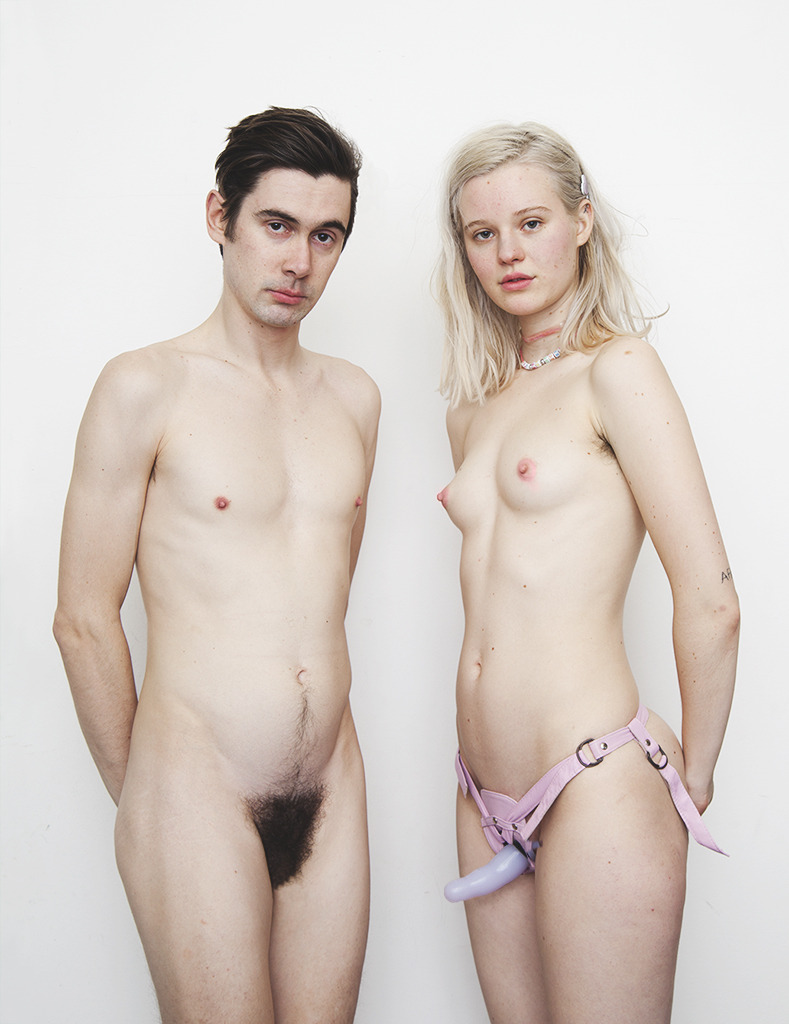
“pink candles,”by LAURENCE PHILOMENE OLIVIER.

Olivier mixes vertical and horizontal framing with impunity; plays fast and loose with framing and use color in such a predictable manner that it I can only think to call it ‘awkward’.

That said, her instincts are on point, devastatingly so. Her images could read as sloppy except for the fact that the undisciplined framing fosters a studied immediacy; the lack of nuance in color management serves as a blunt tool to not only guide the eye through the images while also emphasizing the conceptual underpinnings. It’s as subtle as a train wreck & charmingly radical in its utter lack of affected ambiguity.

The contradictions which cancel each other out–whether happy accidents or clumsy technical experiments–make the work relevant. What makes it important is the way that at twenty, Olivier is already dissembling notions pertaining to gender and sexuality and repackaging them as delicate and delectable parfaits packed with razor edged broken glass.

Beautiful, chilling and crucial.

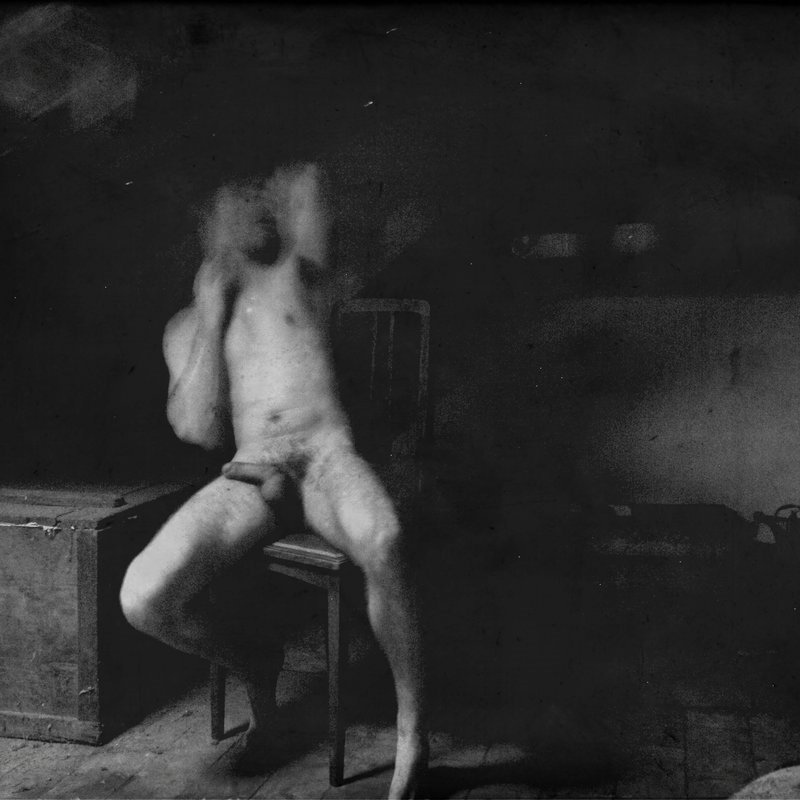
I have tried to source this but neither Google Image search or TinEye are coming up with anything conclusive.

This uncertainty exacerbates my polar reactions to it. Most of the time, the muddiness is reminiscent of Duane Michals early-ish work, particularlly a moment of perfection.

But there are also times–like writing this–where the position way his arms are positioned and his motion blurred face feel more like a horror film, a sort of  E. Elias Merhige’s Begotten-esque haunted house where the ghost seduces then strangles the amorous.

I don’t know what to make of it. Not in an I don’t give fuck one about it, though. It’s so true what is said about the distance between what we love and hate is much less than the disparity separating love from apathy.

There something else rattling around in my head about the body as a house haunted by a soul, but language and I are having another one of our frequent sullen tiffs. Besides, any time it starts to feel like the only thing I have ever known, I start to forget how the stories go.

Juan TroncosoPremonición 2009 (Made with a Nikon D300)

There are strong similarities between Troncoso’s work and art historical precedents. For example: Iluso smacks of Margritte, Real’s bad acid trip made flesh, borrows from a similar work– which escapes me at the moment but also used fragmented images attached to models’ bodies for unnerving effect–both owing a thing or fifty to Max Ernst.

But I can’t help thinking the references are little more than premeditated sleight of hand. The first clue is the image quality. There simply are not that many people around who can coax decent greyscales from digital equipment. Second, though his Flickr account is noteworthy, his personal website–despite its awkward and unwieldy layout– is incisively curated.

My Spanish is quite rusty but I ran Troncoso’s artist statement from the body of work in which this image features through a translation engine. What resulted was borderline nonsense. I tried to clean it up a bit–bear in mind my Spanish grammar is severely limited by my utter impoverishment when it comes to English grammar:

These images were performed over the course of five years and are chronologically arranged to portray a questioning evolution. A journey of visual interventions that came together in interpretations and symbols. Each photograph is a projection of my imagination, inspired by feelings involving me with this world. [A world where] reality and time intertwine with the infinite. The images seek to portray this connection.

Correlations with Margritte and Ernst shift to the background and I am left thinking of Yves Klein–specifically Saut dans le vide. Whether or not this is an astute response, there is something of Klein’s brash dynamism in Troncoso’s work.

Honestly, it matters less to me how they work than that they do–quite well, in fact.

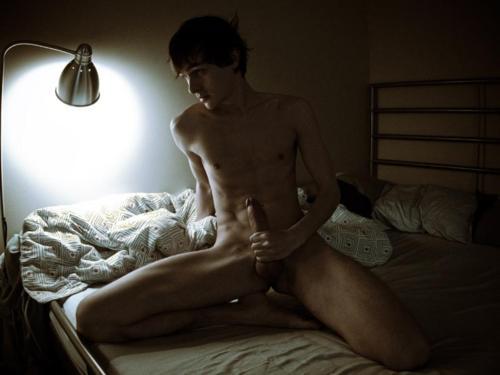
Google Image Search suggests the earliest instance of this image being post to a site on Blogspot called Tacobill in June 2010 even though all the links on the page are broken. Beginning in August 2010 a broad swath of entries are attributed to So Many Boys. (EDIT: Wyohhandplay was kind enough to inform me that the source for this is bitemarks.)

It’s really a shame. For what it is– a staged photo of a boy with his fist circling his cock– I think this is classy.

The composition is nice. He’s presented entirely within the frame, not making eye contact with they camera. His body’s mid-line angles to his right, counter-balancing the framing which clips the vertical of the lamp base against the middle vertical of the metal bed frame/headboard.

With the lamp turned toward the wall, the light blows out into a white-hot super overexposed orb. In turn this allows the reflected light to illuminate the rest of the frame with appealing, dusky tones.

It’s an artful take on what could have easily been another uninteresting, disposable iteration of the same old thing.

boudoirboudoir:

42112 (by brittanymarkert)

I like this image—perhaps for the wrong reasons.

To my eye, it represents a discontinuity with the rest of Ms. Market’s work because I am not inclined to associate it with an obvious photo-historical reference (i.e. Untitled is an obvious homage mashup of Francesca Woodman’s Untitled Providence, Rhode Island, 1975-76 and Untitled Providence, Rhode Island 1976; this still from the hotel haunting screams Diane Arbus via Kubrick, while room 109 invokes David Lynch with the subtlety of a thunderstorm.

Influence is crucial—sheer force of will and work ethic only goes so far. Hell, without inspiration, how many would have picked up a camera to begin with? Let alone kept on after all those rolls of ruined film, struggling through plateau after plateau in the work, etc.

So called fine art photography operates off the principle that imitation of your influences forms the most effective framework for becoming a photographer. Although seen through rose colored glasses, Arno Rafael Minkkinen presents the essential premise behind fine art photography with insight and aplomb in his renowned Helsinki Bus Station Theory.

While I disagree with the notion that gallery owners would so much give you the time of day let alone inquire as to your familiarity with X or Y artist and object to prejudicing the destination over the journey, Minkkinen’s theory does have special resonance for photographers with a vested interest in visual narrative or those—like Ms. Market—who count filmmakers among their foremost influences since the Helsinki bus station presents us a bit of a conundrum.

Even though I am not, let’s say—for the sake of argument— I am a enamored with Stanley Kubrick’s films. But for whatever reason, I prefer the medium of photographer so I arrive the Helsinki bus station and after looking around decide that to take a bus departing from the same platform as Diane Arbus. However, once on board I don’t even make it as far as the suburbs before realizing this isn’t for me. I go back and decide to follow the Walker Evans’ line—which departs from a platform on the opposite side of the station as the previous one. Maybe I make it a little further this time but quickly discover it’s still not for me. What then?

I go back and merely because I have no idea what else to do I wander onto the platform from whence Ansel Adams departed. This time the route choice sticks—but not due to being on a line the focuses on landscape photographer so much as finding a route pathologically preoccupied with the technical. (After all, what Kubrick lacked as a storyteller he more than compensated for with his exacting abilities as a technician and unparalleled production designer.)

Filmmaking and photography are sibling art forms and like siblings, you cannot approach them in an identical fashion. Those of us who come to photography by way of narrative/filmmaking share a frighteningly similar list of influences that, to stick with the metaphor, are dispersed all over the Finnish countryside. Most are contradictory.  Mistakes are going to be made; routes will need to be abandoned and subsequently re-chosen as the line that works for each person is almost never the first choice.

But back to this image—I like it. And I like it because it is one of the few images where I do not feel the photographer is not leaning on something that has been said well before in order to add feeling, depth or relevance to her own ideas.

Flattery is the sincerest form of flattery. Brittany Market demonstrates she handle imitation flawlessly. My interest in her work is what she will produce when she finds herself on a line long enough to leave the Helsinki suburbs behind. This image suggests a great deal of potential that will hopefully be realized in her maturing work.

nymphoninjas:

nymphoninjas:

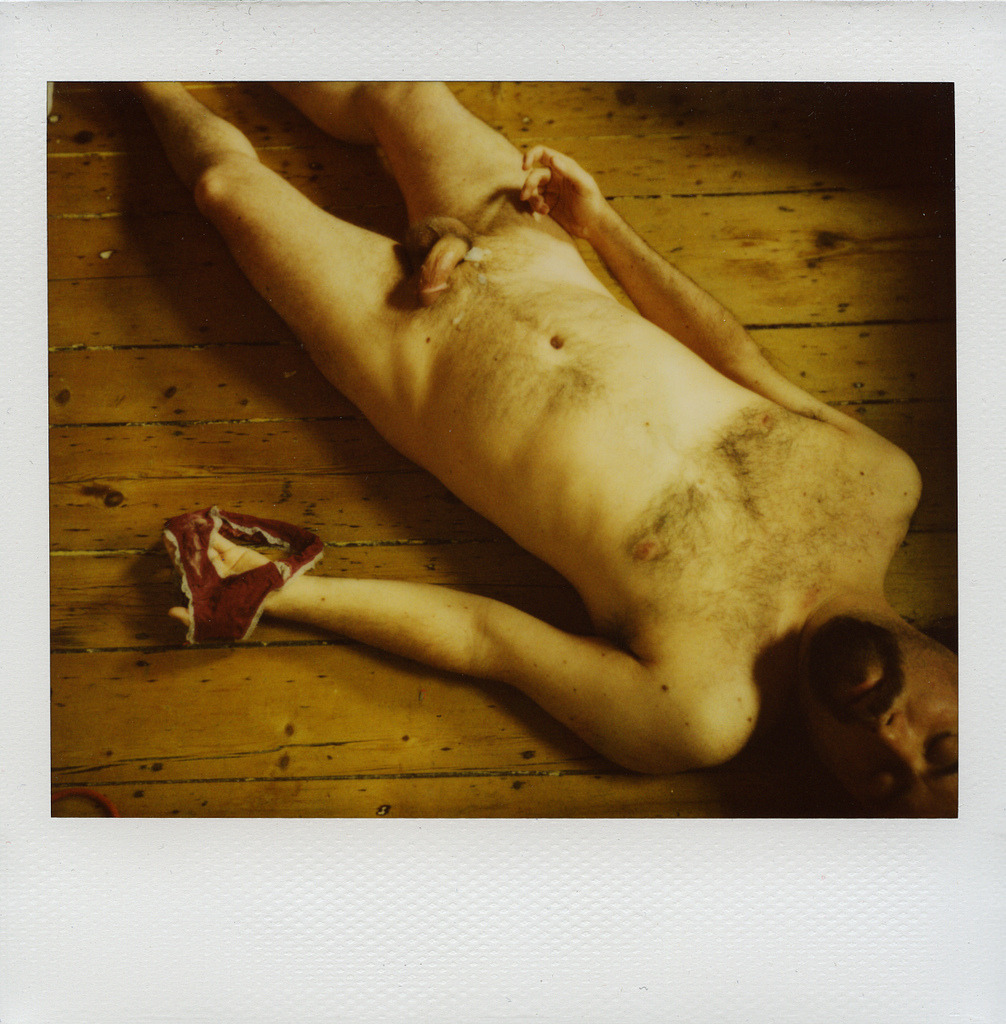
Approximately 65% of my sexual pleasure arises from orgasming. The remaining 35% is determined by what occurs afterward.

Closeness and cuddling are wonderful but I need more before that, something which demands more than I think I can withstand.

I am not necessarily talking so-called post-orgasm torture—though if that’s on the table, I won’t object. No, I crave something and more gently insistent; stimulation which recognizes and respects my heightened state of post-ejaculatory sensitivity while dismissing the notion that there can be such a thing as ‘too sensitive’.

Alas, this is not something I achieve alone—past a point, my nervous system short circuits and my body locks up.

Being alone for the last four years has caused me to seek out the vaguest hints of the same pleasure overflowing into pain, requiring complete surrender to overwhelming physical sensation.

This is a Polaroid of me—holding my ex’s panties stilling bear the marks of her former longing with which I sometimes in an Icarus like attempt to remembered some shadow of the glory arising from responding involuntarily to touch as if shivering in a desperately cold draft.

I feel like this submission would work really great in an art gallery, the photo is beautiful and touching. And the write up sounds more like an essay than a poem or message. Thanks for your submission dude I really fucking like this one and am proud to have it a part of SS. 

kalkibodhi:

The reach through

KalkiBodhi Archives

Even though it’s oriented without any goddamn regard for compositional logic and lacks the technical rigor and sophistication of say a comparable work by Robert Mapplethorpe, this image is noteworthy for avoiding the visual impoverishment which seems to follow as an almost natural consequence of focusing on the extremity of the act– an experience contrary to the experience of fisting and being fisted.

Not that extremity should be excluded. It is more that any roughness or violence in the exchange is– at least in my own experience– is beside the point. It’s about intimacy/connection; or, more specifically it strips the pretense and affectation of intimacy/connections, laying bare the vital underlying vulnerability. 

That’s my two cents, anyway. And since our experiences ends up projected outward on the world around us, this is what I see here.

Plus, I think it’s hell of sexy that you can see her piercing.