
Inside Flesh – Meditation II (2016)
“Art is the communication of ecstasy.” –P.D. Ouspensky

Source unknown – Title unknown (19XX)
This reminds me of Nan Goldin’s work although I am reasonably certain it isn’t hers.
To the best of my knowledge, Goldin used color slide film exclusively. (I vaguely remember that she now uses digital–which makes sense given the gritty immediacy she trades in.)
That it’s B&W would be a huge departure for her.
Also, the orientation of the couple to the space they’re inhabiting is a bit over-stylized–the way her body enters the frame at a slant gives a sense of dynamic left-to-right leaning in, which in turn contributes to a physical sense of forward motion into the cocksucking motion–despite the fact that she’s pretty clearly moving her mouth up the length of the boy’s erection not down it. (That tension between bending in and pulling away, makes it feel a bit like a gif despite the fact that it’s a single frame.)
Again, though: there’s a way in which this image doesn’t seem to be for or about the viewer–it’s merely something the viewer has been deemed lucky enough to witness second hand. (And in that way, it’s also very much like Goldin’s work.)
 https://embedr.flickr.com/assets/client-code.js
Jon Estwards – Untitled (2016)
This is like oil-painting erotica for mermaid aristocracy.
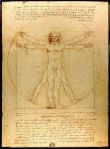

[↑] Leonardo da Vinci – Vitruvian Man (1492); [↓] The Essentials of Aesthetics – Fig. 80 – Woman’s Form Enclosed Between Circles (1907)
Juxtaposition as commentary
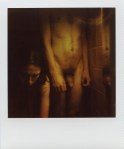
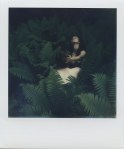
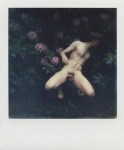
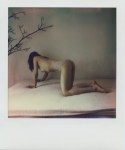
Jan Durina – [↖] Untitled, Prague (2015); [↗] Untitled, Ivan and Maria, Berlin (2015); [↙] Untitled, Tiergarten, Berlin (2015); [↘] Untitled, Maria’s Bed, Berlin (2015)
When I scrolling through my dash, I’m thinking about three things:
Things fitting the second criteria generally provide the prima materia for the best posts. The first are the easiest posts to write.
The third? Well, I have nearly 200 drafted items that in one way or another came to be saved as drafts because I thought I had something to say about them but–unfortunately–now I can’t figure out what to say about them but I still feel as if I can’t delete them either…
Seemingly without variation, my approach to this glut of things about which I want to say something but cannot fit thoughts to words, I tend to trot out a game I like to call pin the tall on the influence.
I’m resisting the urge to do that with Durina’s work. (Although seriously, if I’ve ever posted a veritable who’s who of contemporary internet famous image making, it’s absolutely Durina. Were this an academic setting I’d posit Ryan McGinley, Inside Flesh, Diana Reinoso, Myles Pedlar, Ben Zank, Errance L., and Dara Scully.
As far as a showcase of up-and-coming talent, it’s not a bad list. The struggle I have is that beyond a point–ticking off a checklist of influences is a little like one of those word find puzzles: a good distraction for 5 or 10 minutes but galling boring for any more extended period of time. (Hell, I don’t even like crossword puzzles and I’ll spend hours with those before I’ll waste more than a few minutes on those damn find a word bullshit things.)
I’m of a mind, however, that at a certain point we want art to demand that we, that is the viewer, do some work. I personally find it frustrating when art demands that I fastidiously obsess over influences. For example: I absolutely get why the Beastie Boy’s Paul’s Boutique is widely considered to be one of the best albums ever made. I won’t argue the point. But gimme License to Ill, over Boutique any day–if we’re talking about putting something on to listen to for the express joy of listening.
That’s why I think that Durina’s Polaroid’s are so impeccable. I mean Polaroid’s are exceedingly immediate. You depress the shutter and what you’ve got is what you’ve got–a singular physical artifact of the moment. (I’m going to gloss over the whole conceptual grey area that is using a medium typical pigeonholed for private porn creation as a medium for creativity and how compelling I find that grey area.)
Also, it’s EXTREMELY difficult to make a good Polaroid–and when you do it’s typically a testament more towards stubbornness than technical acumen. The colors are never quite right–but can be more luminous than anything this side of a perfectly exposed chrome. (Honestly, if I could afford to, I would use 65% B&W, 25% Polaroid and 10% slide film.)
That immediacy clear cuts all mess of influences on shirt sleeves and presents something surprisingly candid in its front-facing carnality. It’s as if the whole porn vs art false dichotomy as well as the naked bodies aren’t always inherently sexual can and do coexist because they are obverse faces of a single coin: the eternal battle between the sacred and the profane. Durina’s Polaroids dismiss that narrative and instead present carnal desire less as appetite and more as a symptom of physical embodiment. (I’m putting it poorly because it sounds as if I am suggesting that the same assertion that everything reduces to sexuality–and that’s offensive to asexuals. Here’s the thing though, I think asexuality and queerness have more of a home in these murky Polaroids than in much of the work hitting the interwebz today that is produced from behind a very LGBTQ+ prism.)

Sebastián Gherrë – Firework cum (2016)
Revisiting the first instance of Gherrë’s work I posted, I realize I equivocated a bit too much.
Further encounters with his work have caused me to warm to his so-blunt you can only call it heavy-handed and acontextual style.
I’m not usually a fan of the throw everything at the wall and see what sticks approach. (My nemesis when I was a photography MFA student had exactly such an approach–in the interest of full disclosure, she’s one of two people in a class of 17 that is paying her bills with her creative endeavors.) But with Gherrë there’s a sense of both openness to experimentation that is damn near playful more often than not wed to a commitment to an unflinching and omnivorous eye.
It’s a little too pat to compare his work to someone like Ren Hang–an artist whose is equally out and who works with similar prolific profusion. (In fact, lately I find myself rather put off by what I feel are Hang’s tendency to be casually shallow, mean-spirited and cruel in his work.)
But it is an interesting comparison, in so far as Gherrë‘s photos show ever sign of becoming less focused on provocation and more focused the inherent provocation in moments presented without context and therefore rely upon success or failure with what the convey about immediacy.
The above print is actually enormously clever in it’s composition. The viewers eye follows the boys white inner right thigh down into the frame at a diagonal. A lesser talent would’ve sought a bilateral top-to-bottom symmetry, but they inner left leg juts off at a different angle, pulling the dick in hand off a rigid top-to-bottom mid-line. (The frame is bottom heavy, but the angle of the blanket manages to tie everything together so that it doesn’t feel unbalanced.)
There’s also the way the slight curve of the boys erection and the way it forms a sort of ever so subtle s curve from the base of the cock through the spurting line of ejaculate–allowing for one of those serendipitous moments where things line up almost magically and the lead semen globule floats perfectly aligned with the boy’s suprasternal notch.
And honestly, this is the closest I’ve seen to a photo I’ve been trying to make for almost a decade now.
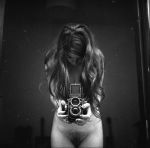

Victoria Baraga – [←] Self-portrait (2012); [→] Self-portrait II (2012)
I could’ve sworn I posted the Self-portrait II previously–but I’ve spent the last half-hour trying to find it and I see no trace, so…
It’s possible I had it saved as a draft and subsequently opted not to post it.
There’s not one but two layers of ubiquity working against these images. The TLR, waist level finder in the mirror trope deserves every bit of shit the bathroom mirror selfie gets. (Folks who pursue the former tend to get a pass they shouldn’t because they’re doing it the old-fashioned way and it’s not as straight forward was aiming the camera and pushing a button–but both tend to be devoid of any vivacity.)
There are exceptions of course. Laura Kampman does some exquisite things within very narrowly circumscribed margins–i.e. there’s a ridiculous degree of technical mastery at work in her better photos. Baraga, on the other hand, tends to fixate on capturing herself in the act of watching herself.
The result is conceptual satisfying–the viewer watches her watch herself, while she watches herself experience intimacy. It’s a clever deconstruction of the triad where the photography use the camera in an effort to parse time and space in such a way that the viewer of the resulting photo see much in the same way the photographer did in the moment of making the image. In this case, the mirror is an impartial arbiter allowing her to focus on one relationship in the triad–photographer to subject and subject to photographer in a fashion that presumes an empathetic response from the viewer.
There’s life an artfulness to these images that far exceeds 98% of comparable work out there.
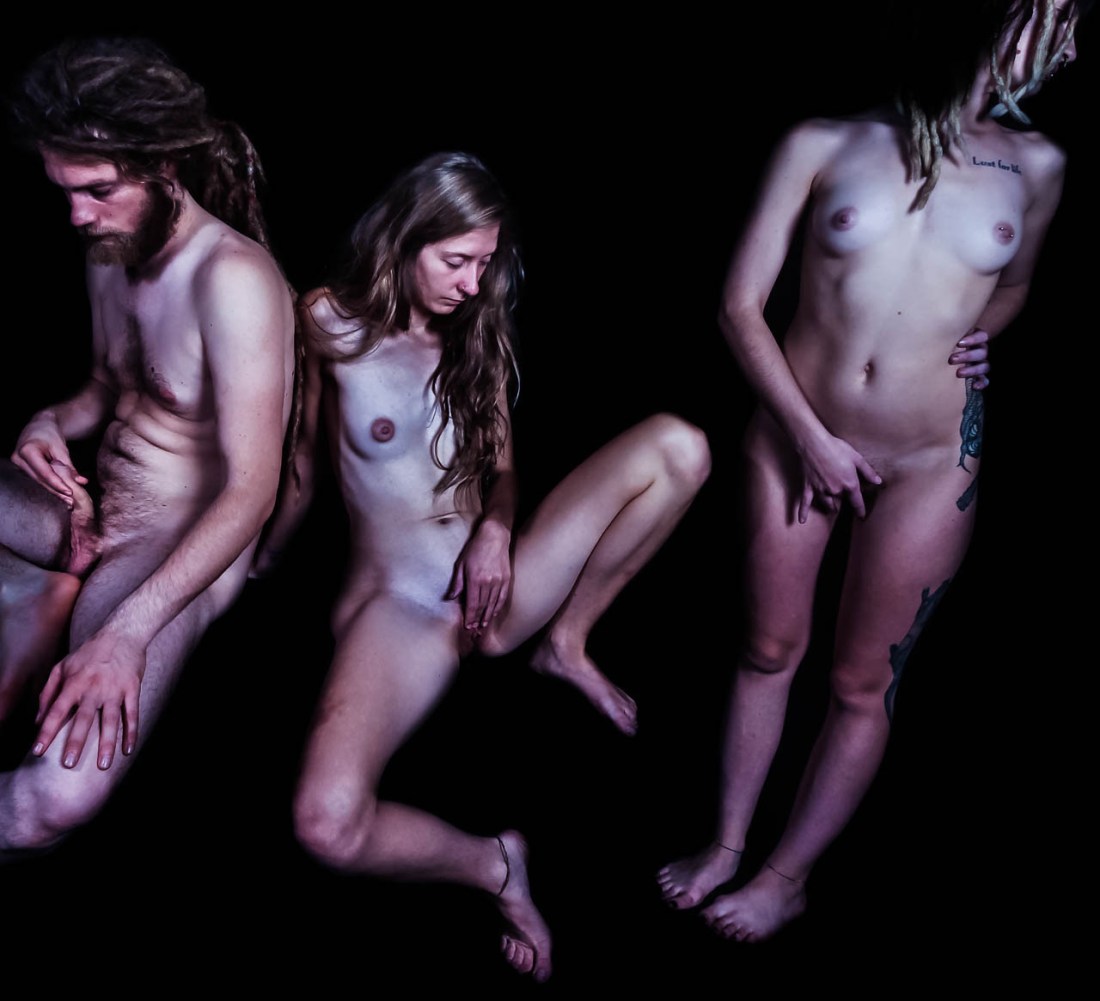
Manuel Laval – Solos (2016)
You will never be able to experience everything. So, please, do poetical justice to your soul and simply experience yourself.
—
Albert Camus, Notebooks (via fyp-philosophy)
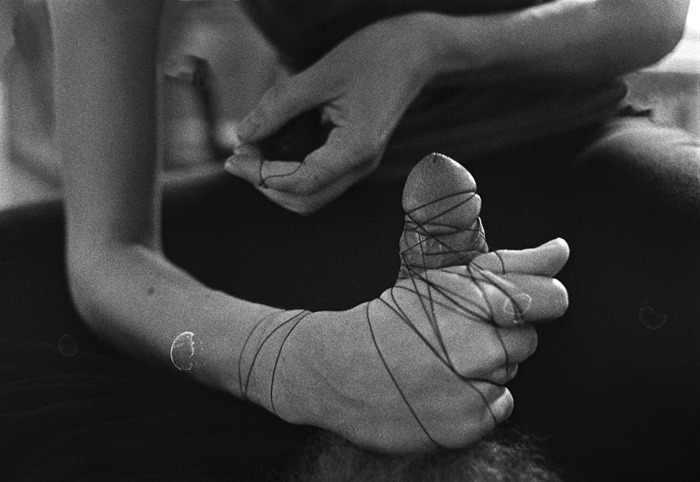
Anna Block – Untitled feat. Konstantin Ladvishchenko from Black Red series (2013)
Block was born in an grew up in Moscow.
She’s currently pursuing a post-graduate photography degree in the Czech Republic.
I’m honestly struggling not to follow the rabbit trail of interrogating influences. Partly because I think of the three dozen or so folks whose names I could drop here–maybe four of them actually ‘hold up’ next to Block’s work.
I’ll let one slip…she shares an almost identical angle of view to Lina Scheynius, only I feel given the same space, Block does for more complicated and nuance things.
What’s much more interesting to me is to compare Block’s work with someone like Inside Flesh.
At first, that’s going to seem absurd. One is porn, the other is ostensibly art. (I’d argue that capital A is in order here; others might disagree.)
But, take this image and compare it with the one above. There are similar motifs–thread/wire, graphic depictions of sexuality: yes; however, the results couldn’t be more different.
Think of them in terms of an aesthetic of desire. If you are familiar with Inside Flesh’s work, you can spot them from twenty yards out. Same with Block. They diverge quite substantially in where they end up–but they’ve accomplished similar feats.
But there’s another difference I think that is also important to address. Of her work, block says:
I
use photography as a space where I can mix my fantasies and desires
with what is called reality. (via redeye)
I don’t think it’s necessarily as cut and dried but I do think that another crucial difference between Block and Inside Flesh is a matter of process ending in production vs product fueling further process, respectively.
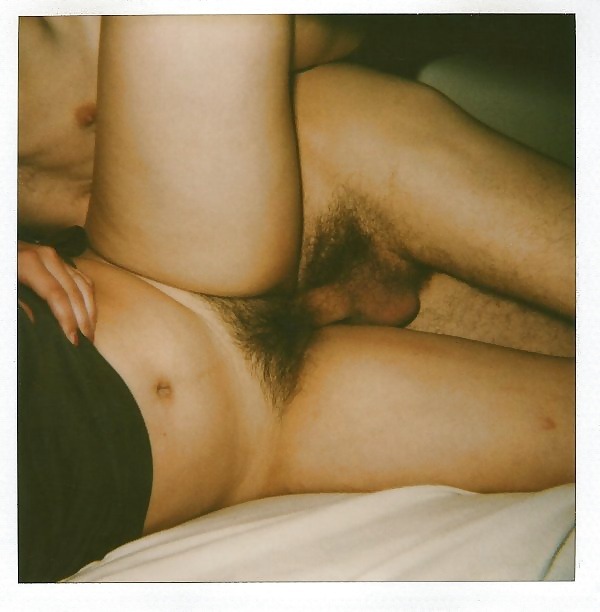
Source unknown – Title unknown (19XX)
There’s a very fine line between simplicity and knee-jerkiness.
This is a square frame. (Judging by the color and insinuation of texture in the border, I’d wager it’s Polaroid 600.)
The act of penetration is just ever so slightly above and right of center. And given most Polaroid cameras are technically TLRs.
It’s a good bet that whomever framed the image, intended to have the explicit action dead center. The discrepancy between the viewfinder and the taking lens due to parallax saves it.
Er… perhaps it doesn’t.
See: initially, I thought I liked the way that the frame is divided into implicit quarters by the L form of her legs. With more careful consideration, I’m not sure it’s such a great idea.
HOWEVER, it does work here–although it is less about the implicit parsing of the frame and more to do with the way the parsing flattens the frame.
Normally, I’m not someone for flattening the frame. But it’s interesting to note that the fellow here is almost entirely parallel to the focal plane. She’s actually every so slightly foreshortened. (It’s not obvious when you look at her abdomen but consider how her leg is straddling the crook of his hip and then trailing back away from the camera.
There are a couple of reasons this ambiguity aides the photograph. First, it draws in more context. There’s not a lot to take in and while I’m not all that big a fan of close-ups, this has the feel of a hotel room to it. But not in a way that makes you think… oh, hotel room. It’s not something you’d necessarily think of unless someone asked you directly where this scene was shot.
Also, while the subject is pornographic, there’s enough of an auspice of formality that renders the whole thing somewhat understated and demure even. (I’m thinking here of how you cannot photograph water. But you can make images of water when it is contained–in a cup, or a stream bed; or in motion, rain and you don’t show the essence of water so much as you can draw attention to certain characteristic attributes.)
The foreshortening also suggests overlap with the paintings of Caravaggio–in color and mood. But I’d be remiss if I didn’t point out how much the remind of Gauguin’s work from Tahiti. (I can’t explain why…just look at it and I think it’ll be plain as day… I just don’t know how to say it.)
 Acetylene Eyes