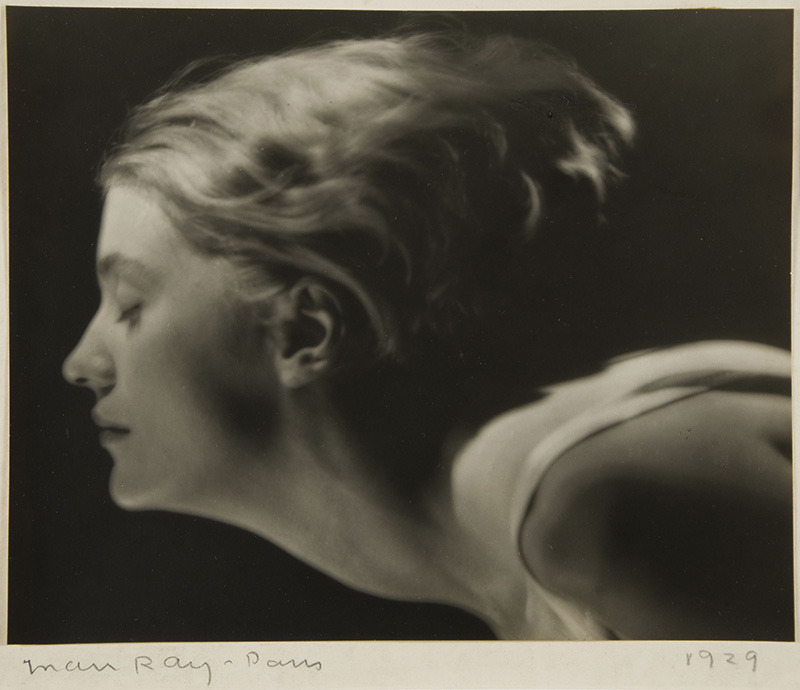
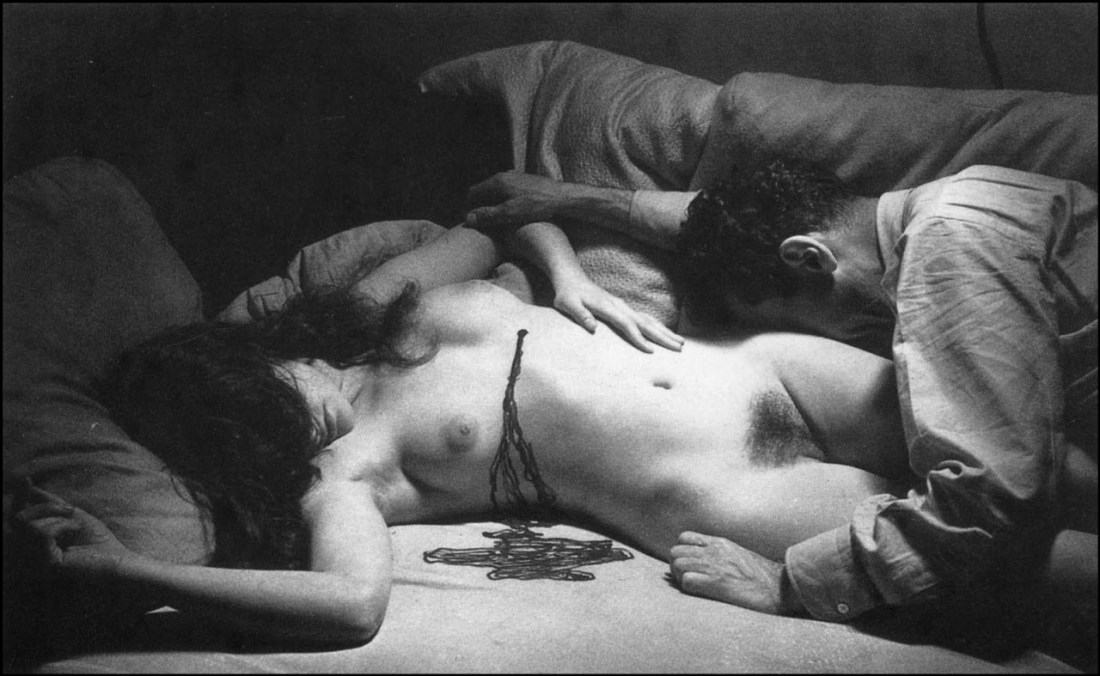
Man RayParis feat. Lee Miller (1929)

My fixation with this photograph boils down to the line of Miller’s neck.

Weirdly, it reminds me of one of the weirdest notes I ever got from someone looking at a drawing I had made–way back when I was 17 and was determined to have drawing be my medium for becoming a famous artist: someone told me they thought my drafting skills were atrocious (true) and that I lacked even a rudimentary understanding of form (a bit overblown, as far as criticisms go) or the conceptual reflexivity between content, context and materials (also: true) but that they loved the truth of a particular line (which they indicated).

It always struck me as a way of making a scathing critique palatable but I realize now that it was actually a backhanded compliment. And it’s this photo that’s made me understand why that’s the case.

See it’s not just the line of Miller’s neck. It’s sensuous–the way the light chisels her body out from the shadows. The pose is meditative and intensely vulnerable but everything about it seems to radiate a warrior’s strength and self-possession.

Also–synchronously: my MFA cohort has begged me to organize an informal class where we screen underappreciated/forgotten miracles of the cinematic form. Last night we I presented Joachim Trier’s Thelma. (Trier is one of the most exciting young filmmakers in the world, having made three films that are all wildly different in style and tone but that all embody a startlingly refined sense of visual dynamism and psychological intensity.)

It’s the 2nd time I’ve seen Thelma (and it’s even better the second time around–I’m pretty sure it’s the first movie in a decade to crack my top 10 favorites of all time) and I was even more impressed with the attention to detail and depth. But also: it’s a bit unnerving to watch because I not only relate to the character but I also see the movie as a kind of mirror because the degree to which the character is aware of herself as both herself and a character in a dramatic scenario short-circuits a lot of my own parameter defenses and I have this weird experience of watching someone who not only looks like I see myself in my head but experiences the world in a way that goes far beyond superficial similarities. Watching it is almost like having someone take my notion of myself and putting her in a narrative that would be exactly the sort of narrative I’d put myself in given half a chance.

And that’s how I feel about this photograph of Lee Miller: that although it was made almost a full 50 years before I was born, it still shows me something unexpected about myself.
Man RaySelf Portrait with Dead Nude (1930)

Excluding the eleven years he lived in Hollywood to wait out the Second World War, Man Ray was an American artist living in Paris.

He moved in the same circles as Picasso and the two were well acquainted. I mention this–less to try to suggest any stylistic overlap in their oeuvres and more to distinguish between the degrees of overt sexism in their respective work.

By now, you’ve probably already seen Hannah Gadsby’s Netflix comedy special Nanette. If not, you should put a pin in this and go watch it now. (It’s exceptional on virtually every level imaginable but it’s act to is a brilliant riff on art history–specifically Picasso.)

Gadsby notes that Picasso offered this perspective on how he felt about women after breaking up with him:

Each time I leave a woman, I should burn her. Destroy the woman, you destroy the past she represents.

“Cool guy,” she follows up.

This isn’t even close to the worst shit Picasso pulled. But in so many ways, Picasso was a colossal, inexcusable and monstrous misogynist. Yet, much of his latent sexism is just as visible in other works of the time. This, for example: not only continues the art historical tradition of presenting female bodies in only specifically proscribed poses.

For example: Duchamp’s Nude Descending a Staircase, no. 2 was rejected from the 1912 Salon de Indépendants with the following note:

A nude never descends the stairs–a nude reclines.

(This anecdote was brought to my attention by PBS Digital Studios’ The Art Assignment’s The Case for Nuditywhich is a bit uneven but by and large worth keeping up with.)

In Man Ray’s photo above, the nude is once again reclining. She’s portrayed as dead–a chest wound ostensibly bleeding out onto the bed.

The photo is indicated as a self-portrait (and in that identification the identity of the artist is reaffirmed while the woman is little more than a placeholder) and it’s uncertain whether Man Ray found her already dead and then felt the need to embrace her one last time (a necrophiliac connotation) or perhaps he killed her and is now grieving her demise (a vampiric connotation).

Neither of these are particularly encouraging interpretations with regards to inherent sexism. However, whereas Picasso uses stylistics to bend, break and otherwise deface women in his work, there’s an honesty about what Man Ray is doing here that–while it does not absolve it of fault, it at least self-implicates the relationship between the author and the problematics.

For example: I read this now as a sort of inverted pieta. This in turn invites a reading of the manic pixie dream girl narrative–that, unfortunately, still exists. Also, you don’t have to stretch it very far to push this into feminist criticism territory–the way that men seek in female bodies, some semblance of salvation. (I’d argue that this lines up especially well with the history of pieta as religious symbol and the way modern pietas interrogate the problematics of Xtian history and the way the form is now moving towards being a trend welcoming of appropriation by sensualist humanists.