



[↖] Source unknown – Title unknown (201X); [↗] Source unknown – Title unknown (201X); [↙] Source unknown – Title unknown (201X); [↘] Source unknown – Title unknown (201X); [↓] Source unknown – Title unknown (201X)
Follow the thread.
[↖] Source unknown – Title unknown (201X); [↗] Source unknown – Title unknown (201X); [↙] Source unknown – Title unknown (201X); [↘] Source unknown – Title unknown (201X); [↓] Source unknown – Title unknown (201X)
Follow the thread.
Mr. Man – Explicit Masturbation in Mainstream Movies (201X)
On the one hand: this is a v. poorly titled super clip–I am familiar with about a third of these scenes but none of them are from mainstream movies. (Ken Park and Shortbus are as close as you’re likely to get to mainstream and they were niche, art house hits at most.)
On the other hand: with mainstream releases continually pushing the envelope on what it’s possible to depict w/r/t sexual exchanges in movies, it is nice to see work which includes explicit masturbation as a valid mode of sexual expression.
That these scenes exist at all is a pleasant and radical corrective to the heteronormalized dude meets lady character–the latter who exists with little more depth than straight up eye candy or some sort of motivational force for the male protagonist’s redemption arc. (Further it challenges the prevailing notion that if there is full frontal nudity, it will favor boobs and bush but exclude penii.)
Yet this also–queerly, in my mind–presents masturbation as an act on a spectrum ranging from decadent self-pleasure to something that is complimentary to interpersonal sexual expression, i.e. the scenes where folks masturbate as a group, or for a consenting audience or as a way of ersatz participation in an orgy setting.
In other words: there is this notion that masturbation is what one does when sex is not available. But this presents masturbation as just another (infinitely varied) form of sexual expression–and that is something that resonates strongly for me.

Aeric Meredith-Goujon – Titles unknown (200X)
Tumblr has it’s problems. However, in at least one regard, I think it’s actually better than a museum.
When I go to a museum: I’m in a public place–which makes me uncomfortable to begin with. Short of seeing something that makes such a profound impression that I lose track of time and physical embodiment, I’m always super vigilant about monitoring my anxiety levels, hunger, do I have to pee and if I do which bathroom can I use with the least fuss.
All these factors preclude my not fully engaging with the majority of works I see.
Tumblr–until they made their asinine best stuff first option (which you all should disable this feature, double pronto)–is sort of wonderful with the way it both introduces you to stuff you wouldn’t have known you loved but also forces you to reconsider work you’ve previous passed on.
I’ve been in the anti Aeric Meredith-Goujon camp for years. He’s completely revamped his website, though; and his editing is better–although I do think he’s lost some of his early edginess in favor of making his bodies of work more accessible.
Either way, the above two images are fan-effing-tastic.

Source unknown – Title unknown (201X)
This is almost certainly an homage to Nobuyoshi Araki’s 1993 Erotos series. (Araki is someone about whom I have entirely mixed feelings; yet even I can admit the series is something special.)
I’ve thought about just leaving it there but it occurs to me that there’s a parallel between this and Greta Gerwig’s directoral debut Lady Bird–which is also something truly special.
If you don’t really follow cinema, Gerwig has made a name for herself as both an astute and incisive actress as well as a startlingly original writer–she co-wrote and played the titular roles in Noah Baumbach’s Frances HA and Mistress America.
Anyway, Lady Bird is every bit as good as you’ve heard. Yes, it’s gallingly lily white. And as much as diversity and inclusion are of crucial importance, Lady Bird aces the Bechdel test in a way that few other things have had the audacity to even consider.
In fairness, I should also confess my own bias: as someone who went to a parochial school (and had much the same relationship to it that Lady Bird does), who felt stultified in my mid-Atlantic, white bread hometown; further, as someone who managed to escape that town by gaining admission to a prestigious liberal arts program, the story was unnervingly resonant for me. (Also, it was like a peak at what my life might have been like if I’d grown up female–as a trans girl, it made me feel seen in a way that I’ve never experienced in my life, if that makes sense.)
Anyway, minimal spoilers ahead: there are three scenes in Lady Bird that run parallel to this image: In the first, Lady Bird (portrayed with an utterly incandescent lack of self-consciousness and vulnerability by the staggeringly talented Saoirse Ronan) is laying on the floor at her prestigious catholic school next to her best friend. They are both on their backs with their legs propped up against the wall snacking on pilfered communion wafers.
The viewer joins the scene en media res and while it’s clear they are talking about using the faucet in the tub to masturbate–their candor is intriguing. Lady Bird is trying to seem cool and worldly, but it’s her friend that actually centers the conversation in the politics of self-pleasure not as an exercise in social conformity but as a means of enjoyment. There is nothing salacious or even remotely titillating about the scene. It’s solely focused on the way teenage girls talk about their experiences of being embodied with each other employing a guileless openness and trust.
But like everything in the movie, the jokes are polysemous–frequently doubling as self-deprecating asides directed to the audience, who is given the advantage of something closer to third person author omniscences w/r/t the narrative.
During a later scene, the viewer is shown the faucet of a tub. A bare leg enters the frame and braces against the pink tile beside the faucet. It’s clear that it’s Lady Bird’s leg due to the pastel polish on her toenails. It doesn’t hold on the shot. It’s presented matter-of-factly, devoid of any lecherous voyuerism–however, in the context of it’s function as a call back it’s honesty is thorougly disarming.
In a scene approaching the end, Lady Bird is called into the Mother Superior’s office–ostensibly for disciplinary proceedings. The nun, however, is far more interested in the psychology than the behavior. She tells Lady Bird that she was impressed with the way she describes Sacramento in such vibrant detail in her college admission essay that she seems as if she rather loves the place. (An on-going joke in the movie is how she considers the city the mid-west of California.) So it’s surprising for both her and the viewer to hear this interpretation.
Lady Bird realizes her typical brusqueness on the subject will not be well met, so she–brilliantly–counters with: I guess I just pay attention to things.
Without missing a beat the nun responds: some might say that loving something and paying attention are, in fact, the same thing.
I keep returning to what the nun said: paying attention and loving are two manifestation for the same underlying truth.
But back to the image–because no matter all the extraneous stuff I routinely throw at you to try to keep your attention–the reason you read this is because it’s supposed to relate to the work showcased.
I won’t argue that this is a good image. At the very least: it isn’t an image that’s easy to immediately digest. You look at it. Think wait. Did I see that right? Look again. Yes, it’s what I thought it was the first time. Wait, are you sure? Look again.
It occurs to me that the image above is erotic only in so far as it invites sustained attention–even if it’s only decoding how things are oriented in the frame. And to me that suggests a potentially worthwhile framework for disguishing pornography, from erotica, from art. Porngraphy is a specific text in framed in a more generalized context–heteronormative patriarchal expectations with regard to libido, lust and physical intimacy. Erotica is less focused on the specificity of the given text and more concerned with the expansive context. Whereas, art, is–in some ways–entirely focused on the marginalia expounded and clarifying the relationship and interpenetration between text and context.
There’s a saying that the mind is the body’s largest erogenous zone. The only way to stimulate the mind is by paying attention–by loving.



Source unknown – Title unknown (201X)
“The body says what words cannot.”
–Martha Graham (via ignacioararipe)“The skin listens too.”
–Pauline Oliveros from Quantum Listening: From Practice to Theory (to practice practice). (via foism)
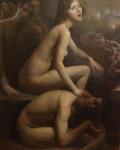


[↑] Adam Miller – Fallout from Compositions series (2012); [+] Akseli Gallen-Kallela – By the River of Tuonela (1903); [↓] All Fine Girls – Vika (201X)
I save things as drafts thinking to myself: self, this belongs here.
Unfortunately–often when it comes to composing some sort of accompanying text, my thoughts scatter like roaches when you flip the light switch.
Dredging through drafts, trying to figure out items to post–it occurred to me that it’s the expressions in these that appeal to me.
In the top image, the woman has an expression which–independent of the title–comes across as mismatched with her surroundings. She looks wild-eyed and terrified except at the same time she’s more engaged than those around her. When I discovered the painting is titled ‘Fallout,’ something finally clicked for me: she’s one of those people who only ever feels fully alive responding to and thrilling in abject chaos and catastrophic tumult.
…
The second painting is based on a the Kalevala–roughly like a cross between the Aeneid and the Icelandic sagas except being fundamentally Finnish (as best as I can tell). The subject of the painting consists of the hero being tasked with completing three difficult tasks, the third of which is slaying a swan on the river Tuonela.
In the painting, the hero (Lemminkäinen) departs in his canoe.
Additional context: this painting was a sketch for a fresco in a mausoleum dedicated to the memory of the daughter of a prominent businessman who died at age eleven. It’s presumably her with the braid trailing down her back and her budding breast exposed, invisible to the other gathered onlookers.
Everything about her suggests that although she does not know what she has lost, she understands what the loss has cost her in a way that no one else can or will.
…
I am unbelievably conflicted about posting this image. It’s porn and not even good porn. Further, I think it is unspeakably heinous when grown ass men refer to women they are attracted to or wish to pursue romantically as ‘girls’–it’s gross and a huge red flag. (And I absolutely judge men I hear do this as total creeps.)
In my experience, to achieve orgasm, you have to stop thinking, stop trying to get off, let go and surrender to an unmediated experience of physical sensation.
By letting go, you can just kind of float there and wait for it like a wave rolling in from the sea. But in letting go, you can also reach for something.
I won’t presume to know what this young woman is experiencing but she is reaching–and with this stunning, febrile desperation. It’s breath-taking to stare at, honestly.
…
When it comes down to it, these expressions are all unusual to witness in person–let alone in visual media. What impresses me and caused me to eventually put them all in the same place is that they are all expressions I’ve seen in the mirror, especially Vika’s desperate reaching. That’s so close to home, I have trouble fighting to urge to claim this as an ersatz self-portrait.

Matthew Draw – Multiple colors of love. (2016)
I’m writing this post while in Reykjavik. Technically, this is my vacation–and I’d hoped to have things sorted in such a fashion that I could just let the queue run. No such luck, sadly…
I’m posting this for you mostly because I like the line work. Everything is rendered with intensity of purpose–efficient, no wasted effort. Still there’s a sense of Michelangelo-esque discovery of the form hidden within the blankness of stone. (The thickness of the lines in certain areas seems but tentative and studied; the lighter lines on the ring and pinky finger de-emphasize their importance as anything but three dimensionally orientating facets of the composition.)
But the real reason I’m offering you this is because I’m sort of blank brained right now–it’s weird to travel to a beloved local while brutally depressed and to feel like the volume on your negative thoughts is turned down a bit due to a better environment but to then feel like the positive experiences that manage to creep in are happening to someone else separate from you?
Anyway, last night, I was rather stoned coming back from a tour. It had been one of those textbook clear Icelandic days that you are extraordinarily rare and the clouds were being rushed in by high winds and the sun was doing it’s slow setting thing that it does this time of year.
It was like the dome of the sky was having blankets slowly pulled over it, essentially like the world was being tucked in to bed for the night in slow motion.
The western edge of the horizon looked like lava was lighting the clouds from the inside. At one point there was a cloud that was shot through with this etheral blue–a color I don’t think I’ve ever seen anywhere else before.
I tried to take a picture of it with my phone but speeding through the growing dark in a charter bus; alas, that’s really not the best sort of vantage for the task. So I decided to watch and realized that the blue was a feature of the refraction of light. The outer edge of the cloud–the side closest to view–was this fantastic blue but the inner edge the side closer to the retreating sun was actually a vivid chartreuse. It made me think of the old masters with their oil paints–how they sculpted rich, super saturated colors by layering paint on their canvases.
So yeah, I dig this image. But! I also enjoy it because the use of color reminds me of the relationship of surreal colors I saw last night in the skies over the south coast of Iceland.

Source unknown – Title unknown (201X)
Oh, to lick your love like tears.
–Maya Angelou, excerpt of Black Ode (via afroui)




 Acetylene Eyes