Laurent Segretier – Title unknown (201X)
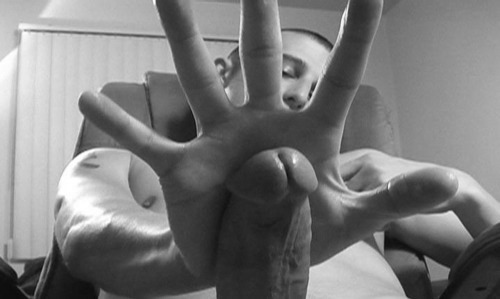
Source unknown – Title Unknown (201X)
I’ve yammered on at great length before about distinguishing between selfies and self-portraiture–but where is the line?
Strictly speaking, this isn’t a selfie. Except… the process that went into making it is almost certainly comparable. I mean the view could be a screen cap from chaturbate that’s been desaturated…
I think anything where you’re consulting a live view in order to compose and frame the image counts as a selfie. Thus: if you’re composing your shot and then setting the self timer before running to get into position–that’s a self-portrait. A micro 4/3 camera with a flip around screen that you can just look at to position yourself in the frame without getting behind the camera is a selfie still.
The question of whether selfies can be art is mired and wrapped round and round with barbed wire because the context is tied up in the context of selfies, where one is trying to appear a certain fashion aligned with their digital curation of self. Not that an artist can’t do that, it’s just that it’s been done already–so that means do it better than Cindy Sherman or go the fuck home. (Sherman was a self-portraitist, so there’s that, too.)
The context of selfies hinges almost entirely on authorial intentionality–and that’s a totally BS line of questioning. Was the selfie an ontological virtual back of the memory of an event–I know I was here because pics, it did happen. Or, is this the version of myself I’m aspiring to be and the selfie is part road map, part fuel for the trip ahead. (Baudrillard would have a freaking field day.) Is it a form of self-care–a radically body positive reclamation of creating a new context wherein you exert a degree of agency in how you are seen by the world (which you may not have recourse to in your day-to-day)? Is it about saying: sharing something with others instead of insisting upon digital attention in the form of likes, regrams/reblogs, etc.?
And please don’t mistake me: I’m not willing to say oh, vanity, vanity all is vanity and dismiss something as art due to a concept that is so steeped–historically–in misogynistic fervor. Whereas I do believe that Art is more about what’s given than what’s taken.
I just worry that so many of the impetuses for selfies are centered upon style over content–essentially canceling out any sort of compositional logical or visual grammar in a quest for something that is on-brand (stylistically consistent) and on fleek (immediate and attention inviting).
I think this is nowhere less front and center than with dick picks. I mean any photo or image that is erotically charged is already fueled by the dichotomy between what looks good and feels good. Models don’t point there toes because it makes it easier to hold a position, they do it because it slims and shapes the body in ways that have come to be accepted as aesthetically desirable.
It seems there are two kinds of dick pics, generally speaking: the look how hard I am help me out type (which the above is not) or the I was really turned on and felt attractive.
This is definitely that latter type but it’s interesting because it is unified in content and form in such a way that it doesn’t seem to be making a choice between what looks good and what feels good. It’s played toward the camera but in a way that conveys a lot about the subject.
Or, perhaps, I’m just once again reading entirely too much into random porn on the Interwebz.

Witchoria – Cancel from Human Error series (2016)
What else is going on
right this minute while ground water creeps under my feet? The galaxy is
careening in a slow, muffled widening. If a million solar systems are
born every hour, then surely hundreds burst into being as I shift my
weight to the other elbow. The sun’s surface is now exploding; other
stars implode and vanish, heavy and black, out of sight. Meteorites are
arcing to earth invisibly all day long. On the planet the winds are
blowing: the polar easterlies, the westerlies, the northeast and
southeast trades. Somewhere, someone under full sail is becalmed, in the
horse latitudes, in the doldrums; in the northland, a trapper is
maddened, crazed, by the eerie scent of the chinook, the sweater, a wind
that can melt two feet of snow in a day. The pampero blows, and the
tramontane, and the Boro, sirocco, levanter, mistral. Lick a finger:
feel the now. [Ed: emphasis added.]
—excerpt from Pilgrim at Tinker Creek by Annie Dillard (via house-of-fortitude)

The Monochrome Id – attempting wonder, being watched (2016)
There are a host of problematic aspects with this:
The light is flat/dead, akin to the sort of light you get from a side table lamp where you have the hot hour glass spot pattern caused by the way the lampshade shapes the light but also as the diffuse spill the shade itself transmits.
The dynamic range is noticeably compressed–the darkest area being the shadow cast by the young woman’s chin; the brightest area is the triangular reflection (a skylight, would be my guess) in the mirror behind her right shoulder.
It’s some EGREGIOUS #skinnyframebullshit, too; further, the problems are compounded by the fact that– as I’ve talked about before: a frame’s functions is either restrictive or indicative (and really it’s at it’s best when it is a bit of both.)
The trouble here is that this frame is restrictive–with the exception of what I’m calling the reflection from the sky light–there is no sense of space beyond the frame being relevant to the information in the frame. This being the case, the frame lines are amputating the young woman’s legs rendering her immobile and unable to get up and leave the frame if she chose to do so.
I do have to give the image maker some props, though. Despite the awkwardness of the angle of the young woman’s head there is a sense conveyed that she wants to be here and seen like this–the shadow cast by her eyelashes against her cheek, and the way her mouth (whether or not you can clearly see it) suggest her lips are ever so slightly parted and that she’s trying to tune into the sensations of the vibrator pressed against her subtly glistening clitoral hood.
Despite the numerous technical flaws, this does deserve some praise due to the fact that it manages to capture the vulnerability that comes from letting go of any sense of self to grab onto the visceral experience of pleasure with both hands. That aspect of it is crystalline in it’s clarity here.

[←] Source unknown – Title unknown (20XX); [→] D. R. Hay – Plate IV from The Natural Principles and Analogy of the Harmony of Form (18XX)


[↑] Alonely Spark – Untitled (2016); [↓] Leah Schrager – Untitled (201X)
Juxtaposition as commentary.

Source unknown – Title unknown (19XX)
Looking at this photo I can’t help but ponder the notion of regret.
I encounter a lot of people who believe life should be lived in such a fashion so as to remain completely absent regret.
Every time I interact with these folks, I find myself vaguely irked. I mean without regret, what motivates the urge to do better/be more/grow?
Yet, that thought is predicated by the belief that one should regret mistakes because a mistake entails a right way of doing things and a wrong way of doing things. By extension: there was the right way and a wrong way or more likely wrong ways and by not doing it the right way–one should regret doing it the wrong way.
It’s rarely that simple, though. I mean: very few people can sit down at a piano and having never taken a lesson before play a passable rendition of Eine Kleine Nachtmusik. (No, you get to being able to play it by practicing–which means playing it for a very long period of time at varying levels of awfulness before it starts to come together.)
My reaction to other folks objecting to regret always surprises me–because I’m someone who claims to live in a way that seeks to minimize regret. What I mean when I say it is something more like: given a time machine and the option to travel back in time to fix things, the things I would opt to fix would do little to shift the broader outcome for a situation/scenario.
As a concrete example: When my ex and I broke up the first time, one of her reasons was that I so rarely walked with her back to the subway when she couldn’t stay the night with me at my place.
To her this represented a lack of motivation and concern for her safety and well-being. And I don’t have my head so far up my own ass that I can’t realize that it was occasionally due to the reason set that it’s freaking cold as fuck out, it’s late and I have to get up and get ready for work in 4 hours. More often than not I didn’t go because I knew she didn’t want to leave–but that she had to–and that my going with her would make it harder for her to leave. (Interestingly, she said that’s what she wanted–me to make it harder for her to leave instead of easier.)
So if you offered me a time machine, I’d go back and walk her back to the subway twice as often as I did. Not because I believe it would’ve changed anything about our relationship just because it was a small thing that would’ve meant a lot to someone I loved.
And that’s why I think of regret when I look at this: it’s not a great image, honestly. The foreshortening of the masturbating woman saves the composition from being unforgivably flat. The light is hard and over bright–tumbling in through a skylight and hazily blowing out in a blueish aura over the scene.
You can see just the faintest hints of the hanging tapestry backdrop. It’s neither great nor is it quite awful, either.
But what I notice–like when presented with the prospect of a time machine to go back and fix things I wish I’d done differently–are the four hands. The way the one woman is holding the other’s hips, how the woman is supporting the woman’s lower back while masturbating and the way the woman in the middle has her wrist clenched and locked.
The rightness of those elements–for me, at least–overpowers the shoddy and weaker aspects of this composition.

Erotobot – Dinks (2014)
I have a outsize obsession with visible texture. When it’s done right–it is like I can almost feel that which I am seeing, sliding beneath my finger tips through nothing more than the act of maintaining an attentive gaze.
With its gooseflesh, dirt, the black mirror-like water, water droplets on goosebumps and even Dinks’ hair, this would’ve had less impact if it had approached me out of a crowd and broken a baseball bat in half over my head.
It’s unquestionably pornography. And honestly being somewhat familiar with Erotobot’s work–all of his photos feature a discomfiting edginess. Shot in abandoned buildings or seeming post-industrial wastelands. It’s dark and sinister; explicitly and graphically depicts sex–frequently of a rather rough variety. Like just looking at the work, I worry a bit that he’s another in a long line of perverts making beautiful work through sometimes questionable disregard for consent, boundaries or interpersonal respect.
But despite how over-the-top the obscenity is in this image, my reading of it leads me in rather the opposite direction. Straight up there’s no way getting this shot didn’t take time. Evidenced by the goosebumps and the fact that Dinks would’ve had to get undressed and roll around in the puddle and dirt for this scene to have come about.
Yes, it’s possible that there were degrees of unseen coercion. And I don’t know if it’s because I want so much to like this–if you feel I’m wrong, please chime in (consent is just about the most important thing to me and if/when I fuck things up, I welcome correction)–but this feels consensual.
The way it’s played toward the camera. Dinks’ expression speaks of wanting so desperate it actually feels like a kind of physical pain that can only be assuaged by sating the desire. There is something here the resonates with an honesty that I find entirely unnerving. (I relate to this so hard.)
But there’s also a way in which Dinks (and maybe that’s not her name but I hope it is because it’s awesome) is presented as seductive but also maybe a little bit dangerous–as in while the image is presented so that the viewer can station themselves between photographer and subject–and thereby presume the show is for them and them alone; standing in such a position carries a lot of potential risk for harm, violence or some sort of untoward resolution.
Beyond that I only know three things:
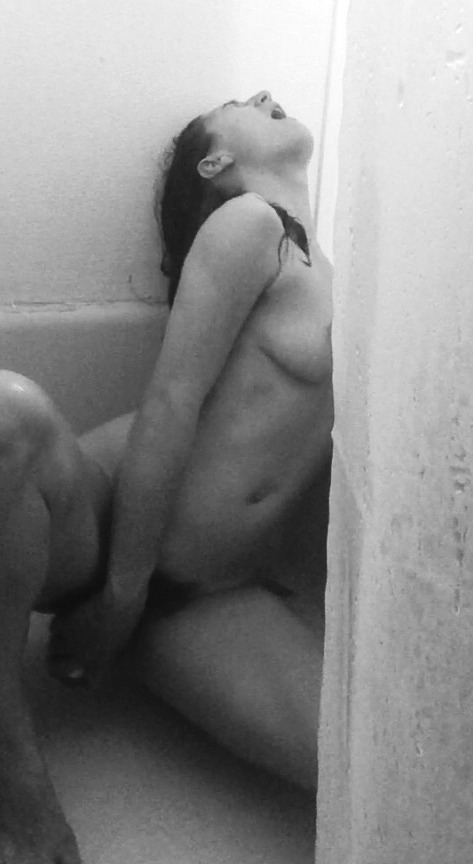
Source unknown – Title unknown (20XX)
Writing for this project, I frequently feel like my primary form of interacting with images is a this-isn’t-a-good-photo/image-but…
I mean beyond my generalized feeling that I am a bit of a broken record sometimes, this this is something about which I’m always very self-conscious.
But…
I mean I think one of the disservices we do in teaching photography (or, hell, more broadly any creative discipline) is that there’s a laser-like focus on the canonical.
It’s not that I don’t think that shit is important. It absolutely is–indispensable, in fact.
But…
It’s all sort of incestuous–in a biblical sense: the genealogies of influence flow in a clear, unbroken fashion back through history. It’s clean and full-up-to-the-gills with masterpieces of unadulterated genius.
So what’s the downside? I mean if one is trying to learn, the presumption is that one wants to learn from the best. Unfortunately, in my experience this has a limiting effect in a number of ways. If I study only greatness and my own work isn’t great (yet) then I either to be a total asshole narcissist or suffer from a certain degree of oblivion. (After all, when comparing your work with canonical masterpieces, your work begins at a stupendous disadvantage. And that disadvantage can cause you to lean on the work that’s already been done (I know so many emerging artists who view certain artists in such an uncritical light, that it’s almost as if their relationship with the work is less hippie looking to expand their mind and more blasted addict chasing the next crest.)
Truthfully, I’ve learned just as much from perusing shitty work as I have from obsessing over the greats. And it’s for that reason that I think every serious photographer should make a point to critically interrogate bad work in the same fashion they do good work.
I mean the above is not a good image. It’s been blown up far beyond the point of disintegration. It’s blotchy and ugly. Yet, even if I knew where it originated, the original is probably not that much better. Unless you’re going to go to the trouble of setting up highly precise, orchestrated lighting–or you’re one of those lucky shits with a bathroom that has a window (and therefore: some natural light)–then the light is going to look like shite.
Despite looking awful, this does do a number of things extraordinarily well. First, according to the letter of Instagram law, this is an image that is Instagram safe. (Though, I’ll admit it would probably be taken down.)
Whether or not the intention of the author was such is immaterial–and given how bad the image is, it’s unlikely that the motivations approached anything like I am about to suggest: but it doesn’t matter because if the images reads a particular way, it reads a particular way.
It reminds me of the line teachers always used to throw around to my classmates about dressing in a fashion to leave something to the imagination. the idea was you’ll be more attractive/alluring if you show off less instead of more. (The creepy implication being that how you dress is an open invitation for others to imagine things about your body.)
The same mentality is frequently utilized in distinguishing porn from erotica and erotica from art. Porn tends to leave little to the imagination; whereas erotica is somewhere closer to the middle and art allows for the assumption of chastity.
For the record, I’ve always instinctively objected to this framework. I think it’s all a great deal more muddy (and therefore more interesting) than that.
But there is something in the whole admonition to leave something to the imagination that does actually inform as to the essential nature of pornography: it’s like they teach you in Writing for the Screen 101–unless you can see it on the screen, it doesn’t go into the script.
This relates to the ‘visual’ nature of the ejaculatory orgasm (and why most porn centers around male arousal and sating)–it’s visibly demonstrable. (Here we run into the inverse of my previous argument that art students should study shitty images, pornographers should study art history, as well: because you can actually depict non-male ecstasy.)
(As a tangential note although I can’t find them now: there are a handful of popular tumblr porn gifs that I do think are exceptions to this notion: despite being close-ups–which I’m not especially fond of–they focus on the pulsing muscular contractions associated with orgasm. In one, a hand stimulates the clitoris of an Asian woman. She audibly squeals as her anus and perineum spasms. In others, ejaculatory contractions can be seen at the case of the erection.)
Now–lest anyone forgets–this isn’t a good picture but the decision to present it in such a way that it is both entirely clear what she is doing but the viewer is not afforded an unobstructed view of the typical erogenous zones. Also, the fact that we don’t do the coded porn thing of zooming in on the woman’s oh-face (a la Albert Pocej’s staid Orgasm series) and instead are presented with the tableau sans access to erogenous zones and within context, this scene is decidedly about female masturbation via orgasm.
In other words, there’s no way the viewers can make this about themselves. Unless they think that perhaps she is fantasizing about them–which is, in itself, radical as to do so demands the recognition that she is not an object and has her own individual agency, volition and inner life (to which the viewer has no immediate access.)
 Acetylene Eyes