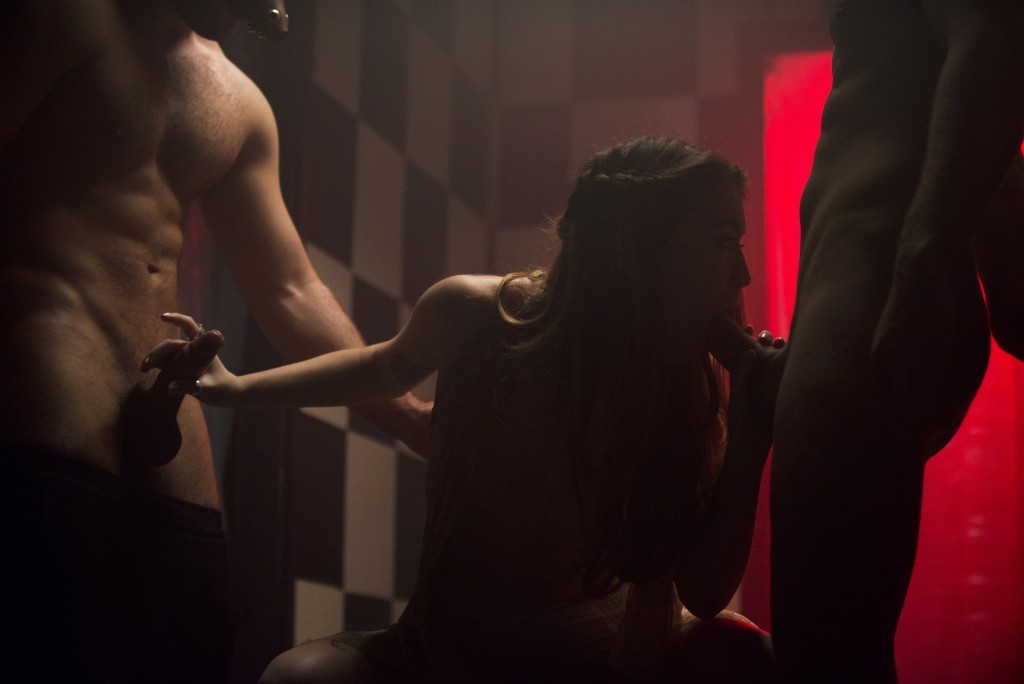
Erika Lust – Title unknown (201X)
nom nom nom (No one comes here for the humor. Back to your regularly scheduled programming nom nom nom) nom nom nom
Erika Lust – Title unknown (201X)
nom nom nom (No one comes here for the humor. Back to your regularly scheduled programming nom nom nom) nom nom nom

Source unknown – Title unknown (201X)
As much as there are performative heteronormative expectations when it comes to the FMM threesome, i.e. it’s perfectly upstanding, straight and good as long as penii don’t touch…
…it’s not something I’ve ever understood. But this makes me think about the mechanics of what porn instructs is the most common bodily configuration for two penis-havers engageing with a vagina-haver.
Like the owner of the lower cock is mostly passive. (If you’ve ever seen these scenes, it’s nearly impossible to get a workable rhythm going and the movement of the person in the middle is only really compatible with the person who is able to thrust and retract.
Second–while any sort of consensual sexual sensitivity is good in my book–there’s a way in which this configuration almost certainly amplifies the sensation of the person in the middle. Two of three orifices are full and there is skin to skin contact in both directions. That alone would be an emotional and intense feeling for me–even before you got down to whether it was pleasurable.
Then there’s also the way that in the heteronormative world there’s this proscription against penii touch. (For that reason I’m always interested in depictions of vaginal double penetration.)
But the rear wall of the vagina and the back wall of the anal cavity are not actually that thick, so there’s almost certainly a way that although penii aren’t touching they are engaged in conversation through a screen–like a supplicant confession to priest.
If any one of the the three orgasms, the body cavity they are inside would server as a resonating chamber of sorts.
And I think that’s why I end up looking at a lot of group sex porn–it’s not the fantasy of the explicit exchange that entices me, it’s the ease with which this sort of thing is depicted in pornography and the fact that that ease of trust and intimacy is nothing something I’ve ever known (or, unfortunately, am ever likely to know).
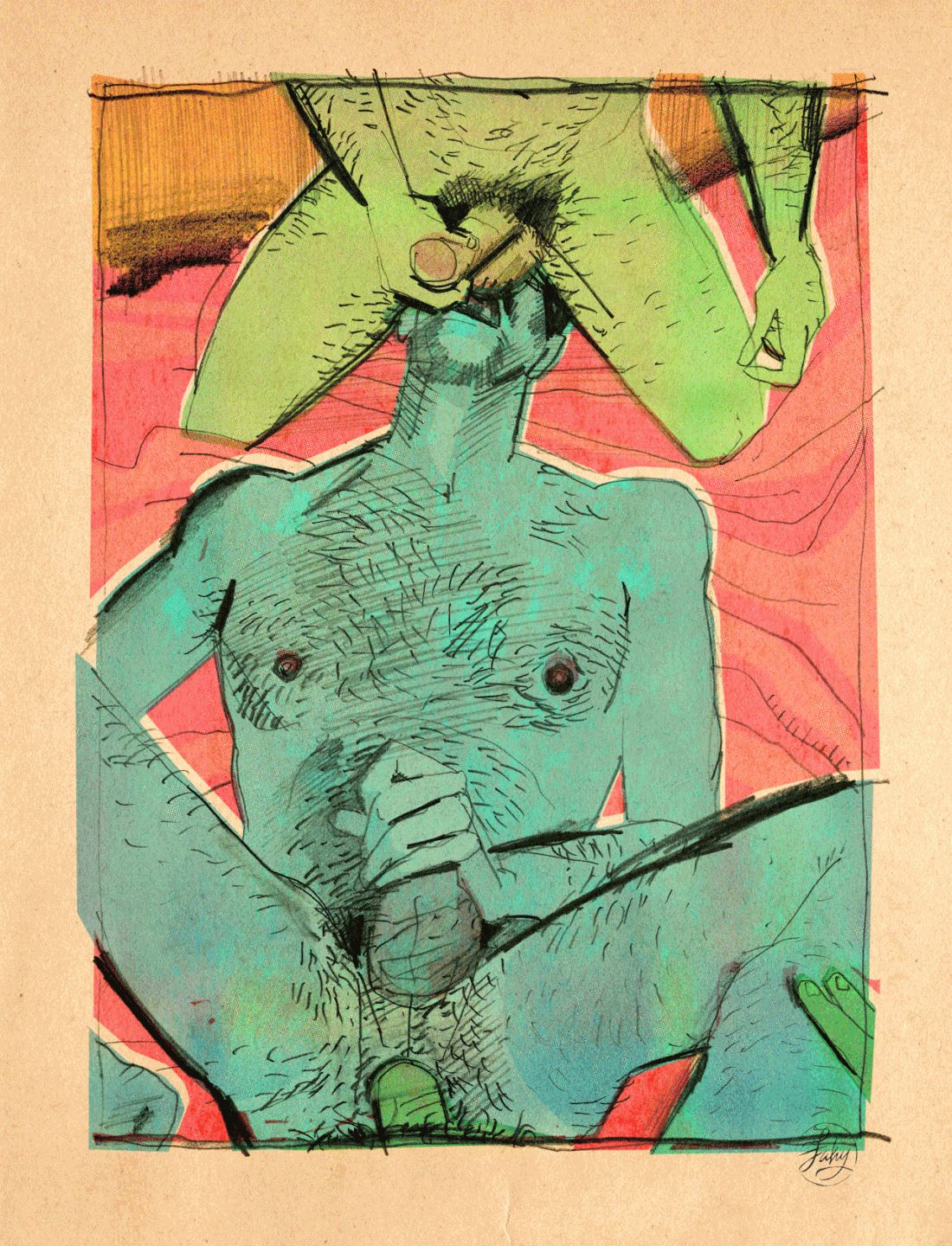
Source unknown – Title unknown (201X)



Arvids Strazds – [←] Untitled from Desires of My Wife series; [→] Untitled from Desires of My Wife series (2017)
Strazds is a Latvian photographer who pictures his wife with various paramours.
The work suffers from a cloying veneer of legitimacy–and by ‘veneer of legitimacy’, I mean to indicate creators who attempt to head off any repudiation of their content by pointing to the demand for technical expertise required by their preferred production medium as proof of intrinsic artistic merit, i.e. these appear to be tintypes (although I am not convinced they are/it appears they may depend upon some post-production digital intervention).
The clearest corollary is likely Jock Sturges, who uses his preference for 8×10 analog view cameras in the creation of his work as a means of dodging valid questions/concerns over the sexual/voyeuristic propriety of his work. (That this has flaccid proposition has succeeded in short-circuiting debate for decades represents an incontrovertible failing on the part of the critical establishment.)
Still, I think there’s more to it than that. The focus on square compositions–a format typically most readily applicable to portraiture, and therefore front loaded with a certain innate intimacy’ is definitely enhanced by use of tactful vignetting and reliance upon the same principle those of us with a ton of freckles have known for years–that any three non-linearly plotted dots will, when connected, form a triangle.
Strazds work works due to these reiterative triads. For example: in [←] the two erections and the the way the rim lighting accentuates her left eye’s acknowledgement of the lens (and implicitly both the photographer and the audience). This scalene imposition renders the composition easily parsed and effectively guides the eye over the scene.
[→] is a bit more complicated. Her downward gaze reinforces that the vertex of the triangle is the site of erotic penetration. This leads to questions over whether the other vertices are her breasts, their faces, or the solarized area under her left breast and the hallow between her armpit and his chest. (This is not necessarily something I would’ve picked up on had I not simultaneously been struggling with how to talk about this absurdist gif while also tentatively engaging with Lucinda Bunnen’s work.)
Another point of convergence with Strazds work is Chloe des Lysses’ erotic self-portraiture. I’ve always had reservations about Lysses’ work–I wouldn’t label it narcissistic but there is an element of narcissism to it. Strazds, on the other hand, seems more collaborative. And although it’s entirely possible that there is a narcissistic cuckold adjacent motivation for the work–he does allow his wife a meditative joy of expression in many of his frames that I find entirely appealing.
Lastly, although I generally frown on watermarking your visual art, I absolutely understand the impetus for doing so. My rule is that if you’re going to do it, keep in mind that one is a visual artist and therefore the water mark should be more than just typeset. (Scott Worldwide is the exception that proves the rule–but again, his logo involves solid graphic design.) Strazds has a superb watermark–riffing off of Albrecht Dürer’s signature and mixing in a bit of the sensibilities from the Japanese tradition of Zen paintings.

Ryan McGinley – Oliver (2005)
With how much I take the piss out of him, it would be easy for someone to conclude that I hold McGinley’s work in contempt.
It’s altogether more complicated than that–and the above image has shifted my opinion some.
He works primarily in color–and has a damn solid eye for it. For all that appears to be going on above and all that those appearance suggest and elide w/r/t what happened prior to this/after this moment, the more I look at it the more I’m convinced that the instinct behind this is the orange polish on her toe nails outset against the tiles.
…
McGinley is not just associated with color work–he work is entirely preoccupied with youth–which leads to a potent and frequent criticism of his work as an uncritical, inherently ageist and cliche celebration/commodification of younger being better if not at least more attractive.
It’s a critical tact with which I agree. However, I think my mixed feelings on his work up to this juncture, have more to do with the fact that I don’t think I’ve ever really felt the criticism is necessarily supported by the work and more that the work seemingly goes out of its way not to acknowledge that such a reading is possible.
It’s something that has always bugged the fuck out of me. I mean: I’ve always read it as McGinley’s work being about immediacy; photography is a medium heavily steeped in immediacy so what would you put in front of your camera if you wanted to focus laser-like on immediacy? What’s more immediate than being young?
However knee-jerk, it makes sense conceptually. But it feels to my as if an artist can grasp that, then he ought to also be able to preempt an obvious criticism by varying the work in such a way so as to complicate facile criticisms. And that just isn’t the case.
My reaction has always been–we’ll that’s lazy/sloppy. Except neither of those words really fit the work.
…
I also struggle with his editing. Once you’re attuned to his obsession with immediacy, his work clearly turns a very tight orbit around that fixed point. Beyond being in color, his photos/images almost always feature motion–which can run a gamut from 2011′s phenom Parakeets to pieces that seem haphazardly composed, poorly focused and motivated by capturing an unrepeatable moment.
That’s the other thing that I’ve had trouble working out–there are scads of photographers doing more groundbreaking things with color. I can’t think of anyone working with a body of work as thoroughly singular as McGinley. (And by that I was brought up that one of the things that makes a work of art such is a nearly impossible degree of difficulty in recreating it by a similarly able technician–for as much as I loathe the unrefined aspects of his work–I would not want to be tasked with recreating it.)
…
Back to the orange toenails for a minute: if you buy that the work hinges on immediacy then perhaps color is largely the impetus for the work–since working via photography and putting young people in front of your lens pretty much ensures the result will suggest something about immediacy of experience. (It also reconciles a lot more of the otherwise questionable editing choices.)
…
I recently encountered 2005′s Kiss Explosion for the first time. It’s almost certainly that prank where you take a swig of soda and then kiss someone while spitting the liquid out. The image definitely evokes that but it also evokes, well, snowballing. (It’s most likely not snowballing as that would be rather a lot of semen, methinks.)
And it occurred to me that perhaps the criticism about deification of youth is camouflage.. or perhaps, stated a better: a red herring?
…
It feels to me as if sex is always hovering just beyond the periphery of the work. Yet, when it does enter the work head on, it’s presented as interesting but no more privileged than anything else presented as interesting in the work. Further, sex as presented as sex regardless of the gender presentation/identification of the participants.
In other words: it’s all queer af.
But go back to the photo above: I’m arguing that it’s about the color of her toenails. The title is Oliver, though… and you sort of have to believe Oliver is holding the shower head against his abs. Is he getting ready to join in the action behind him? And if so, how? Or has he already participated? And if so, how has he participated? Or, is this all staged for the camera?
Either way it is interesting how often in his work, McGinley seems to be hiding queer coded sex positivity right there in plain sight.

Source unknown – Title unknown (19XX)
Looking at this photo I can’t help but ponder the notion of regret.
I encounter a lot of people who believe life should be lived in such a fashion so as to remain completely absent regret.
Every time I interact with these folks, I find myself vaguely irked. I mean without regret, what motivates the urge to do better/be more/grow?
Yet, that thought is predicated by the belief that one should regret mistakes because a mistake entails a right way of doing things and a wrong way of doing things. By extension: there was the right way and a wrong way or more likely wrong ways and by not doing it the right way–one should regret doing it the wrong way.
It’s rarely that simple, though. I mean: very few people can sit down at a piano and having never taken a lesson before play a passable rendition of Eine Kleine Nachtmusik. (No, you get to being able to play it by practicing–which means playing it for a very long period of time at varying levels of awfulness before it starts to come together.)
My reaction to other folks objecting to regret always surprises me–because I’m someone who claims to live in a way that seeks to minimize regret. What I mean when I say it is something more like: given a time machine and the option to travel back in time to fix things, the things I would opt to fix would do little to shift the broader outcome for a situation/scenario.
As a concrete example: When my ex and I broke up the first time, one of her reasons was that I so rarely walked with her back to the subway when she couldn’t stay the night with me at my place.
To her this represented a lack of motivation and concern for her safety and well-being. And I don’t have my head so far up my own ass that I can’t realize that it was occasionally due to the reason set that it’s freaking cold as fuck out, it’s late and I have to get up and get ready for work in 4 hours. More often than not I didn’t go because I knew she didn’t want to leave–but that she had to–and that my going with her would make it harder for her to leave. (Interestingly, she said that’s what she wanted–me to make it harder for her to leave instead of easier.)
So if you offered me a time machine, I’d go back and walk her back to the subway twice as often as I did. Not because I believe it would’ve changed anything about our relationship just because it was a small thing that would’ve meant a lot to someone I loved.
And that’s why I think of regret when I look at this: it’s not a great image, honestly. The foreshortening of the masturbating woman saves the composition from being unforgivably flat. The light is hard and over bright–tumbling in through a skylight and hazily blowing out in a blueish aura over the scene.
You can see just the faintest hints of the hanging tapestry backdrop. It’s neither great nor is it quite awful, either.
But what I notice–like when presented with the prospect of a time machine to go back and fix things I wish I’d done differently–are the four hands. The way the one woman is holding the other’s hips, how the woman is supporting the woman’s lower back while masturbating and the way the woman in the middle has her wrist clenched and locked.
The rightness of those elements–for me, at least–overpowers the shoddy and weaker aspects of this composition.

Source unknown – Title unknown (201X)
My thought with this was originally merely to add one of those diagrams of what areas of the tongue register what kinds tastes. However, as it turns out, that notion has been thoroughly debunked.
First off, there’s no longer just bitter, salty, sour and sweet. There’s umami–which refers to something that is savory (I always think of it as the craving you get for a veggie burger cooked exactly to your preference.
Also, apparently these days they are thinking that fat may actually be a sixth factor contributing to taste.
Interestingly, it’s theorized that receptors designed to register sweetness are binary–they only register whether something is sweet or not? Whereas something that is bitterness has a vast spectrum of distinct variations.

Source unknown – Title unknown (201X)


Source unknown – Title unknown (201X)
You rain on me and I, like the earth, receive you.
–Frida Kahlo, in a letter to José Bartoli (via soracities)
 Acetylene Eyes