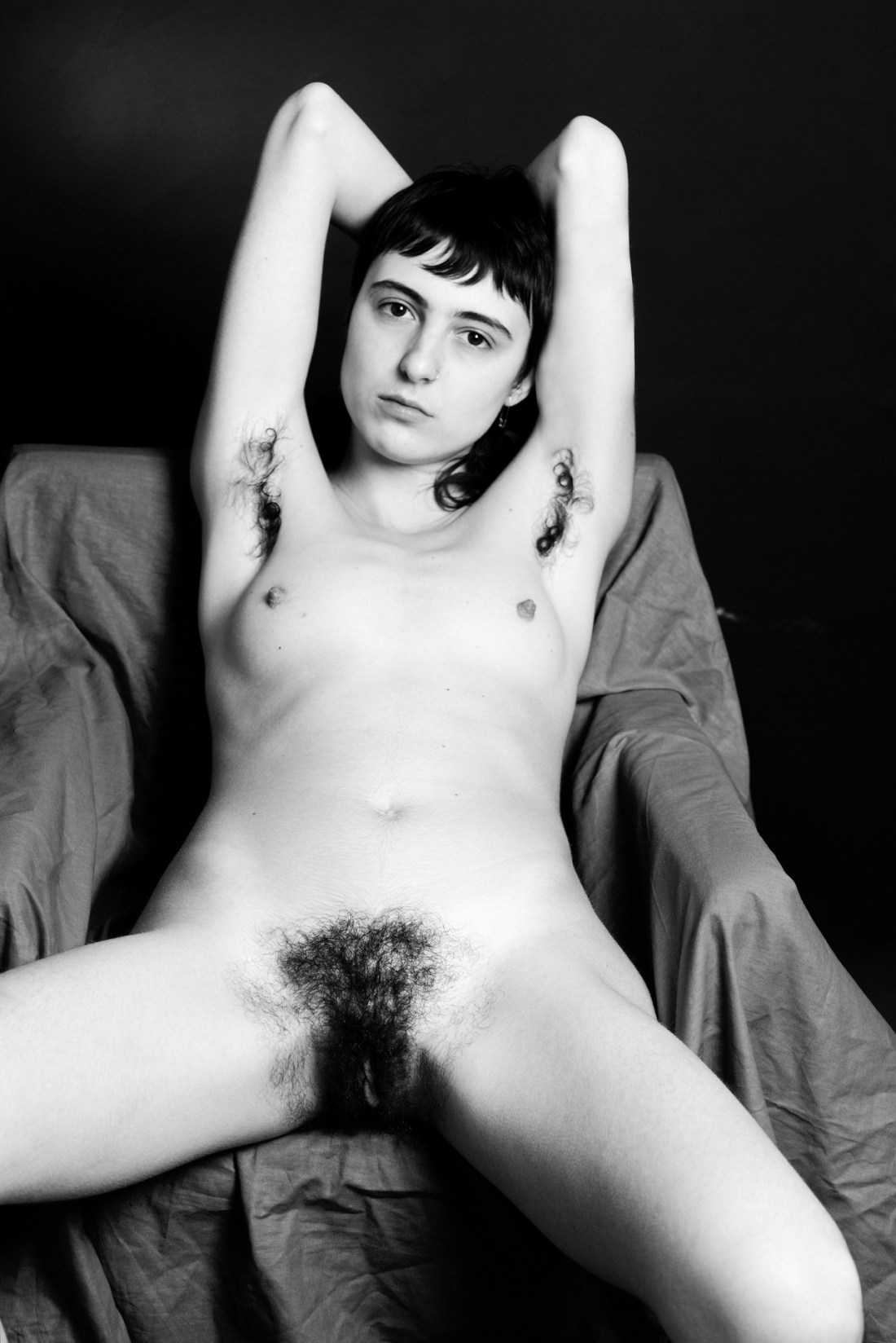
Giovanni Pasini – Chair feat. Eva Collé (2018)
At first blush, this is alluring. Hhigh contrast monochrome accentuates the skin, emphasizes the contrast between light and dark, skin and hair. And the angle of Colle’s thighs reiterate the negative space in the upper right of the frame–it exudes a sense of casualness.
After digging through Pasini’s work, however, I’ve come to a different conclusion: Pasini may or may not be a misogynist but his work utilizes visual grammar in a fashion that is profoundly sexist and super problematic.
It’s no secret: I don’t favor studio work. It’s not the studio itself I’m down on. It’s how the studio is customarily employed that irks me.
Studio work allows for greater technical control. You can get your lighting just right for the parameters of your project. Yet, there is also an directly proportional decrease in limitation. For example: if your project calls for a super model to be wearing a gown designed by a haute couture designer that features a five-figure price tag and standing on the ramparts of a Scottish castle, then–unless you’re David LaChappelle or Tim Walker–you shoot on location at an actual castle and do the best you can with the existing light.
Generally though the increase control with regard to lighting results in the limitation of any authentic sense of actual physical space. If we were talking in terms of the four W’s and H of classic new paper reportage, then studios represent a shift in emphasis away from questions of where, while allowing for greater room to elaborate on Who, Why, What and How.
Limitations are not in and of themselves inherently non-positive. In practice though, studio work has a decided tendency to diminish contextual information. (Don’t forget that questions of where also interact with questions of who, why, what and how.)
Pasini’s images are highly decontextualized–a nude model against an either dark or light background. (The image above is positive grounded in place in time by comparison.)
However, there’s also the way that his titling of the work further decontextualizes things. For example: the model’s name in the image above is not provided by Pasini–the model was added when the image was posted by the always noteworthy The Quiet Front.
As far as I can tell, Pasini doesn’t mention his models names at all. Odd when you’ve worked with popular models.
It’s almost easy to just think that he’s tact is to look at it as the-models-I-choose-to-work-with-are-established-enough-that-they-do-not-require-introduction. I can’t let it go that easily, unfortunately. Because there’s also the way in which Pasini’s work further decontextualizes the woman he photographs.
Take the image of Collé above. The title Pasini’ gives it is ‘Chair’. There’s also Chair, Chair (also Collé, uncredited again), Chair with Dr. Martens and back to just plain old Chair.
Or, if you think I’m cherry picking–consider Back, Back, Back, Back with secretions (really: ‘secretions’ is almost as unsexy as ‘moist’) and Back.
While we’re at it consider: Mature (and opulent) torso, Little girl lost and Panties down. (I’ll spell it out in the event that the mention isn’t enough to clarify why these are thoroughly problematic titles: you can argue that porn started or it porn merely reflects the programmatic of society at large which due to rich, white, cisgender and heterosexual men retain a white knuckled grip on the reigns of state, the beauty standard is young, white and cis-het-flexible female. Thus the title indicates that although the subject is mature (something I never would’ve inferred from only the picture) but also attractive because of a specific physical feature. Little girl lost applies the greatest male fiction ever invented–that of a sexually precocious young woman who has yet to reach the age of consent.
And Panties down is really endemic of everything up to this point: Pasini’s work focuses exclusively on presenting women as sexually available. (Let me preempt any of you #NotAllMen types: I am not saying that it’s inappropriate to make work that presents women as sexually available. Like seriously, have you spent any time on my blog?)
No: the issue is that at every step of the Pasini’s work makes decisions why diminish individual identity and agency in favor of characterizing them as sexually available and plugging them into a rote litany of titillatingly heteronormative tableux. The work is objectifying and sexist.
I have no idea if these facets are representative of the author or not. (I have my own opinion but I’ve purposely structured this so as to not cast uninformed aspersion.
I do find it galling that Pasini refers to his work as ‘art’. One the one hand I do not agree. However, it is precisely that designations that prompted me to articulate all the above. If you refer to your work as art, you are in essence inviting this (and even more in-depth analysis and criticism).
Lastly, while I generally go out of my way to make posts that are this openly critical of work, I made an exception here because I do think it’s interesting that the sense of casualness I mentioned at the start of this is actually something I’ve come to see as confrontational. There’s no way to know just from the photos–but I do feel as if Collé is at least consciously aware of the creepy factor of some of the work and is trying to present herself in a manner that runs counter to it.



 Acetylene Eyes