
Source unknown – Title unknown (201X)
how you love yourself is
how you teach others
to love you
Source unknown – Title unknown (201X)
how you love yourself is
how you teach others
to love you
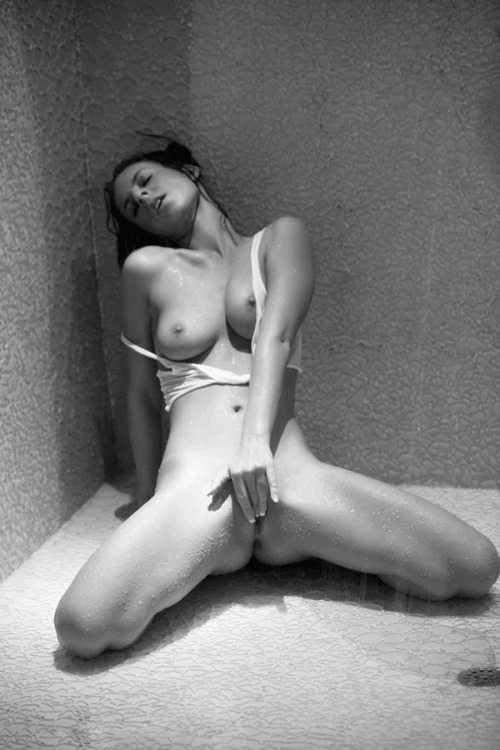
Penthouse – Presley Hart [de-saturated] (2014)
One of the most brilliant things I’ve ever heard about color vs B&W in image making was Mark Steinmetz’s observation that it’s like two sides of a street on a sunny afternoon: the side in the direct sunlight is ideal for B&W and the side in shade is ideal for color.
This image was originally in color. The former image is actually kind of heinous. The two tone cyan of the textured wall and the magenta skin tone–enormously overexposed by a strong overhead light source–renders the image positively garish.
However, some smarty loaded it into Photoshop, de-saturated it and the result emphasizes texture–falling water from the shower, water droplets on wet skin and the crater pocked wall. A simple edit that takes something that was crap and transforms it into something that is visually interesting as well as arresting.

f2.8 – Title Unknown (2016)
This is a fabulous image.
If one were inclined one could comment on the diffuse lighting (how the viewer reads a window beyond the right frame edge even though it remains unseen; the directionality of illumination is opposite the Dutch baroque tradition–right to left as opposed to left to right, and etc.), the soft focus situates the scene very much in the room that feels both charmingly lived in, a bit cluttered by the decor but it does not detract from the primary purpose of the image–the woman standing in such an evocative yet ambiguous pose (does she have a headache, is she sad?)
The use of space and illumination is reminiscent of one of my all-time favorite paintings, van Eyck’s Arnolfini Wedding Portrait. Except van Eyck favors a much deeper focus. (If an apples to apples comparison, I’d posit the insanely talented Paula Aparicio.)
The antlers and marlin on the wall evoke associations with Artemis.
I’m a little worried about posting this. The image maker is fairly adamant that no one should add or remove anything when reblogging.
I have mixed feelings about such an admonition. On the one hand, I understand. With all the DD/lg blogs adding self-promoting links on other folks work or worse swine who feel by virtue of the fact of having a phallus that their opinion about women and their bodies’ is enough to make most decent folks more than a little gun shy.
Alternately though, I vehemently disagree with such prohibitions. It smacks of a sense of control-freakishness that I think is actually detrimental to work. You make the work. You edit the work and before you put it out there you do as much as possible to inform the eventual context. But once it’s out there in the world, it’s no longer yours. Not in the intellectual property way–it still very much is in that fashion; but the image takes on a life of its own that frequently becomes just as interesting for what the creator meant as what’s misunderstood and misconstrued.
I’ve done my best to be respectful in flouting the prohibition because I think this image deserves to be celebrated–and unlike the tens of thousands of self-same reblogs as a statement of personal aesthetic, I do curate here and with that comes a certain standard of admission (proper attribution where possible in a consistent form and commentary to the best of my abilities.)
I hope no offense is taken by the creator. None was intended. I just wanted to feature this image with proper credit–I’d really like to credit the model too, however I couldn’t find that information anywhere.
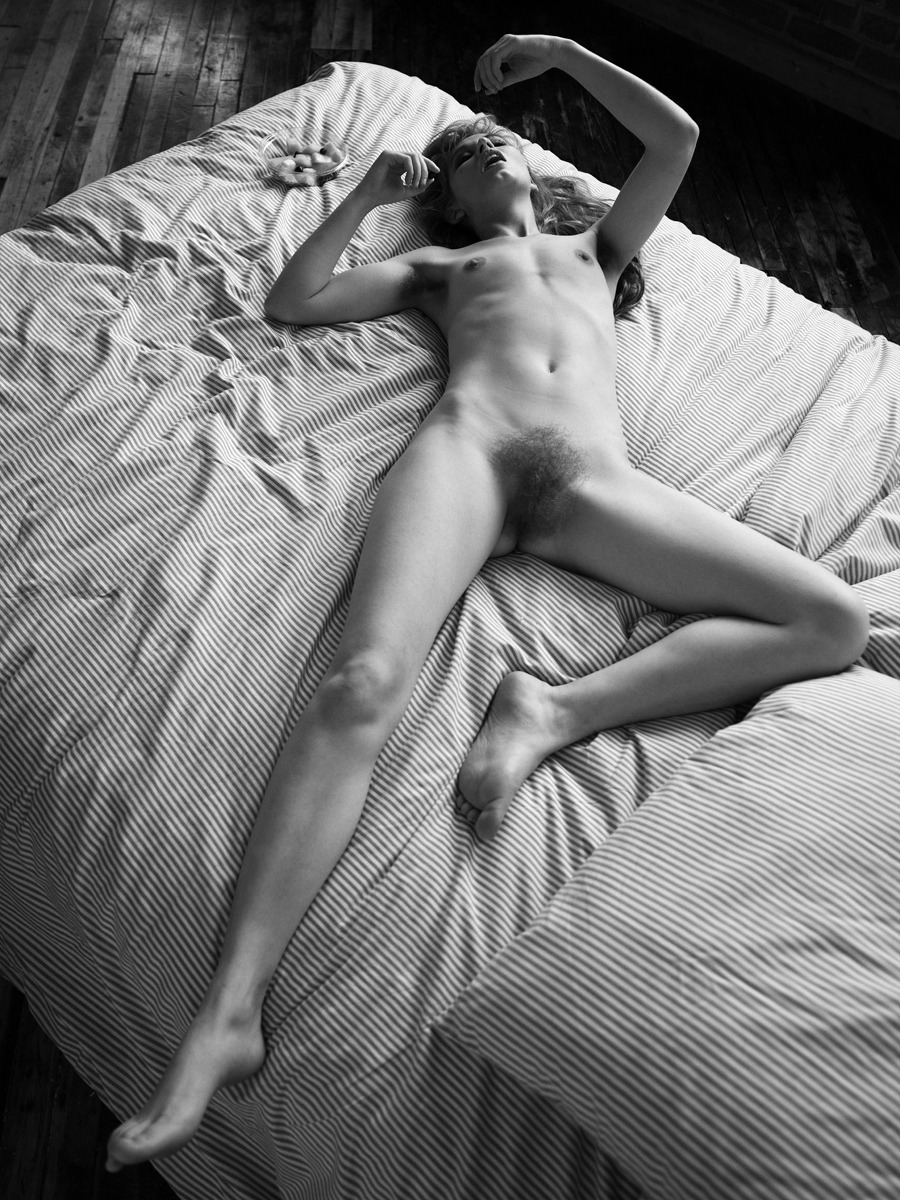
Zvaal – Nettie Harris, Philadelphia, PA (2011)
As someone who believes that whenever possible you should strive to present bodies in context, I very much appreciate Zvaal’s respect for the women with whom he makes pictures.
Like if you want to know when and how to employ the frame edges to crop out part of someone’s body without it being disrespectful or objectifying, you could do much worse than studying Zvaal’s work.
I’m much less fond of his use of vertical orientation. I don’t think I can successfully make a case that his work is #skinnyframebullshit; however, I do strenuously object to like 85% of his use of it. In other words: I won’t argue that it serves a logical compositional purpose but the use more often than not undermines the conceptual vivacity of the work.
I’m primarily posting this because there’s been a dearth of B&W images lately. (If you haven’t noticed I’m super OCD about alternating B&W and color images.) And counter-intuitively, I think the black pinstripe on white sheets are a fascinating texture in monochrome–look at how the sheets almost look white in places where there’s overexposure but how prominent the pin stripes are otherwise.
(Also: Nettie was the first Tumblr model I followed.)

Inside Flesh – Title Unknown (2016)
If you’re at all familiar with music criticism, you know that generally there are three templates for artists with long careers of making continual relevant, ground breaking work:
If Inside Flesh can be said to be following any of the above trajectories, it would be #1.
To me, that’s not just interesting–it’s surprising. Let me attempt to explain what I mean…
I’ve always appreciated IF’s aesthetic. But I’ve always worried that it’s a little too rigidly circumscribed–the whole glitching, industrial hell thing seemed to me that it would become cloying at a rather quick clip.
Quite the opposite, in fact: it feels like someone exploring the interstices between art and pornography could do worse than to immerse themselves in IFs oeuvre.
What I’ve noticed is a degree of conceptual recursion in their work. The limitations of their aesthetic are frequently mirrored in a certain heteronormative predisposition in their work. For example: they have a lot of scenes like this, where the viewer sees an nearly disembodied phallus vaginally penetrating a definitely embodied woman. (I really like that their frames tend to include the entirety of the woman’s body within the frame.)
However, there are two things that distinguish IF from most straight porn:
In their artist statements IF refers to their ongoing preoccupation with “human carnality in all its aspects.”
I know they are based in Poland. But I can’t help seeing what their doing as a sort of radical fuck you to on going policing of sex workers by ‘well-intending’ fuckwits–I’m thinking specifically of the AIDS Healthcare Foundations utterly ridiculous ballot initiative that would empower private citizens to personally sue adult performers not wearing a condom in adult media.
I am about as against the contrived Puritanical prudery that suggests sex is a sin in the eyes of some deity as a means of dodging unwanted pregnancy, disease, eternal damnation, etc., as one person can possibly be. When it comes to sex positivity, I err on the side of over-the-top. I think people who enjoy sex should have more and better sex.
By the same token, I find the sort of heteronormative no risks/all reward notion of sex perpetuated by most mainstream pornography to be only a bit less repugnant. I mean how many times have you watched a scene where a cable guy or plumber shows up to fix something and upon finding the person with the troubles is scantily clad and horny, things progress to sex with little if any flirting, communication or foreplay. It’s pure simulacrum.
But although it’s fantasy, and part of the fantasy is the randomness and availability, the context indicates that there should be behavior in place that pays attention to safer sex. (I say ‘safer ‘specifically because I don’t think there is any such thing as 100% safe sex–at least if your doing it right by recognizing that risk is an intrinsic feature to anything in life truly worth doing–and vulnerability, connection and giving expression to unfiltered desire are all risks; plus, the queer milieu in which I maneuver, I don’t know a single person who uses dental dams or condoms when performing oral sex.
My point is you choose your level of risk and accept the consequences. It’s not really anyone else’s call to make.
Yet, I feel like whereas most porn would argue against condoms for being elements that pull the viewer out of the fantasy, their absence in feels like a radical decision to experience the extremity of human carnality.
And it’s true: safe sex is good sex. But there’s something about unsafe sex that is completely immersive. (It’s like the difference between the hallucinations associated with mushrooms vs LSD–when I’m shrooming, I always remember I’m shrooming, when I’m tripping on acid, I sometimes lose site of the fact that I’m hallucinating–interestingly, I don’t especially like LSD.)
Like you can feel the smallest changes in engorged rigidity, changes in the viscosity of vaginal mucus, the slow build up of clenching and unclenching micro contractions, the warm surge of unrestrained ejaculation.
Really, I think it’s exactly these sorts of intangibles that IF is trying to convey in their work.
 https://embedr.flickr.com/assets/client-code.js
Camilla Cattabriga – Untitled (2015)
I’ve said it before but it bears repeating: if you are a young photographer who wants to work in B&W, invest the time and energy necessary in learning to use analog.
Digital is garbage when it comes to B&W–especially at higher ISOs. (If you only have a digital rig, then you should unequivocally set it to some sort of monochrome setting before firing the shutter. Desaturating in post is always going to produce a tonally muddled image; monochrome settings aren’t much better but every little bit helps.
Also, an image maker it smacks of lazy, knee-jerk, half-assery when you stamp your work with a text-only watermark. I mean, an image maker is ostensibly a visual artist, so it’s just a wasted opportunity. (And that’s completely glossing over my rabidly anti-watermark idealism.)
Still, overlooking those concerns, there’s something fascinating about Cattabriga’s work.
She uses what I’d term wide or establishing shots and extreme close ups. With both, she pursues relatively flat compositions–alternating classical one-point symmetry and more minimalist, De Stiji at a cant asymmetry.
I could point to dozens of young, internet famous image makers she riffs off. But I think what’s most interesting about her work is the aforementioned alternating between wide vs tight shots.
I like her wide shots well enough. They demonstrate a rare contemplative patience. These type of shots tend to outweigh the closeups by a rate of about 4 to 1. This allows the close-ups to convey an unusual immediacy.
As much as I think that like the term post-rock is generally (and rightly) derided by the bands whose music is so labeled, it does at least point to some incredible music.
I feel similarly about the oft touted term ‘female gaze’. Generally, the people who embrace the term are full of shit. (Looking at you, Masha Demianova.) But I can’t look at Cattabriga’s close-up work and not be 120% convinced it applies.
And I’m not sure she sees it in her own work. The above image does not feature in the Nicole E Flavia series of which it is a part. I think generally a tighter edit would’ve added punch to the images but there is something to this image that pairs a little too well with some of the other close-ups, primarily I’m thinking of this one (which is effing incredible).
Also, I love how the image above depicts a state of eroticism that is independent of the audiences experience of titillation. The image doesn’t exist as any sort of invitation, it’s merely a record of white skin, touch and the proximity of bodies in a confined space.
I don’t think there’s ever a justified reason to decapitate people when making an image, but here’s a case where it almost works as long as these images are considered within the context of the entire series.

Dmitry Kuklin – Girl on the bridge (2010)
I like the fact that when Kuklin photographs nudes, he mixes up it–featuring both men and women.
On top of nudes, he works with landscapes and more traditional portraits.
His work is all mostly middling–except for this, which is so effing exquisite it manages to transcend its many flaws.
Coming from me that’s saying a lot as I am normally prone to throwing up a little in my mouth when middling image makers embrace alternative process–in this case: cyanotype–in an effort to attribute some sense of distinction to otherwise mediocre work.
In Kuklin’s case the cyanotype gambit pays off–not due to luck so much as a result of working squarely within the confines and expectations established by art historical tradition, i.e. he’s intimately familiar with the history of portraiture and landscape as themes for visual depiction.
To me: it’s obvious that he lack formal training. The above, for example: if you squint and tune out everything that makes it so compelling you’ll not that the way you can’t see her right arm is super awkward and distracting, the way she’s sitting perpendicular to the bridge is also not entirely compositionally effective given the disbursed negative space. (In addition: you can argue that her right leg is distracting, too–but I thought it was trailing off the bridge into dark water at first. Clearly that’s the effect Kuklin’s going for but there’s no way the water would be higher than the bridge given her position.)
However, the expression and the over-exposure of her left shoulder separates her from the background, this is counter-intuitive given the other lighting cues but actually serves to balance the highlights in the foreground–her skin and underwear, the shoes in the mid-ground and the rhizomatic grasses and their mid-tones in the background.
It’s also charming that she has and seems completely oblivious too the hole in the crotch of her knickers.
Source unknown – Title Unknown (201X)
It feels like this clip’s raison d’etre is: Beautiful Agony is cool and all but wouldn’t the format be improved by a more DIY approach.
As you can see there’s trade offs. this avoids BA’s almost universal flatness by setting the action in what appears to be a field in the waning light of the evening golden hour.
Instead of the crisp, clear sound, gusts of wind completely exceed the range of the on-camera mic–resulting in cringe inducing soundtrack blow outs.
Also, I don’t really understand the framing. Yes, it allows reasonably wide coverage wherever the subject moves. But the tripod in the lower right corner is distracting.
Perhaps that’s the point: a sort of Kubrick’s Full Metal Jacket-esque meta commentary (the numerous dolly shots that track camera men shooting similar tracking shots); but it comes off as a little too ambiguous to successfully tic that box.
Criticisms aside there are some goddamn fucking phenomenal things to celebrate here. When the sound is clear, there’s texture and timbre to it that conveys a blush worthy degree of explication to any otherwise implicit image. Further, it’s lovely how the cruddy video renders the patina of sweat in the dying light.
But as if that wasn’t enough where this clip actually comes into its own, is when you realize the seemingly orgasmic echoes are the result of a second woman–who is very much like the woman we are watching, positioned facing a camera mounted on the tripod visible in the lower right corner.


[←] stillcrazyafteralltheseyears6 – Untitled (2016); [→] Craig Moray – Christelle (201X)
Juxtaposition as commentary. (#skinnyframebullshit Ed. II)

Nicholas Noisenest – glamourmatic glowstick . subclitoral squirt gun (2012)
Believe it or not–despite my many misspellings, myriad grammatical errors and the fact that I routinely forget to include the sort of quantum connective tissue that connects my various notions–I am exceedingly self-conscious about my writing.
So I’m aware that by this point it’s almost a formula for this blog: I start of a post saying I really don’t like X, Y and Z but I’m super down with P, D and Q.
Yeah, yeah–sometimes I invert the order but mostly with the exception of the confessional personal posts or unmediated compositional analysis, I’m an appallingly predictable writer.
For example: the only way I know how to approach the above image is by first subtracting the things I (strongly) dislike about it. The combination of monochrome and strobe clearly asserts an affection for Nobuyoshi Araki’s Tokyo Lucky Hole.
There’s less than no love lost between Araki and myself. But from a technical standpoint this isn’t even thoughtfully derivative work–yes, Araki was using flash and B&W to capture salacious scenes but despite my distaste for most of his work, you can’t dispute the man’s tech chops. Whereas Noisenest–while at least not using the strobe mounted on his device, positions it in such a way that it casts an obtrusive shadow behind the woman. (It’s also #skinnyframebullshit.)
And for a work that appears so self-conscious about its family resemblance, the execution with the strong and the stylized tonal gradation, all work at cross purposes given the Araki impetus. (Araki is afterall and if nothing else grossly immediate in his presentation.)
However, all these (admittedly damning) critiques aside, it does strike me that this instinctively gets something about erotic photography that I haven’t realized before–specifically with regard to ostensible depictions of masturbation; namely: there’s a knee-jerk tendency to frame the scene as something habitual instead of something novel.
The distinction I am trying to draw is that we tend to make work featuring folks masturbating in bedrooms or bathrooms–spaces that exist hand in hand with a degree of personal privacy. Thus, images produced given that sort of framing, tend to serve more as mirrorrs; the viewer responds to them based on their response to the person depicted.
While that is probably an honest depiction of probably about 65% of masturbatory experience, there’s also the part that is experimental and boundary transgressive. The instinct that doesn’t want to be caught but wants to press up against the notion of this is private and that is public and never the twain shall meet.
I mean I don’t think I’m the only one who has masturbated in strange places either because the moment felt right to do so or a libidinal itch demanded scratching without recourse to all the locks and catches of safe privacy.
And I think there are certainly ways of hybridizing these two extremes, but I think if you can’t be bothered to present indications of a fully developed, three dimensional individual when depicting masturbation, that you can at least bother to recall the sense of urgency that drove you to transgress boundaries and use that as a conceptual starting point.
What Noisenest intended to do that with this image or not, he succeeds stunningly in at least that one regard.
 Acetylene Eyes