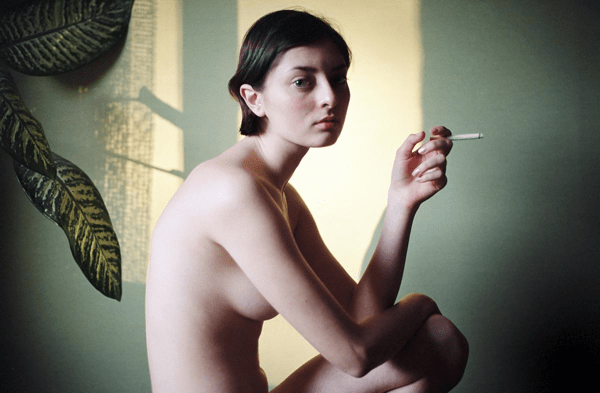
Margo Ovcharenko – 01 from Without Me (2008)
‘Intimacy’, ‘vulnerability’, ‘trauma’ and ‘stories’ are terms which recur in Q&As with Ovcharenko.
Although entirely befitting, they’re ultimately terms of abstraction.
In other words: what does one mean by ‘intimacy’: loneliness, togetherness, expressions of passion, etc., etc.
Don’t misunderstand: I am hell of fond of her work’s aestheticization.
Still, deep in the mix there’s something either coy and waffling; or–worse–intellectually dishonest.
I think it has to do with the way Ovcharenko speaks about her work.
In any interview with The Calvert Journal she offers the following explanation as to the implications of sex and violence in her work:
Sex and death are two of the most sensitive subjects for humans. The fear of death and the desire to prolong life by the passing on DNA are at the heart of everything. All of the social constructions that allow us to live in cities, such as the police and government, lead to perversions of these basic instincts. I am interested in how that works. I’m like a little girl poking a dead frog with a stick: I am sad and frightened but curiosity wins out. (Emphasis mine.)
It’s an adroit response that eschews abstraction. Viewing her work it’s easy to see her as a well intending child poking a dead frog with a stick.
Yet it runs counter to something on her website. (Note: I may be wrong in attributing the remark to Ovcharenko; how the quote appears is ambiguous due to a muddled layout. It could be attributed to the attribution is the author or several subjects.)
Pornography is an ugly and disgusting phenomenon. Erotic can be beautiful, porn–never.
Besides patently disagreeing with the statement, it contradicts her own admitted impetus for creating: what drives us to pornography except being sad and frightened but having curiosity win out in the end.It’s not merely that I disagree with her here.
Also, given her interest in depicting androgynous/non-gender conforming/homosexual folk, I find the absence of any explicit statement supporting LGBTQ rights considering the total clusterfuck in Russia at the moment to be somewhere between naively, tone deaf and irresponsible/exploitative.)
The last thing rankling me about Ovcharenko needs to be unpacked.
Remember that Wired article to which I took such umbrage: 10 Photographers You Should Ignore? It bothered me that the underlying point wasn’t that you can’t or shouldn’t learn from renowned fine art photographers; it was: unless you are making the work you want desperately to make then fuck off and die because you have no business behind a camera.
Fine art photography is a starting point; a set of initial vectors for approaching material. At some point the process and material will demand a very deliberative departure.
The problem is–just like religion–fine art photography is taught as if it is little more than a trigonometric function.
Until I come up with a pithy term in line with #skinnyframebullshit, I am going to call this approach to fine art photography as a trigonometric function as ‘photography as a function’.
The notion arose earlier this week while I was trying to write about Harley Weir.
I’ve run into her work a handful of times. It’s clean, solid. There’s a unity of content and form, muted colors, grounding in art historical perspective/scale considerations–it is what I expect fine art photography to look like.
But I felt fuck all for the work itself. Until I saw this; my brain did this thing it does where it leaps free associative and anchors images to music. I heard that line where the song says:
But for now we are young
Let us lay in the sun
And count every beautiful thing we can see
I realized this feeling of being young, in love and overwhelmed by the beauty of everything was the raison d’etre for Weir’s images.
Now: why isn’t that made obvious by the work? Perhaps because there is too much emphasis placed on aestheticization and not enough on simplicity and clarity of effect.
(I dig Heidi Systo but her work is just as much photography as a function as Ovcharenko or Weir.)
I do feel an undeniable connection with Ovcharenko, though. In fairness, while the above dates from 2008, and while her newer work does little to avoid repeating the aforementioned pitfalls, it is at least much sharper. For example, I am in love with 07 from her Hermitage series. It stands out from the rest of the images as a young girl who is bored with poking a dead frog with a stick, so instead she pokes it because she’s suddenly curious about why poking it makes her sad and frightened.

 Acetylene Eyes