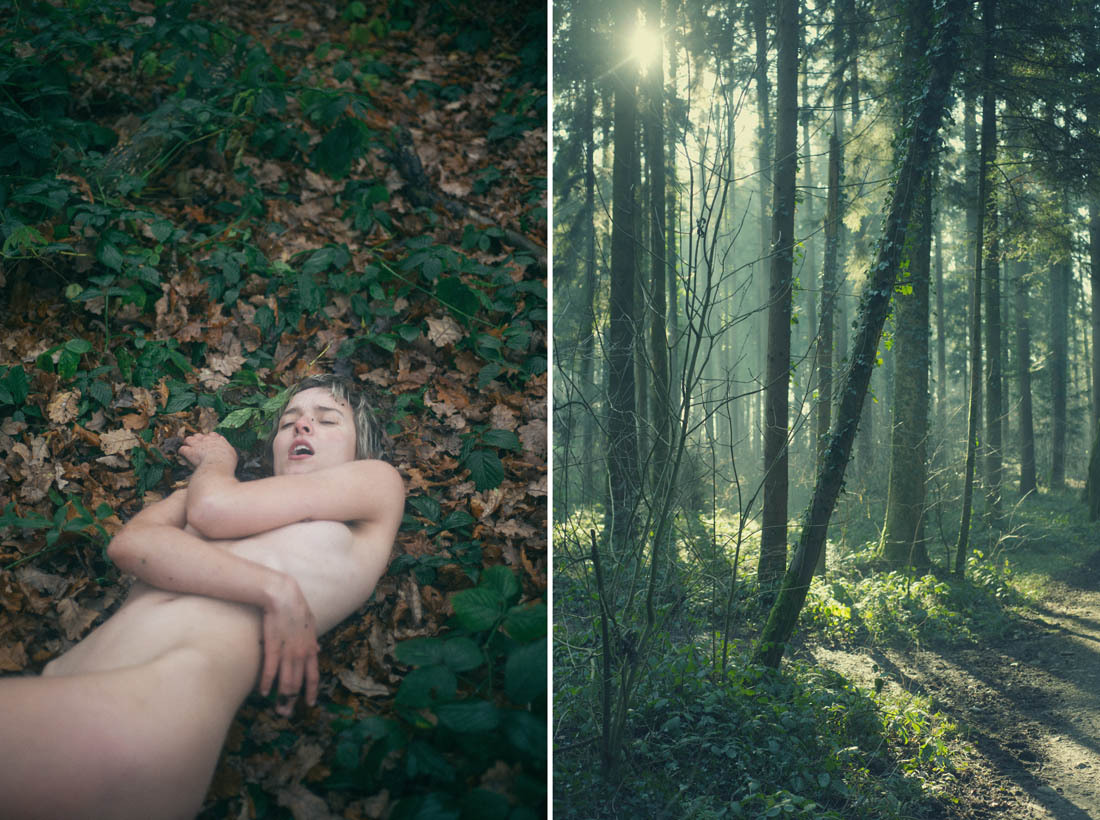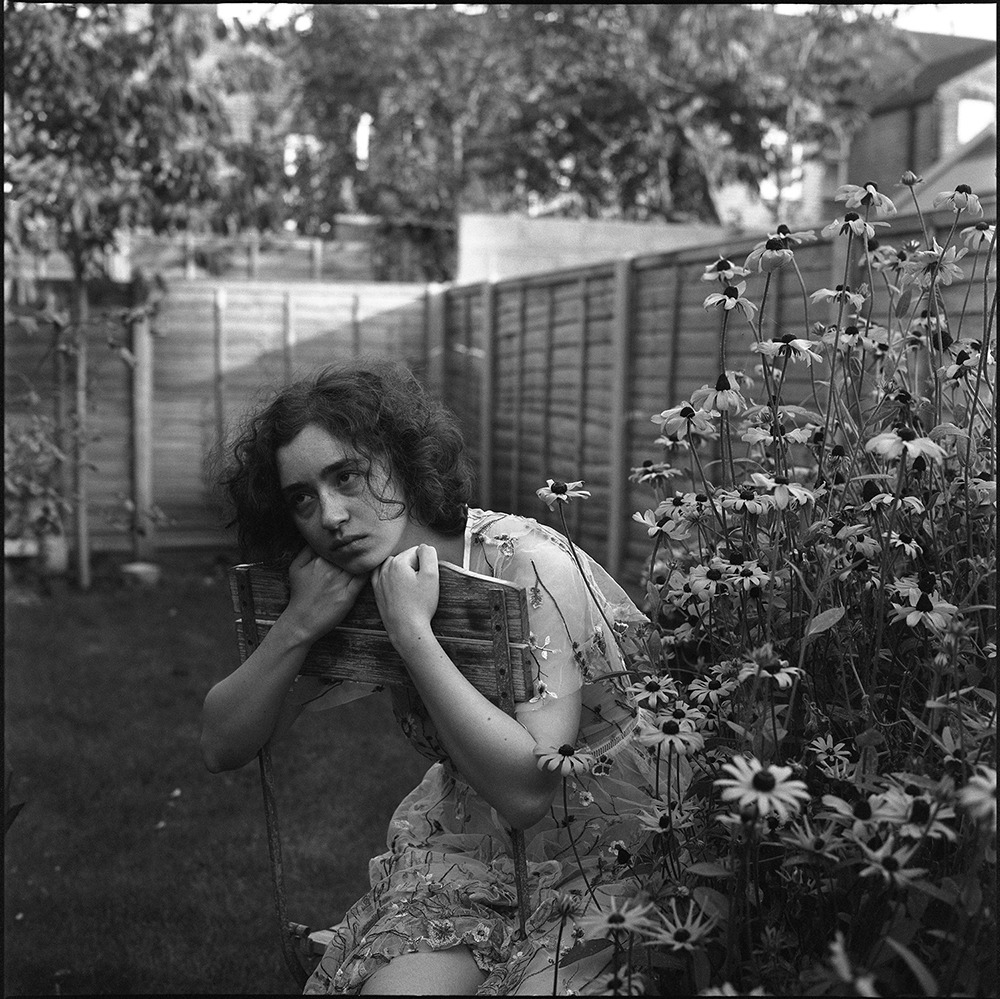
Nagib El DesoukyArtemis (2018)

Every time I’m cruising through my liked posts, I always pause over this photo.

It’s not just this picture, everything El Desouky posts is quality and every third post or so is freaking brilliant. However, there’s something about this photo in particular that I find captivating.

I think it’s mostly the spot on-ness of Artemis’ daydream-y expression. Still, there’s something weird about the composition.

One of the things you learn when you’re studying photography in academia is that one of the ways you can balance a composition is to use the subject’s gaze to draw attention to negative space.

Think of it this way: imagine a photo of someone standing near the rim of the Grand Canyon–given that the camera is set up so that the edge of the canyon runs more or less diagonally from the lower right frame edge to the middle left frame edge.

You take two pictures. In the first, the model–let’s call him Edwin–is standing just back from the edge of the canyon at the left edge of the frame. He’s looking out beyond the left frame edge.

For the second, keep Edwin’s pose the same only move him so that he’s positioned in the right third of the frame.

In Photo #1 you’re seeing Edwin but you can’t see what Edwin sees. You might wonder if he knows he’s missing the view. Or, conversely, maybe he’s got a better view than you, the viewer. (Also, the human eye is generally more immediately interested in people over landscapes–thus: there’s a tendency to focus on Edwin without fully grasping that Edwin is standing in the landscape, due to photographs predominantly scanning from left to right.)

In Photo #2, his positioning dictates that you aren’t seeing the same view but there is at least overlap. It’s possible to follow the angle of his gaze and infer something of what he sees.

In the photo of Artemis, you can somewhat follow her gaze–there’s a bright circle of light (presumably from a gap in the trees foliage about 1/5 of the way down the left most frame edge that is more or less where she’s looking, although her gaze is at an angle that is slightly turned towards the focal plane).

Normally, this would be a trap for the gaze while scanning the photo. It’s not here. I’ve been trying to figure out why and here’s my best guesses:

First, there’s some interesting stuff with triangulation. That little black sprig sticking into the lower left of the frame? It forms a natural triangle with Artemis’ eyes and the aforementioned bright dot in the background tree. This pushes your eye left.

Then there’s the upward oriented triangle suggested by Artemis’ arms–this draws attention to her face but it also echoes a larger triangle between the three darkest points in the frame: the sprig at frame left, her hair to the right of her face and the area in the thicket of flowers near the lower right edge of the frame.

That thicket of flowers is rowdy and cluttered, but the slightly soft focus renders them a decorative anchor to the foreground without distracting our attention from the subject.

All of this is executed in a style reminiscent of the way Renoir tends to give solidity to objects in the foreground while rendering the background in a sort of teary eyed blur.

@house-of-fortitudeUntitled (2014)

This blog gets it’s fair share of garden variety Internet trollery. After that, the most common query I receive is people making reasonably cogent arguments that I present myself as an infallible authority.

Uh… no. I’m wrong. Frequently. However, the frequency is less a function of idiocy and more a matter of the fact that I really do put my ideas out there a lot–which presents more opportunities to be wrong.

(For the record: I encourage everyone to take what I say with a Gibraltar sized grain of salt. Always think for yourself. If you think I get something profoundly wrong, drop me a line. I have zero qualms with substantive disagreement–the point of this project is actually to facilitate dialogue that I find to be currently lacking and which I feel is both vital and important to have within the medium and those who appreciate the medium.)

Case in point: very early on, El Desouky submitted a photo for publication. I don’t really accept submissions–although I have something in the works that won’t necessarily change that but will shift it slightly. (Hoping to make that announcement during the back half of the month. Stay tuned.)

I turned up my nose at it.

Now? Well, now I feel like an arse about it.

I mean I’m super hard pressed to name another photographer with as singular a visual voice, who works in both B&W and color in ways that underscore the necessity of that particular image preferencing one medium over the other and who can be bothered with the notions of melancholy as neither inherently positive or detrimental so much as necessary or perhaps even suggestive of a form of radical self-exploration.

I freaking L<3VE the above photo. It’s partly the simplicity of it. A cluttered kitchen and a woman. Nothing about this is in any way so complicated as to be prohibitive to arrange. Yet, there’s something magical about it. It really does look as if she’s drifted off into quiet reverie as a result of looking at snapshot. The snapshots–splayed as they are on the table, clearly legible as photos but not clear enough to distinctly discern what the portray–suggest a glimpse into the woman’s thoughts in a way that let’s the mystery be.

Then there’s the light–which as far as I can tell comes from two sources. An ugly, bare overhead bulp as well as a single very direct light source just beyond the left edge of the frame angling down on the table, her face, neck, shoulders, back of the chair and the little leak filtering through the shadowed triangle formed between her neck, shoulder, bicep and forearm, drawing attention to her left breast, accentuating the nipple.

The magic of it is that anyone with a camera could have made this image but only El Dosouky could make it in a way that is both insinuating of a narrative and resistant to such interpretation, that feels so vibrantly alive and authentic. It’s a scene that is so mundane, we might overlook it we happened upon it unaware. But now we get to revel in it’s glorious wonderment.

Nagib El DesoukyUntitled (2014)

I don’t think those who follows this blog suffer from any sort of illusion when it comes to this author’s infallibility. Between lapses in grammar, sensibility and taste, I fuck up more often than not.

One of those fuck ups was ignoring El Desouky when he submitted several of images to me roughly two years ago.

The mistake I made–unfortunately, one I make with alarming frequency–was to judge the work based solely upon whether or not it engaged me.

That’s not put as clearly as I’d prefer. Let me employ a metaphor: craft–being a strictly mechanical process–is something anyone can be taught in such a way as to eventually allow them to achieve mastery. Passion, however, is a different story.

I’m not someone who believes that passion is something either inborn with or you’re shit out of luck. But I object to the notion of passion be something–like craft–that can be taught. It doesn’t work like that. Perhaps a better metaphor is either that of the heroes quest, or what shimmers between this wonderful list of rules for education penned by John Cage that’s making the rounds lately.

Or, to put it another way: I don’t think art teachers owe their pupils only constructive criticism. Much the way a Buddhist novice must wait outside the monastery for three days without food, water or encouragement, if one or several instances of brutal criticism are enough to cause you to foreswear a creative pursuit, then don’t let the door hit you in the ass.

All this is to say that although I still find myself put off by most of El Desouky’s B&W work (this incredible photograph being a notable exception), his tentative forays into color are fucking stunning.

I regret that I didn’t recognize El Desouky’s intense and unflagging passion sooner. And I’m calling myself out on it in a very public way, in the hopes that I learn from the mistake instead of continuing to perpetuate it.