
Robert Mapplethorpe – Champagne (1977)
The truth is not always beautiful, nor beautiful words the truth.
–Lao Tzu
Robert Mapplethorpe – Champagne (1977)
The truth is not always beautiful, nor beautiful words the truth.
–Lao Tzu

Rudd – Title unknown (2017)
I love this even if the composition is somewhat funky. (Yes: the ottomon and her arm draw the eye at a diagonal up and right toward her sternum, the equal yet opposite angle of the couch pushes the eye past her face to the hand thrown behind her head; the mass of negative space is like the tension of a bowstring when the arrow is loosed and the gaze spans back to where he’s feasting upon her desire–this subsequently then causes the eye to shuttle back and forth between him and her.)
It works but the layout is just strange and if I had to guess I’d say that this is a drawing made from some sort of image reference. (This would explain the strange layout because when you’re drawing you can put a camera anywhere but in the real world their are limitations on where a camera will fit.)
Still: I really do like the fact that the way the illustration scan preferences her pleasure above its catalyst. And when you subsequently realize the cause of the pleasure, the connection sharpens her experience somehow.
There’s also the little things–like I don’t exactly understand if it’s a stylistic contrivance but both of them appear to have their nails painted black. It’s small but it’s not a bad tact to remind you that her extended right arm is still part of the composition despite the way the viewer’s gaze is encouraged to loop between her face and his.
Lastly, it’s great that below his left armpit and her right inner thigh you can see a puddle of vaginal mucous and presumably saliva spreading on the couch. Good times.

Joana Choumali – Untitled from Emotions A Nu series (2013)
Choumali is an Ivorian image maker who focuses primarily on work featuring African woman.
Her focus is primarily vibrant, super-saturated color (and she’s really fabulous as using the intersections between non-complimentary colors to flatter her subjects.
She also works occasionally in monochrome–and her work here is rather audacious.
I’m not really a fan of studio work. And although that’s what Choumali does more or less exclusively and while I do consider her color work both incisive and bold, it is her monochrome stuff I can’t shake.
Part of it is that I will always be a fan of complication. By that I mean studio photography allows for more control. You can set up in advance, orchestrate the lights, get everything just so and then you can invite the subject and focus on interaction as opposed to juggling 18 other things at once.
Unfortunately, this tends to mean that studio work is pristine and allows for the setting to be decontextualized in favor of allow a laser sharp focus on the subject. Choumali pushes things–ambitiously–in quite a different direction.
Here the almost Pollock-esque speckled backdrop both separates the subject from the backdrop (enhanced with some perhaps less than as subtle as you’d really hope for dodging along the subject’s back and hips. It contributes a solidity to this woman that the shadow her body cases flattens back out.
The solidity is counter balanced expertly by an ephemerality that is echoed in the pose is the subject kneeling or rising? Is her pose contrite or self-accepting and joyful?
I speak virtually on the daily with photographers who are interested in shining a light on the notion of vulnerability with their work. Choumali does exactly that magnificently.

Mary Ellen Strom – Nude #5, Eleanor Dubinsky and Melanie Maar (2005)
Mary Ellen Strom’s meticulous restaging of Gustave Courbet’s The Sleepers (1866),
a classic depiction of lesbian sexuality for the benefit of the
heterosexual male viewer, is projected at the size of the original
painting. Strom’s intent is to re-embody, literally, a territory that
was not only the location of male desire but also the prerogative of
male artistic production. Strom’s models are her peers – contemporary
women artists. Her nudes have names. They collaborate with Strom in
making lesbian pleasures available to lesbians, among other viewers.–Catherine Lord, Art & Queer Culture (New York: Phaidon, 2013), 219.

Janice Guy – Untitled (1979)
Murray Guy is one of the most preeminent galleries for photography, film and video.
Janice Guy is the co-founder and co-owner through March 2017.
She founded the gallery in the 1990s after moving to NYC from Düsseldorf, Germany.
In Düsseldorf, she studied photography at Kunstakademie Düsseldorf, working closely with Bernd and Hilla Becher.
Being a woman and a photographer preoccupied with self-portraiture, she’s frequently lumped together with folks like Ana Mendieta, Cindy Sherman and Francesca Woodman–the operative framing being fixated on artists as both simultaneously author and subject.
To think of it that way strikes me as a bit lazy. It fits–with certain limits–for Sherman and Woodman–less so for Mendieta; however, most of Guy’s photos feel less like self-portraiture and more like proto-selfies.
If one were to describe Guy’s work she documents herself as a photographer considering herself in a mirror–i.e. she’s not setting up the camera like Sherman or Woodman and then positioning herself in front of it; she’s interested in including considerations of process in her product (if you subtract capitalist connotations and instead consider the term in a more mathematical sense).
She’s nude in most of her work–except for a utilitarian wristwatch.
Her work wasn’t really exhibited until the late aughts–but there continues to be interest in it to this day and I suspect that interest may even grow down the line.

Source unknown – Title unknown (201X)


Source unknown – Title unknown (201X)
As much as there are performative heteronormative expectations when it comes to the FMM threesome, i.e. it’s perfectly upstanding, straight and good as long as penii don’t touch…
…it’s not something I’ve ever understood. But this makes me think about the mechanics of what porn instructs is the most common bodily configuration for two penis-havers engageing with a vagina-haver.
Like the owner of the lower cock is mostly passive. (If you’ve ever seen these scenes, it’s nearly impossible to get a workable rhythm going and the movement of the person in the middle is only really compatible with the person who is able to thrust and retract.
Second–while any sort of consensual sexual sensitivity is good in my book–there’s a way in which this configuration almost certainly amplifies the sensation of the person in the middle. Two of three orifices are full and there is skin to skin contact in both directions. That alone would be an emotional and intense feeling for me–even before you got down to whether it was pleasurable.
Then there’s also the way that in the heteronormative world there’s this proscription against penii touch. (For that reason I’m always interested in depictions of vaginal double penetration.)
But the rear wall of the vagina and the back wall of the anal cavity are not actually that thick, so there’s almost certainly a way that although penii aren’t touching they are engaged in conversation through a screen–like a supplicant confession to priest.
If any one of the the three orgasms, the body cavity they are inside would server as a resonating chamber of sorts.
And I think that’s why I end up looking at a lot of group sex porn–it’s not the fantasy of the explicit exchange that entices me, it’s the ease with which this sort of thing is depicted in pornography and the fact that that ease of trust and intimacy is nothing something I’ve ever known (or, unfortunately, am ever likely to know).
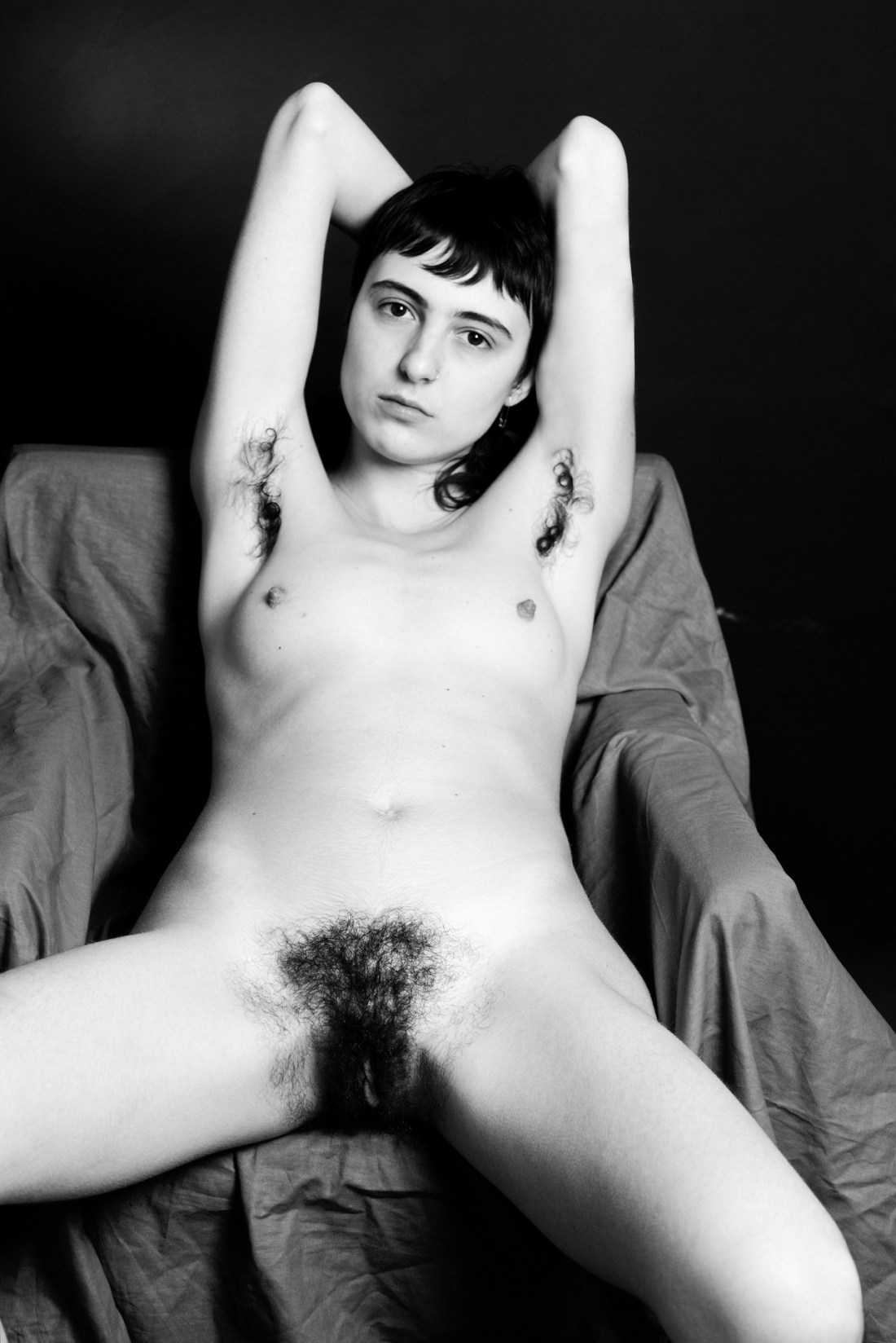
Giovanni Pasini – Chair feat. Eva Collé (2018)
At first blush, this is alluring. Hhigh contrast monochrome accentuates the skin, emphasizes the contrast between light and dark, skin and hair. And the angle of Colle’s thighs reiterate the negative space in the upper right of the frame–it exudes a sense of casualness.
After digging through Pasini’s work, however, I’ve come to a different conclusion: Pasini may or may not be a misogynist but his work utilizes visual grammar in a fashion that is profoundly sexist and super problematic.
It’s no secret: I don’t favor studio work. It’s not the studio itself I’m down on. It’s how the studio is customarily employed that irks me.
Studio work allows for greater technical control. You can get your lighting just right for the parameters of your project. Yet, there is also an directly proportional decrease in limitation. For example: if your project calls for a super model to be wearing a gown designed by a haute couture designer that features a five-figure price tag and standing on the ramparts of a Scottish castle, then–unless you’re David LaChappelle or Tim Walker–you shoot on location at an actual castle and do the best you can with the existing light.
Generally though the increase control with regard to lighting results in the limitation of any authentic sense of actual physical space. If we were talking in terms of the four W’s and H of classic new paper reportage, then studios represent a shift in emphasis away from questions of where, while allowing for greater room to elaborate on Who, Why, What and How.
Limitations are not in and of themselves inherently non-positive. In practice though, studio work has a decided tendency to diminish contextual information. (Don’t forget that questions of where also interact with questions of who, why, what and how.)
Pasini’s images are highly decontextualized–a nude model against an either dark or light background. (The image above is positive grounded in place in time by comparison.)
However, there’s also the way that his titling of the work further decontextualizes things. For example: the model’s name in the image above is not provided by Pasini–the model was added when the image was posted by the always noteworthy The Quiet Front.
As far as I can tell, Pasini doesn’t mention his models names at all. Odd when you’ve worked with popular models.
It’s almost easy to just think that he’s tact is to look at it as the-models-I-choose-to-work-with-are-established-enough-that-they-do-not-require-introduction. I can’t let it go that easily, unfortunately. Because there’s also the way in which Pasini’s work further decontextualizes the woman he photographs.
Take the image of Collé above. The title Pasini’ gives it is ‘Chair’. There’s also Chair, Chair (also Collé, uncredited again), Chair with Dr. Martens and back to just plain old Chair.
Or, if you think I’m cherry picking–consider Back, Back, Back, Back with secretions (really: ‘secretions’ is almost as unsexy as ‘moist’) and Back.
While we’re at it consider: Mature (and opulent) torso, Little girl lost and Panties down. (I’ll spell it out in the event that the mention isn’t enough to clarify why these are thoroughly problematic titles: you can argue that porn started or it porn merely reflects the programmatic of society at large which due to rich, white, cisgender and heterosexual men retain a white knuckled grip on the reigns of state, the beauty standard is young, white and cis-het-flexible female. Thus the title indicates that although the subject is mature (something I never would’ve inferred from only the picture) but also attractive because of a specific physical feature. Little girl lost applies the greatest male fiction ever invented–that of a sexually precocious young woman who has yet to reach the age of consent.
And Panties down is really endemic of everything up to this point: Pasini’s work focuses exclusively on presenting women as sexually available. (Let me preempt any of you #NotAllMen types: I am not saying that it’s inappropriate to make work that presents women as sexually available. Like seriously, have you spent any time on my blog?)
No: the issue is that at every step of the Pasini’s work makes decisions why diminish individual identity and agency in favor of characterizing them as sexually available and plugging them into a rote litany of titillatingly heteronormative tableux. The work is objectifying and sexist.
I have no idea if these facets are representative of the author or not. (I have my own opinion but I’ve purposely structured this so as to not cast uninformed aspersion.
I do find it galling that Pasini refers to his work as ‘art’. One the one hand I do not agree. However, it is precisely that designations that prompted me to articulate all the above. If you refer to your work as art, you are in essence inviting this (and even more in-depth analysis and criticism).
Lastly, while I generally go out of my way to make posts that are this openly critical of work, I made an exception here because I do think it’s interesting that the sense of casualness I mentioned at the start of this is actually something I’ve come to see as confrontational. There’s no way to know just from the photos–but I do feel as if Collé is at least consciously aware of the creepy factor of some of the work and is trying to present herself in a manner that runs counter to it.
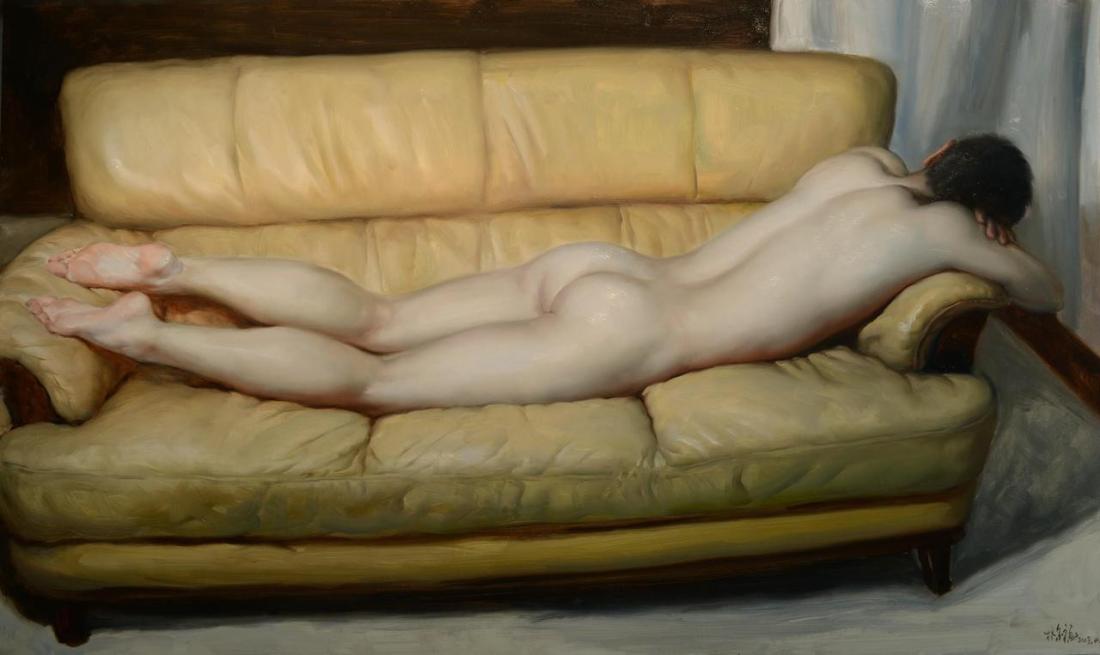
Lin Jinfu – Night (2014)
From an art historical perspective, there is a desperate need for someone who has a working knowledge of emerging work in China and southeast Asia.
Lin’s work is excellent but there is precious little written about him in English, e.g. I spent 30 minutes digging through Google results and was only able to discover that roughly a third of the English posts on his work believe that he’s Japanese or ‘Oriental’ :::shudders:::
He’s actually Chinese and lives/works in Beijing.
Other preposterous assertions made by idiots about his work: due to the influence of Baroque and Neoclassicism on his work along with–apparently the difficulty Westerners have in pronouncing his name– he’s referred to as Caravaggio. (This makes zero sense as he actually goes by the anglicized Jeff Lin; also: I know there’s a tendency to assume repressive regimes keep their people from engaging with more modern art–but I would bet a private cam session that he’s thoroughly familiar with the work of Lucian Freud–the more photographic rendering of light is an absolute dead ringer between the two.)
Lastly, folks make preposterous assumptions about Lin’s engagement with the male nude and gay eroticism–and how unconventional that is in China. Okay, got it–perhaps in painting that’s true but what about Ren Hang? (I know there are at least two others I’ve posted but since I can’t use Google to search my archive anymore… there’s no way I’ll ever find what I’m thinking of…)
But really, Lin’s paintings are excellent. I wish I had a single site to refer you to but you’ll just have to apply a little bit of elbow grease. (The effort is worth it, I promise.)

 Acetylene Eyes