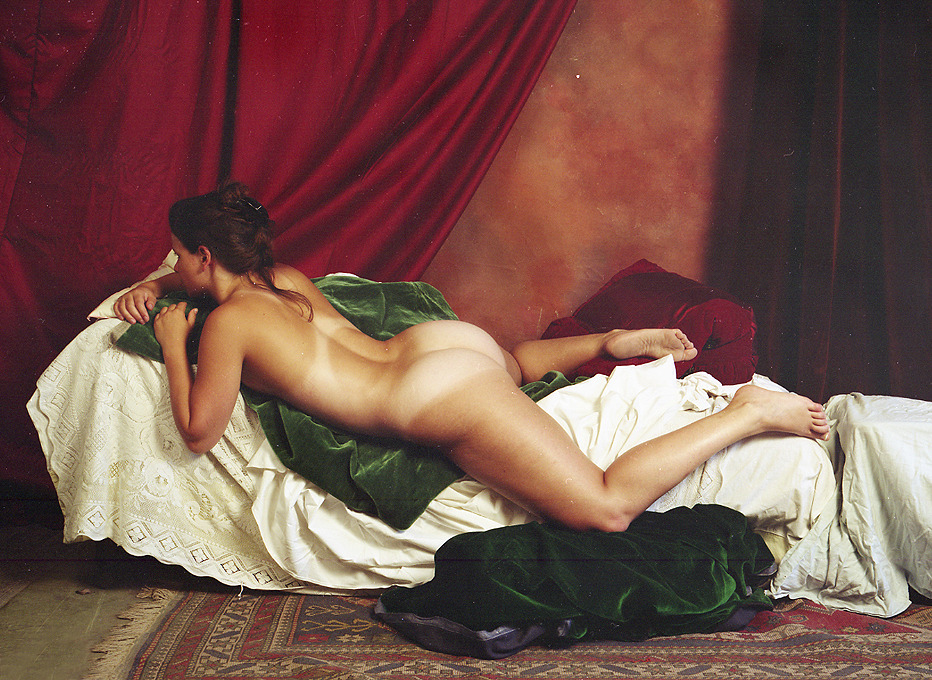
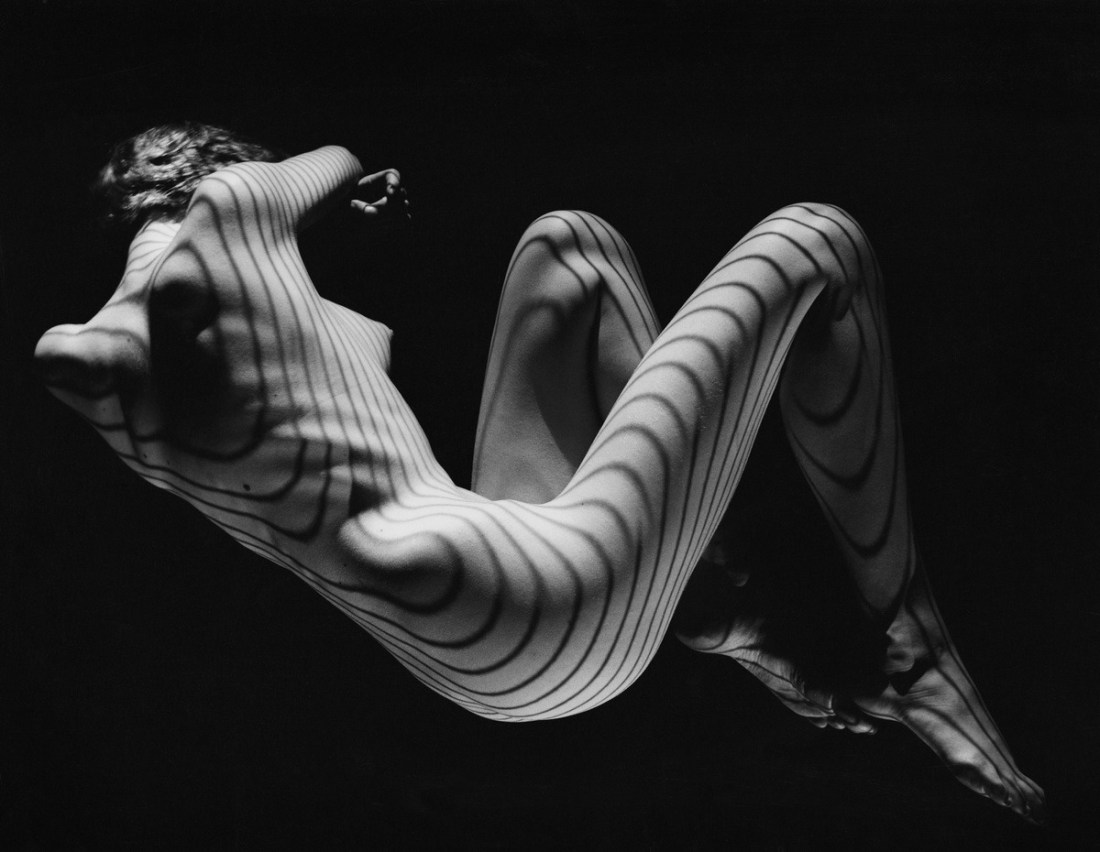
Herb Ritts – [↖] Female Nude with Black Sand, Hawaii (1989); [↗] Female Nude with Black Sand, Hawaii (1989); [↓] Untitled (1989)

If you’re anything like me you’ll ask yourself: Herb who? You already know him–I promise.

This photo of David Bowie? This photo of Michael Jackson? This one of Britney Spears? All three were made by Herb Ritts.

There’s a good bit of common ground between Ritts and Avedon, actually. Both have the same tendency of thwarting expectations. Working in a studio was less something either did as a means of de-emphasizing location as it was an effort to give personality free range to manifest. Also, both make photos that focus on the subject in the same way–Ritts merely trained his lens on larger than life uber celebrities, house name entertainers and supermodels. (Leveraging recognizability and depicting celebrity personality as its own ultra exclusive destination which you could only access as he allowed was a brilliant maneuver.)

Perusing his catalog is a strange undertaking–where you see the person both as they wanted to be seen at the time the photo was made. At the same time, ex post facto, it’s possible to look at the work and guess what the various PR teams had in mind but there’s also a way in which the work also presents a subtle wink to some of the less pristine aspects of many of his subjects lives–about which we have begun to learn.

I don’t care for Picasso at all but it’s sort of like the critic who took issue with his painting of Gertrude Stein by saying it doesn’t look anything like her and Pablo responding shortly: but it will.

Also, there’s no way to fault Ritts for borrowing so readily from others–as the adage goes it’s not theft if you take something and improve upon it.  It’s difficult to say if stealing Avedon’s formula and applying it to the super rich and famous was an act of genius or not–it just works too well to judge that after the fact.

However, in the case of these photos, it’s easier to see that here he was riffing on Iwase Yoshiyuki. (Although again, he did at least pick something of Yoshiyuki’s that was truly and exquisitely exceptional…)

Francesca WoodmanDepth of field, Providence, Rhode Island (1975-8)

Woodman first appeared on my radar in either late 2005 or early 2006.

Her Wikipedia entry was much sparser then–not that it’s anything to write home about now; however, it did have one fantastic feature: there was a ridiculously chronological index of approximately 120 of her photos. (At that point it was the most comprehensive collection of her work–essentially, every photo uploaded to the Internet was centrally linked.)

Dribs and drabs of additional work would emerge as new exhibitions went up. And the spate of new and/or updated monographs in the late aughts introduced even more work.

That shifted noticeable with her 2012 Guggenheim retrospective in NYC–which if memory serves consisted of 20% new/rare photographs.

The Guggenhein show was staged more or less chronologically. Beginning with the early work–culminating in her Swan Song series; before interjecting the work she made while studying in Italy for a year (which was housed in a passage and adjacent niche), followed by the ‘failed’ fashion photographic efforts and then looping back into the first room where there was work from her time at the MacDowell artist colony.

This layout was simplistic but with the simplification driven by cleverness not torpor–allowing her work to demonstrate itself as always of exceptional quality but arranged in such a way that her incandescent genius becomes all that much more apparently as she slowly begins to fire on all cylinders. (If nothing else a strict chronological view of the work shares with the viewer a sense of hard work finally paying off when you consider a photo like the one of her as her alter ego Sloan side-by-side with other work from the same period. She was getting better, saw she was getting better and derived confidence from the awareness.)

The narrative of her trajectory has always been that she peaked during her year abroad and never quite managed to reach such Olympian heights ever again. The notion that her fashion experiments were a failure dovetails nicely with this theory.

Still, it’s always bothered me that one of my favorite photos she ever made emerges from the same period as the fashion ‘failures’–namely, this self-portrait with a wasp on her neck.

Over the last 18 months, I’ve noticed a deluge of work I’ve previously never seen emerging. (The above is an example of such.) There’s no enough of it that I am beginning to question the endurance of the narrative that she was very good but also immature, undisciplined and very lucky.

There’s a couple of things you have to keep in mind here: first, the photos that until recently have been understood as her overarching body of work were ones she exhibited during her life. The subsequent work that’s emerged has been released into the world by her parents. (This has led to issues where there exist an original print or two she made herself vs work that he father has reprinted–the latter tend to present a more dynamic range of tones, whereas hers skew much darker, as a rule.)

The notion that the fashion work was a complete failure is something I think the newly released work calls sharply into question. I won’t argue that a lot of it is bad. There’s enough of it that is at least stubbornly iconoclastic that suggests something further at work here.

Increasingly, I think that what gets interpreted as failure was merely an effort to play the can I be an artist in mid-to-late capitalism and not starve. My impression is that Woodman was attempting to fit her style and preoccupations to what she understood as the framework high fashion sought. When, really, the other way round was the way she should’ve approached it. (A more concrete way of putting it might be to suggest that whereas her early work were about self-expression, the later work is an effort to invert the ploy of inventing an alter ego like Sloan (to allow herself to explore–representation at some degree of remove) and instead wanted to filter her work in such a way that she would be perceived as belonging on the fashion scene. It didn’t work because too much of who she was involved independence and a commitment to non-conformity.

As bad as some of the fashion stuff, it is not all bad and she continued to make exceptional work–or that’s what the emerging work suggests to me. It’s almost as if the darker her vision became the more increasingly universal the reaction to and response to her work.

Stéphane LallemandOdalisque brune (2009)

The Ballad of the Lonely Masturbator
By Anne Sexton

The end of the affair is always death.
She’s my workshop. Slippery eye,
out of the tribe of myself my breath
finds you gone. I horrify
those who stand by. I am fed.
At night, alone, I marry the bed.

Finger to finger, now she’s mine.
She’s not too far. She’s my encounter.
I beat her like a bell. I recline
in the bower where you used to mount her.
You borrowed me on the flowered spread.
At night, alone, I marry the bed.

Take for instance this night, my love,
that every single couple puts together
with a joint overturning, beneath, above,
the abundant two on sponge and feather,
kneeling and pushing, head to head.
At night alone, I marry the bed.

I break out of my body this way,
an annoying miracle. Could I
put the dream market on display?
I am spread out. I crucify.
My little plum is what you said.
At night, alone, I marry the bed.

Then my black-eyed rival came.
The lady of water, rising on the beach,
a piano at her fingertips, shame
on her lips and a flute’s speech.
And I was the knock-kneed broom instead.
At night alone I marry the bed.

She took you the way a woman takes
a bargain dress off the rack
and I broke the way a stone breaks.
I give back your books and fishing tack.
Today’s paper says that you are wed.
At night, alone, I marry the bed.

The boys and girls are one tonight.
They unbutton blouses. They unzip flies.
They take off shoes. They turn off the light.
The glimmering creatures are full of lies.
They are eating each other. They are overfed.
At night, alone, I marry the bed.

Nawa-ArtErika Yukio (1961)

It’s difficult to untangle all the various threads with this–largely because I read zero Japanese; also: it’s weird to me that while translations for Romance languages via Google Translate have improved marked over the last three years, it’s still only the babiest step above word salad for ideogrammatic languages. (I know ideogram is not technically the right term but I can’t think of the right term at the moment–I’m essentially pointing to the way romance languages group characters that make particular sounds in particular situations into words which name things, convey concepts, etc. vs. languages consisting of characters which a vaguely pictorial and convey concepts, i.e. Mandarin and Japanese; although it seems to me that kanji is maybe intended to be closer to the an alphabet? Don’t quote me on any of this–linguistics is one field where I will readily admit a complete absence of any sort of even baseline understanding.)

Anyway, as best as I can tell: Nawa Art is a site where someone–who seems not to want to be viewed as a collector–has archived pornographic BDSM materials that are apparently from brochures disseminated via a secret club in Japan circa 196X.

None of it is even half as edgy as what your average kink-focused Tumblr curator includes on the reg. But to my naive eye–it’s fascinating to consider the effect such material likely had in shaping the overarching vision of someone like Araki.

I really appreciate the presentation of this–there’s a physicality to it: the four holes at the right margin (seemingly from two staples), the way that it both simultaneously seems xeroxed + the way that the strips of black and white (in concert with the thin margin between the images) makes the photos appear three dimensionally stacked; additionally, I really dig the simplicity of the layout–the top half mirrors the bottom half with only a horizontal mirroring (the black and white strips makes it seem far more complicated than that but it’s actually a solid tact for making something simple look more complicated than it really is–good design usually flips that script; however, it can be used to strong effect if it’s used sparingly and in a conceptually resonate fashion).

Two other observations concerning layout: not how the upper left and bottom right image are connected by the inclusion of the dark ribbon looped around her neck, whereas the top right and bottom left are both square (vs. rectangular) and were almost certainly taken in sequence; there’s also the way what appears to be the drain of a bathtub behind Erika Yukio’s head in the top right, top left and lower right frame managed to break up what would’ve been a cloying repetition of fours (staple perforations + photos).

The other thing about this that appeals to me is that as put off as I am by mainstream porn of any kind–I am especially put off by depictions of BDSM in pornography. There is–in my experience–this fixation on both extremity and humiliation that just doesn’t appeal to me personally. (I’m not about to kink shame anyone though–you do you and know that as long as you have the utmost respect for consent; then I support your kinks).

I think it’s because I grew up in such a repressive community that I really don’t enjoy being made to feel dirty about physicality–I struggle with that enough already. But it’s more complicated than that, honestly; as much as I’m not at all into humiliation, testing boundaries is something that I crave.

I think that’s what I appreciate about this–there’s a sense of discomfit paired inextricably with a curiosity. That appeals to me greatly.

Georges Thiry – Title unknown (195X)

Thiry was Belgian and worked with a 6×6 Rolleiflex.

He demurred that his photography was little more than a lifelong hobby–yet there aren’t many hobbyist photographers who managed to make portraits of the likes of René Magritte.

The image above was part of a long running series where Thiry took photos of sex workers. He was not in the least bit shy about availing himself of their services–yet his photos focused less on their status as sex workers and instead presented them more in their own element–preferring to depict the women in their various domiciles.

Carl Larsson – [↑] The Model on the Table (1906); [+] Anna-Stina {Mrs. Alkman, née Rydell} (1905); [↓] Model Writing Postcards (1906)

One of the few things I know about writing is this: Spend it all, shoot
it, play it, lose it, all, right away, every time. Don’t hoard what
seems good for a later place in the book, or for another book; give it,
give it all, give it now. The very impulse to save something good for a
better place later is the signal to spend it now. Something more will
arise for later, something better. These things fill from behind, from
beneath, like well water. Similarly, the impulse to keep to yourself
what you have learned is not only shameful; it is destructive. Anything
you do not give freely and abundantly becomes lost to you. You open your
safe and find ashes.
Annie Dillard