Julie Van Der VaartUntitled 3 from Beyond Time series (2017)

I am v. into the way there’s a sense with what’s visible of these four frames that the motion the viewer is offered glimpses of is not unlike a flipbook animation. (My impression is that the subject is moving from laying on their side to kneeling with their back arched–not an especially comfortable movement to enact…)

The more I look at it though, it’s as if the subject is not only moving, the camera is moving in relationship to the subject while still preserving a sense of continuous motion. It’s really effing cool effect.

Natalia Nobile – [↑] Untitled (2017); [↖] Untitled (2017); [↗] Untitled (2018); [↗] Untitled (2016); [+] Untitled (2017); [→] Untitled (2017); [↙] Untitled (2017); [↘] Untitled (2016); [↓] Untitled (2017)

I don’t necessarily like all Nobile’s work. I’ve been wanting to share some of her work for a while, I just haven’t had the time to really sift through her work until this afternoon.

I sat off drafting this post with the notion of talking about parallels between her work and other similar image makers. However, I realized at a certain point that at face value her images are compelling because of their immediacy.

What we are being shown is clear enough–it’s the why we are being shown it that remains ambiguous. But why we’re being shown what we’re seeing is less of a preoccupation than questions like are those Frida Kahlo panties? Cyrano or Elephant? Is the woman straddling the bedpost posing; additionally, is this pose supposed to suggest something vaguely masturbatory? Are those cannabis plants?

In the picture of the woman in the pink body suit on the bicycle looking back over her shoulder while feigning the fastening of her helmet struck me as having exquisite color rendition. Same with the are those pot plants one.

But organizing them together in this way showed the extent to which Nobile is using color with subtlety and style. It also shows that although you don’t necessarily realize it that color not only ties her images together within themselves, it actually ties her work together just as well as a signature.

Yulia NefedovaUntitled (201X)

Nefedova’s style is akin to what you’d get if you locked the guy who made Where’s Waldo in a room with nothing except Toilet Paper Magazine back issues, American Apparel catalogs and reams of blank paper.

In other words: casually irreverent, audaciously transgressive and charmingly warped.

Yet, what makes the work singular is its curiosity. I don’t think I’ve ever really seen people doing most of the things Nefedova documents hers as doing. And there’s this wonderful ambiguity about whether she’s asking herself I wonder what this would look like vs. I know what this looks like because I’m just drawing from what I see in my own life–an ambiguity frequently complicated by her tendency to draft her own likeness into her visual experiments. It’s not always easy to determine whether these self-referential flashes are tongue-in-cheek jokes or confessions.

Source unknown – Title unknown (201X)

I’m not entirely sure if this is an actual instant photograph or if it’s one of those Photoshop jobs where someone takes a Polaroid mask and overlays it against another image.

The reason I’m not entirely sure is because this acts like a Polaroid–the compressed tonal range (essentially slight overexposure on the model’s stomach, the rest of the skin tone is more mid-tone and then everything falls off to black except for the back of the couch in the upper left third of the frame and the edge of the couch on the lower right), slight chromatic aberrations at the left and right edges as well as the almost selenium-ish tone.

I’m generally not fond of work that decapitates and amputates limbs but with this there is a sense that less was intended as more. (I’m not sure it completely works from the standpoint of eschewing the problematics of depicting women nude as a coding for presenting them as sexually available but the composition is self-consciously voyeuristic enough that I suspect this was made in such a fashion to at least implicitly complicate notions of sexual availability as necessarily passive.

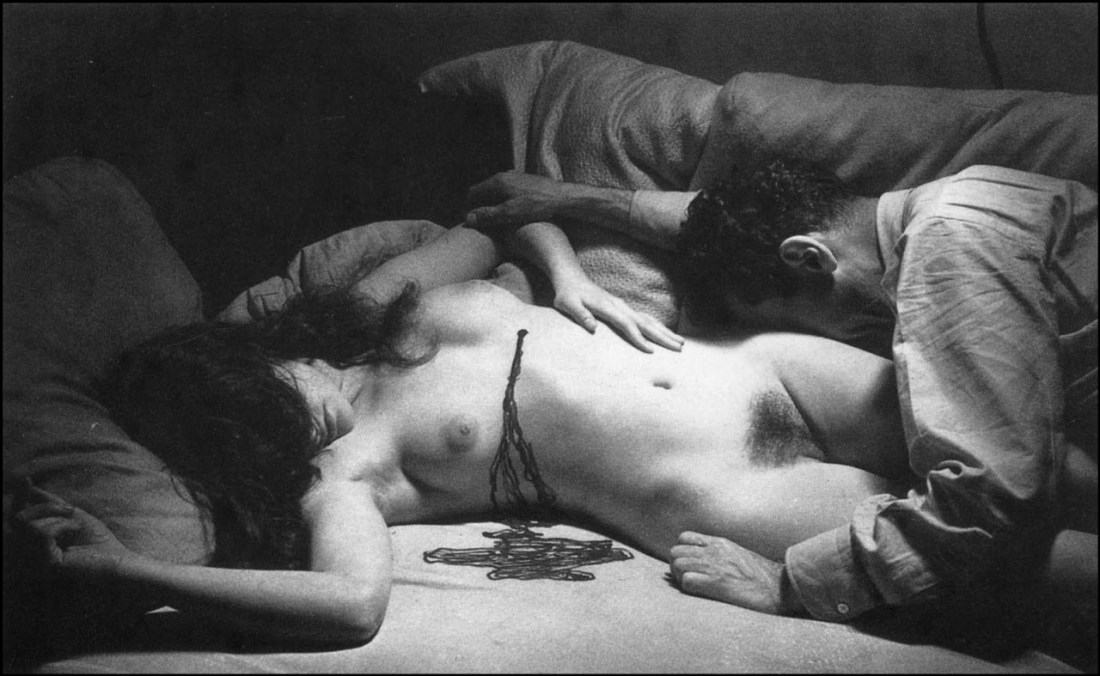
Man RaySelf Portrait with Dead Nude (1930)

Excluding the eleven years he lived in Hollywood to wait out the Second World War, Man Ray was an American artist living in Paris.

He moved in the same circles as Picasso and the two were well acquainted. I mention this–less to try to suggest any stylistic overlap in their oeuvres and more to distinguish between the degrees of overt sexism in their respective work.

By now, you’ve probably already seen Hannah Gadsby’s Netflix comedy special Nanette. If not, you should put a pin in this and go watch it now. (It’s exceptional on virtually every level imaginable but it’s act to is a brilliant riff on art history–specifically Picasso.)

Gadsby notes that Picasso offered this perspective on how he felt about women after breaking up with him:

Each time I leave a woman, I should burn her. Destroy the woman, you destroy the past she represents.

“Cool guy,” she follows up.

This isn’t even close to the worst shit Picasso pulled. But in so many ways, Picasso was a colossal, inexcusable and monstrous misogynist. Yet, much of his latent sexism is just as visible in other works of the time. This, for example: not only continues the art historical tradition of presenting female bodies in only specifically proscribed poses.

For example: Duchamp’s Nude Descending a Staircase, no. 2 was rejected from the 1912 Salon de Indépendants with the following note:

A nude never descends the stairs–a nude reclines.

(This anecdote was brought to my attention by PBS Digital Studios’ The Art Assignment’s The Case for Nuditywhich is a bit uneven but by and large worth keeping up with.)

In Man Ray’s photo above, the nude is once again reclining. She’s portrayed as dead–a chest wound ostensibly bleeding out onto the bed.

The photo is indicated as a self-portrait (and in that identification the identity of the artist is reaffirmed while the woman is little more than a placeholder) and it’s uncertain whether Man Ray found her already dead and then felt the need to embrace her one last time (a necrophiliac connotation) or perhaps he killed her and is now grieving her demise (a vampiric connotation).

Neither of these are particularly encouraging interpretations with regards to inherent sexism. However, whereas Picasso uses stylistics to bend, break and otherwise deface women in his work, there’s an honesty about what Man Ray is doing here that–while it does not absolve it of fault, it at least self-implicates the relationship between the author and the problematics.

For example: I read this now as a sort of inverted pieta. This in turn invites a reading of the manic pixie dream girl narrative–that, unfortunately, still exists. Also, you don’t have to stretch it very far to push this into feminist criticism territory–the way that men seek in female bodies, some semblance of salvation. (I’d argue that this lines up especially well with the history of pieta as religious symbol and the way modern pietas interrogate the problematics of Xtian history and the way the form is now moving towards being a trend welcoming of appropriation by sensualist humanists.
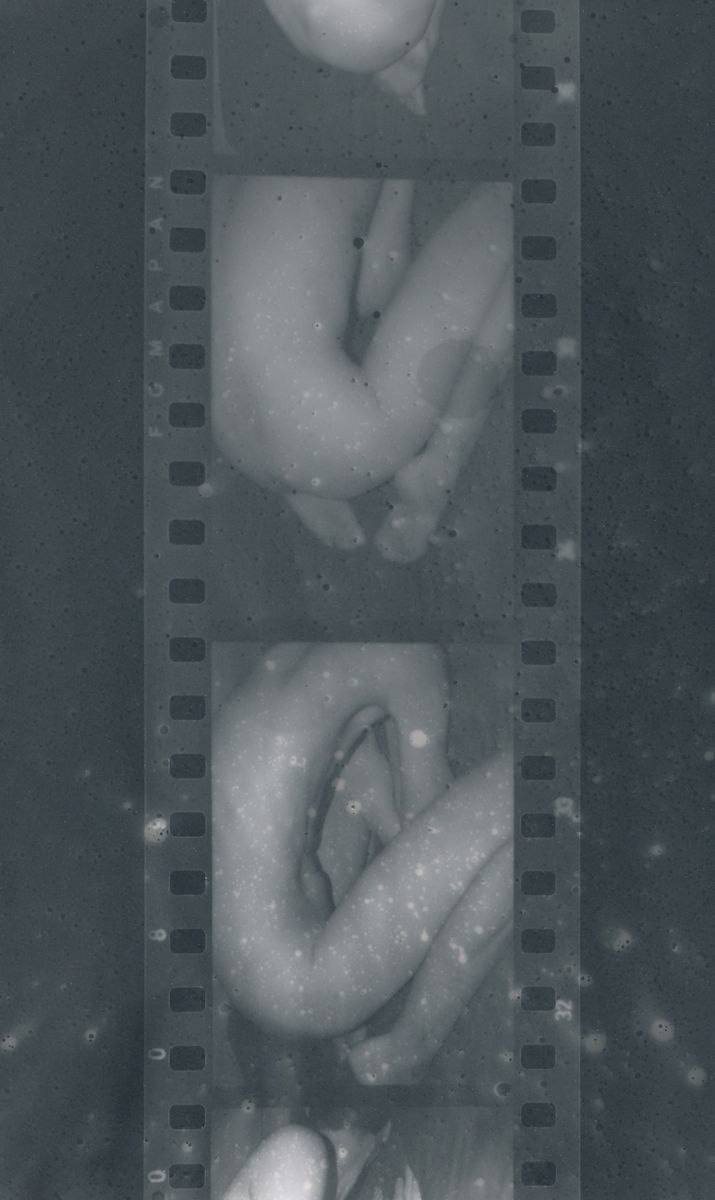
Masao Yamamoto1270, from Nakazora (2001)

I’ve been on Tumblr pretty much every day since mid-to-late 2010. I’ve borne witness to a half dozen or so major changes that have infuriated users and caused folks to scream bloody murder about how they’re killing the site.

The last six months have been especially harrowing. Except… I’m not seeing a lot of screaming this time around. It seems like everyone who has been threatening to leave-has and that leaves two groups: folks like me who are too stubborn to quit and noobs who aren’t super hip to the way the platform words (or, more likely: don’t care).

It’s becoming increasingly challenging to keep this blog up and running, honestly. I mean: previously, I had more content I wanted to post than I had time to prepare posts. Now? Now, there’s still things I want to post–but it’s fewer and further between. I’m less able to pick what photo or image I’m most excited about and instead I’m having to focus more on curation. (This is probably a good thing for my brain but there are times when I feel like folks–in general–are less engaged with the proceedings.

Take the photo above. I’ve been wracking my brain trying to figure out what to say about it. It’s not that I don’t like Yamamoto–I’ve posted another of his photos several years back.

I know most of his work centers on landscapes and nudes. And that he uses tea to tone his prints.

I had some notion that there’s something of William Blake in his work. But, that’s not an assertion I can necessarily support beyond just saying it feels that way to me.

I reread his Wikipedia page and noticed this statement: “[he] makes installation art with his small photographs to show how each print is part of a larger reality.”

This suggests an interplay between images within a given context being important to understanding his work. I googled “nakazora”; it returned the following from the publisher of this work:

Dictionary Definition of Nakazora: The space between sky and earth, the
place where birds, etc. fly. Empty air. An internal hollow. Vague.
Hollow. Around the center of the sky. Or, emptiness. A state when the
feet do not touch the ground. Inattentiveness. The inability to decide
between two things. Midway. The center of the sky (the zenith). A
Buddhist term. Nakazora is our second publication on the work of
Japanese artist Masao Yamamoto. But this is no book: the artist has
designed a scroll measuring over eighteen feet long, beautifully printed
in process color on uncoated Japanese stock. The timelessness of
Yamamoto’s imagery is beautifully echoed in scroll presentation. The
scroll was one of the earliest vehicles used for storing and presenting
visual information. Nakazora combines the aesthetic and tactile
attributes of this traditionally one-off format with the advantages of
modern printing technology. A striking marriage of traditional and
hi-tech materials and production techniques, Nakazora redefines the term
‘artists’ book.’

I can’t think of scrolls in an art context without flashing to Caroless Schneemann’s Interior Scroll. But it seems that my initial instinct with Blake isn’t far off the mark–since short of illuminated manuscripts, Blake was kind of the progenitor of ‘artist’s books’.

I suspect that the similarities run deeper than that but at present I am too brain drained from once again packing all of my worldly possessions in preparation to move ¼ of the way around the world…

Source unknown – Title unknown (201X)

I don’t like that this is vertical. (Any moving image–be it a .gif or video clip–should always be landscape oriented.)

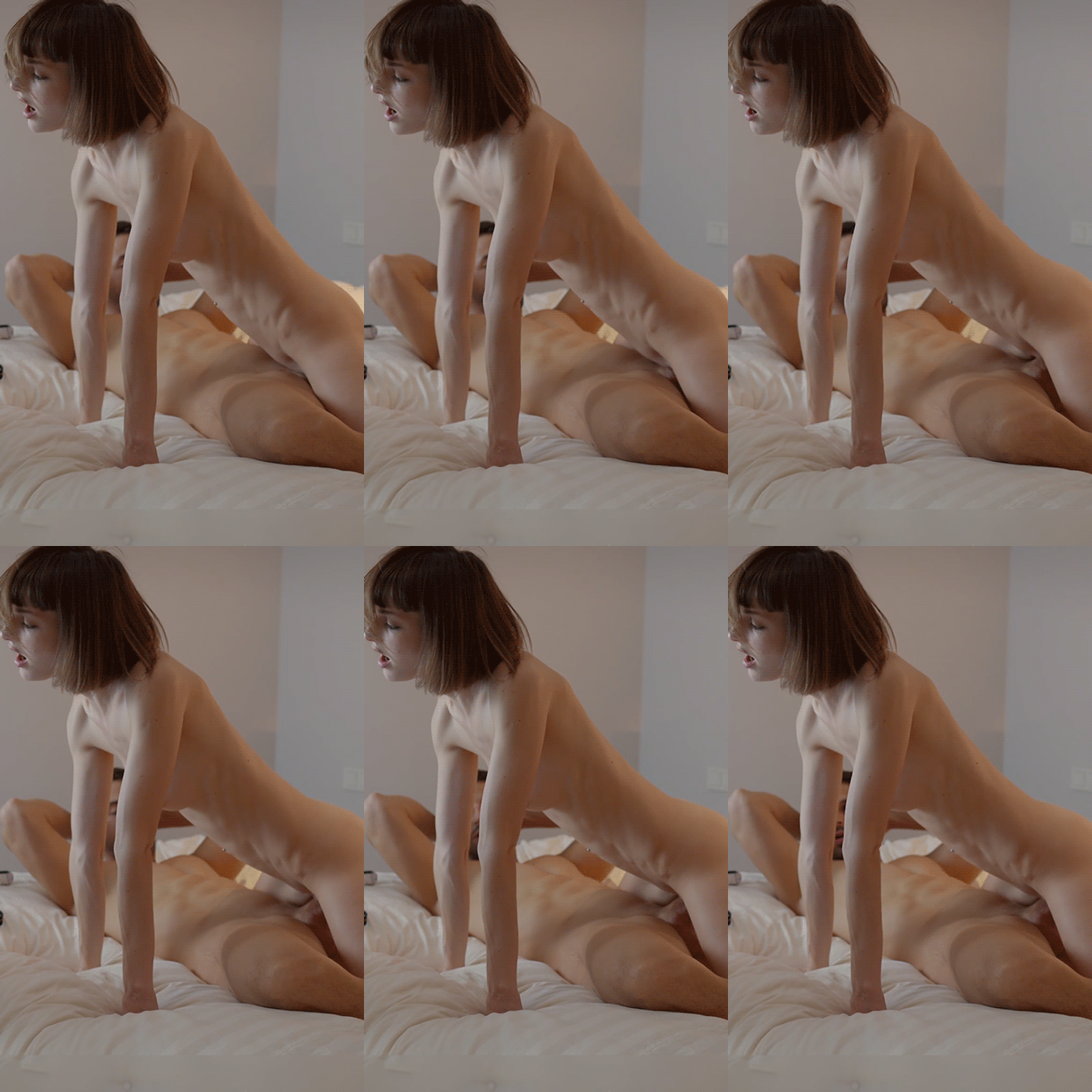
I do quite like quite everything else: she appears to be chasing her own pleasure’s flow-state so single mindedly, he seems just as intensely in his own body (it’s also interesting that his movement from left to right serves as an almost mechanical counterpoint to her thrust); the position (would you call that ‘side saddle amazon’?) is something I’ve never seen before–although it’s reminiscent of a position I have seen before which would involve the dude here pulling his right knee up and then her pulling her right thigh over his body so that she can hug his leg to her body and grind against his thigh while thrusting. (Granted that shift in position would erase another thing I like about this: that with the exception of the base of his cock and the edge of her left nipple, they are both clearly nude but the typical markers of nudity that social media discourages are otherwise absent.)

I don’t like the white duvet, white walls look but unlike most porn shoots that just pour watts and watts of dead white light onto a scene, this at least features more naturalistic lighting. The white light entering the frame from left to right and primarily illuminating her shoulders and arms vs the tungsten light coming from almost the same angle only traveling right to left suggests an overhead light in another room–perhaps from the open door or a hotel bathroom or something of the sort.