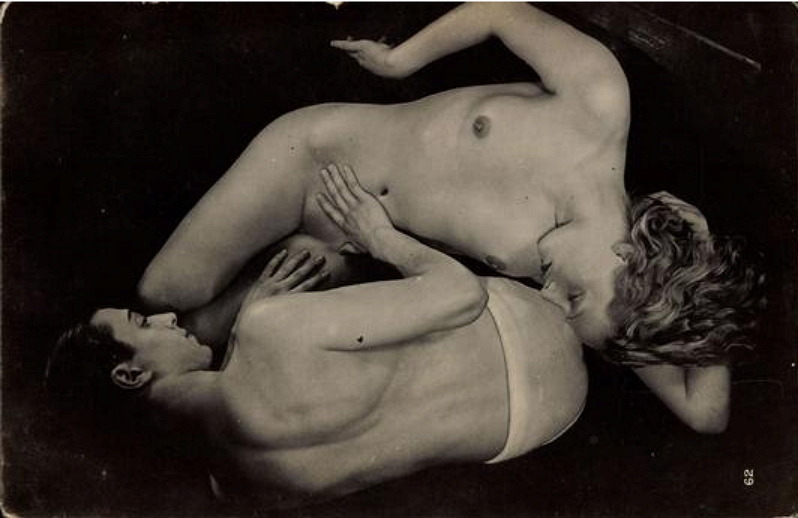
Source unknown – Title unknown (192X)

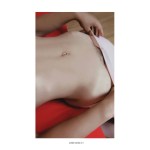
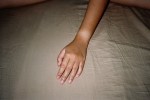
I am posting this because I love the way the two bodies relate to one another against the black negative space. (Keeping with the theme of twos–you can see both subjects hands.)

One figure is curled, the other open… seemingly presented like either a cherub or some sort of water nymph. (Note: how the positions of all four hands work together similar to the two bodies against the black negative space. The cherubic nymph hands imply a triangle with any one of the other hands–but more so with what the other hands frame.)

If you glance at the notes for this you’ll note two things: that it was probably made by Jacques Biederer–a Czech photographer who moved to Paris and became increasingly interested in nudes, erotica and hardcore BDSM/fetish pornography. During Germany’s occupation of France, he was sent to Auschwitz where he died.

Interestingly, the notes also suggest that the curled figure is a man. And while my familiarity with Biederer is admittedly limited. I seem to recall that he had a thing for portraying women as dominant–that could suggest that the commenters are correct that the curled figure is male. However, didn’t Biederer also have a thing for depictions of sapphic desire? Perhaps the undergarments are masculine in cut or design but I’m not an expert on French fashion from the 1920s and to my reading the gender of the curled figure isn’t something that can be determined with any sort of definitive value given only this image–and that’s something that is intriguing to me.

[↖] Girls Out WestAllegra (2017); [↗] Liza MandelupUntitled from Give Yourself to the Sea (2013); [+] Julien ZarkaKim (2017); [↙] Source unknown – Title unknown (200X); [↘] Louis TreserrasTout Simplement (2011); [-] A Private ExposeIt’s Time to Begin (2018)

My work flow for this project is pretty straight forward. I spend about two hours every day cycling through my dash to the point where I quit the previous day–liking anything along the way that catches my eye.

From the resulting likes, I conduct a second pass and ask myself do I have anything to say about this photo/image/illustration/set/etc. Such items get shunted into my drafts. Drafts get moved to my queue so that I can decide the best order to present them in and I usually only compose an entry for something that’s already in queue.

Anyway, there’s a mass of images in my drafts right now that I know I want to engage with but I’m not sure how I want to approach them. (Unfortunately, this has resulted in a bloated drafts section that is a bit cumbersome to navigate.)

I realized this morning that what I want to say about these six images has been difficult to coalesce because individually they don’t trigger much for me except to say that these images all view feminine embodiment in a way that I wish was a way I could learn to see my own body–as something beautiful, a bit awkward sometimes but thorough well-suited for utilitarian use and fundamentally desirable.

Stéphane Fugier – [↖] Kashka from Studio series (20XX); [↗] Ludivine from Couleurs series (20XX); [<] Anne Laure from Studio series (20XX); [+] Sang Mee from Couleurs series (20XX); [>] Jean Marcel from Extérieur series (20XX); [←] Thierry from Couleurs series (20XX); [→] Sang Mee from Extérieur series (20XX); [↙] Delphine from Extérieur series (20XX); [↓] Jean Marcel 2 from Extérieur series (20XX); [↘] Hélène from Studio series (20XX)

I’ve been giving thought to the re-emergence of surrealism–particularly in photography/image making; I am less interested in distinguishing between ‘oneiric’ and ‘surrealist’–this may have been a utilitarian distinction at some point; however, it now seems to be a feature more of photographers/image makers vanity than anything which actually contributes to greater depth of understanding.

It’s possible that my familiarity with photo history a decade ago was of such limited scope that it might be realistic to think that I was just unfamiliar with examples of surrealist photography. While I’m sure there are scads of folks who have forgotten more about the history of photography than I’ve ever known, it seems that Joel-Peter Witkin and Jerry Uelsmann were the only game in town when I first test the waters of photography with an extended toe.

And surrealism is exactly the right distinction in both cases–since as Wikipedia astutely observes: surrealism was fixated upon creating illogical scenes borne out by photo-realistic depictions as well as a preoccupation with “creat[ing] strange creatures from everyday objects[.]”*

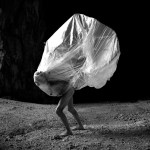
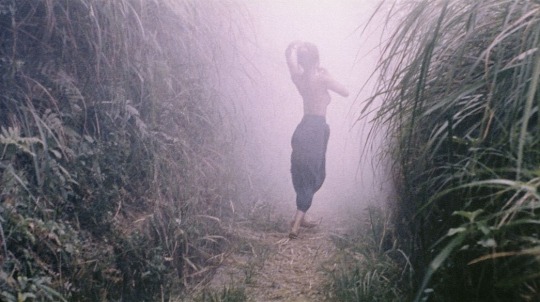
The above definition pretty much encapsulates Fugier’s work. Sticks, plastic bags, apples, fire and apples all employed in an exceedingly unconventional manner. I’ve not be able to find much on Fugier–even his website takes a bit of digging to uncover. However, apparently NY Arts magazine said of his work:

The viewer sees what [they] wants to see, the context contracting and
orienting the possibilities. There is no correct interpretation and
nothing that must been seen or understood. The photographic experience
(experiment) is first and foremost an encounter with a person.

This seems to be pushing back against the notion that the work can or should be deemed surrealist. I see it another way: as a shift from an object focus and a movement towards a consideration of subject. Another good question: what context informed ‘strange’ and ‘everyday’ as far as the original instance of surrealism. How have those contexts shifted in the intervening century. But I digress…

I opened this post by saying that I’ve been thinking a lot about the increasing preponderance of surrealism. It’s basically a crap shoot these days w/r/t whether or not photographers/image makers are surrealist or not–red or black, place your bets and spin wheel.

Why is that?

It strikes me that Dada was a response to the horror of WWI; and: surrealism emerged from the Dadaist milieu. There’s a tendency to see these movements as steps forward in advancement of culture. (I mean they were also EXTREMELY problematic and should be criticized, but again: I digress…)

Loosely, one might argue that dadaism and and surrealism were an effort at a binary response to The Great War–a resounding: no! Keep in mind that Dada emerged almost as if it were twinned with the emergence of fascism–a term few people understand as evidenced by folks who insisted Obama’s regime was both simultaneously fascist and socialist.

Fascism basically said liberalism and democracies are bad, social is bad and totalitarian dictatorships are good. (You’ll already see where I’m headed with this but one personal point first: one thing which never ceases to incense me is the way generally the same folks who critiqued Obama’s regime as simultaneously fascist and socialist are the same people who accuse those of disagreeing with them as being fascists. And slightly more intelligent–and therefore more offensive are the folks who use the term SJW or refer to things as PC. Yes, there are some overzealous progressives–I interact with a half dozen every week. It’s not fascist to denounce someone who is displaying bigotry as a bigot. Especially given that if you do not want to be termed a bigot, you know: stop being a bigot, perhaps? But the thing that folks who throw around the word SJW don’t like is that there perspective is not tolerated, lauded and accepted by others in direct proportion to their own estimation of their intelligence.

Which brings us back to fascism as a the opposite response to WWI from the Dadaist and subsquently surrealist–a sort of this is the way the world works, suck it up and learn to live with it.

Militarism was nearly universal during WWI–there were those horrified by it and those who in what I can only think to term and egregious nihilist sentiment believe that something of human potential was unearthed by wholesale carnage and living (or feeling more fully alive) when faced with death.

Dada and surrealism didn’t stop WWII any more than conceptual art or postmodernism prevented the global war on terror. But were’s still enacting the same cycles over and over. And I’m not sure if that’s a good thing or a bad thing. And while I think Fugier’s work could be more contemplatively realized, his shifting from considering of object to a presentation of humans as subject is at least conceptually satisfying.

P.S. My deepest and most sincere apologies for how things have been on autopilot with this project for the last couple of weeks. My final MFA application was a goddamn doozy–and while I was able to get it in just under the wire, the way those things forcibly constrict your vision is not something I care for and I’ve been struggling to get my head back into the game with this. Not sure I’m totally there yet–but my hope is to extend things out to having a queue again over the next two weeks. That should help. Thank you for your patience and for those of you who wrote in with encouragement–whether or not I responded: your words were greatly appreciated.

*Given an opportunity, I would quibble with the insistence on ‘creatures’ as it contributes undue preference on folks like Ernst; alternately, I do at least understand why the insistence is there–given that once you make it about using everyday objects in unusual ways, you’re practically demanding that someone insist that Dada and Surrealism are not separate movements.
Mr. ManExplicit Masturbation in Mainstream Movies (201X)

On the one hand: this is a v. poorly titled super clip–I am familiar with about a third of these scenes but none of them are from mainstream movies. (Ken Park and Shortbus are as close as you’re likely to get to mainstream and they were niche, art house hits at most.)

On the other hand: with mainstream releases continually pushing the envelope on what it’s possible to depict w/r/t sexual exchanges in movies, it is nice to see work which includes explicit masturbation as a valid mode of sexual expression.

That these scenes exist at all is a pleasant and radical corrective to the heteronormalized dude meets lady character–the latter who exists with little more depth than straight up eye candy or some sort of motivational force for the male protagonist’s redemption arc. (Further it challenges the prevailing notion that if there is full frontal nudity, it will favor boobs and bush but exclude penii.)

Yet this also–queerly, in my mind–presents masturbation as an act on a spectrum ranging from decadent self-pleasure to something that is complimentary to interpersonal sexual expression, i.e. the scenes where folks masturbate as a group, or for a consenting audience or as a way of ersatz participation in an orgy setting.

In other words: there is this notion that masturbation is what one does when sex is not available. But this presents masturbation as just another (infinitely varied) form of sexual expression–and that is something that resonates strongly for me.

Fan Ho – [↑] Title unknown (19XX); [↓] Sichen Concubine (19XX)

I had never heard of Ho until he passed away in June of 2016.

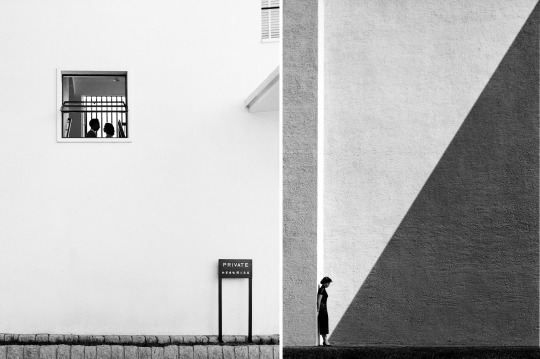
Above are his two most recognizable photos [left] Private (1960) and [right] Approaching Shadow (1954).

I could go on for the better part of the afternoon about all the little things which distinguish his work as simply effing extraordinary. However, for the sake of brevity–which they tell me is the soul of wit (perhaps they are implying I am witless)–I’m going to mention two things and before scooting along to my primary point of order.

First off, both of these photos have a similar quality to Vermeer’s best paintings. What I mean is when I look at a Vermeer canvas I have this tendency to forget that I’m standing in a crowded museum to an extent and I get this weird feeling that I’ve been strolling around Delft and while passing a window in the street, I catch a glimpse of this scene before me and I am frozen watching it; it always feels like at any moment the frozen people are going to resume whatever they were doing–and probably very soon after realize I’m staring out on the street staring at them through their window.

I feel that about these too. Like what are the man and the woman talking about in the stairwell. The location seems to suggest it’s a conversation they want privacy to conduct. (This is–of course–emphasized by the word private inscribed on the sign.) The wash of white on the exterior wall is almost perfectly identical in tonality through the entirety of the picture plain. (That is unbelievably difficult to accomplish in a traditional darkroom, y’all.) But the fact that the only shadow tones are at the base of the frame and through the window–there’s a sense that the conversation is a bit sordid. This is emphasized by the gender of the two conversants and is further tweaked by the way he stands over her and leans in toward her. The way the slats from the window in the background behind them physically separates him from her–so the sense of something potentially sinister is slightly diminished. We’re supposed to think that it’s probably a dicey situation but that she is safe.

In Approaching Shadow, there is a sense that the woman is experiencing a moment of quiet reverie and is unaware of how the world around her is drawing attention to her. (It’s worth mentioning that apparently Ho added the shadow via darkroom trickery–an easier feat than the white facade in Private but no less impressive in its execution.) When I’m looking at this one I figure if I just watch her long enough the shadow will move and she will eventually walk away. (Interestingly with this one I do wander how the shadow will move–will it cover her or creep slowing away from her; also, which way will she walk away–left, right or towards the viewer.)

The second thing I want to point out is that virtually all of Ho’s work features vertically oriented composition none of it is #skinnyframebullshit.

Interestingly, Ho was not only an acclaimed photographer. He was also a notable filmmaker. (As someone who came to photography via studying filmmaking, this is probably yet another reason why his work resonates so much with me.)

Bonus thing: he considered himself a street photographer but I suspect he meant that less in the sense of Henry Cartier-Bresson or Garry Winogrand and more in line with Atget.

Anyway, the above color photos are interesting because Ho worked almost exclusively in B&W. There is some color work available–most slide film from the look of it, that despite having chunky, ungainly grain, demonstrates a sensitivity for color and light that is truly rare to encounter.

Of the two photos, the bottom one is definitely Ho’s work. The top one–although originally posted by someone who is generally very careful when it comes to attributing work to the correct artists and also appearing to be shot on positive stock–could be Ho’s work but also it seems a bit too modern for me to comfortably state that it is his.

If it is, I would be incredibly interested in knowing if there’s more work that he did in this less street photographic style, more off-the-cuff manner.

Thy Tran – [↖] Untitled from Cacher series (2016); [↗] Untitled from Cacher series (2016) ; [↙] Untitled from Cacher series (2016); [↘] Untitled from Cacher series (2016)

When I saw Tran’s work, my first thought was: wow, there’s A LOT of overlap with Kim-Ngân Ao (aka yatender). Both filter elements from Lina Scheynius and Ren Hang through a stubbornly lo-fi analog aesthetic.

However, after sitting here suffering from that oft reported feeling in police procedurals where the unorthodox detective feels like she’s missing a piece of the puzzle that’s right there staring her in the face, I figured it out: Tran and Ao almost certainly know each other.

Consider: this self-portrait from Tran’s Flickr account and this photo made by yatender–the tattoos are the same.

Initially, my thought was that I favored yatender’s work but I’m not so sure that’s the case any longer. Yes, both are working in very similar veins but I think yatender is more audacious in the risks she takes as well as being decidedly on the take photos vs make photos end of the spectrum; Tran is more reserved and contemplative as well as being decidedly on the making end of the aforementioned spectrum.

Also, being that Tran’s Cacher series is focused on interrogating her identity as a lesbian and the visibility vs invisibility that comes part and parcel with that–her work resonates more with me as a fellow queer person.

Ian ReidAmanda Marie & Molly Ace (2017)

There are about 15 different things about this image that leave me with questions. Foremost: yes, clearly the focus is what’s going on in the foreground but what I notice and what keeps claiming my attention is the reflection of the script tattoo across the Ace’s upper back.

Backing up: I didn’t know who any of the folks in this image were upon first encountering it. I knew I’d seen Ace before in an image by @vk-photography and another by @crosxsover. I followed model mayhem through a series of defunct Instagram aliases to an actual Twitter account back to an Instagram (linked above) that is–at the time of this writing–active.

All that was a bit more work than I was expecting just to you know offer proper attribution. However, then things really took an unexpected turn: as far as I can tell there’s not a picture anywhere that has the entirety of the tattoo visible and in sharp focus. (And let me just cut off any objections ahead–given the above resolution, which is the highest res version available… the ubiquitous police procedural motif of enhancing a digital image infinitely just doesn’t work here.)

So then I pulled out a fine tooth comb and went through the pictures I could find. The bit on the right shoulder is easy enough–there are several snaps with it in sharp focus. It reads: ‘these been’

Also the script on the other shoulder is relatively clear in a couple of shots: ‘Quid a’

The middle of it is the problem. In one picture you can make out ‘insolitus’ and something that I’m pretty sure is ‘trinus’.  In another shot at another angle it’s Quid a p-something?

By using Google and Google translate to attempt to reverse engineer something I realized that there is a fish called the Mangarahara cichlid, or Ptychochromis insolitus. They are critically endangered and were thought to be on the verge of extinction when one at the Berlin Zoo was killed while attempting to mate. Later, a small school was discovered in the wild.

Looking back though it’s definitely ‘quid a p(o- or e-something) so no dice on an elaborate Douglas Adams joke.

Best I can tell it reads ‘Quid a po-(something illegible) insolitus trinus is these been’

It’s weird because ‘is these been’ is not Latin. The rest is more or less a way of saying ‘what a long strange trip its been’ but in a way that is not the standard way of translating the Grateful Dead title into Latin–so I suspect there’s some kind of pun I’m too dumb to understand.

Anyway, this was not the direction I wanted to go with this post. I’d originally intended to find out what the tattoo said and then use one of those online tools that mirrors text so that you can post text backwards and just post that.

But I guess now you’ve at least got a wacky story to go along with a really goddamn interesting picture.