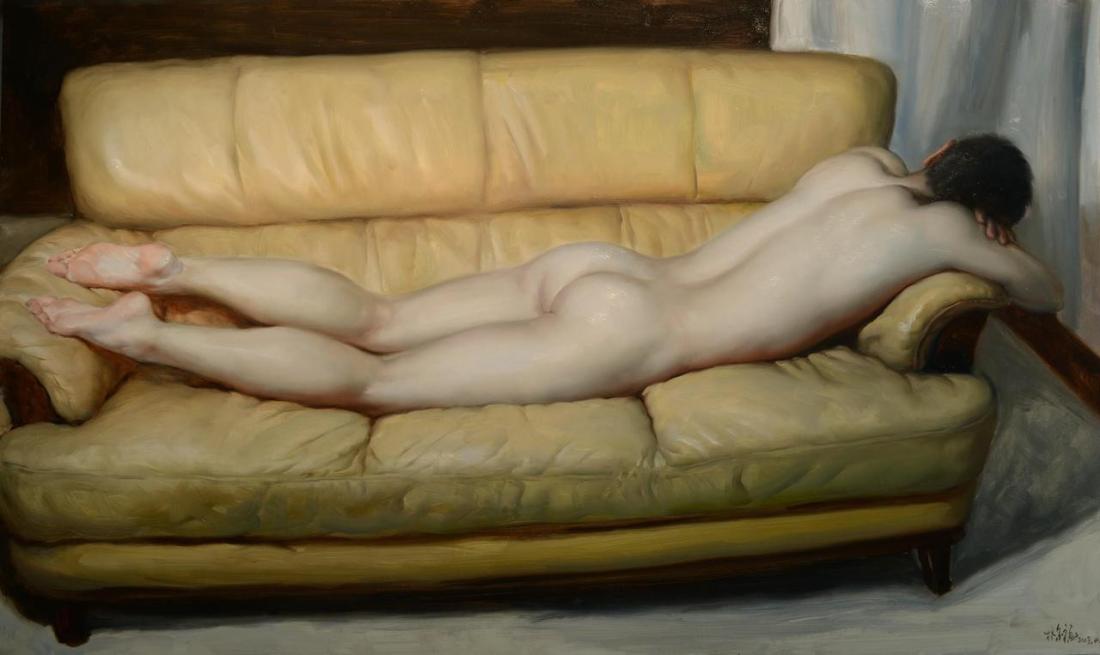
Lin Jinfu – Night (2014)

From an art historical perspective, there is a desperate need for someone who has a working knowledge of emerging work in China and southeast Asia.

Lin’s work is excellent but there is precious little written about him in English, e.g. I spent 30 minutes digging through Google results and was only able to discover that roughly a third of the English posts on his work believe that he’s Japanese or ‘Oriental’ :::shudders:::

He’s actually Chinese and lives/works in Beijing.

Other preposterous assertions made by idiots about his work: due to the influence of Baroque and Neoclassicism on his work along with–apparently the difficulty Westerners have in pronouncing his name– he’s referred to as Caravaggio. (This makes zero sense as he actually goes by the anglicized Jeff Lin; also: I know there’s a tendency to assume repressive regimes keep their people from engaging with more modern art–but I would bet a private cam session that he’s thoroughly familiar with the work of Lucian Freud–the more photographic rendering of light is an absolute dead ringer between the two.)

Lastly, folks make preposterous assumptions about Lin’s engagement with the male nude and gay eroticism–and how unconventional that is in China. Okay, got it–perhaps in painting that’s true but what about Ren Hang? (I know there are at least two others I’ve posted but since I can’t use Google to search my archive anymore… there’s no way I’ll ever find what I’m thinking of…)

But really, Lin’s paintings are excellent. I wish I had a single site to refer you to but you’ll just have to apply a little bit of elbow grease. (The effort is worth it, I promise.)

Ellsworth KellyCité (1951)

Lying in a Hammock at William Duffy’s Farm in Pine Island, Minnesota
By James Wright

Over my head, I see the bronze butterfly,  
Asleep on the black trunk,
Blowing like a leaf in green shadow.  
Down the ravine behind the empty house,  
The cowbells follow one another  
Into the distances of the afternoon.  
To my right,
In a field of sunlight between two pines,  
The droppings of last year’s horses  
Blaze up into golden stones.
I lean back, as the evening darkens and comes on.  
A chicken hawk floats over, looking for home.
I have wasted my life.

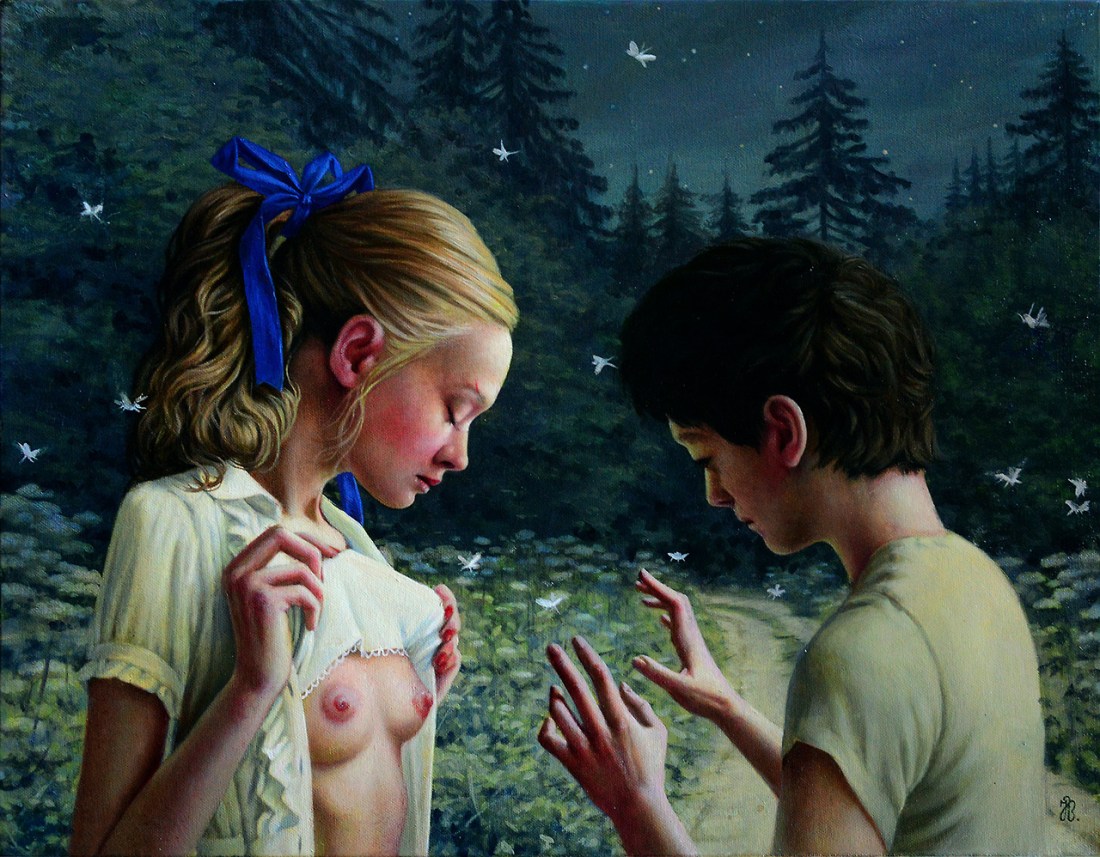
Jana Brikefirst love on the edge of a deep dark forest from Anatomy of Innoncence series (2015)

This is not Brike’s best painting but it resonates with me more intensely than the rest.

In overview, Brike’s is a painter. Her work features pubescent characters with oversized heads–presumably to draw even more attention to her grasp for conveying uncanny nuance of expression.

The duality of innocence and curiosity is her conceptual prima materia. Her scenes often play out in or near bodies of water–i.e. Two Wound Angels on the Beach and Goldilock’s Holiday.

She trades in a number of thinly veiled tropes–masturbation (Gardener and the Centre of the Universe), sensuality (goodbye, Eden, Snow White and when I kissed the teacher), lesbian experimentation (anatomy lesson) and tangentially the girl-girl solidarity that is at once not sisterly, platonic or romantic but is simultaneously each of those things all at once (holiday at grandma’s place).

It’s also worth noting that while she’s always preoccupied with the first flush of physical lust, the occasionally presents it in very concrete ways. There’s an honesty to the diptych little miss sweetheart/gardener’s son that is the most concrete and unassuming depictions of nascent paraphilia this side of the girl with chapped lips from Tarkovsky’s Mirror.

A lot of her work appeals to me for these reasons. But the image I’ve chosen to post here does two things better than I think all the rest of her work combined. Too often, female sexuality potential is painted as an incitement for male sexual arousal. It’s a very heteropatriarchial framework.

This portrays something that is different. A wanting that is both a giving and a taking. The blush on her face and the demure way she is leaning in slightly while waiting for it to happen conveys a desire for what is happening to transpire but also presenting it as a choice that is completely lost on the shy but eager boy. There’s a sense of knowing there will be a debt entered into the ledger that will come due in time.

I don’t think it’s just my gender stuff; I think the audience is supposed to empathize with the young woman here. (My gender stuff just makes it more resonant for me because I have a thing where I want my lovers to see me completely, unhidden, naked and vulnerable while they are still safe and clothed.

I don’t know if it’s that I want them to have a chance to know what they’re getting into so that they can walk away if they want. So much that I know any dalliances with me are things I’ve been taught over time to accept cost far more than anyone really deems worth it.

Lucian FreudAnd the Bridegroom (1993)

Can you believe a decade ago I detested Freud’s paintings? Like really super hated them–I think it was something about their stretched, obtusely rendered perspective.

I do not feel the same way these days and I’ve become borderline obsessed with his work. His use of color–minimal around the edges and growing more layered/nuanced the closer the eye draws to the subject(s).

It’s almost as if everything in the work is designed to draw attention to what can only be inferred–i.e. the psychological state of the subject(s).

It’s a brash maneuver to have everything function solely to the end of conveying something that can’t really be fully communicated through visual depiction.

That Freud manages it so frequently and with seemingly so little effort is so improbable, there’s only one way to accurately encompass it: unmitigated genius.

Here’s to being wrong–and the growth/evolution that arises from being willing to admit it.

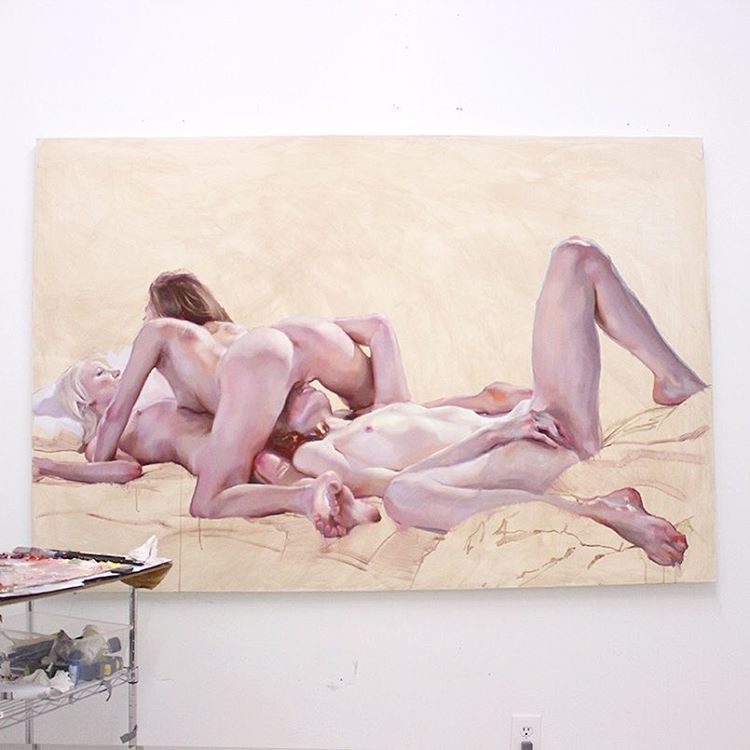
Ivan AlifanThe three graces (2016)

This does several things very well.

Although much of oil painting art historically centers on mythology (Greek and Roman or Xtian), most renowned oil painters were decidedly secular humanist in nature.

The tropes of mythology and religion were widely legible, there was built in interest (due to the universality of public familiarity) and generally if someone had money to hire an up and coming painter, depending upon their particular bent–mythology or religion could be counted on as a source of inspiration.

There was also certain visual coding associated with either. Whether it was the saints or a bible story or an incident from the Illiad, there were interesting technical considerations about staging, technique, etc.

But there was also the way many artist filtered the making of their work through their sexuality. I’m thinking here mainly of Leonardo and Michelangelo, but I’m pretty sure you can follow the trajectory of painting while illuminating this tendency.

What I find clever about this is the way that it–instead of making the myth/religion its pretext, it places its interest in the sexual front and center.

However, in doing this, it’s accomplishing a clever sleight of hand. Because if you know, The Graces were Aglaea (Beauty), Euthymia (Grace) & Thalia (Good Cheer/Festivity).

The first bit about this is to note that all three were Zeus’ daughters and therefore this isn’t just a lesbian menage a trois–it’s incestuous to boot–something you aren’t going to know unless you understand the mythological context.

It’s interesting to play attribute the correct name to the correct figure. My best guess is right-to-left: Aglaea (beauty is inherently untouchable), Euthymia is straddling Aglaea having her clitoris sucked on by Thalia–grace being a singular experience and good cheer requiring both being merry and making merry.

But what I think I like the most is that this is staged to titillate the voyeuristic viewer, but the angle is such as to thwart any sort of expectation that this scene was staged specifically for the so-called male gaze.