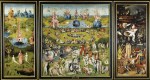
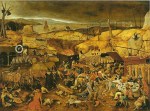
[↑] Hieronymus Bosch – The Garden of Earthly Delights (c. 1490-1510); [↓] Pieter Brueghel the Elder – The Triumph of Death (c. 1562)
Juxtaposition as commentary
[↑] Hieronymus Bosch – The Garden of Earthly Delights (c. 1490-1510); [↓] Pieter Brueghel the Elder – The Triumph of Death (c. 1562)
Juxtaposition as commentary


[←] Félix Edouard Valloton – Nude (1915); [→] Bettina Rheims – June 26, Paris from Chambre Close series (1991)
Juxtaposition as commentary
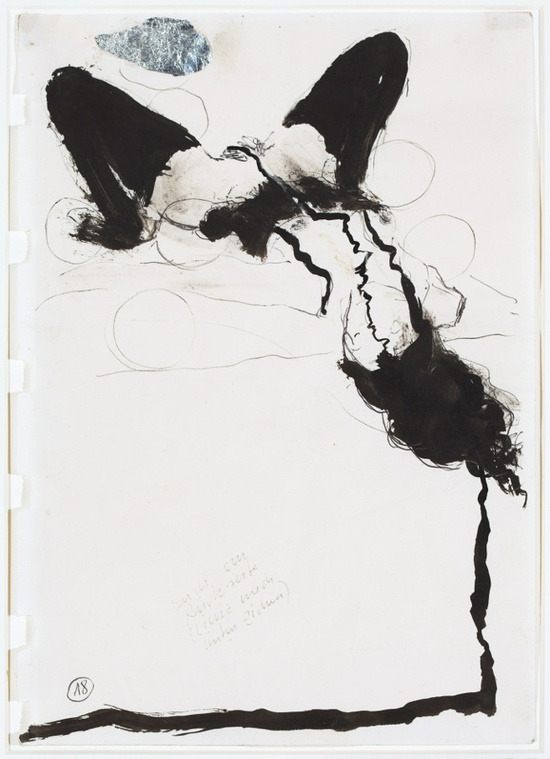
Günter Brus – Selbstbemalung (1964)
Viennese Actionism is something I’ve only come into contact with in the last several months.
Loosely: it’s less school or group and more a collective of people with similar ideas and therefore a similar approach to art making praxis and therefore also producing similar results.
In 1964, Otto Mühl summarized Actionism thusly:
…material action is painting that has spread beyond the picture
surface. The human body, a laid table or a room becomes the picture
surface. Time is added to the dimension of the body and space.
Consider Brus’ Selbstbemalung I (Kopfzumalung) from the same year:

Interestingly, in 1967 Mühl revised the statement from his manifesto to read:
… material action promises the direct pleasures of the table. Material
action satiates. Far more important than baking bread is the urge to
take dough-beating to the extreme.
With that in mind, direct your attention to the notorious Kunst und Revolution in 1968, where:
Gunter Brus, Muehl, Peter Weibel and Oswald Wiener staged a violent and
multiple taboo-breaking takeover of a student gathering at the
University of Vienna. The participants broke into a lecture hall before
whipping and mutilating themselves, urinating, covering themselves in
their own excrement, masturbating, and making themselves vomit – all
while singing the Austrian national anthem.
(For context: Chris Burden’s Shoot wasn’t executed until 1971–three years later.)
There’s ample criticism to be foisted against Actionism’s reactionary underpinnings–however, at the very least it took reaction to a place of visceral extremity. (Most of the stuff considered edgy and avant these days is blazing a very similar trail. Here’s a passable chronology of actions as well as the equivalent of a curated Greatest Hits collection.)
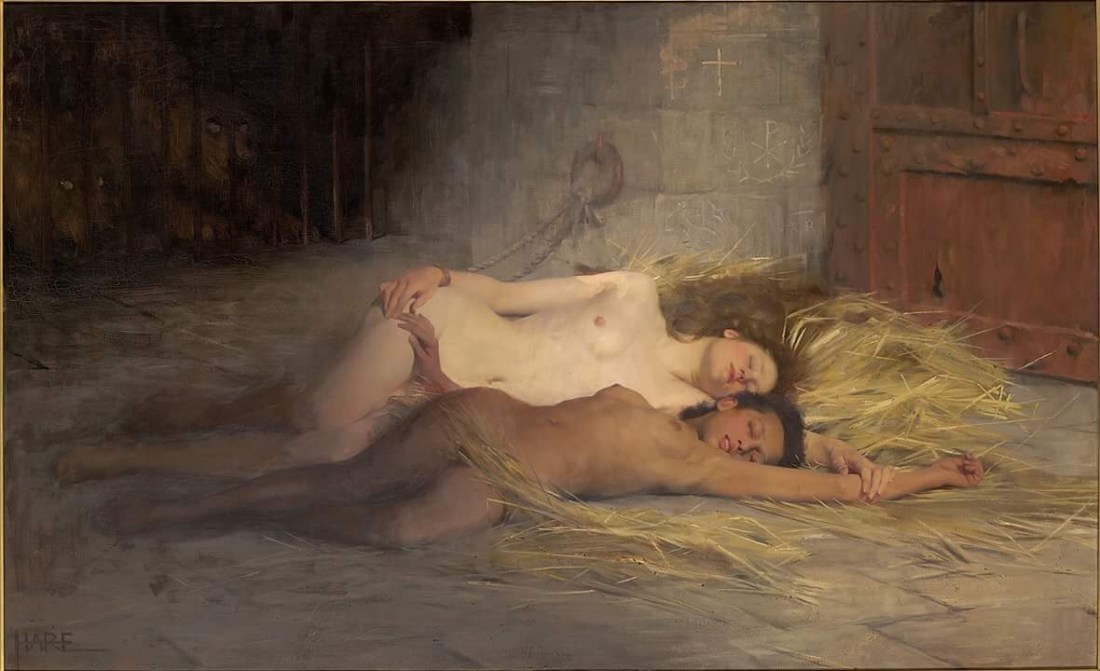
Saint George Hare – Victory of Faith (1889)
I missed the hungry lions lurking behind bars in the heavily shadowed upper left corner when I first saw this–as such my thought was Victory of Faith is a weird title for a painting that is ostensibly about lesbians, isn’t it?
As I’m looking into it now, I’m realizing my mistake and that it’s both a mistake and an insight into the work.
My instinct–that this is a work of erotica–is almost certainly true. Hare’s other work was rife with similar sorts of tableaux. However, the lions I missed initially are rather important.
This scene is ostensibly a depiction of a high society misstress and her maid who are discovered to have converted to Xtianity and sentenced to death by lions in the coliseum. They have been stripped and locked in the anteroom of the coliseum where the lions that are to eat them look on as they slumber.
As has been fairly well-established sex was a fixation within Victorian culture, even if no one really addressed it directly. There was apparently a tradition of coding erotica into work that seemed explicitly Xtian at first glance. The choice of martyrs as subjects would’ve been practically–many saints were tortured and otherwise humiliated/punished, thus them being clothed would been a vestige of protection. (See also: Saint Eulalia)
Additionally, apparently Xtian commentators saw the lack of clothing as proof of their freedom from sin.
Interestingly, I can’t help thinking of this image in terms of the trope of Daniel in the Lions’ Den–where Daniel is depicted as standing upright and prayerful through the night. It reminds me of the tired police procedural trope–which is factually dubiou–where the guilty are so relieved at having finally been found out that they sleep like babies; whereas the innocent are so consumed by their righteous fury at being falsely accused, that they cannot sleep.
Daniel was innocent and stood vigilant through the night; these women are guilty (of being Xtians) and therefore slumber.
The ways in which this is both Xtian allegory and work of Victorian erotic all at once are intriguing. Unfortunately, there’s also apparently racial connotations–namely: the painting can be read to contain only one woman, i.e. the dark skinned woman who in her martyrdom is purified and becomes white.
I think it’s a dubious claim and given that their are two lions, I just don’t see it. However, there was apparently a moral panic in the ‘woke’ Victorian world where slavery was considered to be morally repugnant but instead of working to right centuries of wrong headed thinking, injustice and inequality–a new focus centered on ‘white slavery’ (which apparently was entirely preoccupied with sex work, it seems–something I did not know until just now).
With this painting, Hare was apparently making very thinly veiled erotica designed to fool Xtians but to also give voice to his own interest in a sort of slave spectacle peddled by the likes of Boucicault.
The Victory of Faith is also the title of one of Riefenstahl’s Nazi propaganda films so again, I suspect there’s more unpleasantness to this painting than I’m even able to scratch the surface on.
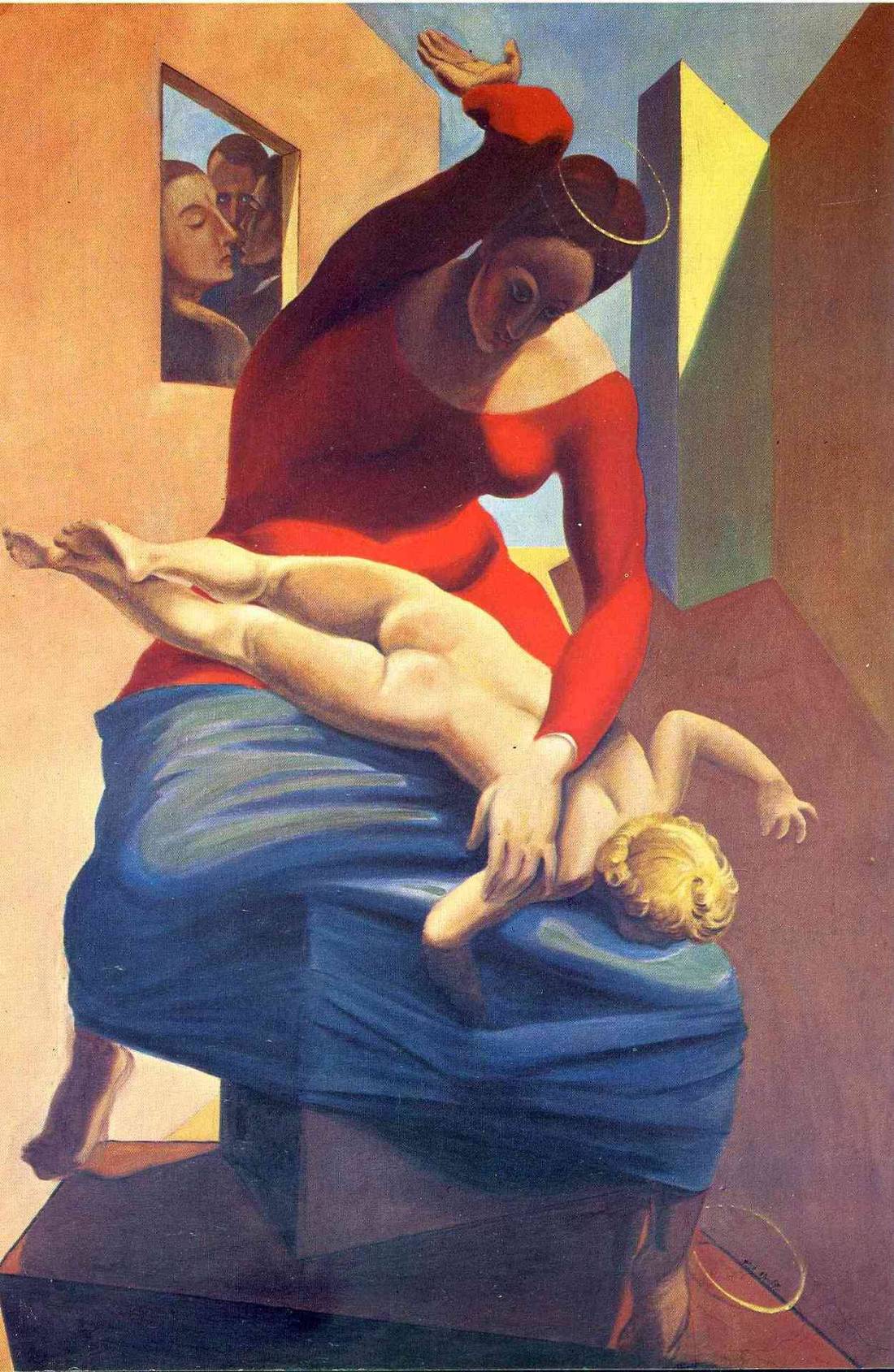
Max Ernst – The Virgin Spanking the Christ Child before Three Witnesses: Andre Breton, Paul Eluard, and the Painter (1926)
As far as differentiating between Dada and Surrealism, the rationale is more or less that Dada:
Surrealism might well be described as dadaism that was decidedly pro-art (Margritte, for example, was a painter of extraordinary talent and sensitivity) and who instead of embracing nonsense, took the domain of the unconscious human mind as its inspiration.
Personally, I’ve only ever managed to link Duchamp with Dada. I’ve read a number of things that argue–with luminous insight–that Matisse and Picasso out to also be considered under the Dada umbrella. But I always sort of shrug and wonder what the point is in going to that kind of trouble? Essentially, Picasso is cubism, so why shuffle him into a movement that he–judging by the modern western art historical canon–far eclipsed as a mature artist. (Matisse is another story for another time.)
For some reason, the other way I think about it is that Dada and Surrealism are not unlike the so-called Meeting of Waters in South America–where the dark waters of the Rio Negro meet with the chalky brown waters of the Amazon. The two rivers come together and fly several miles side by side without mixing.
Looking further down stream you can see the way the impetus for Dada leads to Yves Klein–yes, his Leap into the Void but even more than that his Zone of immaterial pictorial sensibility which prefigured both conceptual and performance art.
Whereas Surrealism and it’s all but universal preoccupation with Freud’s banal bullshit and wish to uphold the sanctity of Capital A art as a medium–has infused virtually every discipline and genre of creative expression.
None of this is news. But I do think it’s interesting to consider Ernst as the great fence straddler–half Dada provocateur, half Surrealist impresario.
In the scene above, Ernst depicts himself alongside writer André Breton and poet Paul Éluard, both pointedly surrealists. They are seen through a window–not unlike witnesses to an execution–except that can’t seem to be arsed to bear witness so much as be seen as present.
The room is incongruent, seemingly not held to laws of perspective or expectation. (Although–it does absolutely suggest a stripped down version of what Margritte would posit in his own style shortly after.) In the foreground, the holy mother hold what appears to be a five or six year old nude Christ child on her lap–cheated with his ass positioned so that the viewer gets an optimal view of it. The holy mother has her hand poised over her head–clearly preparing to bring it down soundly against the bare ass of her holy progeny. (And everything about Mary and Jesus is a logical predecessor to Bathus’ work.)
There’s also the fact that the holy mother’s head is surrounded by a halo, while the child’s has tumbled onto the floor.
It’s depiction of not sparing the rod and therefore not spoiling the child is entirely in line with Xtian precepts. Yet, what about the tumbled halo–the holy in guarding the boundaries of holiness creates through discipline and punishment that which it seeks to prevent: unholiness? (Also, I think it’s funny that I look at it and see a great advertisement against corporal punishment in child rearing… how time marches on and how cultural contexts shift.)
I sort of view it as cheap, unconsidered blasphemy as a means of positioning Dada–which would’ve already been fundamentally anti-Xtian–and Surrealism in a sort of conversation with regard to the futility (or non-sense) inherent in interpretation.
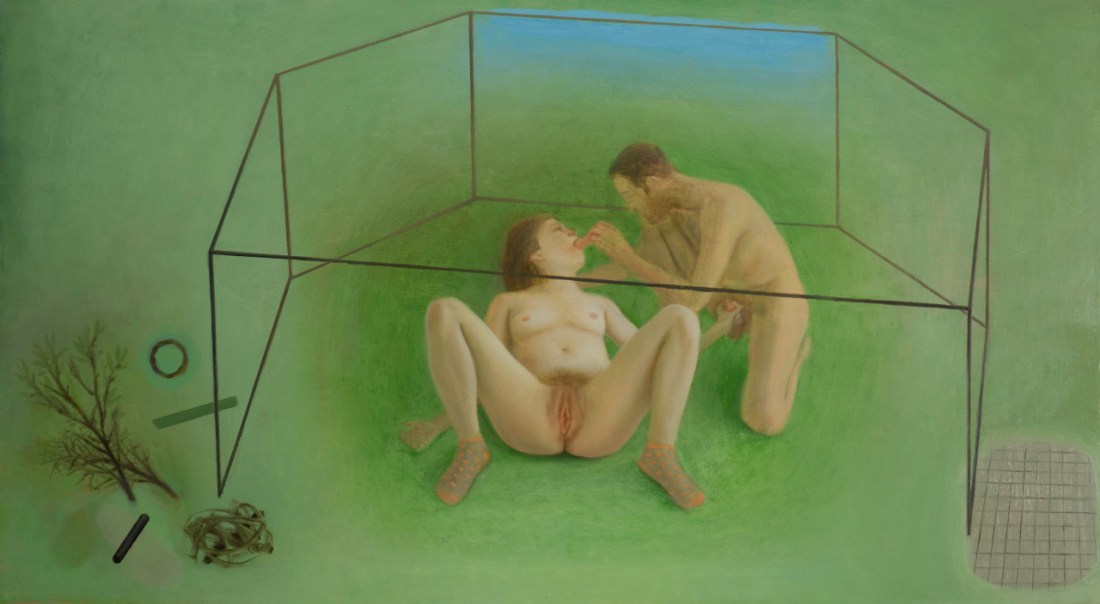
Marion Bataillard – Study of a Loving Couple (2015)
There’s more than a passing resemblance here to Beatrix Mira’s 2014 the normativity parchment.


[↑] Kerbcrawlerghost – Detail from cover art for Weregoat’s Pestilential Rites of Infernal Fornication (2016); [-] Christian Martin Weiss – Untitled (2017); [↙] Source unknown – Title unknown (201X); [↘] Chitra Ganesh – Girls with Skulls (1999)
My initial thought had been to just throw this out there as an Acetylene Eyes All Hallow’s Eve themed post. But I’ve been pondering transgression a lot lately, so…
If you consider the Xtian belief that humans were given free will but in order for us to truly be free we had to be presented with the option to choose slavery by eating of the fruit from the Tree of the Knowledge of Good and Evil…
Except that’s already functionally wrong. The notion that freedom is less than intrinsic and is instead given or revoked suggests an overarching framework of command and control structures–which isn’t freedom, it’s authoritarian.
After the Biblical Fall, humanity is supposedly saddled with a sinful nature. (Again, logically this doesn’t track given that evangelical theology posits that Jesus was the both God and Man but if by being born he became human, then his sinful nature would’ve precluded his distinction of being without sin. The idea that Jesus was born with a sinful nature but never surrender to its temptations is truly a semantic dodge for the ages.
But what interests me is the inter-penetrative nature of sin and salvation–the latter both precludes and is necessitated by the former. If you remove either concept, the other becomes essentially meaningless.
There was this enormous tug-of-war in the Evangelical community when I was in high school in the 1990s. The notion of once saved always saved–by which rational I am still a Xtian–and the sin and salvation two-step (commit a sin, ask for forgiveness, sin again, ask for forgiveness again).
I don’t know how that ever shook out because I 100% stopped caring shortly after I became aware of this schism. (Judging by most Xtians these days, I’d say things landed decidedly on the side of once saved, always saved but that’s not at all scientific.)
But it occurs to me that sin is such a prerequisite for salvation, that perhaps sin is salvation.
The assertion seems like pablum until you stop and carry out a grammatical investigation of the way the concepts are used in context. A sin is wrong doing or making a mistake. I prefer the latter way of framing it. Because when you make a mistake–you either learn from it or continue making the same mistake. (There’s that famous criteria for insanity–wherein someone performs the same action again and again each time expecting a different outcome than the one that manifests.)
I don’t like the way that Xtianity situates sin as something motivated by guilt instead of a desire to learn and grow. (This manifests in other ways–where Xtians believe the world is going to end soon and do not really give more than half a shit about what they leave in their wake for subsequent generations.)
And I guess that’s my point here–I wish you all on not just today (but especially today) that you may not be afraid to trangress in favor of discovering that what you’ve been told isn’t a transgression or that it is and why it is so that you can learn and grow–so you become more instead of less.
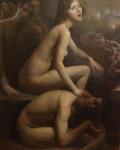


[↑] Adam Miller – Fallout from Compositions series (2012); [+] Akseli Gallen-Kallela – By the River of Tuonela (1903); [↓] All Fine Girls – Vika (201X)
I save things as drafts thinking to myself: self, this belongs here.
Unfortunately–often when it comes to composing some sort of accompanying text, my thoughts scatter like roaches when you flip the light switch.
Dredging through drafts, trying to figure out items to post–it occurred to me that it’s the expressions in these that appeal to me.
In the top image, the woman has an expression which–independent of the title–comes across as mismatched with her surroundings. She looks wild-eyed and terrified except at the same time she’s more engaged than those around her. When I discovered the painting is titled ‘Fallout,’ something finally clicked for me: she’s one of those people who only ever feels fully alive responding to and thrilling in abject chaos and catastrophic tumult.
…
The second painting is based on a the Kalevala–roughly like a cross between the Aeneid and the Icelandic sagas except being fundamentally Finnish (as best as I can tell). The subject of the painting consists of the hero being tasked with completing three difficult tasks, the third of which is slaying a swan on the river Tuonela.
In the painting, the hero (Lemminkäinen) departs in his canoe.
Additional context: this painting was a sketch for a fresco in a mausoleum dedicated to the memory of the daughter of a prominent businessman who died at age eleven. It’s presumably her with the braid trailing down her back and her budding breast exposed, invisible to the other gathered onlookers.
Everything about her suggests that although she does not know what she has lost, she understands what the loss has cost her in a way that no one else can or will.
…
I am unbelievably conflicted about posting this image. It’s porn and not even good porn. Further, I think it is unspeakably heinous when grown ass men refer to women they are attracted to or wish to pursue romantically as ‘girls’–it’s gross and a huge red flag. (And I absolutely judge men I hear do this as total creeps.)
In my experience, to achieve orgasm, you have to stop thinking, stop trying to get off, let go and surrender to an unmediated experience of physical sensation.
By letting go, you can just kind of float there and wait for it like a wave rolling in from the sea. But in letting go, you can also reach for something.
I won’t presume to know what this young woman is experiencing but she is reaching–and with this stunning, febrile desperation. It’s breath-taking to stare at, honestly.
…
When it comes down to it, these expressions are all unusual to witness in person–let alone in visual media. What impresses me and caused me to eventually put them all in the same place is that they are all expressions I’ve seen in the mirror, especially Vika’s desperate reaching. That’s so close to home, I have trouble fighting to urge to claim this as an ersatz self-portrait.

Lee Krasner – Untitled (1953)
I’m not in a very good place mental health wise right now. And I don’t know whether it’s in spite of this fact or because of it that–for once–I’m going to walk you through my thought process upon encountering this image for the first time and subsequently engaging with it.
I guess, we need to start with the fact that I’d never seen it before and I have no idea who Lee Krasner is but it reminds me of Jackson Pollock if he’d spent ten years obsessively studying the futurists.
As it turns out, Krasner was not only familiar with Pollock, they dated.
…
My Survey of Western Art I & II professor was enamored with Pollock. I never saw it but I am the type of person where if I respect someone and that person consistently raves about an artist I don’t give two shits about, I’m inclined to give said artist a great many chances than someone without that sort of reference attached.
Thus, shortly after moving to NYC–I spent a Saturday roaming around in The Metropolitan Museum of Art.
I spent a good half an hour each with the three Vermeer’s–and wrenching my attention from them felt disorienting, like waking from an afternoon nap and finding it’s well after sunset.
I ended up in the Modern Art wing towards the end of the day and spent a half an hour examining Pollock’s Autumn Rhythm (Number 30).
It did not have anything like the effect on me of the Vermeer’s; studying the lines felt tedious and unpleasant–as if I was doing something not for the pleasure of it but for the edification it might contribute to me.
I walked away nonplussed.
…
In the course of my third and final old college try, I found both praise and criticism of Pollock to be startling half-assed.
And here I really need to bring in reinforcements. Consider this write-up on a 1999 Pollock retrospective at The Tate in the Socialist Review. (I don’t necessarily agree with anything in this piece; however, it does–in broad and clumsy strokes–address the criticisms with regard to Pollock; namely: the fetishization of the drip method of his paintings.
A second piece goes on to excoriate art history for something mentioned in passing in the first piece: the notion that Pollock never intended there to be any nationalistic fervor in his work but we’ve come to attribute it to the work unfairly.
This second piece hinges upon the notion that our appreciation of Ernest Hemingway has fuck all to do with knowing he operated his type writer standing up.
I find this comparison to be incredible disingenuous and intellectually dishonest. (And I suspect the author of this piece went out of his way to avoid literature classes in college–’cause if he’d taken them he’d know that posture is not technique and that an understanding of technique is integral to coming to terms with both Hemingway and Pollock–who are both incidentally cishet white men (and as such as much as the piece vamps it up when summarizing feminist criticisms of Pollock “[that look] askance at the machismo of the ‘hero in the studio’ and
tends to see the whole drip and flick performance as the acting out of
the phallocentric male fantasy on the symbolically supine canvas,” is at least a good faith engagement with the fundamentals of culture in context).
The other problem with the second piece is that it says that the cult of celebrity has been unfair to Pollock. Arguing that we view his Life Magazine photo of him painting as more central than the work itself. I have a really difficult time with that proposition. I mean did someone hold a gun to Pollock’s head and make him do the interview and allow a photographer into his studio? It’s sort of saying that history acted unfairly against him because of his greatness–and isn’t that the biggest load of bullshit white man claptrap you’ve ever heard.
…
There’s the argument that a Ukrainian woman (Janet Sobal) was the progenitor of the drip painting style. I don’t know if it’s a straw man argument–it certainly operates like one–that feminists feel that a white male appropriated the work of a woman and got accolades for it. (And although this has happened all throughout history–Sobal’s work, although not uninteresting lacks the depth and dynamism of some but definitely not all of Pollock’s work.)
(For example: I’ve become rather fond of Blue poles (Number 11), less as a result of the drip method than the use of color and line to draw attention to the use of color and line.)
…
But back to Krasner, because I have regretably spent most of this article talking about the person she dated instead of her.
Consider the work above. Now consider these paintings Pollock made during 1953–where he noticeably diverges from the drip method:
Portrait and a Dream, Easter and the Totem, Ocean Grayness, and The Deep.
The Deep is exquisite but the rest are blase, at best. And I feel objectively that Krasner’s image above is just objectively better than most of Pollock’s work. Yet, I know who Pollock is and I’m comparing Krasner’s work to his when really the comparison is probably closer to the truth to say that when his work worked it was taking after hers.

Falk Gernegroß – Twister (2014)
If I weren’t feeling as if–perhaps–I have insisted on being a bit to solipsistic and autobiographic in responding to stuff recently, I would likely talk about how I relate to the awkward girl to the right. (That was totally me at ten.)
But I think there are more interesting things to interrogate here–like how color adds to the sense of the painting.
You’ll note that the left-most young woman, the stripe on her socks is color coordinated to her cami. The middle young woman’s skirt matches the stripe of her socks. Whereas the girl who is my surrogate is purposely isolated not only by her position in the frame, her being blocked by the stretching leg of the young woman in the middle, but he outfit purposely doesn’t coordinate–she’s wearing white socks, one of which is up to her knee; the other which is pushed down to her lower shins. Further, her skirt is more orange the the yellow circles on the Twister board and her knickers are far more pink–the sort of bubble gum hot pink that you only find in juniors sizes.
There’s also the way that the two older girls are intertwined. They are positioned in such a way that they can’t really see anything of each other. (The angle of view offered the audience is what’s suggestive not what we’re seeing. I mean it’s clear that the young woman in the pink top can’t really see up the skirt of the young woman in the yellow top. She also can’t check out her figure because the girl in the yellow top’s right leg is blocking things.
Similarly the young woman with the braid can’t see up the young woman in the pink top’s skirt either. The situation is suggestive upon first glance–until it’s not.
The boy peering over the fence Wilson from Home Improvement style could be a surrogate for the audience or the painter. I’m inclined to believe it’s the painter. What makes me think that is that the women/girl in this are presented in a typical short hand: blond, brunette, redhead. Also: bun, braid, pony tail.
Still, I’m not willing to dismiss it because the colors and subtle gradations are just punchy af and the tableau is resonate.
This is the second time I’ve featured Gernegroß’s work. And I think what I’ve gotten a little bit better hand on is how he’s combining the tool developed over time in the pursuit of figurative painting and giving it a pop art nodding/Balthus inflected spin.
 Acetylene Eyes