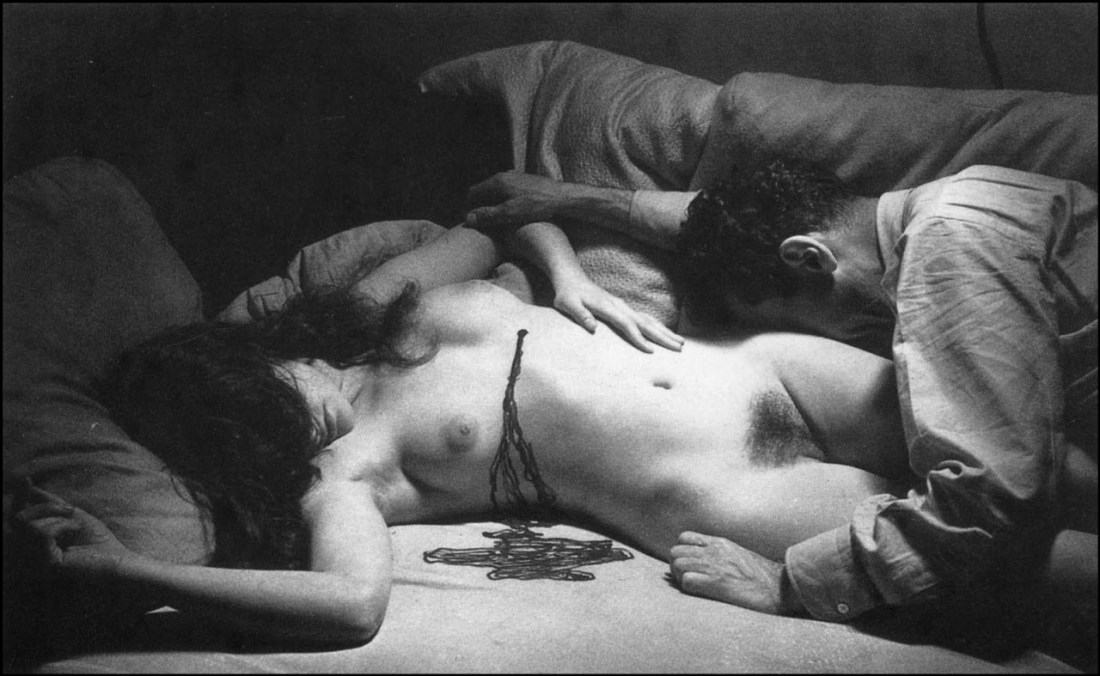
Man RaySelf Portrait with Dead Nude (1930)

Excluding the eleven years he lived in Hollywood to wait out the Second World War, Man Ray was an American artist living in Paris.

He moved in the same circles as Picasso and the two were well acquainted. I mention this–less to try to suggest any stylistic overlap in their oeuvres and more to distinguish between the degrees of overt sexism in their respective work.

By now, you’ve probably already seen Hannah Gadsby’s Netflix comedy special Nanette. If not, you should put a pin in this and go watch it now. (It’s exceptional on virtually every level imaginable but it’s act to is a brilliant riff on art history–specifically Picasso.)

Gadsby notes that Picasso offered this perspective on how he felt about women after breaking up with him:

Each time I leave a woman, I should burn her. Destroy the woman, you destroy the past she represents.

“Cool guy,” she follows up.

This isn’t even close to the worst shit Picasso pulled. But in so many ways, Picasso was a colossal, inexcusable and monstrous misogynist. Yet, much of his latent sexism is just as visible in other works of the time. This, for example: not only continues the art historical tradition of presenting female bodies in only specifically proscribed poses.

For example: Duchamp’s Nude Descending a Staircase, no. 2 was rejected from the 1912 Salon de Indépendants with the following note:

A nude never descends the stairs–a nude reclines.

(This anecdote was brought to my attention by PBS Digital Studios’ The Art Assignment’s The Case for Nuditywhich is a bit uneven but by and large worth keeping up with.)

In Man Ray’s photo above, the nude is once again reclining. She’s portrayed as dead–a chest wound ostensibly bleeding out onto the bed.

The photo is indicated as a self-portrait (and in that identification the identity of the artist is reaffirmed while the woman is little more than a placeholder) and it’s uncertain whether Man Ray found her already dead and then felt the need to embrace her one last time (a necrophiliac connotation) or perhaps he killed her and is now grieving her demise (a vampiric connotation).

Neither of these are particularly encouraging interpretations with regards to inherent sexism. However, whereas Picasso uses stylistics to bend, break and otherwise deface women in his work, there’s an honesty about what Man Ray is doing here that–while it does not absolve it of fault, it at least self-implicates the relationship between the author and the problematics.

For example: I read this now as a sort of inverted pieta. This in turn invites a reading of the manic pixie dream girl narrative–that, unfortunately, still exists. Also, you don’t have to stretch it very far to push this into feminist criticism territory–the way that men seek in female bodies, some semblance of salvation. (I’d argue that this lines up especially well with the history of pieta as religious symbol and the way modern pietas interrogate the problematics of Xtian history and the way the form is now moving towards being a trend welcoming of appropriation by sensualist humanists.

Arseni KhamzinUntitled (2013)

…holy shit: this. is. FAN-FUCKING-TASTIC!

It’s a compositional marvel, really–the interplay between line, texture and shadow vs. light is exemplary.

The subject is slightly off-center to the right of the frame; allowing the top and right of frame to be counter-balanced by the much darker shadows cast by the subject and chimney.

There’s an intoxicating variety of sumptuous texture–poured concrete, mortar, corrugated metal, skin, hair and fabric. (It’s an especially inspired touch that the lines on the tartan print blanket reiterate the two point perspective of the composition, but in their slightly imperfect alignment, they server to further direct attention toward the subject.

Why does it all work so well? Two years ago I would’ve just offered the cop out of attention to detail regarding texture and balance but actually, the frame works off a simple 45 degree clockwise re-orientation of the rule of thirds.

And I’m not even to the best part–this is a Pietà! Yes, it’s oriented differently. Traditionally, Pietà present Jesus from head to toe starting with his head at frame left and his feet towards frame right. [Can someone with a little bit more comprehensive of an Art History background explain the relevance of such positioning? I suspect there’s something to it (sacred vs profane, which would be interesting given the fundamentally humanist trappings underlying the codification of the trope)–not unlike the direction Ganesh’s trunk curls having distinctly different meanings.]

Yes, it’s also short a figure and the genders are swapped–or so it seems to me. But there’s really some fascinating reinterpretation going on surrounding the trope. I can’t help but think the point of this variation has something to do with the loneliness of existence and a sort of embodiment of that notorious line from Donnie Darko: every living creature on earth dies alone.

Lastly, this was made on Impossible Instant Black and White Film with Hard Color Frame–which in my experience is not the easiest film to use if you want to produce a thoroughly luminous result such as the above.

Stunning and exceptional.

Source unknown – Title Unknown (date unknown)

This is meant to resemble the Pietà, a work–predominantly represented sculpturally–wherein the Virgin Mary cradles Jesus Christ’s crucified body.

In general, I’m not into religious art–it’s largely redundantly boring and although I realize the majority of it was conceptualized as a means of earning a living through the practice of one’s art while also encoding religious work with a humanist undertow.

Pietàs are a notable exception–there’s just something viscerally affecting about them.

It took seeing this image for me to realize why I dig Pietàs: art historically the aren’t exactly erotic in form of fashion but they are decidedly physical. Christ’s musculature assuming a taut not of will but driven by the pull of his body’s weight by gravity. The duality of the Virgin’s attention to both the emptiness of the vessel as well as the vessel itself.

If the Virgin did cradle her son’s body after he was taken down and before he was put into the tomb, he almost certainly would have been naked–after all  Mark 15:24 notes the soldiers guarding him gambled for possession of his garments.

With Pietàs there is always a feeling that the cloth in which Christ’s junk is shrouded, was a concession to the holy patrons that commissioned the works and less an interest of the artist.

So while I don’t think the above is well executed–I am entirely enamored with it as pushes the erotic undertow to the fore. (I think there’s a great deal of room to explore various erotic notions with this form: la petite mort, angel lust and any number of other coded references. (One of my favorite erotic Pietàs is by the incredibly talented Paula Aparicio.)

Further I think there’s a winking bit of blasphemy to this as Jesus–if he actually existed as a legitimate historical figure–was a 33 year old man with a 36 hour refractory period. Whereas, the gentleman pictured above is already risen again.

Paula AparicioUntitled (2010)

Aparicio is a 25 year-old photographer based in Buenos Aires.

Her photos elide any too obvious debt to her influences mostly because of the meticulous care with which she handles both sexuality and nuances of nudity.

But there’s also the characteristic sense that within her frames seduction and consummation are done; leaving in their wake that palpable feeling of  impermanent post-coital stasis, the waning of ecstatic satiation and the waxing hunger of wanting more.