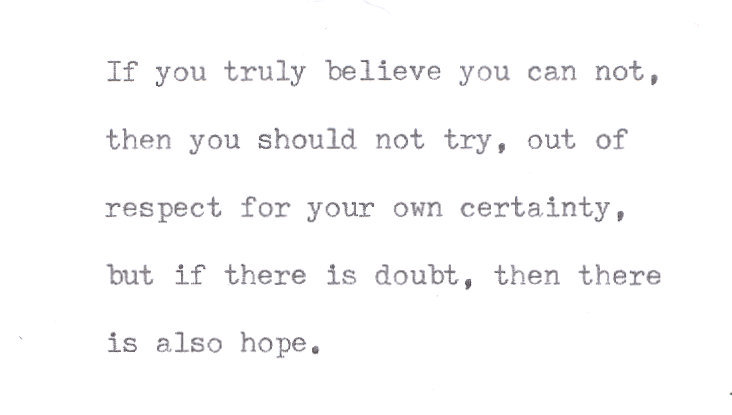
Tag: quote
I have to work for art if I want art to work on me.
Jeanette Winterson, Art Objects
You were made and set here to give voice to this, your own astonishment. “The most demanding part of living a lifetime as an artist is the strict discipline of forcing oneself to work steadfastly along the nerve of one’s own most intimate sensitivity.” Anne Truitt, the sculptor, said this. Thoreau said it another way: know your own bone. “Pursue, keep up with, circle round and round your life… Know your own bone: gnaw at it, bury it, unearth it, and gnaw at it still.” Write as if you were dying. At the same time, assume you write for an audience consisting solely of terminal patients. That is, after all, the case.
Annie Dillard, The Writing Life (via fork-tender)
Art is in love with time. It needs time, it takes time, and it steals time in order to survive in time and be quiet enough to display the silence that betrays everybody and everything.
Marlene Dumas (via wordsnquotes)
The witch-burnings did not take place during the “Dark Ages,” as we commonly suppose. They occurred between the fifteenth and eighteenth centuries– precisely during and following the Renaissance, that glorious period when, as we are taught, “men’s” minds were being freed from bleakness and superstition. While Michelangelo was sculpting and Shakespeare writing, the witches were burning. The whole secular “Enlightenment,” in fact, the male professions of doctor, lawyer, judge, artist, all rose from the ashes of the destroyed women’s culture. Renaissance men were celebrating naked female beauty in their art, while women’s bodies were being tortured and burned by the hundreds of thousands all around them.
Monica Sjoo & Barbara Mor in The Great Cosmic Mother: Rediscovering the Religion of the Earth (via lunamtenebris)
چراغی به دستم، چراغی در برابرم
من به جنگ سیاهی می روم
Holding a lantern in my hand
Carrying a lantern in my embrace
I march forward
to fight
darkness
Shamlo (via honeyandelixir)
Sexually awakened women, affirmed and recognized as such, would mean the complete collapse of the authoritarian ideology
Wilhelm Reich, The Mass Psychology of Fascism, 1933
(via neo-catharsis)
(via neo-catharsis)
Art is love made public.
Hernando Fuentes, Sense8 Christmas Special
At this point it’s my duty not to crumble and close off. I’ve gotten this far because of my willingness to make myself vulnerable
Fiona Apple
(via fionaapplerocks)
(via fionaapplerocks)
It’s an interesting combination: Having a great fear of being alone, and having a desperate need for solitude and the solitary experience. That’s always been a tug of war for me.
Jodie Foster (via wnq-movies)
 Acetylene Eyes