danishprinciple:

[Siren by] Stephen Carroll

I am about as anti-digital as you can get short of Nottinghamshire circa November 1811.

In the broadest strokes my grudge distills to rejecting the commonplace assumption that since the physical process and user interfaces involved in making a photograph and a digital image is similar, there exists an interchangeable equivalency between them.

Fucking bullshit.

Analog photography produces a physical artifact representing a moment in time. That resulting artifact—negative or positive—stands in relationship to both the moment of creation and all subsequent retellings.

Digital image making translates light into a phenomenally long string of ones and zeros.

As a result of these differences, each process responds differently to similar situations.

  • Digital can’t handle overexposure; negative stocks benefit from mild overexposure.
  • Digital has immense depth of field even large apertures; film shot using fast lens with the aperture fully open have a narrow depth of field (DOF).
  • Digital makes it easier to capture an image in low-light settings as result of its extended DOF; however, digital is incapable (and will always fall short) of rendering a true black.

Digital works best when its limitations are embraced instead of obfuscated. (Recall the scenes in Zodiac where they are driving around at night and nothing is really dark so much as murky vs. The Social Network where wide open prime lenses stopped down to the correct aperture using ND filters in an effort to create a more filmic DOF and instead resulted in emphasizing the deathly plastic pallor digital imposes on everything and looked less like film.)

As much as a detest digital, there are a small group of people who embracing the multifarious shortcomings of digital and do interesting things.

  • Noah Kalina has created a cottage industry using the sweet spot just inside to digital overexposure margine for fashion editorial work.
  • Pedro Costa’s Colossal Youth is one of the few instances wherein digital proved superior to film.

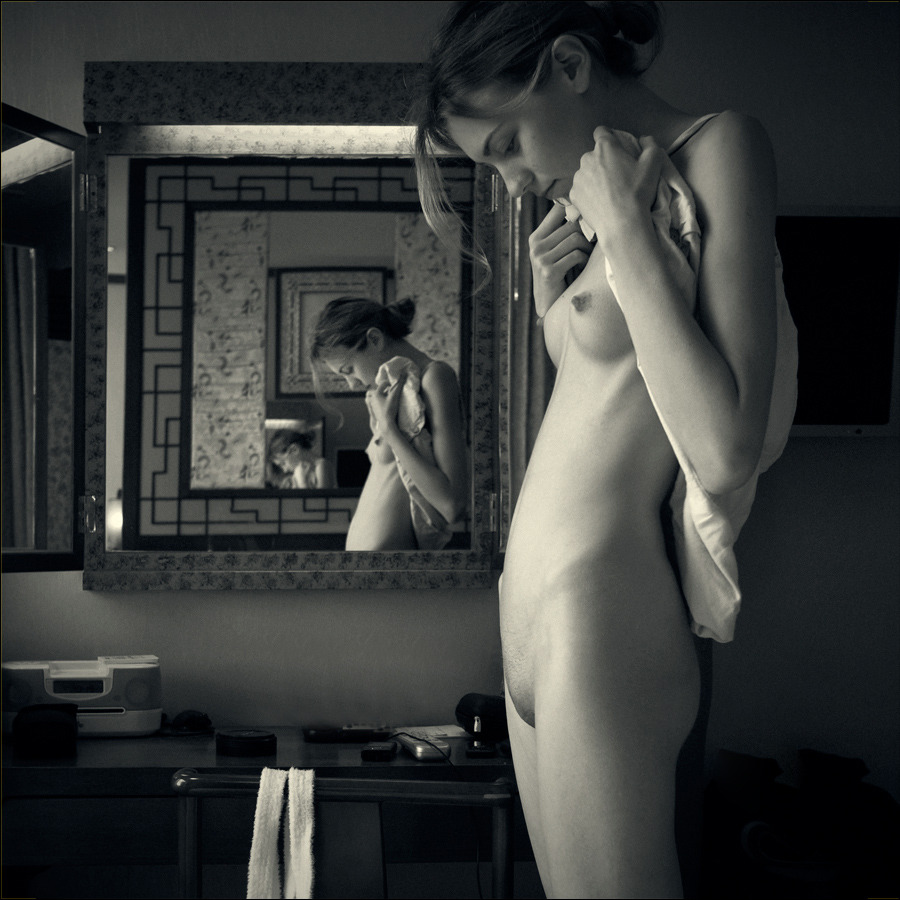
After seeing the image above and how it employs the same deathly plastic pallor I loathe so much in digital as a hyper-stylized means of conveying the ethereally phantasmal splendor of fading light on still water and wet skin.

toutdroitaller:

Mathilda Eberhard

Untitled

Is it me or is there something almost post-coital about the way this feels to the eye—towel-wrapped, shower-wet hair and still damp skin sheathed in afterglow and diaphanous light?

In spite of being digital, I wish this were an image I had made. It exemplifies so many imagistic attributes I hold dear:·       

  • It eschews the forced intimacy of knee-jerk close-ups    
  • Employs a scale fixed somewhere betwixt Wall’s voyeuristic medium shots and Angelopoulos’ telescopic long shots in order to offer the viewer a wealth of contextual information.
  • A visually compelling interior is presented so as to avoid the trappings of perfect production design. (Tarkovsky is as close to having a deity as I come, but I’m perpetually frustrated by his über-eclectic, pristinely cluttered sets with no room for real people to live)
  • It features a beautiful young nude woman with exquisite, tiny breasts and pubic hair.

All that is missing is a narrative seed, one moment suggesting what came before and what follows. But this is more of a tone poem, it would seem.

Tone poems, though, are slippery as eel skin. And there is a tendency to use them as an excuse for untouched inconsistencies.

For example, the framing here pans the camera slightly right to ensure the golden light on her back appears reflected in the mirror; this wawker-jawing complicated by the extreme wide angle is nearly balanced out by the uneven curtain rod’s counter-angle—keyword: nearly.

Also, her pose is odd. It is clearly staged but she holds it in such an unself-conscious way that it from avoids appearing contrived.

These inconsistencies cut both ways: justifying the unresolved aspects as endemic to the work is what makes it great; it is also what keeps it from being truly exceptional due to such justification obfuscating the implicit awareness the image provides of viewing something up to a terminal point—the snapping of the shutter—and then being left with little except the technical inconsistencies to ponder for clues that simply don’t exist.

The oft trotted proverb goes: good artists borrow; great artists steal.

Whether it was T. S. Eliot or Picasso who provided this sentiment and regardless of any inherent merit, this has become a prima apologia for shitty artists the world over.

With its focus on a scene unfolding in a room lit from frame left, this image ostensibly borrows from Vermeer. Yet, unlike Vermeer—whose canvases present their subjects en media res: reading the final lines of a letter, pouring milk—this woman actions are ambiguous, her pose highly contrived in an effort to appear natural; however, consider what situation might require her to so pull her gown up around her shoulders and face away from a readily available mirror in order to stare down at her nude body?

I would be very surprised if the individual responsible for this image was unfamiliar with Vermeer. However, borrowing here from Vermeer is like asking a friend to lend you a designer sweater to wear with your new backless red dress. 

The theft that does work is from an artist I would wager is unknown to the image maker: VelázquezLas Meninas specifically

Mirrors have a way of fucking with subjectivity. Velázquez depicts the subject—that is, the king and queen—only in a faint reflection; the scene instead focuses on the artist—presumably Velázquez himself—painting. At the same time, note the painter is considering both his subject and we the spectators.

The mirroring in the image above is less complicated but does produce, if accidentally, an interesting effect. By angling the camera so it views the reflection without being itself reflected, as well as the inclusion of the reflection of the young woman’s face reflected from a smaller mirror along the so-called fourth wall gives the room an implicit dimensionality. An implicit dimensionality that, in effect, deletes the physical presence of the camera from the scene; muddling matters of subject/object, observer/observed along with the questions of exhibitionism and voyeurism accompanying them.