Rimantas DichavičiusUntitled from Žiedai tarp žiedų (1965-1989)

When my absence doesn’t alter your life, my presence has no meaning in it.
–Unknown

If I say of myself that it is only from my own case that I know what the word “pain” means—must I not say the same of other people too? And how can I generalize the one case so irresponsibly?
Now someone tells me that he knows what pain is only from his own case!–Suppose everyone had a box with something in it: we call it a “beetle”. No one can look into anyone else’s box, and everyone says he knows what a beetle is only by looking at his beetle.—Here it would be quite possible for everyone to have something different in his box. One might even imagine such a thing constantly changing.—But suppose the word “beetle” had a use in these people’s language?—If so it would not be used as the name of a thing. The thing in the box has no place in the language-game at all; not even as a something: for the box might even be empty.—No, one can ‘divide through’ by the thing in the box; it cancels out, whatever it is.
That is to say: if we construe the grammar of the expression of sensation on the model of ‘object and designation’ the object drops out of consideration as irrelevant.
Ludwig Wittgenstein, Philosophical Investigations §293
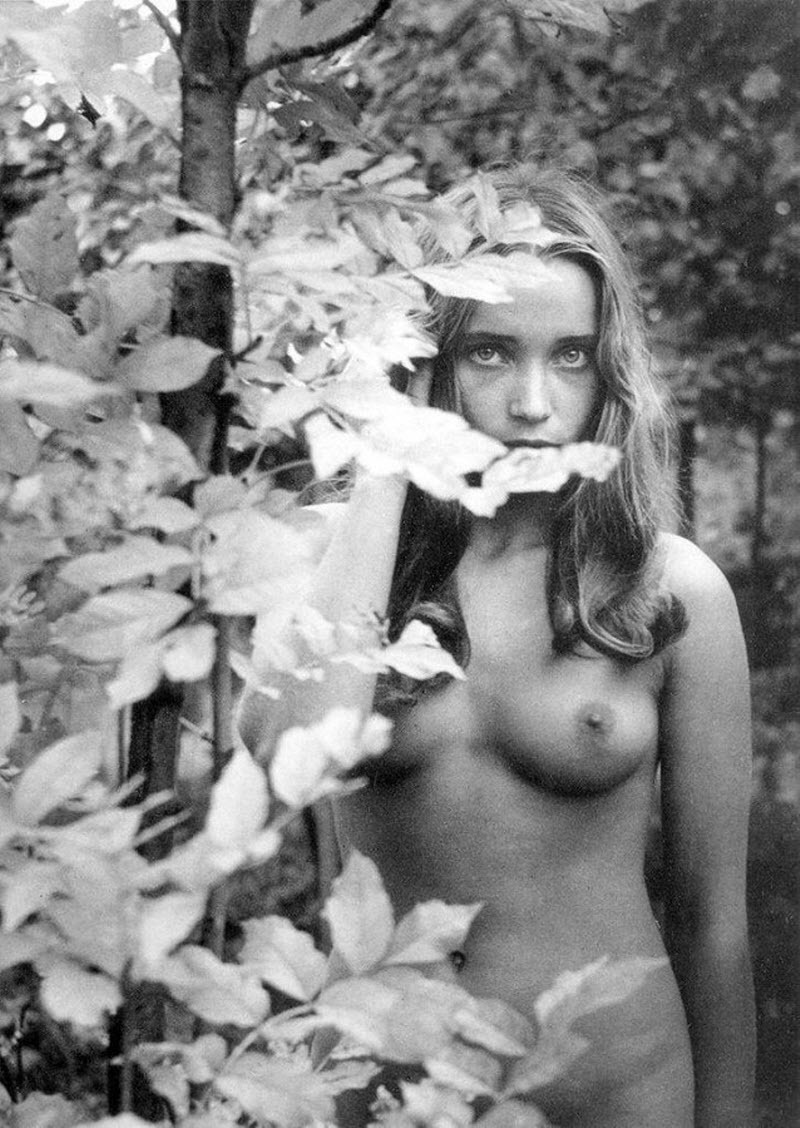
Rimantas DichavičiusUntitled from Žiedai tarp žiedų (1965-1989)

All of Dichavičius‘ work that I’ve encountered feature female nudes in nature (in fields of tall grass, walking along the shore of some eastern European lack or amidst sandy shoals and dunes).

The subjects of his images seem more like mythical nymphs than women–he likes wildly, disarrayed settings where grass, leaves and even cascading hair serves to both veil the subject and make them recede slightly, as if each belongs to the landscape more than the viewer.

Additionally, he preferences extremes of contrast–prejudicing tones at the edge of over-exposure and at the point where details in the shadows begin to flag to more measured/even tonality.

Along with his frequently surreal flattening of space and his efforts to skew perspective through composition tricks contribute an extra layer of surreal feeling to his scenes.

The work I’ve seen is all a bit too one note for me. But I’ve admittedly not seen more than the scant offerings available online. And really, the above image is thoroughly exceptional–not in that it’s far more concrete than a lot of his work.

(Further, I can’t help but feeling that this photo is likely an effort to imagine what the photo Imogen Cunningham might have taken of Twinka in Judy Dater’s reknowned photo if the photo had been an actual random encounter instead of a staged happening.)